

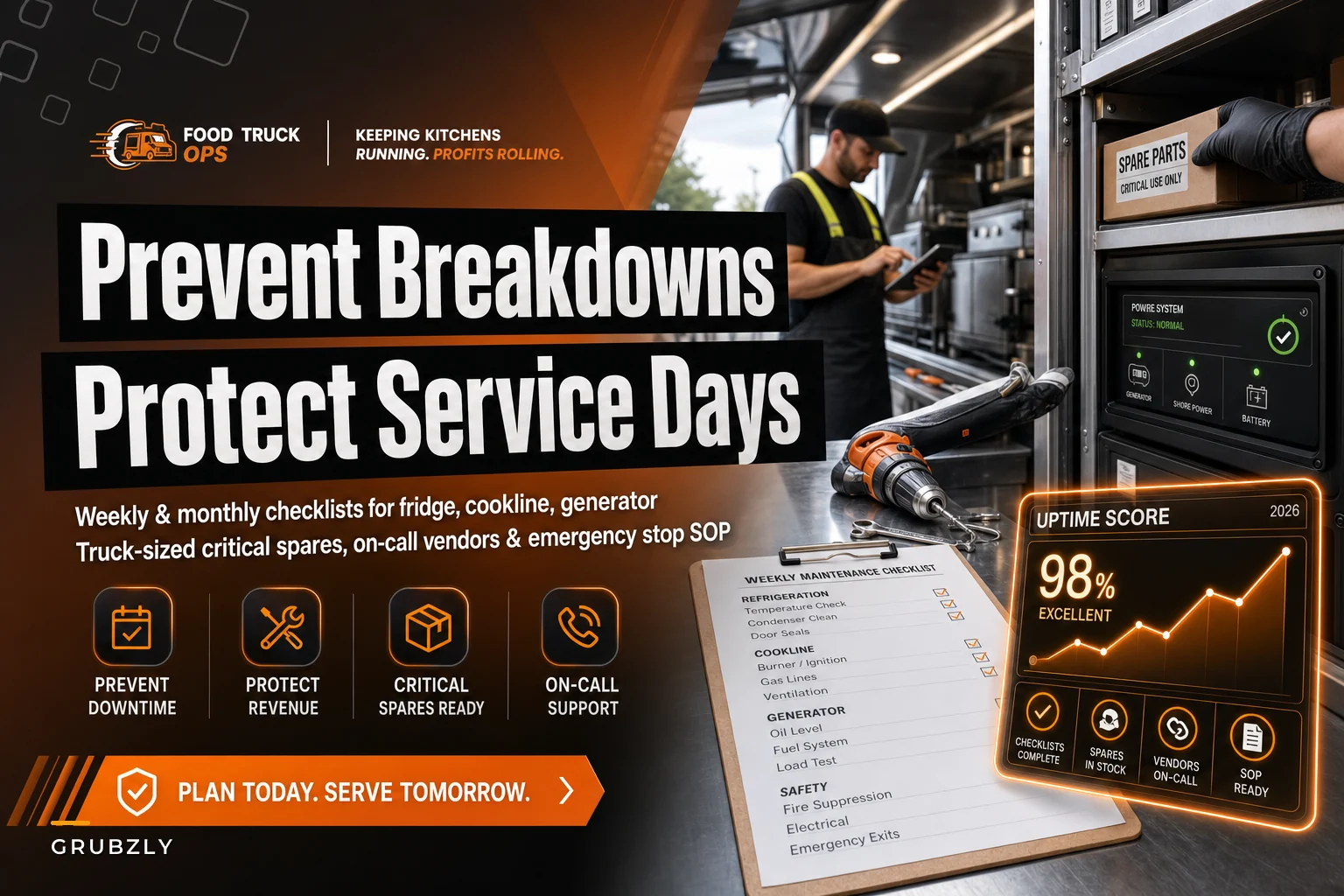

Your fryer dies at 11:47am on a Tuesday.
Line stretched halfway down the block, tickets backing up, and suddenly your main cookline goes dark. No warning. Just dead metal where hot oil should be.
This exact scenario killed a taco truck's entire week recently – not because the fryer couldn't be fixed, but because they had no backup plan. No spare heating element. No vendor on speed dial. No protocol. They lost $3,400 in revenue waiting for parts that should've already been on the truck.
Most food truck preventative maintenance checklists stick to the obvious – oil changes, tire pressure, basic cleaning. The real operational failures come from systems nobody thinks about until they're standing in a dead truck with forty hungry customers outside.
The three systems that actually shut you down
After watching hundreds of mobile kitchens grind through breakdowns, the pattern becomes obvious. It's not the truck engine that kills service days. It's three specific systems operators consistently ignore until they fail.
Refrigeration breaks differently in a truck than in a restaurant. Constant vibration loosens door seals faster. Road heat stresses compressors harder. Power fluctuations from generators create voltage spikes that burn out control boards. A walk-in cooler might run five years without major service. That same compressor in a truck? Lucky to get eighteen months.
The cookline takes abuse that would destroy most restaurant equipment. Every pothole jolts connections loose. Every turn shifts weight onto different mounting points. Gas lines develop micro-leaks from constant flexing. Electrical connections corrode from steam and grease in tight spaces. Restaurant equipment gets bolted down once. Truck equipment fights physics every single day.
Generators fail in ways that seem impossible until you understand what they're actually doing. They run harder than any stationary unit – powering equipment that wasn't designed for variable power input. They breathe dirty air from traffic exhaust. They operate at weird angles on sloped streets. Most operators treat them like lawn mowers until they won't start on a Saturday morning at the farmer's market.
Why weekly checks beat monthly overhauls
The maintenance approach that actually works isn't about major monthly inspections. It's five-minute daily checks that catch problems while they're still cheap.
Stop losing sales to poor planning.
Grubzly helps you plan routes, track inventory, and maximize daily sales effortlessly.
- Real-time route optimization
- Inventory tracking & alerts
- Mobile sales & reporting
No credit card required
Refrigeration systems don't just fail one day. First, the door seal develops a small gap. Barely noticeable. Condensation starts building around it. The compressor runs a little longer to compensate. Extra runtime creates more heat. Heat stresses other components. Six weeks later you're buying a new compressor because nobody spent thirty seconds checking a seal.
Here's what actually prevents breakdowns:
Monday morning refrigeration check (3 minutes):
-
Run your hand along all door seals feeling for cold air leaks
-
Look for ice buildup in unusual spots (indicates air infiltration)
-
Listen for compressor cycling (should run 4-6 minutes, off 6-10 minutes)
-
Check condensation drain for blockage
-
Verify thermometer reads within 2 degrees of setpoint
Wednesday cookline inspection (5 minutes):
-
Wiggle every gas connection checking for movement
-
Look for grease buildup blocking burner ports
-
Test every pilot light and ignition system
-
Check mounting bolts for looseness
-
Inspect electrical connections for corrosion or burn marks
Friday generator service (4 minutes):
-
Check oil level and color
-
Inspect air filter for blockage
-
Start and run under load for 60 seconds
-
Listen for unusual sounds or vibrations
-
Verify voltage output stays steady
The real value comes when you map these checks to specific equipment serial numbers and track patterns over time. Compressor #3847B always struggling on hot days? Schedule preventative service before summer. Fryer igniter failing every four months? Order a spare at month three.
Building your critical spares kit (sized for actual truck storage)
Most spares lists assume infinite storage space. Real trucks have maybe two cubic feet for parts. Every item needs to earn its spot based on failure frequency and revenue impact.
Refrigeration spares (fits in a 12" x 8" x 6" box):
| Refrigeration spares (fits in a 12" x 8" x 6" box) |
|---|
| Door seal kit for your specific model |
| Start capacitor for compressor |
| Replacement thermostat |
| Evaporator fan motor |
| Temperature controller board |
| Refrigerant leak sealant |
| Electrical contact cleaner |
Cookline spares (fits in a 16" x 10" x 8" box):
-
Universal thermocouple set
-
Pilot light assemblies
-
Gas valve rebuild kit
-
Ignition module
-
Burner orifices (various sizes)
-
High-temp wire nuts
-
Heat-resistant gasket material
-
Electrical tape rated for 200°F
Generator spares (fits in a 10" x 8" x 6" box):
-
Spark plug set
-
Air filter
-
Fuel filter
-
Pull cord assembly
-
Voltage regulator
-
Circuit breaker (main size)
-
Fuel stabilizer
-
Carburetor cleaner
What you leave out matters as much as what you pack. Don't carry a spare compressor – too big, too expensive, and requires professional installation anyway. Don't stock circuit boards unless you've had multiple failures. Focus on parts that fail predictably and can be swapped in under twenty minutes.
Your vendor lifeline network
The difference between a two-hour fix and a three-day shutdown is having the right phone numbers programmed before you need them.
Build your vendor list by system, not by company name.
Primary refrigeration tech: Someone who works on mobile equipment specifically. Restaurant HVAC guys don't understand truck-specific failure patterns. Find someone who services food trucks, ambulances, or mobile medical units – they know what vibration damage looks like.
Backup refrigeration source: An equipment rental company that stocks portable refrigeration units. When your main system dies, you need cold storage within two hours.
Mobile generator specialist: Not just any electrician. Someone who troubleshoots generator-to-equipment power problems and understands load balancing for sensitive cooking equipment.
Emergency parts supplier: A distributor who stocks your equipment brands and offers same-day pickup. Build the relationship during slow times. Open an account. Know their inventory system.
Mobile welder: Frame cracks and mounting failures happen. A welder who comes to you saves serious towing costs.
Propane system certified tech: Gas leaks shut you down instantly. You need someone certified for mobile propane systems who can respond within a few hours.
Test these relationships during slow periods. Call your refrigeration tech for a minor issue in February, not when you're desperate in July. Pay promptly. Become the customer they actually prioritize.
The emergency stop protocol that saves your Saturday
When equipment fails mid-service, every minute costs money and reputation. A solid emergency protocol turns panic into process.
Minute 0-2: Assess and communicate
-
Identify what failed and what still works
-
Make a go/no-go decision on continuing service
-
If continuing
announce longer wait times immediately
-
If stopping
give a realistic timeline or refund option
Minute 2-5: Implement workaround
-
Shift menu to items your working equipment can handle
-
Redistribute prep to functioning stations
-
Modify portions if necessary to stretch inventory
-
Communicate changes to every staff member
Minute 5-10: Start repair process
-
Assign one person to manage customers
-
Assign one person to attempt field repair
-
Call your primary vendor for guidance
-
Check the spares kit for applicable parts
Minute 10-15: Make continuation decision
-
If fixable within 30 minutes
continue modified service
-
If not fixable
begin shutdown protocol
-
Post on social media about the situation and expected return
-
Contact next day's venue about potential cancellation
After service: Document everything
-
What failed and when
-
What warning signs you missed
-
What spare parts would have helped
-
Which vendors responded fastest
-
Total revenue impact
Here's a quick visual of the emergency protocol workflow.
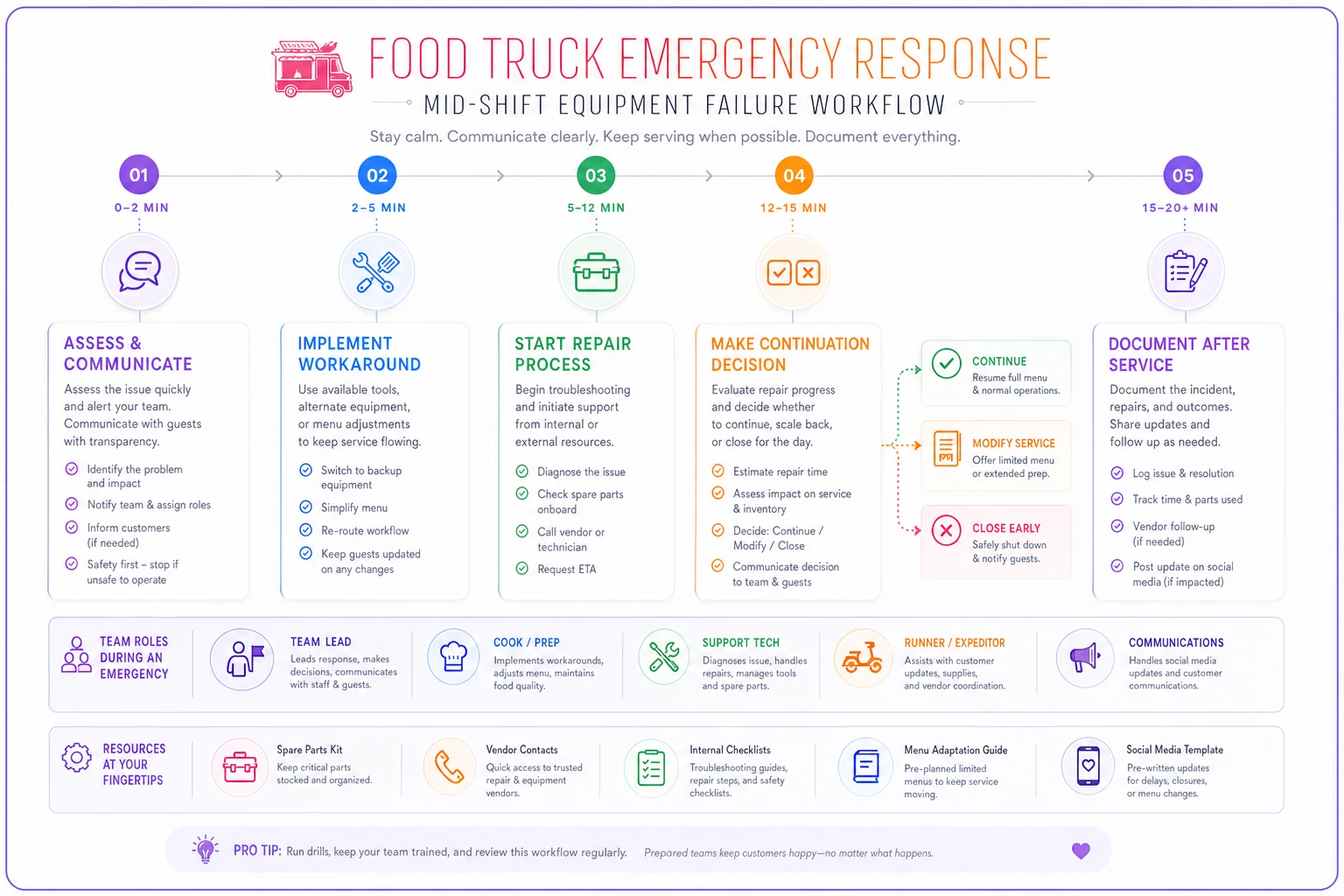
The protocol only works if everyone knows it before they need it. Print it. Laminate it. Post it inside your electrical panel where panicked hands will actually find it.
Real-world breakdown: How preparation saved a BBQ truck's festival weekend
Carolina Mike's BBQ truck learned these lessons the hard way first. Their generator failed Friday night before a three-day music festival – their biggest revenue weekend of the year.
Without preparation, they would've lost roughly $18,000 in sales. Instead, they lost two hours and $400.
Their weekly generator check caught unusual vibration on Wednesday. They couldn't identify the cause but flagged "generator risk" on their Friday prep list. When it failed at 7pm, their protocol kicked in:
-
A spare generator rental was already on standby ($400 for the weekend)
-
Their generator tech had been pre-warned about potential issues
-
They had mapped every piece of equipment's power draw
-
Staff knew exactly how to rebalance electrical loads
By 9pm, they were selling brisket again. The failed generator got repaired Monday during their scheduled maintenance window. They grossed $17,200 that weekend instead of zero.
That wasn't luck. It was systematic preparation mapped to their specific equipment vulnerabilities.
Making maintenance stick in daily operations
The best maintenance schedule means nothing if it doesn't actually happen. Trucks skip checks because staff are exhausted after service, rushing through prep, or just forgot.
What works is tying maintenance to routines that already exist. Morning coffee takes four minutes? That's your refrigeration check. Waiting for the fryer to heat? Cookline inspection. End-of-week cash count? Generator service.
Tie each check to a daily routine your staff already performs so it doesn't get skipped.
Track completion with simple check marks on a printed sheet, not complex digital systems. Date, initial, done. Note problems only – not successful checks. Over time this builds a failure pattern history without drowning in documentation.
Some operators work maintenance into their prep list directly: "Pull pork, check compressor seal, slice onions." Others assign specific systems to specific staff who own that inspection completely. Whatever method, consistency matters more than complexity.
The hardest part is staying disciplined during busy seasons – which is exactly when equipment gets stressed hardest and maintenance matters most. A missed August generator check becomes a September breakdown becomes an October repair bill that quietly eats your entire summer margin.
Bottom line on food truck preventative maintenance
A food truck preventative maintenance checklist isn't about following some generic template. It's about understanding the specific ways your specific equipment fails in your specific operation.
Map maintenance to actual equipment serial numbers. Size your spares kit to your actual storage space. Build vendor relationships before you need them desperately. Create emergency protocols your panicked brain can actually follow at 11:45am on a Saturday.
The difference between profitable trucks and broken trucks isn't lucky equipment or bigger budgets. It's five-minute checks that catch twenty-dollar problems before they become two-thousand-dollar disasters.
Most operators wait until something breaks to think about maintenance. By then you're already losing money. The time to prevent next month's breakdown is during this morning's coffee brew. Check that door seal. Listen to that compressor. Feel those gas connections.
Your equipment is telling you something. The only question is whether you're paying attention before it starts screaming.
A food truck preventative maintenance checklist isn't about following some generic template. It's about understanding the specific ways your specific equipment fails in your specific operation.
Map maintenance to actual equipment serial numbers. Size your spares kit to your actual storage space. Build vendor relationships before you need them desperately. Create emergency protocols your panicked brain can actually follow at 11:45am on a Saturday.
The difference between profitable trucks and broken trucks isn't lucky equipment or bigger budgets. It's five-minute checks that catch twenty-dollar problems before they become two-thousand-dollar disasters.
Ready to drive your food truck business forward?
Join 2,000+ food truck operators relying on Grubzly to boost efficiency, increase sales, and delight customers.