


Running out of generator fuel during a busy Saturday music festival is basically throwing away $2,000 in potential revenue. Yet every summer, trucks die at festivals because operators miscalculate fuel burn rates or forget that their 6500-watt generator burns differently under full load versus idle.
The brutal math of generator fuel consumption during festival marathons
The real killer isn't single events — it's back-to-back service windows. Friday night brewery, Saturday morning farmers market, Saturday afternoon festival, Sunday brunch popup. Each stop drains fuel at different rates. Your fryer pulls 3000 watts, warming lights add 600, POS and lights another 400. But almost nobody tracks actual consumption rates per equipment configuration.
Most operators just fill the tank and hope. Then wonder why they're sprinting to Home Depot for gas cans while customers wait in line.
Why generator fuel calculations get complicated fast
Generator fuel consumption isn't linear. A Honda EU7000is burns about 0.54 gallons per hour at quarter load (roughly 1750 watts) but jumps to 1.47 gallons per hour at full load. That's nearly triple the fuel for double the power output.
Stop losing sales to poor planning.
Grubzly helps you plan routes, track inventory, and maximize daily sales effortlessly.
- Real-time route optimization
- Inventory tracking & alerts
- Mobile sales & reporting
No credit card required
-
Idle with just lights
0.3 gal/hour
-
Lunch rush with everything firing
1.8 gal/hour
-
Slow afternoon with minimal equipment
0.6 gal/hour
Weather makes it worse. Running AC in 95-degree heat adds 2000–3000 watts of continuous draw. Cold mornings mean pre-heating equipment longer. Wind increases ventilation fan runtime.
Then there's the aging factor. A three-year-old generator burns 15–20% more fuel than when new. Dirty air filters, worn spark plugs, old oil — all of it increases consumption. Most operators are still using manufacturer specs from day one and wondering why the math doesn't add up.
Distance between stops matters too. Driving 45 minutes between venues means the generator cools completely, requiring longer warm-up cycles. Quick 10-minute moves keep everything at temperature but burn fuel during transport if you leave it running.
Equipment combinations that destroy your fuel calculations
Different menu items require wildly different power draws. A breakfast setup might run:
-
Coffee makers
1500W continuous
-
Griddle on low
800W cycling
-
Warming cabinet
400W
-
Total average
~1800W (0.65 gal/hour)
Switch to lunch service:
-
Fryer heating
3500W for 20 minutes
-
Fryer maintaining
1200W cycling
-
Grill at full temp
2000W cycling
-
Exhaust fans
600W continuous
-
Total average
~3200W (1.2 gal/hour)
The problem compounds when you're switching menus between stops. That Saturday morning farmers market runs light breakfast items for 4 hours. The afternoon food truck rally needs a full lunch menu for 6 hours. Same day, completely different fuel demands.
Some trucks run dual generators — a small 2000W for basic power and a larger 6500W for cooking equipment. Smart for fuel efficiency, but it doubles your calculation complexity. Which generator runs when? Do you factor standby consumption? What about switching delays? There's no clean answer, it just has to be planned out in advance.
Building a fuel demand calculator that actually works
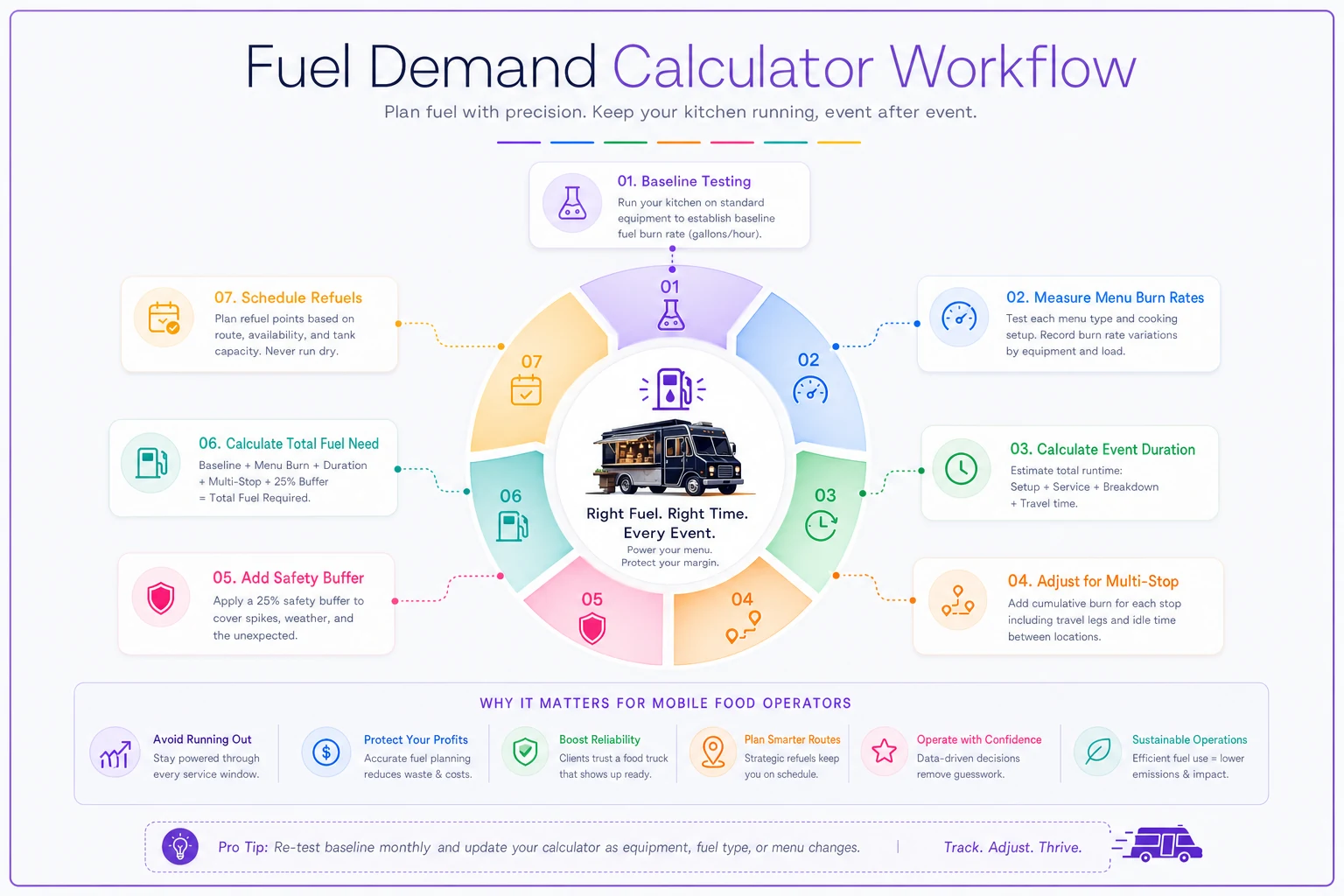
Start with baseline testing. Run your typical lunch setup for exactly 2 hours. Measure fuel consumed. Repeat for breakfast service, slow periods, maximum load. Write it all down.
Here's a practical calculation framework:
Base Consumption Rate Formula:
-
Generator capacity (watts) × Load percentage = Actual draw
-
Actual draw ÷ 1000 × Fuel factor = Gallons per hour
-
Fuel factor varies
0.08–0.12 for inverter generators, 0.12–0.18 for conventional
Event Duration Calculation:
-
Setup time (usually 45 min) × Idle burn rate
-
Service hours × Average service burn rate
-
Breakdown time (30 min) × Idle burn rate
-
Travel time (if running) × Travel burn rate
-
Total = Minimum fuel needed
-
Add 25% safety buffer
Workflow overview:
Multi-Stop Adjustment:
| Stop | Fuel Used | Fuel Remaining |
|---|---|---|
| Stop 1 | 2.4 gallons | 3.6 gallons |
| Transit | 0.3 gallons | 3.3 gallons |
| Stop 2 (needed) | 3.8 gallons | Deficit — refuel required |
If you're arriving at Stop 2 with 3.3 gallons and need 3.8, that refuel has to happen before or during the stop — not when the generator starts sputtering. Plan the refuel into your transit, not your service window.
Refuel timing based on real event patterns
Five-hour festivals need different strategies than 90-minute lunch services. Long events typically follow this consumption curve:
-
First hour
High burn (setup plus initial rush)
-
Hours 2–3
Moderate steady burn
-
Hour 4
Lower burn (crowd thins)
-
Final hour
Spike (last-call rush) then idle
A 5-gallon tank with a 1.2 gal/hour average burn technically lasts 4 hours. But you never run below 10% capacity — it damages the fuel pump — so effective capacity is closer to 4.5 gallons, which is about 3.75 hours of actual runtime. For a 5-hour event, you're refueling around hour 3 whether you planned for it or not.
Shorter events create different problems. Three back-to-back 2-hour stops with 30-minute gaps:
-
Stop 1
2.4 gallons
-
Gap
0.2 gallons
-
Stop 2
2.4 gallons (running total: 5.0)
-
Gap
0.2 gallons
-
Stop 3
2.4 gallons (running total: 7.6)
You need to refuel during or between Stop 2. But when? During service means shutting down equipment. Between stops might make you late. The answer is partial refuels — add 2 gallons during Stop 2's slow period rather than waiting for a critical low.
Festival organizers sometimes provide refueling windows. A 12-hour event might schedule:
-
10am
Vendor setup begins
-
2pm
First refuel window (20 min)
-
6pm
Second refuel window (20 min)
-
10pm
Service ends
Miss a window and you're waiting 4 more hours. Plan accordingly.
Risk triggers that force immediate refueling
Certain situations demand immediate refueling regardless of your calculations.
Temperature spikes above 90°F: Generators consume 20–30% more fuel in extreme heat. Your 4-hour runtime becomes 3 hours. When temps climb unexpectedly, refuel at 40% capacity instead of 25%.
Equipment failures forcing backup systems: Your hood vent dies. Now you're running three box fans at 300W each — an extra 0.3 gallons per hour you didn't account for. Refuel immediately when switching to backup equipment.
Extended wait times between scheduled stops: Supposed to start at noon, but the previous vendor won't clear out until 12:45. You're burning fuel just sitting there. More than 30 minutes of unplanned delay triggers a refuel check.
Generator performance degradation: Starts running rough, struggles under load, or shows rpm fluctuations. These symptoms suggest fuel system issues that worsen with low fuel levels. Refuel and add fuel treatment immediately.
Unexpected menu additions: Event organizer asks if you can serve breakfast items at the afternoon festival. Sure, but your coffee setup adds 1500W of continuous draw you didn't plan for. Recalculate and refuel before service starts.
The handover checklist for multi-operator shifts
When operators change mid-event, fuel status gets lost. Morning operator tells the afternoon person "tank's about half full" but doesn't mention they ran the fryer non-stop for 3 hours. That gap in communication is where generators die.
Create a physical handover card. Both operators sign it, someone takes a photo. That one step prevents most "nobody told me" situations when the generator dies at 7pm.
Fuel Status Section:
-
Current fuel level (gallons, not percentage)
-
Hours run since last refuel
-
Equipment configuration used
-
Abnormal consumption notes
-
Next required refuel time
Generator Condition:
-
Current hour meter reading
-
Any performance issues noted
-
Oil level check (yes/no)
-
Air filter condition
-
Unusual sounds or vibrations
Event-Specific Notes:
-
Remaining service hours
-
Expected equipment needs
-
Crowd size and demand level
-
Weather changes expected
-
Organizer refuel windows
Take a photo of the fuel gauge and attach it to the handover card.
It takes two minutes to fill out. It also takes about two seconds for a miscommunication to cost you the rest of the event.
Safe refueling procedures that prevent disasters
Refueling a hot generator wrong can end your business. Vapor ignition, fuel spills on hot surfaces, static discharge fires — this stuff happens, and it happens fast.
Pre-Refuel Shutdown Sequence:
-
Switch off all cooking equipment and wait 2 minutes
-
Run generator at idle for 3 minutes to cool down
-
Turn off generator completely
-
Wait at least 5 minutes (10 minutes in summer heat)
-
Check exhaust area temperature with your hand
-
Open fuel cap slowly to release pressure
During Refueling:
-
Use metal fuel cans (plastic builds static)
-
Ground the can to the generator frame before pouring
-
Pour slowly and watch for overflow
-
Never fill beyond 90% capacity
-
Keep paper towels ready
-
Have a fire extinguisher within reach
Post-Refuel Restart:
-
Wipe any spills completely before starting
-
Check that the fuel cap is sealed tight
-
Start generator with no load connected
-
Run for 2 minutes before switching equipment back on
-
Check for fuel leaks around the cap and fuel line
-
Document gallons added and the time
Some operators try to hot-refuel with the generator still running. Don't. The vibration alone causes spills, and one spark ends your day permanently.
Sample calculators for common scenarios
Weekend Festival Circuit Calculator
Saturday scenario:
-
9am–2pm Farmers Market (5 hrs) — Breakfast menu at 0.6 gal/hr = 3.0 gallons
-
3pm–9pm Food Truck Rally (6 hrs) — Lunch menu at 1.2 gal/hr = 7.2 gallons
-
Daily total
10.2 gallons
-
Tank capacity
6 gallons
-
Refuels needed
2 (after the market, and once during the rally)
High-Demand Event Calculator
-
Music festival with around 10,000 attendees
-
Generator
7000W capacity
-
Average load
75% (5250W)
-
Burn rate
1.4 gal/hr
-
Service window
11am–11pm (12 hours)
-
Total fuel needed
16.8 gallons
-
Safety buffer (25%)
4.2 gallons
-
Total required
~21 gallons
-
Refuel schedule
Every 3.5 hours (3 times during the event)
Variable Load Calculator
| Period | Load | Rate | Duration | Fuel |
|---|---|---|---|---|
| 11am–2pm lunch rush | 80% | 1.5 gal/hr | 3 hrs | 4.5 gal |
| 2pm–5pm idle | 20% | 0.4 gal/hr | 3 hrs | 1.2 gal |
| 5pm–8pm dinner | 70% | 1.3 gal/hr | 3 hrs | 3.9 gal |
| Total | 9.6 gal |
Refuel at 4pm during the slow window so you're not scrambling when dinner service picks up. That 20-minute window in the middle of the day is the whole plan.
When fuel management automation makes sense
Tracking fuel consumption across multiple events gets messy fast. You're juggling receipts, calculating burn rates, predicting refuel windows across different venues and menu configurations. One miscalculation means a dead generator mid-service.
This is where AI-powered operational software actually earns its place. Instead of paper logs and mental math, you get automated consumption tracking based on actual equipment usage. The system learns your specific generator's burn patterns and adjusts for weather, menu changes, and equipment configurations over time.
The better platforms monitor fuel levels against upcoming event schedules — factoring in travel distances, menu requirements, and weather forecasts — then push refuel alerts before things get critical, not mid-lunch-rush. Some even connect with local fuel delivery services for automated replenishment scheduling.
For multi-truck operations, centralized fuel management through these platforms prevents the chaos of individual operators making isolated decisions. You can track consumption patterns across your whole fleet, spot inefficient generators before they become a real problem, and optimize refuel logistics without manually coordinating everything.
Even single-truck operators benefit. Reducing generator failures alone tends to cover the cost of the software. No angry customers, no lost revenue, no emergency gas runs.
Avoiding the cascade failure of poor fuel planning
Bad fuel management creates cascading problems. Generator dies during lunch rush — you lose a few hundred dollars in immediate sales, customers post negative reviews, the event organizer doesn't invite you back, and your staff stands around getting paid while you chase down a gas can. Food starts spoiling without refrigeration.
The math is simple. Proper fuel planning takes maybe 20 minutes per event. Getting it wrong costs hours and real lost revenue. Most operators learn this the hard way — generator sputtering to silence while 50 customers wait in line.
Track consumption consistently. Test your actual burn rates. Build buffers into every calculation. Create clear handover procedures. Follow safety protocols even when you're rushed. These aren't suggestions for the overly cautious — they're just what professional operation looks like.
Your generator is the heartbeat of your mobile business. Running out of power mid-shift isn't just embarrassing. It's entirely preventable with the right planning.
Ready to drive your food truck business forward?
Join 2,000+ food truck operators relying on Grubzly to boost efficiency, increase sales, and delight customers.