


Your best regular just walked away without their free taco because your Square reader couldn't connect to process their tenth-purchase reward. Meanwhile, the food truck next to you has customers flashing paper punch cards like it's 1995 — except when they get back to their commissary kitchen, everything somehow syncs into their digital system.
The disconnect between offline operations and online tracking kills loyalty programs for mobile food businesses. You need customers to feel rewarded at the window, but you also need fraud protection and accurate tracking when you're managing multiple trucks or events.
The mobile connectivity problem nobody warns you about
Food truck loyalty programs fail in three pretty predictable ways. Digital-only systems break when your hotspot dies at exactly noon during the lunch rush. Paper-only systems create reconciliation nightmares where you're manually entering hundreds of punches every Sunday night. And hybrid attempts usually mean running two separate systems that never actually talk to each other.
Most food truck operators only discover this after launching. You print 500 punch cards, customers love them, then you realize you have no idea who your actual repeat customers are or how much revenue the program generates. Or you set up a QR-based system that works great at your regular downtown spot but completely fails at the farmers market where cell signal might as well not exist.
The real operational challenge isn't choosing between digital or physical. It's building something that handles both without falling apart.
Manual redemption workflows that actually protect revenue
Think through what happens when a customer presents a loyalty reward during peak service. Your cashier needs to verify it's legitimate, mark it as redeemed, and complete the transaction — all while the line grows behind them. Without clear workflows, you get duplicate redemptions, confused staff, and annoyed customers.
Stop losing sales to poor planning.
Grubzly helps you plan routes, track inventory, and maximize daily sales effortlessly.
- Real-time route optimization
- Inventory tracking & alerts
- Mobile sales & reporting
No credit card required
A truck in Austin lost roughly $2,400 last summer because their paper voucher system had no real verification process. Customers were screenshotting digital coupons, printing them multiple times, and redeeming them at different trucks in the fleet. The owner only caught it when comparing redemption counts against issued vouchers.
A fraud-resistant manual workflow looks like this:
-
Each reward gets a unique 6-character code (mix of letters and numbers)
-
Codes follow a pattern your staff recognizes (like starting with the truck number)
-
Staff writes the date and their initials on physical redemptions
-
Digital tokens show as QR codes that change color when scanned
Daily reconciliation process:
-
Count physical redemptions at shift end
-
Log redemption codes in a simple spreadsheet or app
-
Check for duplicate codes across trucks (if running multiple units)
-
Flag any codes that don't match your pattern
-
Verify high-value redemptions against customer purchase history
A quick visual of the manual redemption workflow.
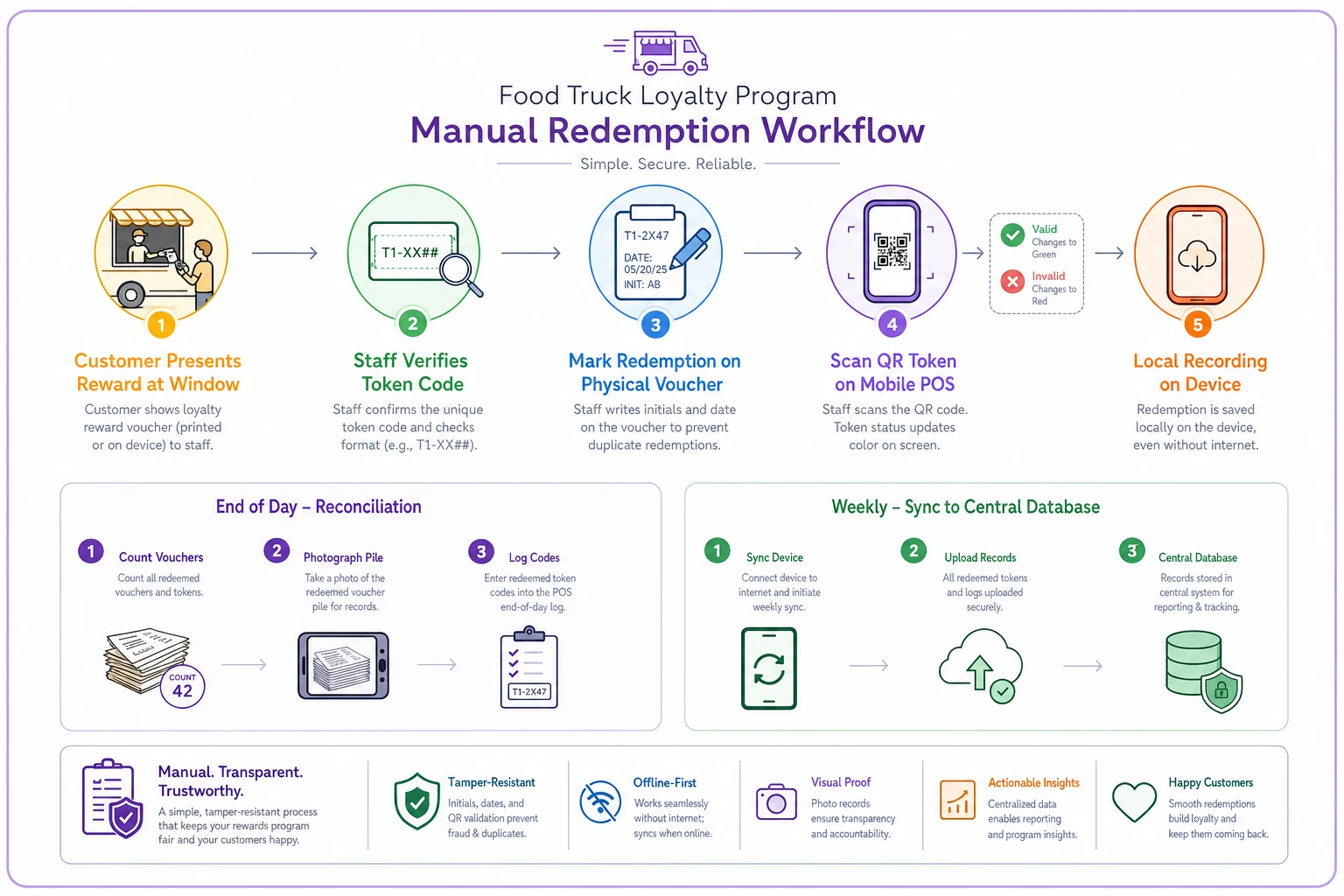
Use a consistent code pattern so staff can instantly spot anomalies.
The pattern recognition element matters more than people expect. When your codes follow a format like T1-XX## (Truck 1, two letters and two numbers), staff quickly spot fakes. One Portland truck caught someone trying to use "FREE-TACO" as a redemption code because it didn't match their standard format.
Stamp cards that convert to digital points
Physical stamp cards work because they're simple. Customer buys a burrito, you stamp their card, after ten stamps they get a free one. But those cards create tracking problems the moment you want to understand customer behavior or run targeted promotions.
The answer isn't getting rid of stamp cards — it's making them compatible with digital tracking. Every physical card needs a bridge to your digital system.
Physical-to-digital bridge design:
Each stamp card gets a unique QR code or short code printed on it. When customers first receive their card, that code exists in your system but isn't linked to any contact info. As they accumulate stamps offline, you're building up unredeemed value attached to that card ID.
The interesting part happens during redemption or when they choose to register. You scan the QR code, see they have seven stamps, and offer to convert it to a digital account. Around 40% of customers will provide an email or phone number at that point to "protect" their earned rewards.
| Conversion Point | Typical Rate | Best Approach |
|---|---|---|
| First stamp | 8-12% | Too early, low value perception |
| Fifth stamp | 35-40% | "Halfway there" messaging works |
| At redemption | 55-65% | High motivation to claim reward |
| Loss replacement | 70-80% | Digital backup prevents lost cards |
Once converted, their physical card still works for offline stamping, but now you're tracking everything digitally when you sync. They can check their balance online, you can send targeted offers, and you're actually building a customer database instead of a pile of cardboard.
QR codes that work without internet
QR-based loyalty sounds great until your scanner app needs internet to verify anything. The workaround is pre-loaded validation rules that run locally on your device.
Your POS tablet or phone downloads a validation file each morning with:
-
Valid customer codes for that day
-
Redemption limits per code
-
Special promotion rules
-
Blacklisted codes from previous fraud attempts
When offline, the app checks codes against this local file. Customer scans their QR code, the system validates it locally, records the transaction, then syncs when you reconnect. The key is setting expiration rules so codes can't be reused across multiple offline periods.
A breakfast truck in Denver runs this exact setup. Their app downloads fresh validation data at 5 AM during commissary prep. Throughout the morning, all loyalty transactions process locally. When they're back around 2 PM, everything syncs and the owner can see which regulars visited, redemption patterns by location, and average purchase value for loyalty members versus walk-ins.
The technical side isn't complex. Most modern POS systems support offline mode, and simple validation rules don't require much database logic. The harder part is training staff to trust the system when they can't see real-time updates.
Syncing chaos: from paper to database without losing your mind
Every Sunday night, you're staring at a pile of stamp cards, paper vouchers, and manual redemption logs that somehow need to become data. This is where most food truck loyalty programs quietly die — not from lack of customer interest, but from operational exhaustion.
The manual entry trap goes like this: you collect all physical redemptions, start typing them into a spreadsheet, try to match them with customer records, realize half the codes are illegible, give up, and promise yourself you'll catch up next week. By month-end, you have no real idea if the loyalty program is even working.
Batch processing workflow that holds up:
-
Set up collection points throughout your operation. Each truck gets a lockbox for redeemed items. Every shift lead spends about three minutes at close documenting:
-
Sort physical items by type (stamps, vouchers, special promos)
-
Enter counts first, codes second
-
Flag anything that doesn't match daily logs
-
Upload photos as backup documentation
The photo documentation seems redundant until you actually need it. One truck owner caught an employee creating fake redemptions by comparing daily photos with reported counts. That visual record also helps when customers dispute whether they already used a reward.
Building reconciliation rules that catch fraud early
Fraud in food truck loyalty programs usually isn't sophisticated — it's opportunistic. Someone notices your voucher codes are sequential. A customer realizes they can screenshot a QR code and use it multiple times. An employee starts generating extra punches for their friends.
You need rules that flag unusual patterns without creating false positives that annoy legitimate customers.
Basic fraud detection logic:
-
Same code used twice = immediate flag
-
More than 3 redemptions in 24 hours = review required
-
New customer with high-value redemption = verification needed
-
Employee redemption rate >2x average = audit trigger
The nuanced part isn't the rules — it's handling edge cases without punishing real customers. Maybe that person really did visit three times on Saturday because they were picking up lunch for their whole office. Your system should flag it for review, not automatically reject it.
Context matters too. A truck that serves office parks will see legitimate customers redeeming multiple rewards when they're ordering for colleagues. Their rules need to account for bulk orders. A late-night taco truck might flag any redemption over $20 as worth reviewing because the customer behavior patterns are completely different.
When to stay analog vs when to digitize
Not every food truck needs a fully digital loyalty system. The decision really comes down to operational complexity and where you're trying to take the business.
Stay primarily analog when:
-
You run a single truck with consistent staff
-
Your menu and pricing rarely change
-
Most customers pay cash
-
You serve events where internet is always unreliable
-
Your customer base skews older or less tech-comfortable
A Korean BBQ truck in Sacramento runs entirely on paper punch cards because roughly 70% of their customers are construction workers who pay cash and don't want another app. The owner manually tracks their top 20-30 regulars in a notebook. It works perfectly for that operation, and there's no shame in that.
Digitize when you have:
-
Multiple trucks or pop-up locations
-
Plans to expand or franchise
-
Need for actual customer data (email marketing, preferences)
-
High-value rewards that need fraud protection
-
Seasonal menu changes requiring flexible reward rules
The transition doesn't have to be sudden either. Start by digitizing just your backend tracking while keeping the customer experience analog. Add QR codes to existing punch cards. Introduce digital options for customers who want them while keeping physical alternatives around.
Redemption templates that travel with your truck
Your redemption rules need to work identically whether you're at your regular lunch spot, a brewery event, or a festival. But context changes everything — what works at a corporate campus fails at a music festival.
Templates solve this by pre-packaging redemption rules for different scenarios:
Daily lunch service template:
-
Standard loyalty points apply
-
All regular rewards active
-
Employee discounts enabled
-
Normal fraud rules
Special event template:
-
Loyalty points earned but not redeemed (encourage return visits)
-
Event-specific promotions only
-
Cash-only redemptions
-
Relaxed velocity limits
Catering template:
-
Bulk redemption allowed
-
Points earned at 50% rate
-
No individual rewards
-
Manual override required
Each template lives on your POS device and activates based on location or manual selection. When you pull up to the brewery on Friday night, you switch to Event Mode and your entire reward structure adjusts automatically.
This prevents awkward situations where customers try to redeem birthday rewards at a wedding you're catering, or festival-goers get frustrated they can't use points they just earned. Clear rules, consistently applied, make everything smoother.
The Monday morning sync ritual
Every mobile food business needs a synchronization rhythm. Monday mornings tend to work best — you're usually prepping anyway, last week's data is complete, and there's time before the lunch rush to fix any issues that come up.
The sync process shouldn't take more than 15-20 minutes:
Upload physical redemptions from the previous week. Those photos and logs you collected get entered into your system. Batch entry is faster than daily updates and creates less room for errors.
Review flagged transactions. Your fraud rules caught six suspicious redemptions. Three are legitimate (catering order), two are duplicates (customer tried to use the same code at two trucks), one needs more investigation.
Update validation files for the week ahead. Push new customer codes, remove expired promotions, add special event rules. Every device gets fresh data before service starts.
Check reconciliation reports. Do physical counts match digital records? Are any trucks showing unusual patterns? Is revenue per loyalty customer trending the right direction?
Consistency is what makes this work. Skip two weeks and suddenly you're untangling hundreds of transactions with no clear timeline to reference.
Making offline loyalty profitable
The economics of food truck loyalty programs are fairly unforgiving. You probably need at least 15% of customers participating to break even on operational overhead, but most trucks see 5-8% participation with traditional programs.
Offline-capable programs tend to perform better because they remove friction. A customer doesn't need to download an app, create an account, or remember a password. They just need to keep a card in their wallet or a photo on their phone.
A rough look at the math:
-
Average customer visits 2.3 times monthly without a loyalty program
-
With a working program, that often increases to around 3.1 visits
-
If 20% of your base participates, that's roughly 16 extra transactions per 100 customers
-
At a $12 average ticket, that's about $192 in additional monthly revenue per 100 customers
But the real value isn't just direct revenue — it's predictability and customer data. Knowing that 30-40 regulars will show up on Tuesday lets you prep more accurately. Understanding that a particular customer always adds guac means you can suggest it before they even ask.
The technology stack that makes this possible
Building an offline-first loyalty system requires less technology than most people assume. You need local storage on your POS device, basic sync capabilities, and simple validation logic. That's mostly it.
Most food trucks already have tablets or phones running Square, Toast, or similar POS systems. These platforms increasingly support offline modes and custom loyalty integrations. The main thing is choosing tools designed for intermittent connectivity rather than assuming constant internet access.
The backend can be as simple as a structured spreadsheet or as complex as a full customer database. What matters is consistency — every redemption follows the same process, every sync uses the same format, every rule applies uniformly across trucks and locations.
Some operators build their own using no-code tools, connecting their POS to Google Sheets through Zapier or Make. Others use specialized food truck management platforms that include loyalty modules. The specific tool matters less than having clear workflows and actually sticking to them.
AI-powered operational software can automate a lot of this reconciliation and fraud detection over time, but the core process needs to be solid first. You can't automate chaos — working manual processes have to come before adding any intelligence layers on top.
Real-world results from trucks that figured it out
A Vietnamese banh mi truck in Portland switched from an app-based program to offline-first punch cards with digital sync. Their active participation jumped from around 60 users to over 400 in three months. The technology wasn't the reason — removing friction at the point of sale was.
A taco operation running three trucks in Phoenix built fraud detection that caught around $3,000 worth of duplicate redemptions in their first month of implementation. They weren't losing that much every month, but the accumulated fraud over the previous year had quietly eaten into margins in ways they hadn't tracked.
The most interesting case was a dessert truck in Nashville that used offline loyalty data to rethink their route. By tracking which customers redeemed at which locations, they figured out that downtown lunch customers almost never visited their evening brewery stops. That led them to build separate reward structures for different customer segments, which improved overall program ROI by around 40%.
When everything syncs, it's a good morning
The first time your offline loyalty system syncs perfectly, it does feel a little satisfying. Yesterday's paper stamps show up in your database. QR codes scanned at three different events reconcile into single customer profiles. That regular who lost their punch card gets their points restored from backup.
But it's not luck — it's the result of every small operational decision adding up. Code formats, sync schedules, fraud rules. All of it building toward a moment where what felt like chaos becomes clean data.
For food truck operators, this isn't about having the most sophisticated system on the market. It's about building something that works when nothing else does — when you're in a parking garage with no signal, when the festival WiFi crashes, when your tablet dies and you're running on paper backup.
The best offline loyalty program is one your staff trusts completely. They know the rules, understand the workflows, and can handle edge cases without calling you. Customers get their rewards, you get your data, and everyone gets their tacos.
Start with clear processes, add simple tools, then scale based on what your operation actually needs. Your food truck doesn't need Silicon Valley's loyalty solution — it needs something that works at noon on Tuesday when everything else fails.
Ready to drive your food truck business forward?
Join 2,000+ food truck operators relying on Grubzly to boost efficiency, increase sales, and delight customers.