


Three weeks ago I watched a food truck owner literally cry over a dumpster. Not because of some dramatic Gordon Ramsay moment, but because she was tossing her third batch of spoiled avocados that month while simultaneously running her Square data showing she'd turned away 47 customers the previous Saturday when her tacos ran out by 2pm.
This wasn't amateur hour either. She'd been running her truck for four years, had a loyal following, great reviews. But her inventory system? A clipboard with "order more" scribbled next to items and a prayer that she'd guess right for the weekend rush.
Most food truck operators fall into this trap. They focus on perfecting recipes, building their brand, finding the best spots. Meanwhile their inventory system stays stuck at "buy stuff when it looks low" while money bleeds out through spoilage and missed sales.
Why mobile food businesses struggle with perishables more than restaurants
A brick-and-mortar restaurant has walk-in coolers, dedicated prep space, predictable foot traffic patterns. Your truck has a mini-fridge that barely fits, storage that shifts every time you hit a pothole, and customer volume that swings wildly based on weather, events, and whether that construction site down the street is active this week.
The constraints multiply fast. Your generator dies and suddenly everything in your cold storage is at risk. You're parked at a festival expecting 500 people but 2,000 show up. That private catering gig gets moved from 50 to 75 guests two days before. Each scenario breaks a traditional restaurant's inventory assumptions.
Then there's the ordering challenge. Restaurants can get daily deliveries from multiple vendors. You're managing pickups between stops, storing ingredients at commissary kitchens, transferring stock from your prep location to your truck. Every handoff increases spoilage risk.
I tracked inventory flow for six different trucks over a month. The average truck touched each ingredient 4-7 times before serving - from vendor to commissary to prep to truck to service. Compare that to a restaurant's 2-3 touches. More handling means more temperature breaks, more chances for FIFO violations, more opportunities for that expensive protein to sit forgotten in the back of the truck cooler.
The counting cadence that actually works
Daily counts in a food truck environment? Not happening. You're exhausted after a 14-hour day, still need to clean and prep for tomorrow, and now you're supposed to count every portion of pulled pork?
Stop losing sales to poor planning.
Grubzly helps you plan routes, track inventory, and maximize daily sales effortlessly.
- Real-time route optimization
- Inventory tracking & alerts
- Mobile sales & reporting
No credit card required
The trucks that nail inventory use a three-tier counting system:
Critical items (count after every service): Your money makers and high-spoilage items. If you're a taco truck, this is your proteins and guac. BBQ truck? Your brisket and ribs. Takes 5 minutes, saves hundreds.
Secondary items (twice weekly): Produce, dairy, sauces. Count these Monday morning and Thursday night. You're looking for trends, not precision.
Shelf-stable (weekly): Dry goods, seasonings, packaging. Sunday night full count while you're doing your weekly prep anyway.
One operator running three trucks explained her evolution: "First year, I counted everything daily and burned out my staff. Second year, stopped counting and lost thousands to waste. Third year, we figured out this tiered system. Now my waste is under 4% and my team doesn't hate me."
Match your counting frequency to your spoilage risk and reorder cycles. That imported cheese you order weekly? Count it weekly. Those avocados that turn from perfect to garbage in 48 hours? Check them every service.
Building par levels that adapt to your route
Static par levels kill food trucks. Monday at the office park needs different inventory than Saturday at the brewery. Yet most operators use the same prep list regardless of where they're headed.
Start with a basic framework. Track your sales by stop for four weeks. Not just total sales - actual item movement. How many breakfast burritos at the construction site versus the college campus? Build three par level templates:
Weekday office stops: Heavy on lunch items, lighter on beverages (they have break rooms), extra vegetarian options. One truck found their office stops ordered 3x more salads but 70% fewer sodas than their weekend spots.
Event/festival days: Maximum everything, but especially handhelds and quick-serve items. Prep for 150% of expected attendance because event organizers always lowball their numbers. Extra napkins, extra ice, extra backup proteins.
Catering/private events: Precise counts based on headcount plus 10% buffer. Different packaging needs. More complex items work here since you're not managing a line.
The smart move? Build these pars into a simple spreadsheet that adjusts based on your route. Input tomorrow's stops, it spits out your prep list. Takes the guesswork out of that 5am commissary kitchen scramble.
FIFO in a truck: the tape system that prevents the shuffle
First In First Out sounds simple until you're digging through a truck cooler while customers wait. The physical constraints make traditional FIFO nearly impossible. Your prep containers stack three deep, new deliveries get shoved wherever they fit, and that morning's prep ends up buried under afternoon restocks.
The solution comes from an unlikely source - a former hospital kitchen manager who switched to food trucks. She brought a medical kitchen trick: colored tape dating.
Every container gets a strip of colored tape. Monday is red, Tuesday orange, Wednesday yellow, and so on. One glance tells you what needs to move first. No dates to read, no labels falling off in the steam. When you're slammed and reaching for burger patties, you grab red before orange.
Your real FIFO challenge starts at your commissary or prep kitchen. That's where ingredients sit longest, where you do bulk prep, where spoilage actually happens. Set up zones in your commissary storage - new deliveries always go to the right, pull for prep always from the left. Prepped items get staged by service date. Nothing moves to the truck without tape.
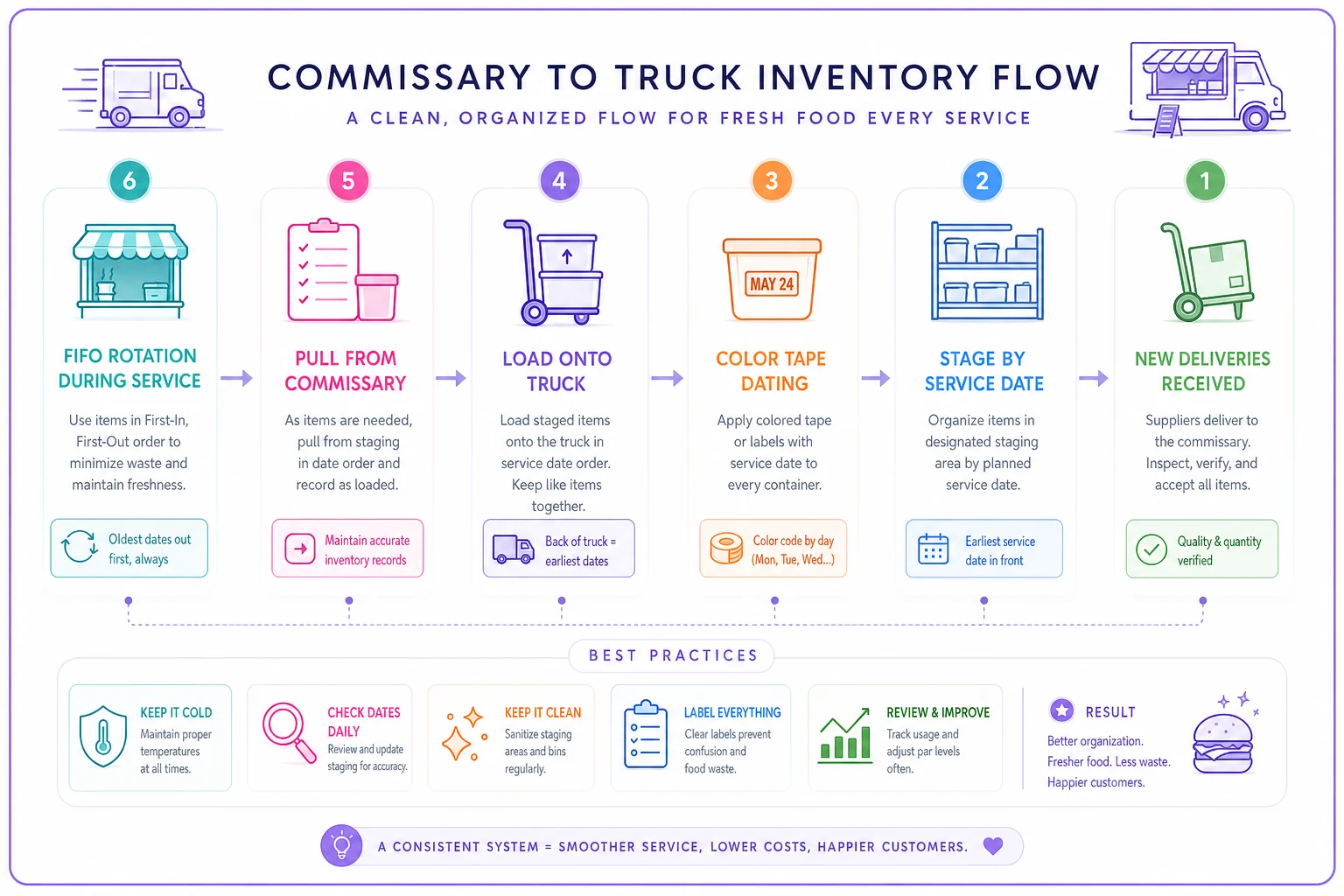
This diagram shows the flow from commissary to truck and where tape dating and staging happen.
Keep a roll of each day's colored tape at both your commissary and in each truck.
One BBQ truck cut their protein waste by 60% just by fixing their commissary FIFO flow. They were perfectly rotating stock in the truck while $400 briskets went bad in their walk-in because "whoever grabbed them grabbed them."
The waste tracking template that reveals hidden losses
Most trucks track waste wrong. They write "threw out lettuce" without capturing quantity, reason, or cost. That tells you nothing about whether it's an ordering problem, storage issue, or prep miscalculation.
Here's a waste log that actually drives improvement:
| Item | Amount | Cost | Reason | Location | Date/Time | Action Needed |
|---|---|---|---|---|---|---|
| Pulled pork | 3 lbs | $27 | Overproduced for Tuesday route | Truck | 3/15 8pm | Reduce Tuesday par by 2 lbs |
| Avocados | 12 units | $18 | Over-ripened, couldn't prep in time | Commissary | 3/16 6am | Order less ripe, stagger delivery |
| Burger buns | 2 packs | $8 | Bottom of box got wet | Truck | 3/14 2pm | Check storage seal, move buns higher |
Tracking is just step one. The magic happens when you analyze patterns. One taco truck discovered they threw out cilantro every Monday because their weekend prep always overestimated. Another found their cheese waste spiked whenever they worked lunch spots because the afternoon sun hit their prep station.
A barbecue truck owner showed me six months of waste data: "We were tossing $200 of brisket every week, always on Wednesdays. Turns out Wednesday was our commissary's delivery day and we were prepping before the new delivery arrived, using Saturday's leftover meat that sat too long. Moved prep to Thursday, saved ten grand a year."
Connecting orders to actual demand
Your Tuesday office park stop averages 45 customers. But when it rains? 25. When that tech company has their monthly all-hands with catered lunch? 15. When the construction crew next door hits overtime? 75.
Static ordering based on "normal" Tuesday murders your margins through waste or stockouts. You need ordering rules that account for reality. Build trigger rules for common scenarios:
-
Weather adjustments - Rain forecast means 30% reduction on everything except soup and comfort food which get a 20% bump. First sunny day after cold spell? Bump salads and cold items by 40%. Over 95°F means cutting hot items by 25% but doubling beverages.
-
Event-based modifications - Festival weekend equals maximum proteins, double beverages, triple napkins. Corporate catering needs standard portions with no modifications. Construction sites get 40% larger portions, extra chips and sides, double drinks.
-
Day-of-week patterns - Monday typically sees 20% less than weekend pars because people eat healthier. Friday bumps shareable items and desserts by 30%. Sunday depends entirely on location - some spots are dead, others are slammed.
What separates profitable trucks from everyone else? They track their adjustments and refine them. That rain penalty might be 30% at office parks but only 10% at covered brewery patios. Your Friday bump might be 50% at bar districts but actually negative 20% at business centers where everyone leaves early.
The refrigeration crisis plan nobody talks about
Your compressor dies at 11am on a Saturday. You're two hours from your commissary, have $800 of inventory on board, and a catering gig at 6pm. Most operators don't think about this until it happens.
Build your refrigeration failure protocol before you need it. Immediate triage in the first 30 minutes means checking temps on everything, moving critical proteins to any working cold storage, and icing down what you can't refrigerate. Text your truck network for backup storage. Cancel or modify upcoming stops based on remaining safe inventory.
Recovery planning in the next hour involves identifying what can be saved versus written off, finding the nearest commercial kitchen for emergency storage, and arranging inventory transfer to a backup truck if available. Contact customers about menu modifications and document everything for insurance.
Prevention beats crisis management. Put a thermometer in every cooler and check it every two hours. Keep backup portable coolers with ice packs ready. Build relationships with nearby restaurants for emergency storage. Maintain your generator monthly, not quarterly.
A successful truck operator in Austin told me about their near-disaster: "Compressor failed during SXSW, our biggest week. But we had protocols. Transferred proteins to our backup truck within an hour, ran a limited menu, still made 70% of projected sales. The truck next to us with the same problem? Complete shutdown, lost everything."
Sample calculators and practical tools
Forget complicated restaurant formulas - you need calculations that work from a phone calculator while you're standing in a walk-in at 5am.
Basic par calculation: (Average daily usage × Days until next order) × 1.2 buffer = Par level
Example for chicken: Tuesday office stops average 30 lbs, Thursday breweries average 45 lbs, Saturday festival takes 80 lbs. Order arrives Wednesday, need to last through Saturday. Thursday + Friday + Saturday usage equals 170 lbs. Multiply by 1.2 buffer gives you 204 lbs to order.
Waste cost calculator: (Ingredient cost per unit ÷ Portions per unit) × Portions wasted = True waste cost
Don't just track the $15 pork shoulder. Track the $45 in lost sales from the 12 portions you could have sold.
Prep quantity optimizer: Known bookings + (Historical walk-up average × Weather modifier) + 15% buffer
If you've got 30 pre-orders, usually get 40 walk-ups, and rain is forecast: 30 + (40 × 0.7) + 15% buffer = 67 portions.
Keep these calculations simple enough to do while exhausted. Complexity kills systems in food trucks.
When inventory software makes sense
A single truck doing lunch runs doesn't need enterprise inventory management. You need a clipboard, discipline, and maybe a good spreadsheet. But watch what happens as you scale.
Two trucks means double the ordering but split deliveries. Three trucks means coordinating who gets what from which delivery. Add catering and suddenly you're managing inventory across trucks, commissary, and event-specific purchases.
The breaking point usually hits around $30-40k monthly revenue. That's when manual tracking starts costing more in mistakes than software would cost to prevent them. One operator put it perfectly: "I resisted software until I realized I was spending two hours every night reconciling inventory. At that point, paying $200 a month to get my evenings back was obvious."
Most inventory software is built for restaurants, not mobile operations. You need something that handles multiple service locations with different pars, commissary to truck transfers, shared inventory across trucks, weather and event adjustments, and quick mobile entry that doesn't require a desktop.
AI-powered operational software can automatically adjust par levels based on your route, weather forecasts, and historical patterns. Instead of manually recalculating chicken portions for different stops, the platform learns your usage patterns and suggests optimal inventory levels. Some systems even integrate with your POS to track real-time sales and adjust future orders automatically.
Start manual, build your system, then add technology when manual breaks. Don't try to software your way out of not having a system.
Making it work in your operation
The perfect perishable inventory system for food trucks doesn't exist because every truck faces different constraints. But the patterns remain consistent.
Start with the basics. Pick one thing - maybe waste tracking or par levels for your top five items. Run it for two weeks. See what breaks, adjust, continue. Layer in complexity only after the foundation works.
Most trucks try to implement everything at once, it fails spectacularly, and they revert to chaos. The ones that succeed build gradually. Month one focuses on waste tracking. Month two adds FIFO taping. Month three introduces par levels. Month six sees the full system humming.
Tight inventory management can be the difference between barely surviving and actually building wealth from your truck. That operator crying over the dumpster? She implemented a basic system - just counting, pars, and waste tracking. Six months later she was banking an extra $3k monthly just from waste reduction and better ordering.
Your truck is essentially a $50,000 investment rolling around with $2,000 of perishable inventory that can make or break your week. The trucks that thrive treat that inventory with the respect it deserves. They count it, track it, rotate it, and most importantly, they build systems that work when you're exhausted, rushed, and trying to serve 100 hungry customers.
Stop letting inventory be the thing that "you'll figure out later." Later means thousands in waste, countless stockouts, and customers who won't come back after you run out of their favorite item. Build the system now, while you can still afford the mistakes.
Ready to drive your food truck business forward?
Join 2,000+ food truck operators relying on Grubzly to boost efficiency, increase sales, and delight customers.