

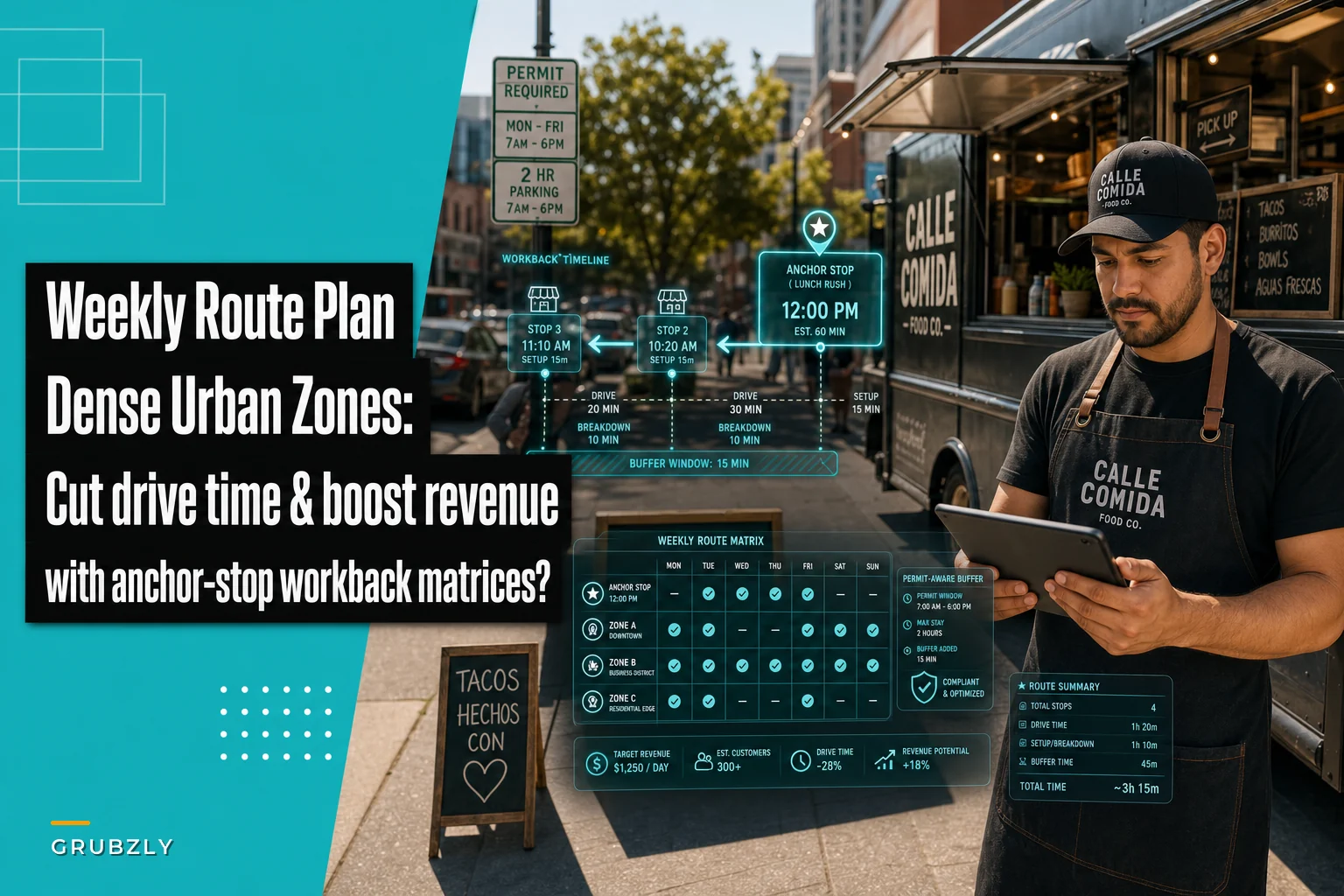

Running a food truck in a dense urban zone feels like playing three-dimensional chess while someone keeps changing the rules. You're tracking permit zones, parking restrictions, lunch rush patterns, construction closures, and competing trucks—all while trying to make enough revenue to justify burning $4.50/gallon diesel crawling through traffic.
Most food truck operators handle route planning the same broken way: check social media for events, text their regular spots, then wing it based on gut feeling that morning. The result? Spending two to three hours daily just driving between stops, missing prime revenue windows, and getting tickets because you forgot Thursday has street cleaning on that killer downtown spot.
A proper weekly route plan isn't about finding the "best" spots—it's about clustering stops intelligently, working backward from your anchor locations, and building in the buffer time that keeps you profitable instead of stressed.
Why Traditional Route Planning Falls Apart in Dense Cities
Urban food truck routing breaks differently than suburban or event-based operations. Your competition isn't just other trucks—it's every minute lost to double-parking while you serve, every block you drive searching for legal spots, and every regular customer who gives up waiting because you're running 20 minutes late.
The standard approach goes something like this: pick high-traffic spots, show up during meal times, hope for the best. Except in practice, that means arriving at the financial district at 11:45 AM to find three other trucks already parked in the good spots, then circling for 15 minutes before settling for a side street where foot traffic dies after 12:30 PM.
Real urban routing requires understanding movement patterns, not just destination quality. A mediocre spot that fits perfectly between two great locations often generates more profit than an amazing spot requiring a 40-minute crosstown drive.
Take downtown Seattle as an example. The Amazon campus area pulls massive lunch crowds, but if you're coming from a University District morning stop, you're looking at 35-45 minutes of driving during late morning traffic. Meanwhile, South Lake Union sits right between them—slightly lower volume, but you save roughly an hour of drive time daily plus fuel costs.
Building Your Anchor Stop Framework
Anchor stops form the skeleton of your weekly route plan. These aren't necessarily your highest-revenue locations—they're the stops everything else revolves around because of permits, regular commitments, or time-sensitive opportunities you can't miss.
Stop losing sales to poor planning.
Grubzly helps you plan routes, track inventory, and maximize daily sales effortlessly.
- Real-time route optimization
- Inventory tracking & alerts
- Mobile sales & reporting
No credit card required
Start by identifying your non-negotiable stops. Maybe you have a Tuesday brewery partnership, a Thursday office building contract, or a Saturday farmers market permit. These become your anchor points. Everything else gets scheduled around them using a workback approach.
Here's how it actually works: if you need to be at the Wells Fargo building downtown at noon on Wednesdays, you work backward. Setup takes 15 minutes, drive time from your previous stop is 20-30 minutes depending on route, breakdown at the previous location is 10 minutes. That means your previous stop needs to wrap by 11:15 AM at the latest.
Most operators get this backward—they plan forward from where they start instead of backward from where they must be. That single difference determines whether you're rushed and late or smooth and profitable.
Anchor stops should meet clear criteria:
-
Guaranteed minimum revenue through contracts or proven history
-
Legal parking for your required time window
-
Reasonable access from commissary or previous stops
-
Some protection from weather or seasonal dropoffs
Lock anchors first, then fit clusters around them to avoid last-minute scrambling.
Visualizing the workback workflow can make scheduling much clearer.
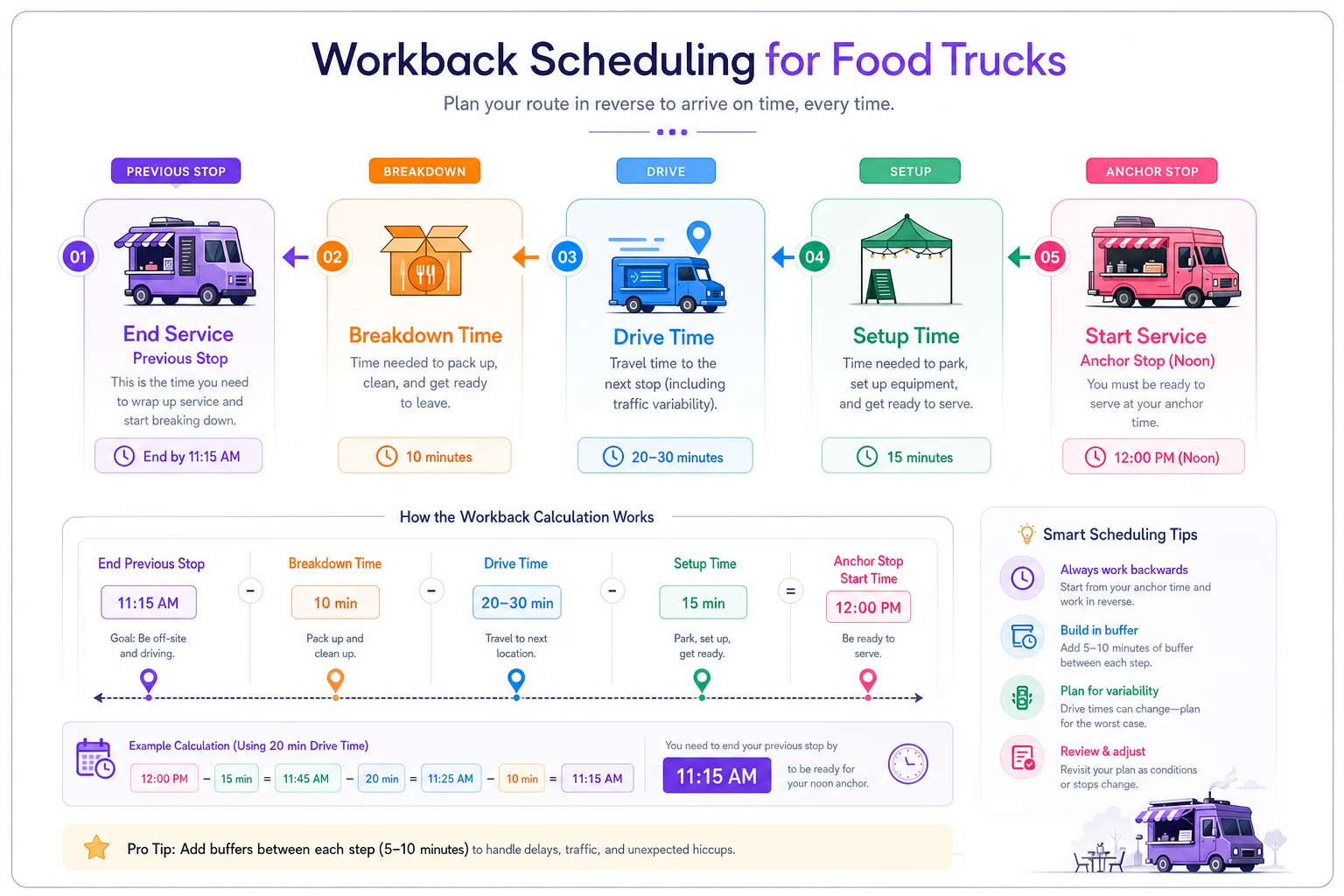
Everything else gets scheduled around them using a workback approach.
The Clustering Strategy That Reduces Dead Miles
Dead miles—driving without serving—kill food truck profitability faster than slow days. In dense urban areas, you might drive 60-80 miles daily but only serve customers for four or five hours. The math doesn't work unless you cluster intelligently.
Effective clustering means grouping stops by geography AND timing, not just proximity. Two spots might be three blocks apart, but if one serves breakfast and the other serves dinner, they don't belong in the same daily cluster despite being neighbors.
Map your city into zones based on drive time, not distance. In Manhattan, Midtown East and Midtown West might only be a mile apart, but crossing town during business hours takes 25-30 minutes. Different zones. Meanwhile, Union Square to Greenwich Village might be the same distance but takes 8 minutes—same zone.
Within each zone, identify three to five viable stops with different peak times. This creates natural progressions through the day without excessive movement. A solid zone might include:
-
Morning coffee spot near a transit hub (6
30–8:30 AM)
-
Late morning office complex (10
30 AM–12:00 PM)
-
Lunch spot at a nearby park (12
15–2:00 PM)
-
Afternoon snack location near schools (2
30–3:30 PM)
Staying within one zone all day means you're never more than 10 minutes from any stop, regulars know where to find you, and you can respond to unexpected opportunities without blowing up your schedule.
Encoding Permits and Parking Rules Into Your Matrix
Cities love making parking complicated, especially for food trucks. Every block has different rules, and those rules change by day, time, and season. Miss one detail and you're looking at tickets, towing, or an angry standoff with parking enforcement.
Build your permit and parking constraints directly into your route matrix—don't track them separately. Each potential stop needs clear notation about when it's legally available and what permits apply.
Here's a working example from a Portland food truck's planning matrix:
| Location | Mon | Tue | Wed | Thu | Fri | Sat | Sun |
|---|---|---|---|---|---|---|---|
| SW 5th & Oak | 11A-2P | 11A-2P | NO (cleaning) | 11A-2P | 11A-2P | All day | NO |
| Pearl District Lot | All day ($15) | All day ($15) | All day ($15) | All day ($15) | All day ($15) | NO (market) | NO |
| PSU Food Pod | 10A-3P* | 10A-3P* | 10A-3P* | 10A-3P* | 10A-3P* | NO | NO |
| Cartopia | After 5P | After 5P | After 5P | After 5P | After 5P | All day | All day |
*Requires monthly permit ($200)
The visual matrix prevents mistakes. You can see at a glance that Wednesday downtown is a no-go due to street cleaning, Saturday Pearl District conflicts with the farmers market, and the PSU pod requires a permit investment that only makes sense if you commit to regular weekdays.
Beyond basic availability, encode the specific conditions too:
-
Meter until 6 PM ($2.60/hr)
-
Loading zone OK after 10 AM
-
30-minute limit without food vendor permit
-
No parking during Trail Blazers games
This level of detail seems excessive until it saves you from a $165 ticket or losing a prime spot to a competitor who knew the rules better.
Buffer Rules and Transition Windows
The biggest scheduling mistake operators make is planning back-to-back stops with no breathing room. In perfect conditions, maybe you can break down, drive, and set up in 35 minutes. Perfect conditions don't exist in urban food service.
Build mandatory buffers into your schedule:
-
15 minutes between same-zone stops
-
30 minutes between adjacent zones
-
45 minutes between distant zones
-
60 minutes for any transition crossing downtown during rush hour
These aren't suggestions. Better to arrive early and prep than late and flustered. Customers forgive a lot, but chronic lateness kills repeat business.
Transition windows also matter for inventory. Moving from breakfast to lunch service means swapping menu boards, restocking different items, and cleaning equipment. Rushing those transitions leads to running out of popular items or serving breakfast burritos to the lunch crowd because you didn't have time to switch over.
Some operators resist buffers because they feel like wasted time. But buffers actually increase revenue by ensuring you hit prime windows at each stop. Arriving 20 minutes late to a lunch spot means missing the 11:45 AM–12:15 PM rush when office workers have tight schedules. That's a significant chunk of potential revenue gone before you even open the window.
Sample Weekly Matrix for Different Urban Scenarios
Different urban environments require different routing strategies. Here's what actually works in three common scenarios:
Downtown Business District Focus
Monday-Wednesday-Friday:
-
6
30–9:00 AM: Transit station breakfast
-
9
30–11:30 AM: Prep/restock at commissary
-
12
00–2:00 PM: Office building lunch
-
2
30–4:00 PM: Hospital staff afternoon
-
4
30–6:30 PM: Happy hour brewery
Tuesday-Thursday:
-
7
00–9:30 AM: Construction site breakfast
-
10
00–11:30 AM: Government building brunch
-
12
00–2:30 PM: Park lunch service
-
3
00–5:00 PM: University campus
-
5
30–8:00 PM: Residential dinner
Mixed Residential-Commercial Zones
Weekdays:
-
Morning
Coffee near transit
-
Late morning
Restock and prep
-
Lunch
Business district
-
Afternoon
Schools or parks
-
Evening
Residential neighborhoods
Weekends:
-
Brunch
Farmers markets or parks
-
Afternoon
Breweries or events
-
Evening
Bar districts or entertainment zones
Event-Heavy Urban Areas
Non-Event Days:
-
Standard neighborhood rotation
-
Focus on regular customers
-
Build relationships for event days
Event Days:
-
Single location commitment
-
Extended service hours
-
Premium pricing
-
Pre-ordered inventory levels
The pattern across all three scenarios is the same: consistency within flexibility. Regulars need to know when to find you, but you need room to chase opportunities when they come up.
Adjusting for Seasonal Patterns
Urban food truck routing shifts dramatically with seasons, and not just because of weather. College schedules, tourist patterns, construction seasons, and local events all affect where crowds gather and when they're hungry.
September–May (Academic Season): Heavy university presence, indoor lunch spots prioritized, coffee emphasis in the morning, avoid outdoor-only locations except on sunny days.
June–August (Tourist/Festival Season): Waterfront and tourist zones viable, extended evening hours, festival permits worthwhile, outdoor seating areas draw crowds.
November–February (Wet Season): Covered locations only, partnership with bars and breweries for indoor seating, trimmed menu focused on items that travel well, stronger emphasis on pickup orders.
Track revenue by location and season. That amazing summer spot might die completely in winter, while the mediocre parking garage location becomes your best stop when it's raining.
Technology Integration Without Overcomplication
Modern food trucks need some technology help for routing, but most operators either use nothing or overpay for complex systems they barely touch.
The basics you actually need:
-
Simple spreadsheet for your weekly matrix
-
Phone GPS with traffic updates
-
Basic POS tracking sales by location
-
Weather app with hourly forecasts
-
City parking app for permit zones
That's it. You don't need expensive fleet management software built for 50-truck operations.
The real challenge isn't usually technology—it's discipline. Operators know they should track revenue by stop, but they don't. They know they should check permit changes monthly, but they forget. They know buffer time matters, but they squeeze in "just one more stop."
AI-powered operational software can help by handling the routine stuff—permit renewal reminders, tracking which locations perform best on which days, flagging traffic issues that affect your schedule. But the core planning still requires human judgment about your customers, your food, and your city.
When Your Route Plan Needs a Full Overhaul
Sometimes tweaking isn't enough. Your entire routing strategy might need a reset if you're seeing:
-
Daily revenue below $800 despite being consistently busy
-
More than three hours daily driving between stops
-
Parking tickets exceeding $200 monthly
-
Missing the same time windows repeatedly
-
Regulars complaining about inconsistent presence
-
Fuel costs running above 15% of gross revenue
These signals mean your routes don't match reality anymore. Maybe construction changed traffic patterns, new trucks entered your zones, or customer behavior shifted.
Start fresh with a two-week tracking period. Note actual arrival times, actual revenue, actual problems at each stop. Compare that reality to your planned schedule. The gaps show exactly where theory meets street-level truth.
Often the fix requires dropping some ego about certain "must-have" spots. That prestigious financial district location might sound impressive, but if getting there means missing two profitable neighborhood stops, the math just doesn't work.
Building Your Master Weekly Route Plan
Pull everything together into a working document you'll actually use. Not a polished presentation—a practical tool that lives in your truck and gets updated with real experience.
Your master plan needs:
-
Primary weekly matrix (location x day grid)
-
Permit expiration calendar
-
Backup spots for each time slot
-
Seasonal adjustment notes
-
Revenue tracking by location
-
Problem log (tickets, conflicts, issues)
-
Contact list for location managers
-
Special event calendar
-
Competition tracking notes
-
Weather contingency options
Keep it simple enough to check while driving but detailed enough to prevent costly mistakes. Most operators find a laminated weekly grid plus a digital spreadsheet for details works well.
Update monthly based on actual performance. That promising new spot might flop while the backup location becomes a goldmine. Route planning stays dynamic—lock in what works but stay ready to adjust.
Making Route Optimization Sustainable
The perfect route plan means nothing if you can't maintain it week after week. Urban food truck success comes from showing up consistently, not from occasional perfect days.
Build sustainability in from the start. If your "optimal" route requires 14-hour days six days a week, it's not optimal—it's a breakdown waiting to happen. Better to run a slightly less aggressive schedule you can hold for months than burn out chasing every possible dollar.
Operational sustainability matters too. Routes that require completely different inventory for every stop create prep nightmares. Routes that ping-pong across the city stress your equipment with constant setup and breakdown. Routes without bathroom access or supply restock points get miserable fast.
Your weekly route plan ultimately determines whether you're running a business or just driving around selling food. The difference shows in your fuel receipts, your stress levels, and your bank account.
Smart clustering, rigid buffer rules, and encoded permit tracking turn chaos into profit. Work backward from your anchors, stay within zones when possible, and track what actually matters. The result isn't just better routes—it's a sustainable operation that grows your regular customer base while leaving room for opportunities when they come up.
Urban food truck routing will never be simple, but it doesn't have to be painful. Build the framework once, adjust it based on reality, and stick to the discipline even when tempted to chase something random. Your regulars, your vehicle, and your margins will all be better for it.
Ready to drive your food truck business forward?
Join 2,000+ food truck operators relying on Grubzly to boost efficiency, increase sales, and delight customers.