

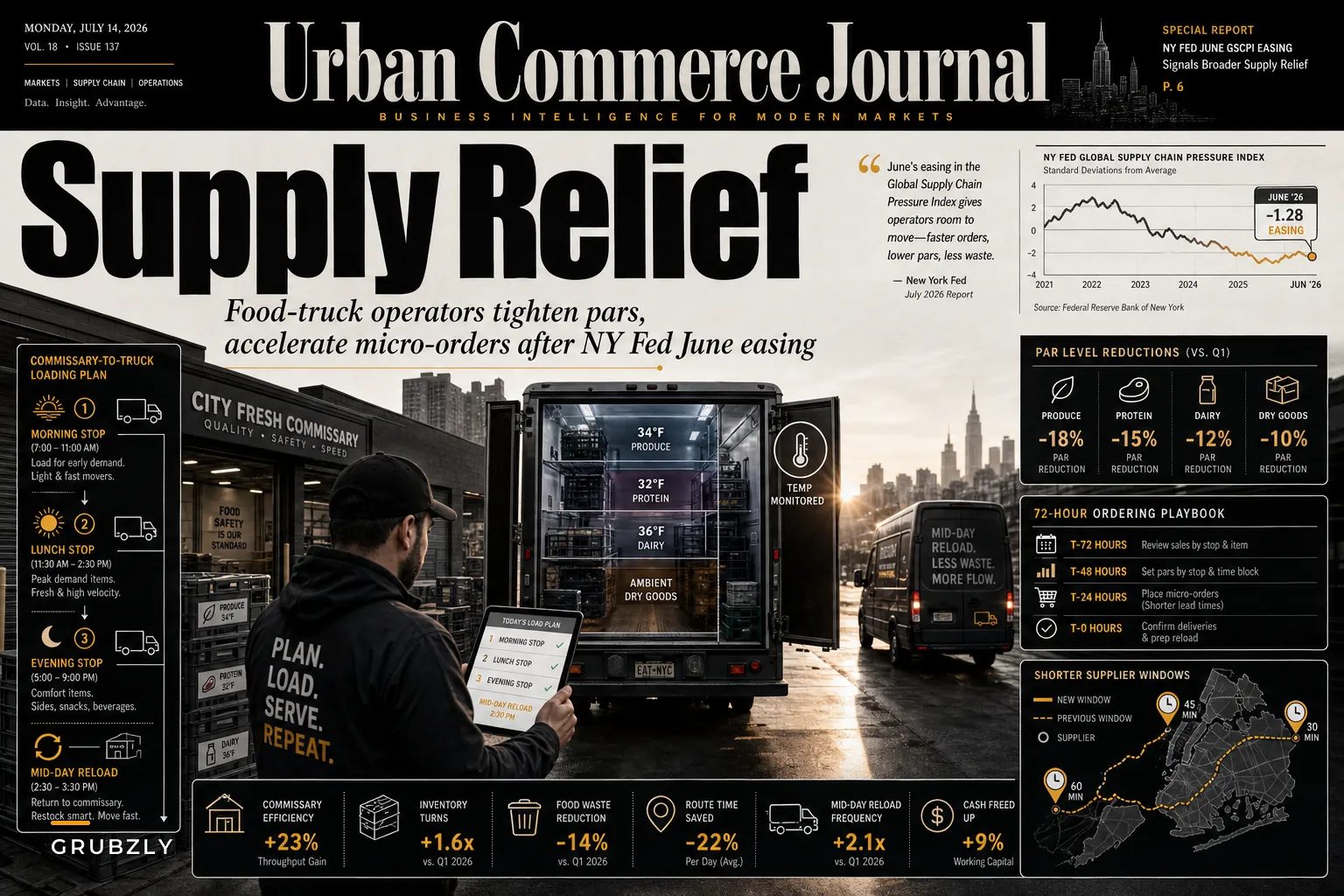

Last week I watched a food truck owner throw out two cases of avocados while frantically calling three produce suppliers for tomorrow's delivery. The irony? Supply chains just got easier — the New York Fed's latest data shows their Global Supply Chain Pressure Index dropped to 1.25 in June from 1.81 in May. But most mobile food operators are still ordering like it's 2021.
This disconnect happens every time supply pressures ease. Operators keep their panic-mode inventory buffers, stick with expensive backup suppliers, and maintain those "just in case" relationships that quietly drain margins. Meanwhile, the smarter ones are already restructuring their operations to take advantage of shorter lead times and more reliable deliveries.
The real opportunity isn't just cheaper ingredients or faster shipping. It's the chance to rethink how you manage inventory flow from supplier to commissary to truck. When supply chains stabilize — even slightly — the whole operational equation shifts. Your safety stock levels, your ordering frequency, your route planning, even which menu items make sense at which stops.
Why mobile operations feel supply changes differently than restaurants
A brick-and-mortar restaurant can absorb supply hiccups with walk-in coolers and backup inventory. Food trucks operate on razor-thin storage margins. When my trucks were running three lunch spots plus an evening brewery rotation, we had maybe 36 hours of total ingredient coverage split between the commissary and the truck itself.
That constraint actually becomes an advantage when supply chains ease. While restaurants might not notice a two-day reduction in lead times, food truck operators can immediately convert that into fresher ingredients, smaller order minimums, and less commissary space rental. The math changes fast — if your protein supplier drops from 5-day to 3-day lead times, you can cut freezer inventory by roughly 40% without increasing stockout risk.
Most operators miss this because they're tracking the wrong things. Food cost percentage gets obsessed over while inventory turns get ignored. Price per pound gets negotiated while delivery frequency doesn't. Routes get planned around expected sales but not around ingredient shelf life under different temperature conditions.
The supply chain easing creates a specific moment: either you keep running your crisis-mode systems and leave money on the table, or you make targeted adjustments that compound into real margin improvements by September.
The Tuesday-Thursday ordering trap that kills freshness
There's a pattern that comes up constantly — food trucks ordering produce on Tuesday for Thursday delivery because "that's how we've always done it." That made sense when suppliers needed 48-72 hour minimums and delivery slots were scarce. With current conditions, many suppliers can now do next-day or even same-day delivery for regular customers.
Stop losing sales to poor planning.
Grubzly helps you plan routes, track inventory, and maximize daily sales effortlessly.
- Real-time route optimization
- Inventory tracking & alerts
- Mobile sales & reporting
No credit card required
Yet operators stick to the old cadence. They load up Thursday morning with enough produce to last through Sunday, watching quality degrade with each passing shift. By Saturday evening, the tomatoes look tired, the lettuce is wilting, and customers notice.
The financial impact compounds fast. Say you're buying $800 of produce weekly with 15% spoilage on the back half of your inventory. That's $120 weekly, roughly $6,000 annually, just from holding produce too long. But the real cost is reputation — customers remember the sad-looking toppings from Saturday night, not the fresh ones from Thursday lunch.
With shorter lead times, that same $800 order could be split into three deliveries: Tuesday, Thursday, Saturday morning. Yes, you might pay slightly higher per-unit costs or small delivery fees. But you'd eliminate most spoilage, serve noticeably fresher food on weekends, and reduce the capital tied up in inventory at any given moment.
Commissary tetris: the loading sequence nobody talks about
Improved supply reliability doesn't just change what you order — it changes how you load the truck. When deliveries were unpredictable, operators crammed in everything possible as a buffer. Now you can be more strategic about commissary-to-truck transfers.
Most operators load their trucks backward. Tomorrow's ingredients go in first, today's on top, creating an archaeological dig every time you need something mid-service. With reliable supply chains, you can implement stop-specific loading based on actual consumption patterns rather than worst-case assumptions.
Take a typical Saturday: farmers market at breakfast, downtown for lunch, evening festival. Instead of loading everything at 6 AM, a targeted reload between lunch and dinner keeps morning proteins at optimal temperature longer, reduces refrigeration strain during peak heat hours, and lets you adjust inventory based on what actually sold earlier.
Visualizing the loading and reload flow can make the shift obvious.
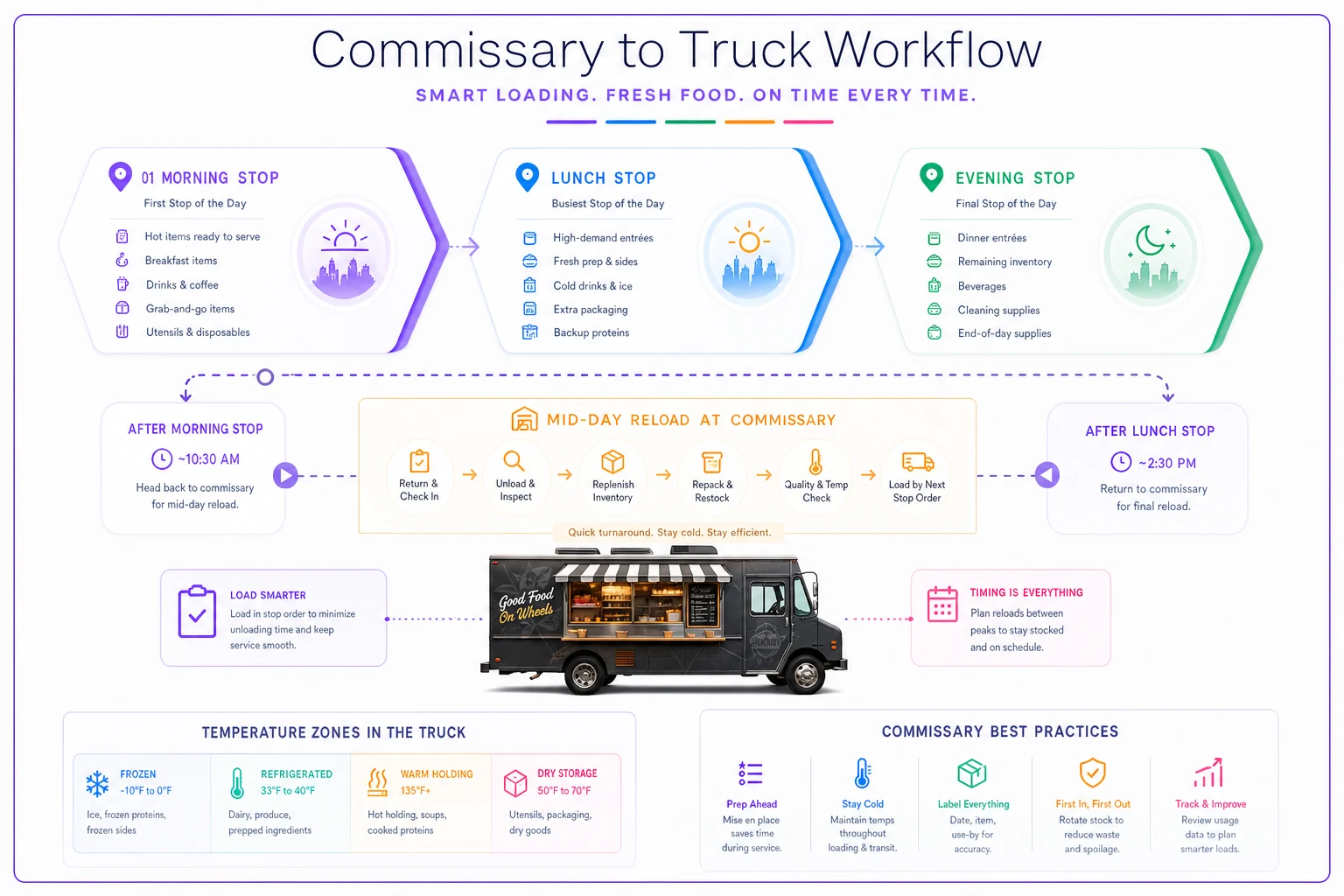
That kind of mid-day reload requires trust in your supply chain. But when lead times are consistent and suppliers are reliable, it becomes a competitive advantage. You're serving fresher food with less waste while competitors are still digging through boxes packed twelve hours ago.
Shift from minimum orders to frequency optimization
Every food truck owner knows the supplier minimum order dance. You need 10 pounds of chicken but the minimum is 40, so you buy 40 and figure out how to use it before it turns. During the supply chaos years, those minimums often jumped higher as suppliers prioritized their largest accounts.
Current conditions flip this dynamic. Suppliers have capacity again. They want consistent business. That creates leverage — not just for pricing, but for order structure. Instead of meeting a $500 minimum once a week, you might negotiate $200 minimums three times weekly for the same total spend.
When proposing increased frequency, lead with consistent scheduling (e.g., set days each week) — suppliers value predictability even if individual orders are smaller.
The cash flow impact alone is worth pursuing. Instead of dropping $2,000 on Monday for the week's supplies, you're spreading that cost across multiple smaller transactions. For food trucks, where weekend sales need to fund Monday's orders and a single slow day can create a cash crunch, that spread matters.
The flexibility matters more. Smaller, more frequent orders mean you can pivot menu items based on actual sales data rather than projections. If your Korean BBQ special isn't moving, you're not stuck with three more days of specialized ingredients. You adjust tomorrow's order and cut the loss short.
The 4-hour rule most operators violate without realizing
Temperature abuse during route transitions destroys more inventory value than actual spoilage, and it's nearly invisible until someone gets sick. With supply chains stabilizing, operators can finally address this systematic loss point that got ignored during crisis operations.
Here's what typically happens: truck leaves the commissary at 7 AM with proteins at 38°F. First stop is 8:30 AM downtown. By the lunch rush, those proteins have been through two hours of travel, three hours of service, multiple lid openings, and ambient temperature exposure. The interior truck thermometer reads 40°F, but proteins in frequently accessed containers have crept into the danger zone.
When deliveries were unpredictable, operators had no choice but to push every day's inventory as far as possible. With reliable next-day delivery available, you can implement strict 4-hour rotation protocols without fear of running short. That means actually pulling and replacing proteins mid-shift rather than "making it work" through dinner service.
Implementation is straightforward but requires discipline. Mark every protein container with its pull time when it leaves refrigeration. Set phone alarms for rotation points. Keep backup proteins in the coldest zones until needed. You'll occasionally toss proteins that look fine. But you'll also avoid the one incident that can destroy a business.
Stop-specific par levels beat generic safety stock
Traditional safety stock calculations assume steady demand and consistent storage conditions. Neither applies to food trucks. Your par levels for a Wednesday office park stop should look nothing like your Saturday festival setup — yet most operators run the same inventory levels everywhere.
With supply chain easing, you can finally implement the perishable inventory system for mobile kitchens that reflects actual operational reality. That means distinct par levels for each regular stop based on historical sales, weather patterns, and ingredient shelf life under those specific conditions.
A downtown lunch stop might need 40 portions of grilled chicken. An evening brewery stop needs just 15. But that brewery needs triple the pizza dough for shared appetizers. Generic safety stock has you carrying maximum levels of everything, which guarantees waste.
The key is tracking consumption by stop, not by day. Build a simple matrix: stop location, typical volume, most-ordered items, storage conditions (how long you're set up, ambient temperature). After three weeks of data, patterns become obvious and you can dial in actual inventory needs.
This precision only works when suppliers can deliver reliably on short notice. If Tuesday's delivery might arrive anywhere between Monday and Thursday, you have to carry maximum inventory regardless. With consistent next-day availability, you can run lean with actual confidence.
Renegotiate while suppliers still remember the chaos
Right now, suppliers are relieved. After years of chaos, they can finally fulfill orders consistently. Their warehouses aren't constantly depleted. Their drivers show up. That relief creates a negotiation window that won't stay open long.
Go to your top three suppliers this week with a specific proposal: increased order frequency and consistent weekly minimums in exchange for reduced per-delivery fees, extended payment terms, or Saturday delivery slots. Most will take the deal.
Keep the conversation focused on mutual benefit — you're not threatening to leave or asking for charity. You're proposing a structure that gives them predictable revenue while giving you operational flexibility. Emphasize the frequency increase. Suppliers love consistent customers, even if individual orders are smaller.
Document everything in plain terms. Delivery windows, minimums, payment terms, and how both parties handle adjustments. Getting this locked in before the next supply chain hiccup hits protects both sides. The suppliers who work with you now are the ones you'll stick with when things get tight again.
The weekend routing adjustment nobody makes
Friday afternoon, most food truck operators plan their weekend routes based on expected crowds and event schedules. Almost none factor in how their supply chain status affects route optimization.
With reliable supply chains, your Saturday route can start at the commissary for a morning reload instead of carrying Friday's leftovers through another day. That sounds obvious, but it requires rethinking the week's entire flow. Instead of maximum loading Thursday for a Friday-Saturday-Sunday run, you plan Thursday-Friday as one cycle and Saturday-Sunday as another.
The economics shift noticeably. That $200 of proteins you'd normally lose to Sunday afternoon spoilage stays fresh. Saturday evening customers get ingredients prepped that morning, not Thursday night. And your refrigeration isn't fighting a losing battle against three days of accumulated inventory.
Map out your weekend routes with reload points built in. If your commissary is 20 minutes from your Saturday lunch stop, that morning reload adds 40 minutes total but saves hundreds in spoilage. If it's an hour away, maybe you work out cold storage access with a nearby restaurant for mornings. The point is building reloads into the operational rhythm, not treating them as emergency measures.
Warning signs you're still operating in crisis mode
Some operators won't adjust even with clear supply chain improvements. Watch for these in your own operation:
-
Still ordering from the expensive backup supplier "just in case" the primary fails
-
Carrying inventory levels that made sense when everything was uncertain
-
Menu unchanged despite some ingredients becoming reliably available again
-
Still paying rush delivery fees for standard orders because planning cycles haven't been updated
The psychological component is real. After years of fighting for every delivery, reducing buffers feels risky. But carrying crisis-level inventory when conditions have improved is like wearing a winter coat in July.
Start small if that helps. Pick one category — produce is usually easiest — and reduce safety stock by 20%. Track what happens for two weeks. When nothing breaks, cut another 20%. Within a month you'll have real evidence that the new approach works, which makes it easier to adjust other categories.
Real scenario: Austin taco truck's $400 weekly win
A three-truck taco operation in Austin was spending around $3,200 weekly on ingredients and carrying 4-5 days of safety stock based on old supply chain delays. The owner had noticed local suppliers advertising next-day delivery but assumed it was mostly marketing.
After tracking actual delivery performance for two weeks — everything arrived on time — they restructured their ordering. Instead of one large Monday order, they moved to Monday-Wednesday-Friday deliveries with proportionally smaller amounts. Protein safety stock dropped from 5 days to 2 days. Produce went from 4 days to 1.5 days.
The immediate results: roughly $400 weekly reduction in spoilage, mostly from weekend produce and proteins that previously sat too long. Refrigeration costs dropped around $50 weekly from running lighter loads. The bigger win was menu flexibility — specials could be built around actual sales velocity rather than advance projections.
Suppliers preferred the new arrangement too. Smaller, more frequent orders helped them manage their own inventory and delivery routes better. One supplier offered an additional 2% discount just for the consistent tri-weekly pattern.
Making the shift systematic, not chaotic
The biggest mistake when supply chains ease is trying to change everything at once. Pick one area and adjust methodically.
| Week | Action |
|---|---|
| Week 1 | Document your current lead times and delivery reliability. Actually call your suppliers and confirm their current capabilities versus what you've been assuming. You might be surprised how much has improved. |
| Week 2 | Choose your highest-spoilage category and test reduced ordering quantities with increased frequency. Track the actual impact on waste, labor, and food quality. |
| Week 3 | Based on results, expand to another category or pull back if problems showed up. Most operators find the benefits obvious pretty quickly. |
| Week 4 | Renegotiate terms with suppliers based on your new ordering patterns. Lock in the improvements before market conditions shift again. |
Every percentage point of spoilage eliminated drops straight to the bottom line. Every day of fresher ingredients builds customer loyalty. None of this requires a complete overhaul — just consistent, targeted adjustments.
Software finally makes sense for this
For years, food truck operators managed inventory on paper or spreadsheets because the complexity didn't justify more elaborate systems. But when you're running multiple daily reloads, stop-specific pars, and supplier relationships with different lead times, manual tracking breaks down fast.
This is where AI-powered operational software becomes genuinely useful rather than just a trendy pitch. Modern platforms can track consumption patterns by stop, adjust par levels based on weather forecasts, and coordinate reload timing with your route plan. The AI components help surface patterns that are easy to miss manually — like how Tuesday downtown sales correlate with Monday's weather, affecting Wednesday's order needs.
The automation side matters too. Automated reorder points that account for supplier lead times, delivery schedules, and your upcoming route plan eliminate the daily scramble of figuring out what to order. The system tracks what you actually used at each stop rather than what you projected, which makes predictions more accurate over time.
But the technology only pays off because supply chain conditions finally allow for real optimization. When everything was chaos, precise inventory management was largely pointless — suppliers couldn't deliver reliably anyway. Now that they can, the tools to capitalize on that reliability earn their cost.
The three-month window before everyone adjusts
Supply chain improvements create temporary advantages for operators who move quickly. Right now, your competitors are still carrying crisis-level buffers, paying premium prices for rush deliveries, and throwing away weekend inventory. Adjust now and you'll capture margin improvements they won't see for months.
By October, most food trucks in your market will have caught on. Suppliers will have adjusted their terms. The negotiation leverage disappears. The operators who moved early will have locked in better terms and built efficient systems. Everyone else plays catch-up.
This pattern repeats every time markets shift. The operators who recognize changing conditions early capture outsized benefits — not from being smarter or working harder, but from paying attention and moving when windows are open. This is one of those windows.
Your summer margins, your fall competitive position, and your ability to handle the next disruption all depend on what you do in the next few weeks. The conditions are in place. What's left is execution.
Ready to drive your food truck business forward?
Join 2,000+ food truck operators relying on Grubzly to boost efficiency, increase sales, and delight customers.