



The Conference Board's Consumer Confidence Index dropped to 81.9 in September 2026, the lowest reading since 2014. The PR Newswire release tied the slide to rising inflation expectations, souring views on jobs, and a late-month fuel spike. CNBC's coverage framed it as fear over prices and employment hitting simultaneously.
For a food truck, numbers like that don't show up as headlines. They show up as a slower noon rush, a few more people asking if there's a smaller portion, and an event organizer who suddenly "needs to confirm numbers" three days out when they used to lock it in weeks ahead. The index is a lagging feeling that becomes a very present operational problem.
A confidence dip doesn't crater your sales overnight. It erodes them in ways that are easy to miss until your weekly cash position looks thinner than it should. So skip the macro commentary — what matters is what actually changes on the truck, and what you can adjust this week without reworking your whole business.
What actually shifts in your numbers (and what stays the same)
Price-sensitivity doesn't hit every part of your menu evenly, and that's the part most operators get wrong. They either panic-discount across the board or hold the line stubbornly and watch average ticket slide anyway.
When confidence drops, the first thing to move is usually the add-on. The drink. The side. The second taco. People still show up — walk-up traffic holds better than you'd expect because a $12 lunch is still cheaper than most sit-down options — but the ticket shrinks because the extras get cut. Your base item stays sticky. Your margin-rich upsells go soft.
That distinction matters because it tells you where to defend and where to adapt:
| What's happening | What it looks like on the truck | Where to focus |
|---|---|---|
| Add-ons get cut first | Entrée sales steady, drink/side attach rate drops | Bundle the add-on into a perceived-value combo |
| Average ticket softens | Same line length, lower per-head spend | Protect food cost %, not total revenue |
| Event attendance gets volatile | Organizers hedge headcounts, confirm late | Shift toward guaranteed-fee bookings |
| Perishables risk rises | Same par levels, softer demand = more waste | Tighten ordering to recent actuals |
| Fuel eats margin | Routing inefficiency costs more per mile | Concentrate on proven stops |
Total revenue isn't the first thing to protect here. Food cost percentage and waste are. You can survive a 10% dip in top-line sales if your margins hold. You cannot survive flat revenue with a spoilage problem and a stale route.
The underlying problem: your pars and your route are built for last quarter's demand
Most mobile operators set their par levels and weekly route based on what worked a month or two ago, and they only revisit it when something breaks — a big spoilage day, a dead stop, a short shift that ran out of the main protein.
Stop losing sales to poor planning.
Grubzly helps you plan routes, track inventory, and maximize daily sales effortlessly.
- Real-time route optimization
- Inventory tracking & alerts
- Mobile sales & reporting
No credit card required
In a stable market, that lag is fine. Demand doesn't move fast enough to punish you. But a confidence shock compresses the timeline. The demand you're ordering and routing for is already gone by the time your historical averages catch up. You're prepping for the truck you had in August while serving the customers you have in October.
That's the real exposure. Not the index number itself — the fact that your operating assumptions are quietly out of date and you won't feel it until the waste and the empty-stop losses accumulate.
A realistic example
Take a two-truck taco operation running five lunch stops and two weekend events. Through late summer they were averaging roughly $1,900–$2,200 per lunch shift, with a drink-and-side attach rate around 60%.
Three weeks into a softer market, the entrée count barely moved — still pulling similar line volume — but attach rate fell to about 40%, dragging the average shift down toward $1,600. Meanwhile they kept ordering produce and tortillas at the old par, and spoilage crept from a tolerable level to something like $120–$160 a week in thrown-out perishables across both trucks.
Nothing dramatic broke. No single bad day. Just a slow bleed of maybe $300–$400 a week per truck between the softer ticket and the extra waste. Over a quarter, that's real money — the kind that turns a profitable fall into a break-even one.
The fix wasn't a price cut. It was three adjustments made within one week.
The one-week adjustment plan
You don't need a strategy offsite for this. You need to reset your assumptions to current reality and re-check them weekly instead of monthly. Here's the sequence:
-
1. Pull your last 10 shifts, not your last 60 days. Average the recent entrée counts and attach rates separately. The recent window is your new baseline — the older data is misleading you right now.
-
2. Recut pars to recent actuals plus a thin buffer. If your protein usage dropped, your order should too. A 10–15% buffer protects against a surprise rush without loading the truck with waste risk. Do this for perishables first; shelf-stable items can lag.
-
3. Rank your stops by reliability, not habit. List every recurring stop by its last-four-visit average. The bottom one or two are candidates to pause or replace. Dead stops cost you twice now — the fuel to get there and the perishables you prepped for them.
-
4. Rebuild the add-on as a bundle. Instead of a $3 drink and a $4 side sold à la carte, offer a $5–$6 "lunch combo" add-on. You recover some attach rate by reframing it as value rather than an upsell. Margin per combo is lower, but attach volume recovers.
-
5. Set a hard reorder rule tied to par, not to feel. When you're eyeballing orders during a soft stretch, you over-order out of fear of running out. A written par removes that bias.
-
6. Check cash weekly, not at month-end. A soft market punishes slow bookkeeping. You want to catch the margin drift in week two, not discover it at close.
A quick checklist before each week
-
- [ ] Recent-shift average recalculated (last 10 shifts)
-
- [ ] Perishable pars matched to current demand
-
- [ ] Weakest stop flagged for review
-
- [ ] Combo/bundle signage ready and legible
-
- [ ] Reorder quantities written down, not guessed
-
- [ ] Weekend event headcounts re-confirmed 48 hours out
A quick visual of the weekly reset helps keep the team aligned:
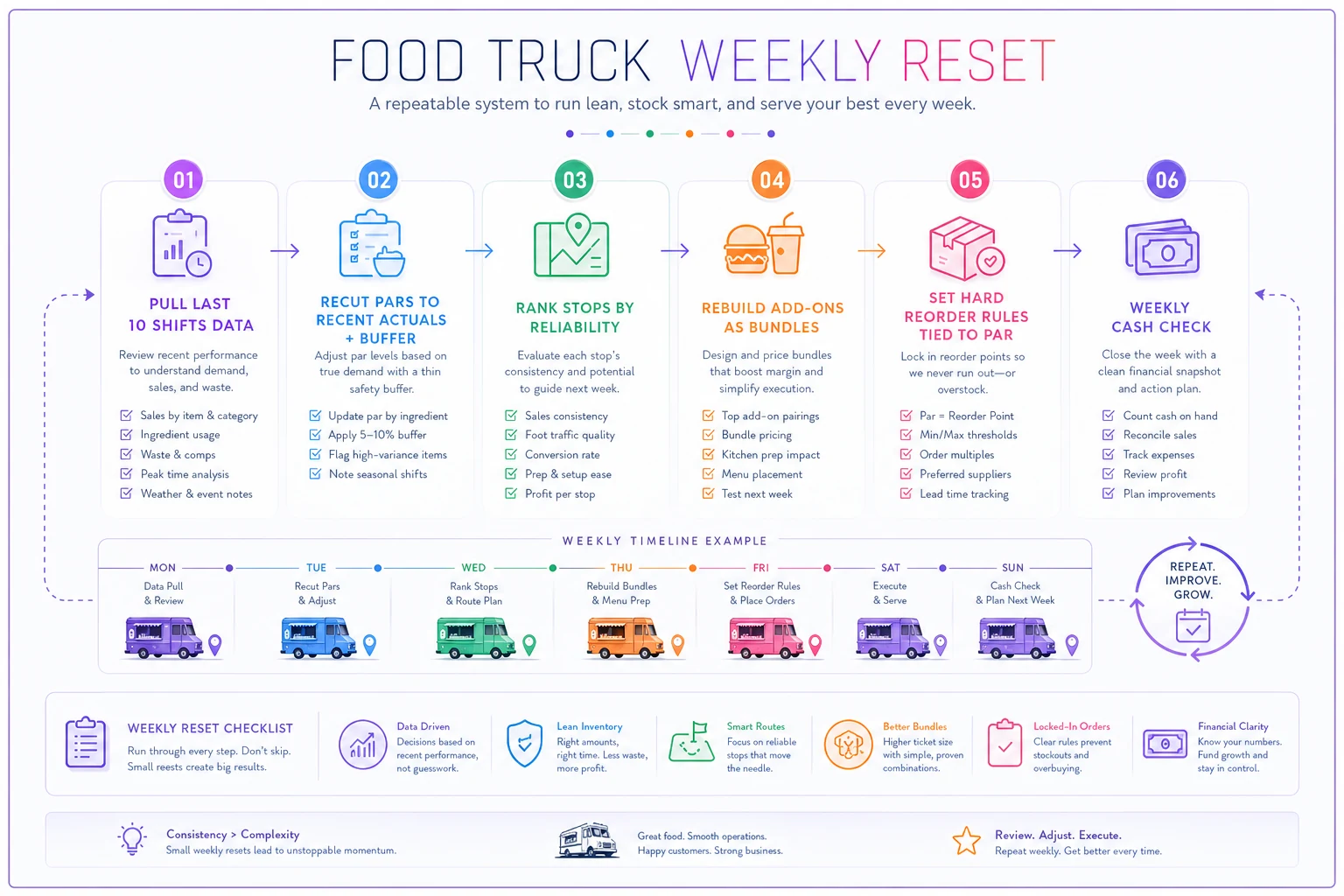
Use this as a one-page guide during prep so the weekly math doesn't get skipped.
Re-weighting your bookings toward what's guaranteed
The route and the par are the daily levers. The bigger structural move during a confidence dip is on the event side, because that's where attendance volatility hits hardest.
Walk-up foot traffic is noisy but somewhat predictable. Private and public events are the opposite — a soft market makes organizers nervous, headcounts get hedged, and the free-attendance festival you counted on for a strong Saturday suddenly draws two-thirds of the crowd. Your costs were fixed; your revenue wasn't.
This is exactly the moment to lean toward guaranteed-fee and deposit-backed bookings over pure spec events. A catering gig with a confirmed minimum, a corporate lunch with a locked headcount, a venue that pays a flat fee regardless of turnout — these protect you from the attendance swings that get worse when people are watching their spending.
If you haven't already structured how you weigh one booking against another, that's the foundational work worth doing right now. The logic for ranking stops and events by reliability and margin is laid out in our event portfolio strategy for profitable food-truck stops, and a soft market is precisely when that framework earns its keep.
When concentrating your route makes sense — and when it doesn't
It makes sense when: you have clear data separating your strong stops from your weak ones, fuel costs are eating into thin margins, and you're seeing consistent dead shifts at specific locations.
It's a bad idea when: you're reacting to a single slow day, or when the "weak" stop is actually a newer location still building regulars. Cutting a stop that's three weeks into ramping up throws away the investment just before it pays off. Give new stops a fair runway — judge them on trend, not on one reading.
Who should hold steady: operators with already-tight routes and strong attach rates. If your waste is low and your stops are proven, don't manufacture changes out of anxiety. Over-adjusting during a dip can do as much damage as ignoring it.
Where tracking this by hand quietly fails
The adjustments above are simple in concept. The reason they don't happen isn't complexity — it's that recalculating recent averages, re-cutting pars, and re-ranking stops every single week is tedious, and tedious tasks slide when you're busy running service.
In real operations, this is where the gap opens up. The operator knows they should recut pars weekly, fully intends to, and then it's Thursday, prep is behind, and the order goes out at last week's numbers because that's faster. The drift compounds quietly.
This is the kind of recurring, rules-based work where operational software earns its place — pulling your recent shift data automatically, flagging when a stop's average drops below its trailing baseline, surfacing which perishables are trending toward waste before you've already ordered them. Not to replace judgment, but to make the weekly reset something that happens reliably instead of something you have to remember to carve time out for. When margins are thin, the operators who stay disciplined about the boring weekly math are the ones who come out of it intact.
The read for this fall
A confidence index at a decade low isn't a reason to panic-discount or freeze. It's a signal that the lag between your operating assumptions and your actual demand just got expensive. The operators who struggle will be the ones running October on August's pars and August's route. The ones who hold margin will be the ones who shortened their feedback loop — recent-window averages, tighter perishable ordering, a route weighted toward proven stops, bookings tilted toward guaranteed money.
None of that requires a dramatic overhaul. It requires catching the drift early and adjusting in small, frequent increments instead of big, late ones. Tighten the loop, protect your food cost percentage, and let the softer tickets happen without letting waste pile on top of them. That's how you get through a price-sensitive stretch with your margins — and your momentum — still intact.
A confidence index at a decade low isn't a reason to panic-discount or freeze. It's a signal that the lag between your operating assumptions and your actual demand just got expensive. The operators who struggle will be the ones running October on August's pars and August's route. The ones who hold margin will be the ones who shortened their feedback loop — recent-window averages, tighter perishable ordering, a route weighted toward proven stops, bookings tilted toward guaranteed money.
None of that requires a dramatic overhaul. It requires catching the drift early and adjusting in small, frequent increments instead of big, late ones. Tighten the loop, protect your food cost percentage, and let the softer tickets happen without letting waste pile on top of them. That's how you get through a price-sensitive stretch with your margins — and your momentum — still intact.
Ready to drive your food truck business forward?
Join 2,000+ food truck operators relying on Grubzly to boost efficiency, increase sales, and delight customers.