


Most food truck operators don't have a booking problem. They have a selection problem. The calendar fills up — festivals, breweries, office parks, weddings, a Tuesday night market a friend recommended — and by the time summer hits, you're running six days a week and somehow ending the month with less cash than expected.
The issue isn't that any single event is bad. It's that nobody treats the calendar like a portfolio. Every stop gets judged on its own ("did we make money that day?") instead of against every other stop competing for the same truck-hours, prep labor, and generator fuel. When you don't rank events against each other, you end up saying yes to mediocre bookings that quietly crowd out great ones.
This is a systems piece. The goal is to give you a repeatable way to score events, price the marginal ones correctly, set gates that automatically reject junk bookings, and rebalance the mix so recurring and one-off stops line up with your weekly cash needs instead of fighting them.
Why "did we make money?" is the wrong question
A stop can be profitable and still be a bad use of the day.
Say you did $2,100 in gross at a Saturday street fair. Feels great. But you were parked for nine hours, drove 90 minutes round trip, burned a full tank of generator fuel, and paid three people for the whole window even though sales only really moved during a three-hour lunch spike. Meanwhile, the brewery lot you turned down would've done $1,400 in four hours with two staff and no travel.
The fair "made money." The brewery would've made better money per unit of the thing you're actually short on — time, labor, and truck availability.
The unit that matters isn't revenue. It's margin per minute of committed operation. Once you start scoring events that way, the whole calendar reorganizes itself.
The two-axis scoring model: attendance signal + margin-per-minute
Every event gets scored on two things. Keep them separate — they answer different questions.
Stop losing sales to poor planning.
Grubzly helps you plan routes, track inventory, and maximize daily sales effortlessly.
- Real-time route optimization
- Inventory tracking & alerts
- Mobile sales & reporting
No credit card required
Axis 1 — Attendance / demand signal. How reliably does this stop generate tickets? This is about volume predictability, not just size. A 300-person office park with a captive lunch crowd can outscore a 4,000-person festival where you're one of 40 trucks.
Axis 2 — Margin per committed minute. Total contribution margin (revenue minus food cost, labor, fuel, event fees, and travel) divided by committed minutes — which includes drive time and setup/teardown, not just service hours. This is the number that exposes long-tail events pretending to be winners.
Here's a working template you can adapt. Score each factor 1–5, then combine.
| Factor | Weight | What you're rating |
|---|---|---|
| Ticket volume reliability | 25% | How predictable is the crowd? |
| Margin per committed minute | 30% | Contribution ÷ (service + travel + setup) |
| Repeatability | 15% | Can this become recurring? |
| Operational drag | 15% | Permits, load-in complexity, shared power, restrictions |
| Strategic value | 15% | Brand exposure, catering leads, new zone testing |
Multiply each 1–5 score by its weight, sum it, and you get a single number between 1 and 5. Anything above roughly 3.8 is a keeper. Between 3.0 and 3.8 is a "price it right or pass." Below 3.0 gets declined unless something changes.
The discipline is in committed minutes, not service minutes. A wedding that pays well but eats your entire Saturday — two hours of packing scaled orders plus a 40-minute drive each way — needs to be measured against the full day it consumes. If you already run private events, the food-truck catering playbook breaks down how packing and run-sheets change that committed-minute math.
Marginal-cost pricing: how to price the borderline events
This is where a lot of operators leave money on the table or, worse, take a booking that loses money on the margin.
The mistake is pricing every event off the same target. Once your fixed costs for the week are covered by anchor recurring stops, additional one-off events should be priced against their marginal cost — not your blended average.
Marginal cost = the extra cost of running that specific stop you wouldn't otherwise incur:
-
Incremental food cost (COGS for expected covers)
-
Incremental labor (only the hours added for this stop)
-
Fuel + generator for this specific run
-
Event fee / booth cost
-
Any prep overtime it forces at the commissary
Everything else — insurance, truck payment, permits you already hold, base salaries — is already paid for by your recurring base. So for a marginal event, your floor price is marginal cost, and anything above that is contribution.
A worked example
Your recurring stops (a weekday lunch route plus a Friday brewery night) already cover roughly $4,800 in weekly fixed costs. A one-off Sunday market invites you.
-
Expected performance
-
- Projected covers
~130
-
- Average ticket
$12
-
- Projected gross
~$1,560
Marginal costs for that Sunday:
-
- Food cost (28%)
~$437
-
- Incremental labor (2 staff × 7 hrs @ $18)
~$252
-
- Fuel + generator
~$70
-
- Booth fee
$150
-
- Prep overtime forced Saturday night
~$60
-
- Total marginal cost
~$969
Contribution: ~$591 on a day that's otherwise idle. That's a clear yes — your fixed costs are already handled, so every dollar above $969 is real profit.
Now flip it. Same market, but the booth fee is $400 and the crowd projection is soft — say 80 covers because it's a first-year event. Gross drops to ~$960, marginal cost climbs to roughly $1,050, and you're paying to work. Hard no, unless you can negotiate the fee down or the organizer guarantees better placement.
The same event can be a yes or a no purely based on marginal math. Score first, then run the marginal-cost check on anything in the middle band.
Gating thresholds: rules that say no for you
Bad bookings sneak onto the calendar because decisions get made emotionally, one email at a time, usually when you're tired. Gates fix that by pre-deciding.
A gate is a hard rule that auto-rejects or auto-flags an event before it ever reaches a judgment call. Set these once, apply them every time.
Sample gating rules:
-
- Minimum contribution floor Any one-off must clear at least $350 in projected contribution, or it's declined.
-
- Margin-per-minute floor Below $0.90/committed-minute, it goes to the "negotiate or pass" pile.
-
- Travel ceiling No stop with more than 75 minutes round-trip travel unless it's a recurring anchor or clears a higher contribution bar.
-
- Fee-to-gross cap Booth/event fees above 22% of projected gross get flagged automatically.
-
- Concentration limit No more than one unproven first-year event per week.
-
- Blackout protection Recurring anchors are locked; a one-off can never bump them.
Use the margin-per-minute floor as a quick triage so incoming booking requests get an automatic first pass.
Gates aren't about being rigid for its own sake. They protect you from the slow drift where "just this once" becomes your entire August. When someone on your team can point to the rule instead of arguing about a specific booking, the conversation gets faster and less personal.
Tying the mix to weekly cashflow and reserves
Scoring and pricing tell you which events are good. Cashflow timing tells you which good events you can actually afford to wait for.
This trips up a lot of growing trucks. Recurring stops pay predictably — you know Friday's brewery night lands roughly the same range every week. One-off events and catering are lumpier: bigger tickets, but often with deposits, delayed venue payments, or a feast-then-famine rhythm.
A healthy portfolio balances the two so your recurring base covers the non-negotiable weekly outflows — payroll, commissary fees, loan payments — while one-offs and catering ride on top as the upside. If recurring income already covers fixed weekly obligations, you can be choosier about one-offs and hold out for the high-scoring ones.
-
Recurring income should cover 100% of fixed weekly outflows before you count any one-off revenue as "real."
-
Hold a reserve equal to 3–4 weeks of fixed costs so a bad-weather run doesn't force you into desperate bookings.
-
Cap unproven one-offs at a set share of monthly revenue — many operators land around 25–30% — so you're never betting the month on events you can't predict.
For the deeper build on this, the decision-driven operating finance model for mobile kitchens walks through how to structure those outflows and reserves so the portfolio decisions here have real numbers to sit on.
The rebalancing cadence
A portfolio drifts. Recurring stops soften, new events prove themselves, seasons shift demand. You rebalance on a schedule instead of reacting whenever something feels off.
A workable cadence:
-
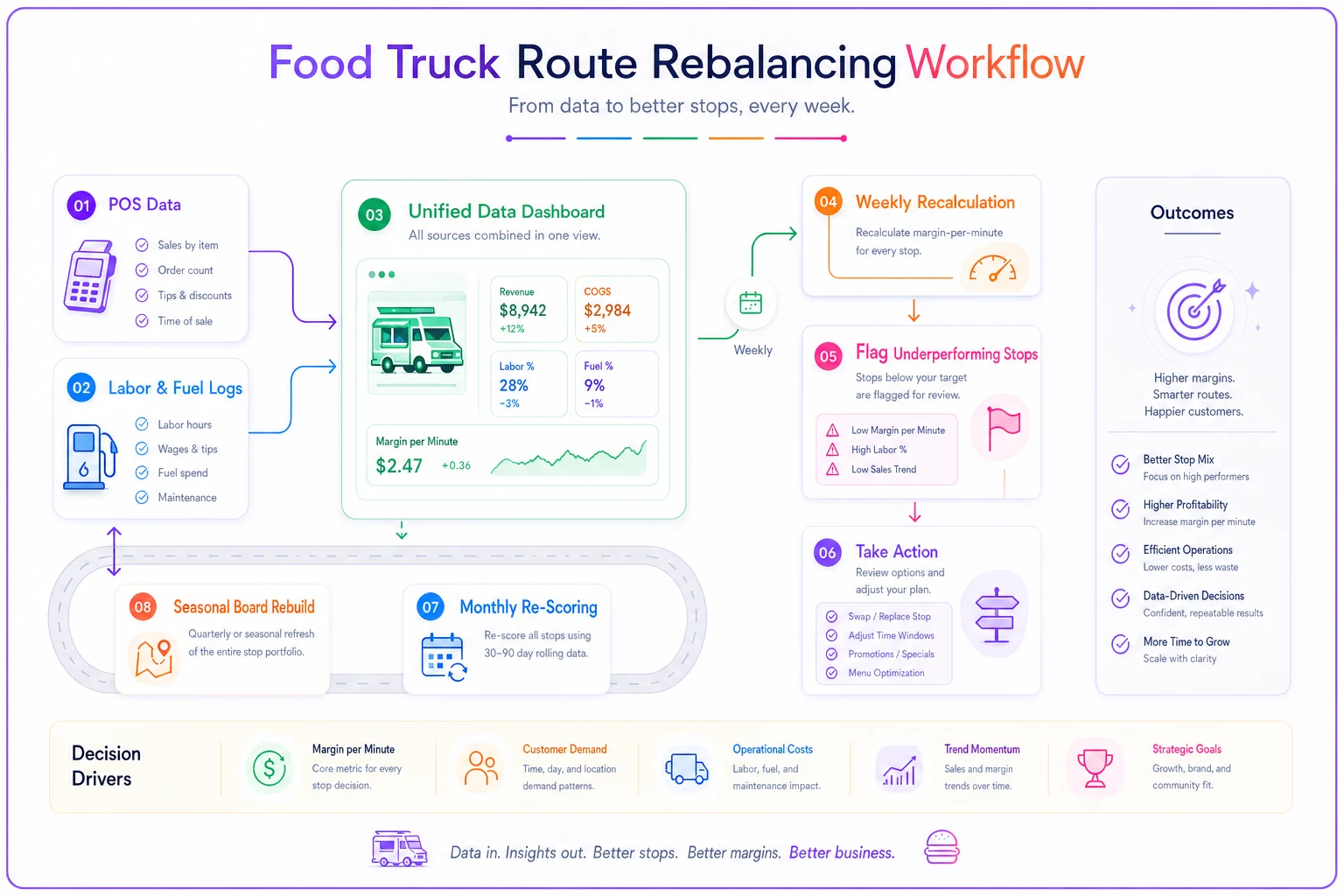
Weekly (15 minutes) Update each recent stop's actual margin-per-minute against your projection. Flag anything that underperformed by more than roughly 20%.
-
Monthly Re-score every recurring stop. A brewery night that's been fading for three weeks isn't an anchor anymore — it's a one-off pretending to be one, and it might need to be replaced or renegotiated.
-
Seasonally Rebuild the whole board. Summer festival math and winter office-park math are completely different portfolios. Don't carry a summer calendar into October.
The most useful habit is comparing projected vs. actual on every stop. Scoring only works if you close the loop. An event you scored a 4.2 that keeps delivering like a 3.1 is either mis-scored or declining — and the weekly check is what catches it before you've locked in another season of it.
Where does the data come from? Your POS gives you ticket counts and revenue. Labor and fuel logs give you the cost side. Trucks that do this well aren't running spreadsheets by hand — they're pulling stop-level numbers from POS and logs into one view so the weekly re-score takes fifteen minutes instead of an evening. Operational platforms that centralize per-stop sales, labor, and cost data make the projected-vs-actual comparison something you'll actually keep doing. The system only helps if it removes the friction that makes you skip the review.
Here's a quick visual of the rebalancing workflow.
The system only helps if it removes the friction that makes you skip the review.
When this framework makes sense — and when it doesn't
When it's worth the effort:
-
You're turning down events or running near capacity and need to choose.
-
You run a mix of recurring and one-off bookings and the mix feels chaotic.
-
You've had profitable-looking months that ended with thin cash.
When it's overkill:
-
You're brand new with one or two stops. You don't have a portfolio yet — you have a route. Build volume first, then start scoring.
-
You run a single locked contract (one corporate park, five days a week). There's nothing to rebalance.
Who should be careful:
-
Operators expanding into catering and delivery alongside street stops. The committed-minute math gets more tangled when a single Saturday could be a market, a wedding, or a delivery block.
If that's you, the governance rules for hybrid food-truck operations are worth setting up before layering portfolio scoring on top — otherwise you're scoring events that don't even share the same rulebook.
A short real scenario
A two-truck taco operation was running roughly 11 stops a week across markets, breweries, and a handful of first-year festivals. Revenue looked fine — somewhere around $22k–$25k monthly per truck — but the owner was constantly scrambling on payroll weeks.
When they broke stops into recurring vs. one-off and scored each on margin-per-minute, three things surfaced. Two festivals they were proud of were nearly break-even once travel and booth fees were counted honestly. A quiet Wednesday brewery night they almost dropped was one of the highest margin-per-minute stops they had. And they had zero reserve — every good week got immediately spent on the next event's fees.
They cut the two weak festivals, locked the Wednesday night as a recurring anchor, added one nearby low-drag market to replace lost volume, and set a rule that recurring income had to cover fixed costs before any one-off counted. Revenue barely moved. But the payroll scramble stopped, and by the end of the season they were sitting on a real reserve instead of living week to week.
Nothing about that required more bookings. It required choosing better ones.
The takeaway
Your calendar is a portfolio whether you manage it like one or not. Left alone, it fills with whatever asks first and shouts loudest — and the truly great stops get squeezed out by the merely okay ones.
Score every event on demand reliability and margin per committed minute. Price the borderline ones off marginal cost, not your blended average. Set gates that reject junk before it reaches you. Anchor your fixed costs to recurring income, hold a few weeks of reserve, and re-score on a cadence so the board never drifts too far. Do that, and you stop measuring success by how busy you are and start measuring it by how much of the right work you're actually doing.
Your calendar is a portfolio whether you manage it like one or not. Left alone, it fills with whatever asks first and shouts loudest — and the truly great stops get squeezed out by the merely okay ones.
Score every event on demand reliability and margin per committed minute. Price the borderline ones off marginal cost, not your blended average. Set gates that reject junk before it reaches you. Anchor your fixed costs to recurring income, hold a few weeks of reserve, and re-score on a cadence so the board never drifts too far. Do that, and you stop measuring success by how busy you are and start measuring it by how much of the right work you're actually doing.
Ready to drive your food truck business forward?
Join 2,000+ food truck operators relying on Grubzly to boost efficiency, increase sales, and delight customers.