

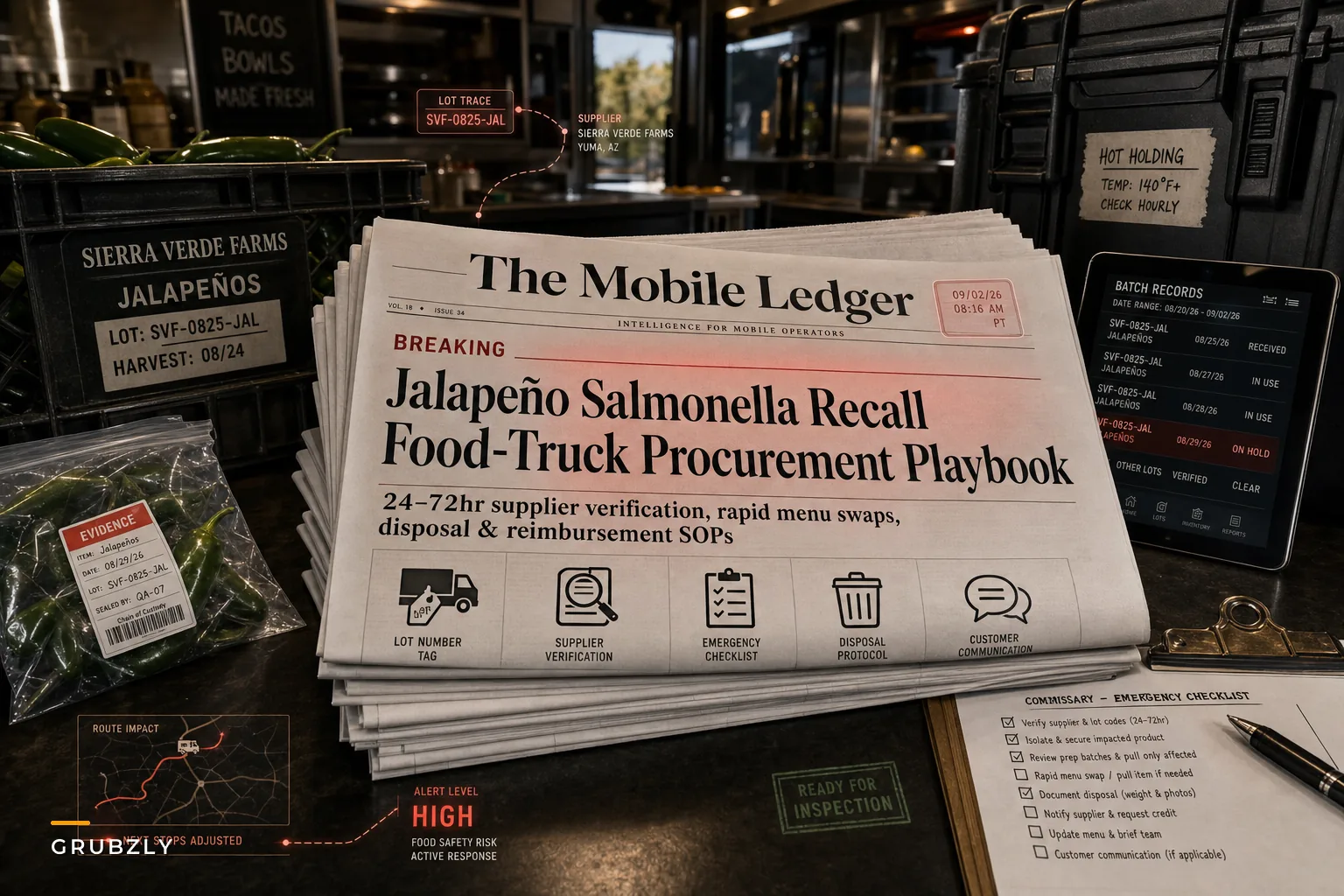

If you run a truck built around fresh peppers — tacos, birria, Nashville hot anything, loaded fries with pickled jalapeños — the past few weeks probably forced some uncomfortable decisions. The CDC's ongoing investigation into a multistate Salmonella Javiana outbreak tied to jalapeños out of Sinaloa, Mexico has climbed to 431 reported illnesses across 32 states, with recalls and menu pulls rippling through the supply chain. Even Chipotle and QDOBA yanked product while the traceback ran its course, according to Reuters reporting on the outbreak.
What separates a food truck from a chain in this situation isn't knowledge — it's capacity. A chain has a corporate food-safety team, a distributor hotline, and a legal department deciding what comes off the menu. You have yourself, maybe two people on the line, and a lunch rush starting in 40 minutes. The recall math is identical. The response capacity is not.
This isn't a piece about what happened — the CDC investigation page covers case counts and product details better than any blog can. This is about what you actually do on a truck when a core ingredient becomes a liability overnight.
The first 48 hours decide everything
The mistake most small operators make during a recall isn't sourcing bad product — it's reacting slowly, then reacting sloppily. A recall creates a narrow window where you can either look competent or look like you're winging it, and customers can tell the difference faster than you'd expect.
When a produce recall lands, the questions that matter aren't philosophical. They're brutally practical:
-
Do I have the recalled product on the truck right now?
-
Do I have it staged at the commissary?
-
Did I serve it in the last few days, and to whom — catering clients especially?
-
What does my menu look like without it, and can I still run a shift?
Across a lot of small food operations, these questions get answered from memory, not records. Someone thinks the last jalapeño delivery was Tuesday. Someone believes it came from the usual produce guy. That guessing is where trucks get into trouble — a recall investigation, or a health inspector, doesn't accept "I'm pretty sure."
A fast triage sequence for the first day
-
Freeze the ingredient. Physically separate anything suspected — recalled item, plus anything prepped with it (salsas, pickles, marinades). Bag it, label it "DO NOT USE — RECALL," and pull it off every prep surface. Cross-contamination during a recall is its own second incident.
-
Check your lot codes against the recall notice. Not just the brand — the specific lots and date ranges. Two boxes of the same brand can have different statuses. If you can't identify the lot, treat it as recalled.
-
Pull your recent invoices and delivery photos. You need to know when it arrived and from which supplier. This is the step that falls apart for most trucks.
-
Decide your menu response before service (covered below), so your team isn't improvising at the window.
-
Document the disposal. Photo of the bagged product, weight or count, date, who did it. This protects you if a claim surfaces later.
That whole sequence should take under an hour if your records are solid. If they're not, it can eat your entire morning — and you'll still be uncertain at the end of it.
Why traceability is the real problem a recall exposes
A recall doesn't create your sourcing problem. It reveals it.
Stop losing sales to poor planning.
Grubzly helps you plan routes, track inventory, and maximize daily sales effortlessly.
- Real-time route optimization
- Inventory tracking & alerts
- Mobile sales & reporting
No credit card required
Most trucks buy produce through three channels, often simultaneously: a primary produce distributor, a restaurant-supply cash-and-carry, and the occasional "we ran out, grab a case from the grocery store" run. Each of those has completely different traceability. The distributor invoice ties to a lot. The cash-and-carry receipt might. The grocery run has zero paper trail.
When you blend those sources into one batch of salsa, you've lost the ability to answer the most important question during a recall: where did this specific ingredient come from?
A typical scenario: a taco truck runs low on jalapeños Saturday, grabs two cases from a wholesale club, mixes them into the same bulk pickle batch as the Thursday distributor delivery. Monday, the distributor's jalapeños get recalled. Now the operator can't tell which salsa contains the recalled product, so everything pickled gets tossed — maybe $600–$900 of prepped product — because they can't isolate the risk. Clean records would've meant pulling one batch instead of the entire cold line.
This is the exact failure point that good commissary procurement systems that prevent last-minute substitutions are built to close. When purchase orders, delivery logs, and prep batches are connected in one place, a recall becomes a lookup instead of a guessing game. You search the lot, you see which batches it touched, you pull only those. That's the difference between losing one container and losing your whole cold line.
Menu substitution without killing the dish
Pulling an ingredient and keeping customers happy are two different skills. Operators who handle recalls well treat substitution as a menu-engineering problem, not a scramble.
| Original role of jalapeño | Fast substitution | Sourcing note | Menu-language shift |
|---|---|---|---|
| Fresh heat + crunch | Serrano or fresno | Often same distributor, different lot — verify it's outside the recall scope | "Serrano-spiced" reads as an upgrade, not a downgrade |
| Pickled tang | Pickled banana peppers or pickled red onion | Banana peppers rarely overlap the affected supply | Reframe as a "seasonal pickle" |
| Roasted/charred depth | Poblano or hatch (roasted) | Different growing regions; lower recall overlap | "Fire-roasted poblano" sells itself |
| Mild color/garnish | Diced bell pepper + chili flake | Bell peppers weren't implicated | Keep it simple; don't over-explain |
The subtle mistake here is over-communicating the recall at the window. You don't need a sign that says "WE REMOVED JALAPEÑOS DUE TO A SALMONELLA RECALL." That reads as alarming and invites questions your line cook can't answer during a rush. A cleaner move: "Featuring serrano this week" or a small "menu update" note. You're being honest — the item changed — without turning your truck into a public-health bulletin board.
If a customer asks directly, tell them straight: the ingredient was part of a national recall, you removed it out of caution, and you're running an alternative. That answer builds trust because it's calm and specific, not because it's rehearsed.
The supplier conversation most operators skip
During a recall, trucks focus almost entirely on their own inventory and barely at all on auditing the supplier who sold them the product. Your inventory is a one-time cleanup. Your supplier relationship is what either protects you or exposes you next season.
When the recall clears, get on the phone — or email, so it's in writing — and ask your distributor:
-
Which of your recent deliveries, by lot, were affected?
-
What's your recall-notification process — how fast do you contact buyers, and through what channel?
-
Can you provide lot-level documentation on future produce deliveries?
-
What's your alternate sourcing if a growing region gets flagged again?
The answers tell you whether this supplier is an asset or a risk. A distributor who notified you proactively, before you saw it on the news, is worth keeping. One who left you to find out from a customer's stomachache is a liability — even if their prices are good.
A quick supplier-audit checklist
-
Do they provide lot codes on invoices, not just product descriptions?
-
Do they have a documented recall-notification method (text, email, portal)?
-
Can they name the growing region and country of origin on request?
-
Do they carry a backup source for high-risk fresh items?
-
Have they ever notified you before a public recall announcement?
Two or fewer boxes checked, and you're sourcing critical ingredients from someone who genuinely can't help you when it matters most.
When substituting is actually the wrong call
Not every recall response should be "swap it and keep selling." Sometimes pulling the dish entirely for a few days is the smarter move.
When substitution makes sense: you have a clean, verified alternative in hand, it fits the dish, and your team can execute it without new equipment or major prep changes. Serrano for jalapeño on a taco is an easy call.
When pulling the item is smarter: the ingredient is the dish — a jalapeño popper truck, say — or your only available substitute compromises quality enough that you'll disappoint regulars. Selling a bad version of your signature item does more long-term damage than a temporary "sold out." Three days of "back soon" beats a wave of "it's not the same" reviews.
One specific case where you should not improvise: if you do heavy catering or serve high-risk populations — schools, hospitals, senior events — don't freelance a substitution mid-contract. Notify the client, document what you did, and get their sign-off. Catering clients can handle transparency. What they don't forgive is finding out after the fact.
A short real scenario
A two-truck birria operation running roughly 300–350 tickets a day got caught mid-recall. Their consommé and salsa both relied on fresh jalapeños from a single distributor.
Because their commissary logs tied each produce delivery to a batch sheet, they identified in about 30 minutes that only the Thursday and Friday salsa batches contained the recalled lot — not the consommé, which used a different pepper. They tossed roughly $400 of salsa instead of dumping their entire cold line, swapped to serrano for the weekend, and put a small "serrano salsa this week" card at the window.
They lost maybe half a day of full menu availability and a few hundred dollars of product. What they didn't lose was the weekend's revenue or a single complaint about their consommé — because they could prove it was never at risk. A truck without those batch records, in the same situation, would likely have dumped several times that in product and spent the weekend uncertain about liability they couldn't rule out.
Building the muscle before the next one
There will be a next recall — leafy greens, onions, cantaloupe, peppers, something else entirely. Fresh produce recalls are a recurring feature of running a food business, not a freak event. Operators who stay calm during them aren't lucky. They just did the boring work ahead of time.
The habits that make recall response fast:
-
Lot codes on every produce invoice, filed somewhere searchable.
-
Delivery photos timestamped at receiving, so origin and date are never in question.
-
Batch sheets that link prepped items back to which delivery they came from.
-
One primary supplier for high-risk fresh items, with cleaner traceability than mixing channels.
-
A pre-decided substitution list for your top three fresh ingredients, so menu changes take minutes, not a group chat.
None of that requires fancy tools. It requires the discipline to log what came in, from whom, and where it went — and to keep those records somewhere you can actually search under pressure.
Here's a quick workflow that captures the decision sequence above.
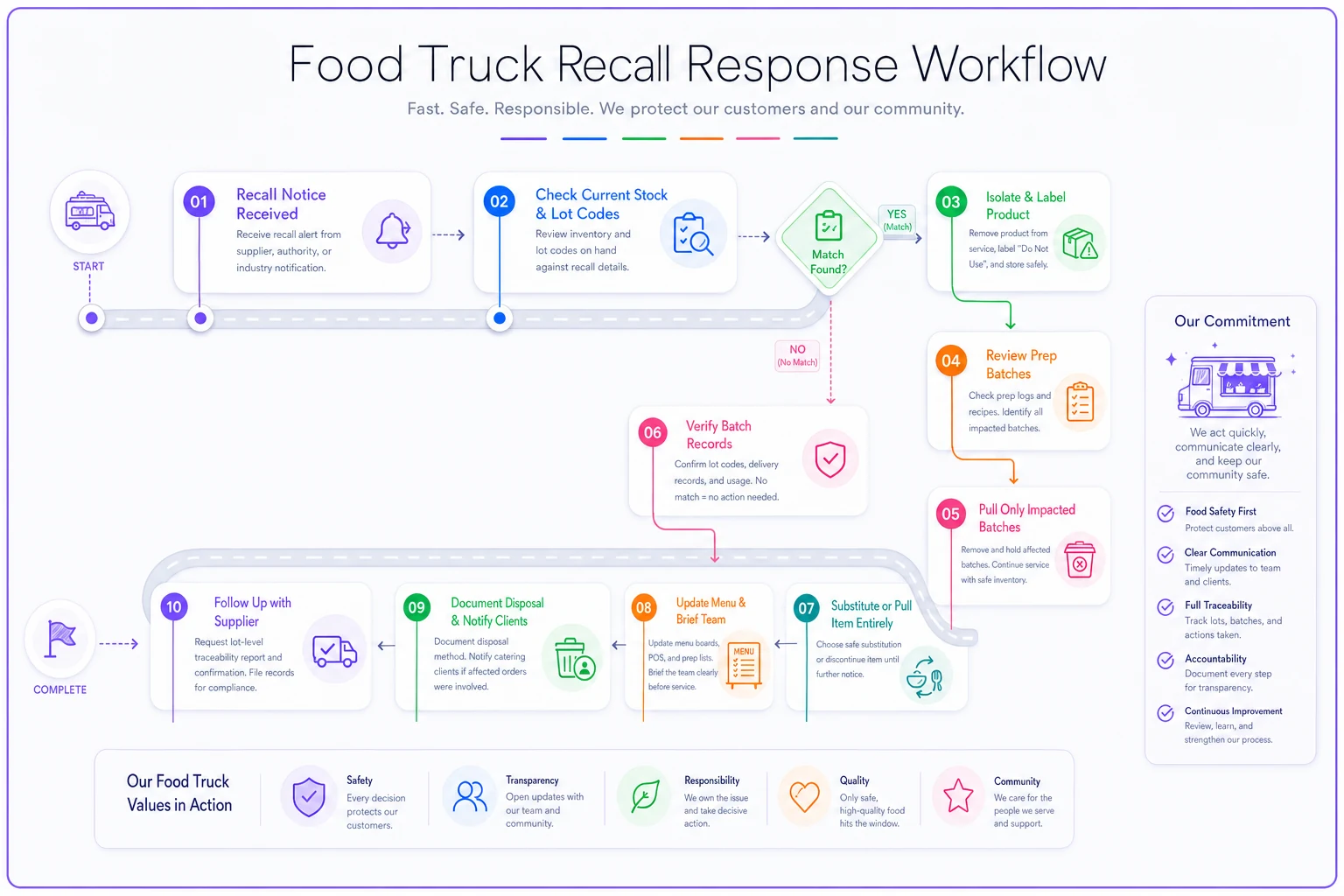
Trucks managing this on paper can do it — it just takes longer and breaks down on busy days. When procurement and prep records are linked in one place, answering "which batch touched the recalled lot" takes about as long as making a coffee.
A recall is stressful because it collapses a lot of decisions into a short window. But almost every one of those decisions gets easier when your sourcing is traceable and your substitutions are pre-planned. The pepper coming off your menu this month is temporary. The systems you build responding to it are what carry you through the next one.
Ready to drive your food truck business forward?
Join 2,000+ food truck operators relying on Grubzly to boost efficiency, increase sales, and delight customers.