
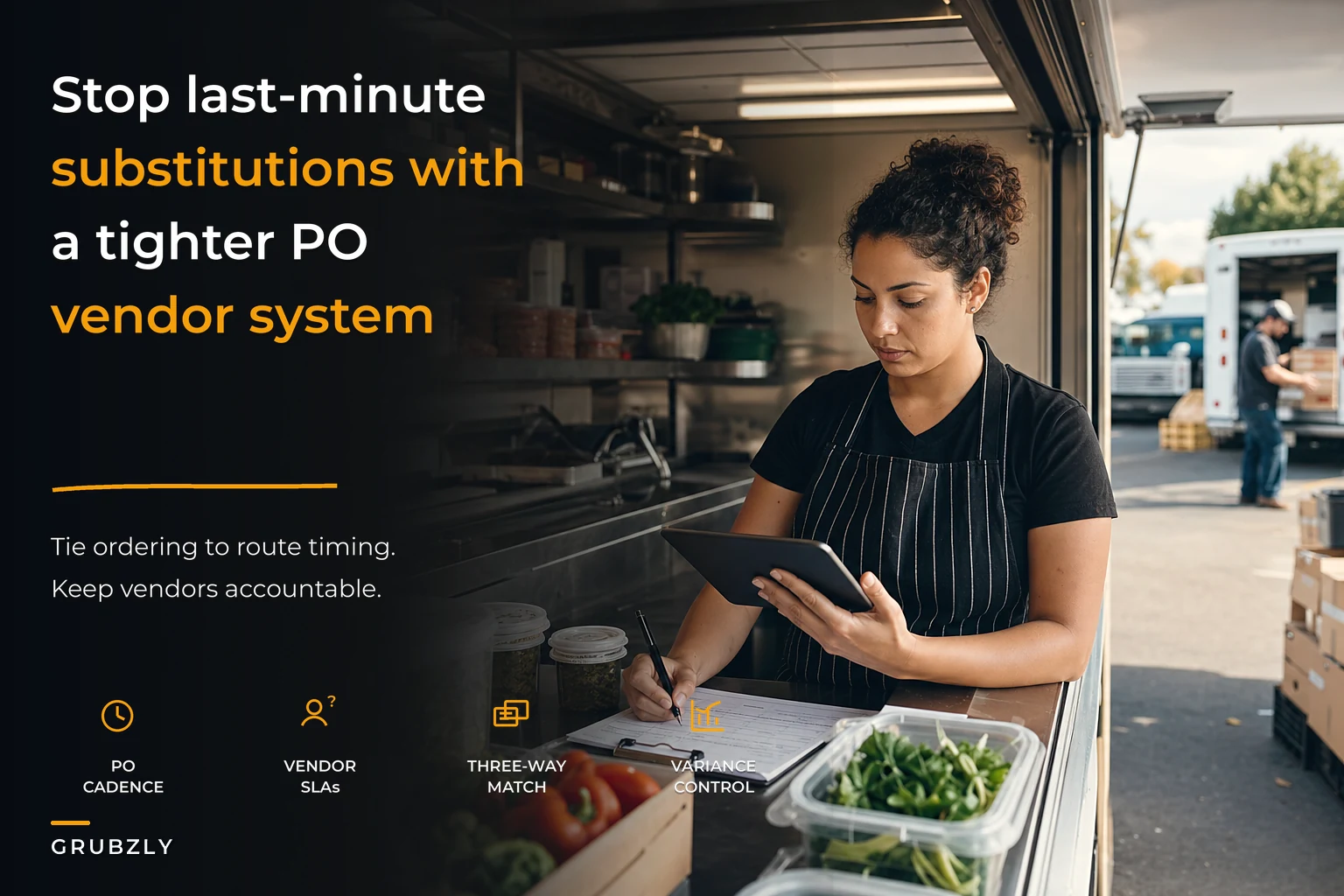

The text came through at 6:47 AM: "No chicken today. Sent pork instead. Same price."
That's when everything fell apart for Miguel's taco truck. His Friday corporate lunch stop had pre-ordered 80 chicken tacos. The pork substitution meant canceling the stop, refunding $960, and losing a client who'd been booking weekly for eight months. All because his produce vendor decided to make a "helpful" call without asking.
This pattern is way more common than it should be. Most mobile food businesses treat procurement like grocery shopping—place orders when you remember, accept whatever shows up, hope the invoice matches. But when you're running routes with specific menu commitments, that approach falls apart fast. A commissary procurement system food truck operations actually need looks completely different from what most operators are running. It needs purchase orders tied to your route schedule, vendor agreements that prevent surprises, and reconciliation processes that catch problems before they compound.
Why Standard Restaurant Procurement Breaks for Mobile Operations
Restaurant procurement assumes predictable daily volume and the ability to adjust on the fly. Your local bistro can 86 the salmon if the delivery arrives questionable. They pivot, customers adapt, service continues.
Food trucks operate under opposite constraints. When you're parked outside a tech campus at noon with 200 pre-orders through their corporate app, there's no pivoting. Those orders locked in 48 hours ago. Your commissary holds exactly what fits in your truck for tomorrow's five-stop route. Every substitution, shortage, or quality issue cascades through multiple service windows across different locations.
The traditional approach—calling vendors individually, taking verbal confirmations, sorting out invoice discrepancies weeks later—creates operational chaos when you're managing inventory across multiple stops. You need systems that prevent problems, not ones that just document them after the fact.
What actually breaks this isn't vendor malice. It's misaligned expectations and unclear communication. Your protein supplier thinks they're being helpful by sending an equivalent-cost substitution. Your produce vendor assumes fresh deliveries override standing orders. Your dry goods distributor treats your account as fill-in volume between their restaurant accounts.
Those assumptions are margin killers for mobile food operations because they ignore a fundamental reality: you've already sold specific products to specific customers at specific locations. A commissary procurement system food truck operations rely on has to account for that commitment-based model.
Building Purchase Order Cadence Around Route Commitments
Purchase order timing drives everything else. Most operators place orders when inventory looks low or when they remember. That reactive approach practically guarantees problems.
Stop losing sales to poor planning.
Grubzly helps you plan routes, track inventory, and maximize daily sales effortlessly.
- Real-time route optimization
- Inventory tracking & alerts
- Mobile sales & reporting
No credit card required
Map your ordering to your route schedule instead. If you run corporate lunch Monday through Friday, farmer's markets on Saturday, and private events on Sunday, each service type needs its own procurement timeline.
Corporate lunch routes need 72-hour lead times. Place orders Thursday morning for Monday service, Friday morning for Tuesday service. That gives vendors proper notice while leaving buffer time for confirmation and adjustment.
Weekend events require different timing. Place farmer's market orders on Tuesday, giving vendors three full business days to source and confirm. Private event orders go in the moment you take the deposit—regardless of the event date. Lock in your supply before committing to the customer.
Create order templates for each service type:
Corporate Lunch Template:
-
Base proteins
40 lbs per stop
-
Vegetables
15 lbs per stop
-
Tortillas
20 dozen per stop
-
Dairy
5 lbs per stop
Farmer's Market Template:
-
Proteins
60 lbs total
-
Vegetables
25 lbs total
-
Specialty items
10 units
-
Backup proteins
15 lbs
Private Event Template:
-
Exact quantities from signed contract
-
Plus 15% overage allowance
-
Backup menu items specified
-
Special request items noted
These templates eliminate guesswork and establish consistent vendor expectations. Your suppliers learn your patterns, which reduces errors over time.
One critical rule: never place an order without a confirmed service commitment. Forecasting ingredient demand helps predict needs, but procurement should follow actual bookings, not projections.
The following diagram shows how a route-based procurement workflow should flow from booking confirmation through delivery and into invoice reconciliation:
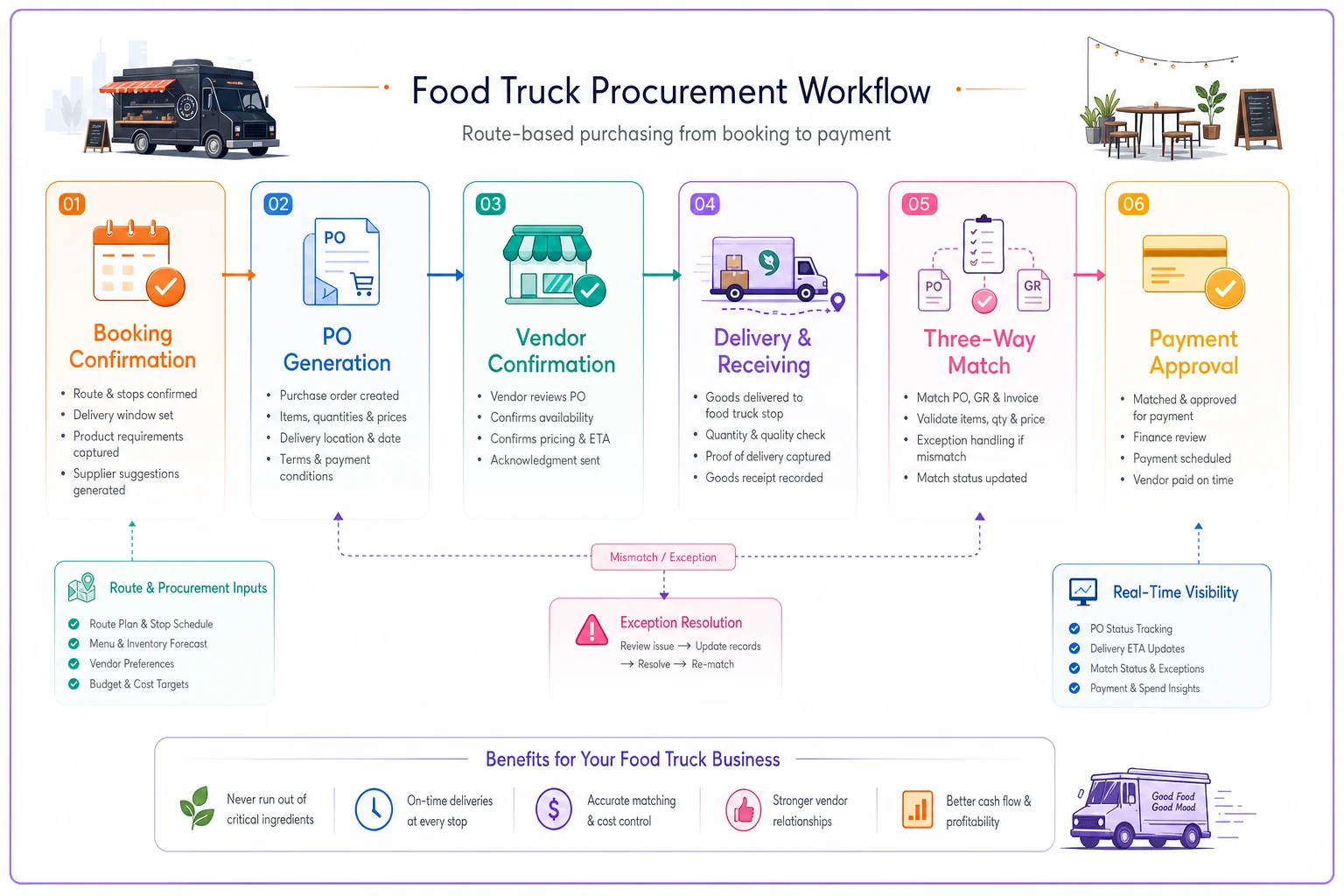
Getting this sequencing right matters more than the tools you use. A spreadsheet running this process properly beats fancy software running it backwards.
Vendor SLAs That Actually Protect Your Operations
Service Level Agreements sound corporate, but they're really just documented expectations. Every food truck needs them, especially smaller operations that vendors tend to deprioritize when things get busy.
A functional vendor SLA covers five areas:
1. Substitution policies No substitutions without 24-hour written approval. This single rule prevents most procurement disasters. If they can't fulfill an order, they must notify you with enough time to find alternatives or adjust your route.
2. Delivery windows Specify exact windows that align with your prep schedule. "Before 10 AM" is too vague. "Between 6:30–7:30 AM Tuesday and Thursday" gives everyone something concrete to work with.
3. Quality standards Define acceptable quality with measurable criteria. "Fresh produce" means nothing. "Tomatoes firm to touch, no soft spots, maximum 5% blemished" creates actual accountability.
4. Communication requirements Order confirmations in writing within 4 hours. Issues reported within 2 hours of identification. Delivery confirmations with timestamps and signatures.
5. Failure remedies What happens when standards aren't met? Specify credits, replacement timelines, and escalation paths. Without consequences, SLAs are just suggestions.
Document these agreements even with informal vendors. A simple email outlining expectations, with their reply confirming, creates enforceable standards. You're not being difficult—you're protecting both parties from miscommunication.
The vendors who push back hardest on committing to anything in writing are usually the ones who need the most managing. That resistance is useful information early in the relationship.
Three-Way Matching That Catches Problems Early
Three-way invoice matching sounds like accounting overkill for a food truck. Until you realize you're losing $400–600 monthly to invoice errors that quietly compound across multiple vendors and deliveries.
The process is straightforward:
| Document | What It Represents |
|---|---|
| Purchase Order | What you ordered |
| Receiving Document | What actually arrived |
| Invoice | What they're charging you |
These three documents need to match before payment. When they don't, you catch the problem immediately instead of finding it during monthly reconciliation—or never.
Here's what this looks like in practice:
Tuesday, 6:45 AM: Driver arrives with produce delivery. Your prep cook checks items against the purchase order on their phone. Everything looks right except the roma tomatoes—ordered 20 lbs, received 15 lbs. They note the discrepancy, take a photo, and accept the partial delivery.
Tuesday, 11:00 AM: Invoice arrives showing a full charge for 20 lbs. Your commissary manager flags the mismatch, sends the morning's receiving photo to the vendor, and requests an adjusted invoice.
Tuesday, 2:00 PM: Corrected invoice arrives. Three-way match complete, approved for payment.
Take a photo of any discrepancy at delivery and attach it to the receiving document.
Without this process, you'd likely pay the full invoice and never recover that $18 difference. Multiply similar errors across all vendors weekly and you're bleeding margin on administrative oversights.
The key is making three-way matching part of daily operations, not monthly bookkeeping. Train staff to treat receiving like a financial transaction—because it is. Every delivery acceptance is a payment commitment.
Escalation Procedures for Substitutions and No-Shows
When vendor problems threaten service, you need escalation procedures that drive immediate action, not future promises.
Templates remove emotion from urgent situations:
Substitution Response (Immediate): "We cannot accept [substituted item] as replacement for [ordered item]. This substitution will cause us to cancel [specific service commitment]. Please confirm within 30 minutes whether original items can be delivered by [specific time] or we need to source elsewhere. This substitution violates our agreed terms dated [date]."
No-Show Response (After 30 Minutes Late): "Your scheduled [time] delivery has not arrived as of [current time]. This delay will impact our [specific service]. Please confirm arrival within 15 minutes or we will source elsewhere and deduct associated costs from outstanding invoices per our agreement."
Quality Rejection (At Delivery): "We're rejecting [quantity] of [item] due to [specific quality issue]. Photos attached. Please arrange immediate replacement or credit. This delivery does not meet the standards outlined in our agreement. We need resolution by [specific time] to maintain service."
These templates work because they state facts, specify consequences, and demand timely responses. Vendors can't claim they didn't understand the urgency.
Escalation paths should be clearly defined:
-
Driver/delivery person (immediate issues)
-
Account representative (within 1 hour)
-
Vendor management (within 2 hours)
-
Ownership (same day)
Include multiple contact methods—phone, text, email—for each level. During a critical issue, use all three simultaneously.
Vendor Scorecards That Drive Better Service
Tracking vendor performance feels like extra work until you spot patterns. That produce vendor who's "usually reliable" actually fails quality standards nearly a third of the time. The protein supplier with great prices has missed delivery windows on eight of the last twelve orders.
Build simple scorecards tracking:
| Metric | Target | Impact of Failure |
|---|---|---|
| On-Time Delivery Rate | 95% | ~$200 lost per late delivery |
| Order Accuracy Rate | 98% | ~30 min resolution per error |
| Quality Acceptance Rate | 95% | Risk of service disruption |
| Communication Response Time | 30 minutes | Delays cascade fast |
| Pricing Stability | <5% monthly variance | Unexpected margin erosion |
Share scorecards with vendors monthly—not as threats, but as performance conversations. A vendor averaging 85% on-time delivery might genuinely not realize their impact on your operation. Showing them actual numbers like "your delays caused us to miss roughly $2,400 in sales last month" creates urgency they can understand.
Good vendors want to improve. They'll ask what they can adjust, modify their operations, sometimes even offer make-goods for poor performance. Bad vendors get defensive, make excuses, and promise improvements that never materialize. The scorecard shows you pretty quickly which you're dealing with.
Building Your Complete Procurement System
A commissary procurement system food truck operators can actually rely on needs all these pieces working together, not just isolated improvements.
Start with route-based ordering templates. Build them in a simple spreadsheet initially—don't overcomplicate. Column for each route type, rows for each ingredient category, quantities based on actual historical usage.
Document vendor agreements next. Send a straightforward email to each vendor outlining your five SLA points. Most will agree without pushback. The ones who resist are telling you something.
Implement three-way matching with whatever tools you have. Phone photos, printed purchase orders, basic spreadsheets. The process matters more than the platform. Train everyone who handles deliveries on why accurate receiving actually matters.
Create escalation templates and distribute them to anyone who might need them. Include them in your operations manual, save them somewhere accessible, print copies for the commissary. When problems hit, you want immediate access to professional responses—not a panicked group chat.
Start scorecards with your most critical vendors first. Track just on-time delivery initially, then add metrics as the process becomes routine.
This approach transforms procurement from a series of daily fires into something predictable. Problems still happen, but now you catch them early, respond professionally, and track patterns that actually inform vendor decisions.
The difference shows up in your margins. That $400–600 monthly loss to invoice errors? Recovered. The $960 lost order from an unexpected substitution? Prevented. The scramble to find last-minute replacements? Gone. More importantly, you can focus on actually running your business instead of constantly managing vendor chaos.
When Systems Become Competitive Advantages
Larger food truck operations tend to run 8–12% better margins than single-truck operators, and a big chunk of that comes from procurement efficiency. They're not getting dramatically better prices—they're preventing problems that smaller operators just absorb as "part of the business."
A perishable inventory system helps track what you have, but procurement systems determine what arrives in the first place. The two have to work together, with procurement feeding accurate data into inventory tracking.
This creates real opportunities for growth. When you can guarantee ingredient availability, you can commit to recurring corporate contracts. When vendors meet SLAs consistently, you can expand routes without fear of procurement failures. When three-way matching eliminates payment disputes, you maintain vendor relationships that actually support scaling.
Some operators worry that this level of systemization removes flexibility. The opposite is true. Clear systems create flexibility by eliminating uncertainty. You can take on a last-minute catering gig because you know exactly how long procurement takes. You can add a new route because vendor performance is predictable. You can test new menu items because ordering templates make adjustments simple.
When the procurement system works properly, it becomes almost invisible. Orders flow, deliveries arrive as expected, invoices match reality. You stop thinking about it every day, which frees mental bandwidth for growth.
This is also where AI-powered operational software starts making real sense—not as a replacement for these systems, but as an enhancement. Automated PO generation based on confirmed bookings, substitution alerts before they impact service, vendor performance tracking that updates itself. The software handles routine monitoring while you focus on decisions that actually require your judgment.
Making Procurement Systems Work for Your Operation
Every food truck operation is different. A BBQ truck with four suppliers needs different systems than a fusion concept sourcing from twelve vendors. But the core principles stay the same: align ordering with commitments, document expectations, verify accuracy, track performance.
Start small if this feels like a lot. Pick your most problematic vendor and implement just SLAs with them. Or begin three-way matching only for proteins—your highest-cost category. Build systems gradually as you see results.
The goal isn't perfection. Even cutting procurement problems in half transforms your operation. That's dozens of hours monthly not spent fighting fires, thousands of dollars annually not lost to errors, and countless service disruptions prevented before customers notice.
A commissary procurement system food truck businesses actually benefit from isn't about complex software or corporate procedures. It's about creating predictability in an inherently unpredictable business. When you control what you can—ordering, receiving, reconciliation—you're in a much better position to handle what you can't.
Your vendors want you to succeed. You're recurring revenue for them. But without clear systems, they can't support you effectively even when they want to. These procurement processes give them a framework to actually deliver, turning vendors from variables into partners.
The next time a vendor texts about a substitution, you won't panic. You'll execute your documented response, protect your service commitments, and maintain the margins that keep you profitable. That's what separates mobile food businesses that grow from the ones just trying to survive each week.
Ready to drive your food truck business forward?
Join 2,000+ food truck operators relying on Grubzly to boost efficiency, increase sales, and delight customers.