


Running allergen control on a food truck feels manageable until you start rotating menus. Suddenly your standard allergen matrix breaks down, staff hesitate during customer questions, and that confident "we handle all allergies" claim becomes a liability waiting to happen.
The problem gets worse because mobile operations already fight against space constraints, limited prep surfaces, and fast service windows. Add rotating menus—whether seasonal, supply-driven, or event-specific—and your allergen control SOP food truck system needs serious rethinking.
Most trucks find this gap after their first close call. A customer asks about sesame in today's special, your window person checks the wrong day's matrix, gives the all-clear, and twenty minutes later you're dealing with an allergic reaction at a corporate campus. Even without a medical emergency, the operational drag of uncertain allergen info kills service speed and erodes customer trust fast.
Why standard allergen protocols fail on rotating menus
Traditional allergen control assumes a stable menu. Restaurant kitchens build their contamination zones, train staff on fixed recipes, and post permanent allergen matrices. These systems work because ingredients rarely change, prep patterns stay consistent, and staff develop muscle memory around specific dishes.
Food trucks already strain these assumptions with compressed workspaces. Add menu rotation and three specific failures tend to emerge:
Information lag between prep and service. Your morning prep team knows today's taco special contains cashew crema, but the afternoon service crew wasn't there for the ingredient swap. The handwritten note about the change got buried under order tickets. Now you're relying on verbal relay of critical safety information across shift changes in a loud, cramped environment.
Surface contamination across menu days. Monday's menu had peanut sauce for satay skewers. Tuesday switches to Mediterranean wraps with tahini. Your single prep surface technically got cleaned between days, but without explicit contamination protocols for rotating ingredients, trace amounts stick around. The Tuesday customer with a severe peanut allergy doesn't know their "safe" wrap was assembled on a surface that had peanut sauce on it 18 hours earlier.
Declaration confidence breakdown. Staff who confidently handle allergen questions for regular menu items freeze when faced with specials or rotating items. They know the permanent menu's allergen profile but haven't internalized the new additions. Rather than risk being wrong, they give vague answers like "I think it's okay" or "let me check with the kitchen"—responses that rightfully concern allergy-sensitive customers.
The operational cost of allergen uncertainty
Beyond the obvious liability risk, poor allergen control on rotating menus creates daily friction. Service windows stretch as staff double-check ingredients. Customers with allergies skip ordering entirely rather than deal with unclear information. Your reputation takes hits on review sites from people who felt unsafe or dismissed.
Stop losing sales to poor planning.
Grubzly helps you plan routes, track inventory, and maximize daily sales effortlessly.
- Real-time route optimization
- Inventory tracking & alerts
- Mobile sales & reporting
No credit card required
The numbers add up. A truck averaging 120 daily transactions might lose 8-10 sales from allergen-concerned customers who don't trust the system. At a $12 average ticket, that's over $100 daily in lost revenue—roughly $2,500 monthly from customer uncertainty alone. More critically, one significant allergen incident can shut down operations entirely. Health department investigations, insurance claims, legal consultations—the downstream costs dwarf any efficiency gains from loose protocols. A single EpiPen deployment at a high-profile location can end corporate campus contracts worth thousands monthly.
Building fast allergen declaration cards that actually work
Effective allergen cards for rotating menus need to balance completeness with speed. The traditional matrix approach—listing every ingredient against every allergen—gets unwieldy when menus change frequently. A two-tier card system works well here:
| Tier | Purpose/Notes |
|---|---|
| Tier 1: Binary presence indicators | Simple YES/NO cards for the top 9 allergens displayed at your service window. Each day's menu gets its own card set, printed on distinct colored paper to prevent confusion. Staff can answer most allergen questions by glancing at these cards. The visual distinction between days (blue Monday, yellow Tuesday) prevents anyone from accidentally referencing yesterday's information. |
| Tier 2: Detailed ingredient maps | Behind the quick-reference cards, maintain complete ingredient breakdowns for each rotating item. These don't need to be customer-facing but must be immediately accessible. Format them as single-page sheets with: - Item name and date - Complete ingredient list with brand names - Prep surface used - Cross-contamination risks - Safe modification options |
Tier 1: Binary presence indicators
-
Gluten
YES (buns, wraps)
-
Dairy
YES (cheese, crema)
-
Nuts
YES (cashew crema)
-
Shellfish
NO
-
Soy
YES (sauce base)
Tier 2: Detailed ingredient maps
-
Item name and date
-
Complete ingredient list with brand names
-
Prep surface used
-
Cross-contamination risks
-
Safe modification options
The combination lets window staff give instant binary answers while having detailed backup for complex questions. A customer asking "does it have nuts?" gets an immediate "yes" from the card. Someone asking "what kind of nuts?" triggers a quick check of the detail sheet.
Prep surface segregation rules that scale with menu changes
Physical space limitations mean most trucks can't maintain permanent allergen-free zones. Instead, you need temporal segregation—using the same surfaces differently across time periods with strict protocols between uses.
Map your prep surfaces into contamination levels:
Level 3 (High Risk): Surfaces that contacted major allergens (nuts, shellfish, gluten)
Level 2 (Medium Risk): Surfaces with dairy, egg, soy contact
Level 1 (Low Risk): Surfaces only touching vegetables, fruits, oils
When menus rotate, surfaces must move down levels—never up—without deep cleaning. If Monday's nut-based items used Surface A (Level 3), Tuesday's dairy-only items can also use Surface A without special cleaning. But Wednesday's allergen-free items cannot use Surface A without a complete sanitization protocol first.
Keep an extra set of colored magnetic markers handy to swap during shifts.
This directional approach cuts cleaning overhead while maintaining safety. Track surface levels with magnetic markers or colored tape that changes daily. A simple grid on your prep station showing "Surface A: Level 3 Monday, Level 2 Tuesday" keeps everyone on the same page.
For deep cleaning between incompatible uses, establish a witnessed protocol:
-
Complete physical debris removal
-
Hot soapy wash with color-coded allergen cloths
-
Sanitizer application and air dry
-
Fresh cutting board/prep tools
-
Photo documentation of clean surface with timestamp
-
Two-person sign-off on cleaning completion
The photo and dual sign-off feel excessive until they prevent your first contamination incident. When a customer has a reaction and claims cross-contamination, timestamped photos of cleaned surfaces become critical evidence.
Staff verification steps that prevent service window confusion
The fastest allergen systems fail when staff can't confidently execute them. Rotating menus multiply the knowledge burden—staff must track not just what contains allergens, but which menu is even active today.
Build verification into three operational moments:
Morning lineup verification Start each shift with a 60-second allergen brief. Display today's menu with allergen indicators highlighted. Have each staff member state one allergen present and one absent. This verbal confirmation ensures everyone's operating from the same information. "Today we DO have nuts in the cashew crema, we DON'T have shellfish anywhere."
Mid-shift rotation check When staff rotate positions or new crew arrives, require allergen card review before taking orders. The incoming window person reads the current allergen card aloud to the outgoing person. This handoff catches information gaps and reinforces current menu status.
Order-time confirmation For any order involving allergen modifications, use a callback system. The person taking the order states the allergen concern to the prep station, who confirms the modification is safe. "Customer has tree nut allergy, ordering modified bowl no cashew crema, confirm safe?" This real-time check prevents assumptions based on yesterday's menu.
Here's a simple visual workflow to show how those three moments connect during a typical shift.
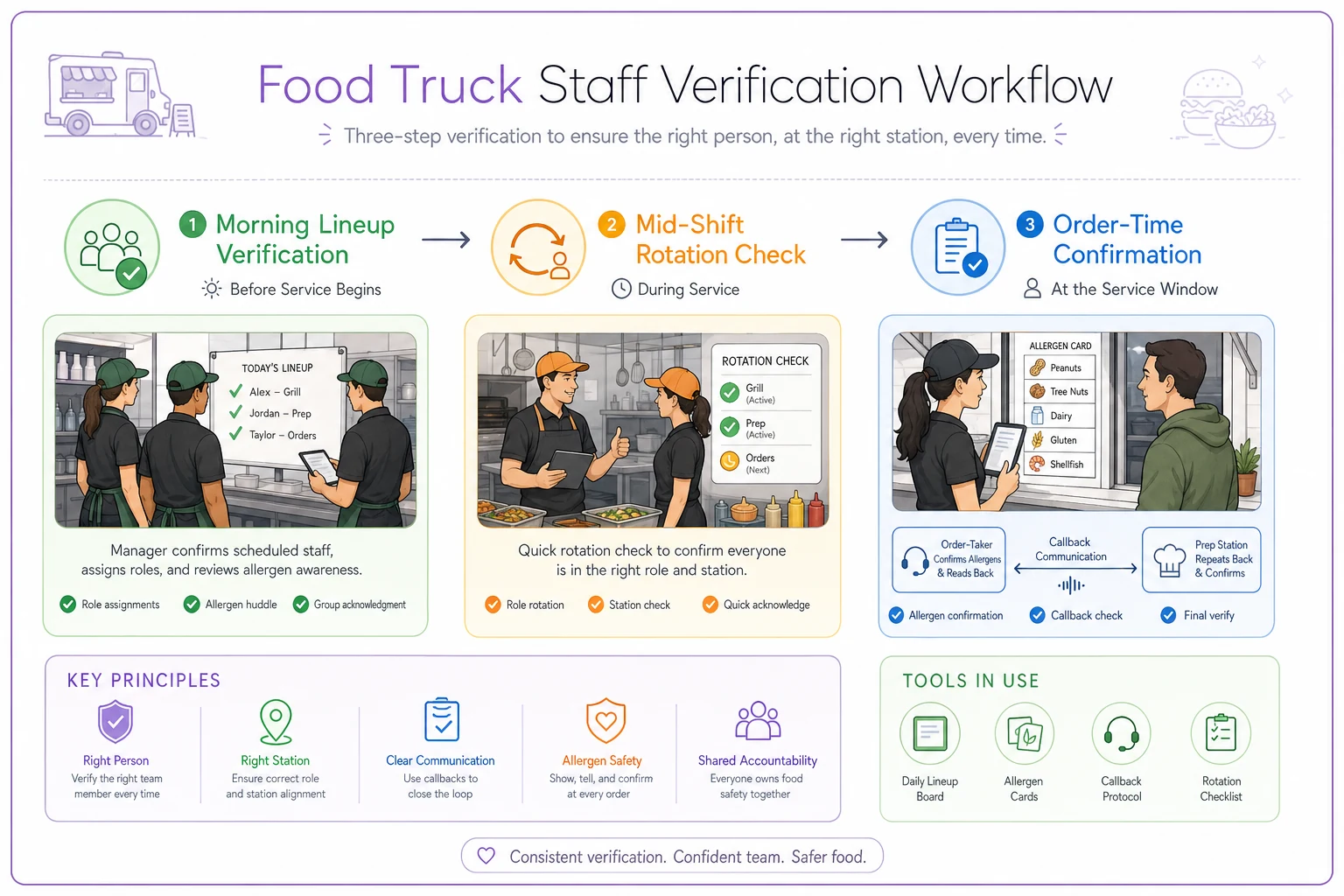
Some trucks resist these steps as time-consuming, but each takes seconds and prevents much longer confusion during service. The callback especially helps during rushes when staff might otherwise guess rather than verify.
Digital tools vs. paper systems: what actually works
The instinct is to digitize everything—tablet-based allergen matrices, cloud-updated ingredient databases, real-time menu synchronization. In practice, hybrid systems work better for mobile operations.
Paper excels for customer-facing quick references. Laminated allergen cards at your window work regardless of screen glare, dead batteries, or spotty network connections. Customers can see them without asking, which reduces repetitive questions. Paper also handles spills, drops, and the general chaos of truck service without issue.
Digital systems are better for back-end management. A simple spreadsheet tracking ingredients by supplier, updating when deliveries come in, calculating allergen exposure across menu combinations—these tasks benefit from automation. When you modify Tuesday's special because your supplier sent tahini instead of hummus, updating a digital matrix propagates changes everywhere instead of you hunting down every paper reference.
A workable combination looks like:
-
Paper allergen cards at point of service
-
Digital ingredient database on a tablet
-
Paper prep surface logs with photos uploaded to cloud storage
-
Digital staff training tracking with paper shift verification sheets
This redundancy feels excessive until your tablet dies during lunch rush and you're grateful for the backup cards. The key is ensuring digital and paper systems sync at defined points—morning prep, shift changes, end of day—rather than requiring constant coordination throughout service.
A real truck's transformation
Green Bowl Express operated three trucks running rotating globally-inspired bowls, changing menus every two days based on ingredient availability. Their loose allergen approach—staff verbally relaying information—led to two near-miss incidents in one month, including a customer reaction requiring Benadryl at a tech campus.
They implemented a three-part overhaul:
-
Color-coded allergen cards for each menu rotation, taking about 10 minutes to produce each change but eliminating service window hesitation. Staff could instantly answer whether today's Korean bowl contained sesame (yes) or if tomorrow's Mediterranean bowl had nuts (no, unless adding the optional dukkah).
-
Strict surface progression rules with photo documentation. Prep surfaces moved from high contamination (Monday's peanut sauce) to low (Tuesday's tahini) to fresh (Wednesday's nut-free options), with deep cleaning only required between incompatible progressions. This cut their deep-cleaning time by around 40% while actually improving safety.
-
Mandatory allergen callbacks during order modifications. Any customer allergen concern triggered a verbal confirmation between order-taker and prep station, adding maybe 5 seconds per affected order but eliminating modification errors.
Results after three months:
-
Zero allergen incidents despite increasing menu rotation frequency
-
Customer complaints about allergen handling dropped from 3-4 weekly to none
-
Service times improved by 15-20 seconds on average as staff stopped hesitating over allergen questions
-
Two new corporate campus contracts specifically citing their "professional allergen handling"
Total implementation cost was around $200 for laminating supplies, colored markers, and a basic tablet for ingredient tracking. The saved liability risk and gained customer trust paid that back in under a week.
When automation amplifies allergen control
Manual allergen tracking works until you hit scale—multiple trucks, daily menu changes, dozens of ingredients from various suppliers. At that point, the human coordination burden becomes unsustainable. Someone forgets to update Tuesday's cards, prep surfaces get mislabeled, and a system you carefully designed starts breaking down at the edges.
This is where operational software for inventory management extends naturally into allergen control. The same platform tracking your ingredient quantities can map allergen exposure. When you mark receiving tahini instead of expected almond butter, the system automatically updates that day's allergen profile across your records.
AI-assisted platforms are particularly good at catching non-obvious contamination risks. They can track that a Tuesday supplier sometimes shares transport with a seafood distributor, flagging potential shellfish contamination you'd never catch manually. They remember that last month's "nut-free" granola actually contained coconut—technically a drupe but treated as a tree nut for allergy purposes.
The real value comes from automated handoffs between menu planning and service execution. You plan next week's rotations in the system, it generates appropriate allergen cards, sends prep surface schedules to morning crew, and pushes verified allergen info to your POS. Staff still execute the physical protocols, but the information flow happens automatically instead of through a chain of verbal handoffs.
For multi-truck operations, this coordination becomes essential. When Truck A's unused tahini transfers to Truck B for tomorrow's menu, the system tracks that allergen exposure moving between vehicles. Without automated tracking, those cross-fleet ingredient movements create dangerous information gaps that no amount of paper cards will catch.
Beyond compliance: competitive advantage through allergen excellence
Most operators treat allergen control as purely defensive—avoiding lawsuits, preventing incidents, maintaining compliance. But excellent allergen handling on rotating menus can become an actual competitive advantage in crowded markets.
Customers with allergies develop strong loyalty to businesses they trust. When your truck confidently handles complex allergen needs while others waffle or refuse service, you capture not just that customer but often their entire office's lunch orders. The colleague group that includes someone with celiac disease becomes your Tuesday regular when you're the only truck they trust for safe modifications.
Corporate catering especially values sophisticated allergen handling. Event planners managing hundreds of dietary restrictions need vendors who can guarantee safety while maintaining menu variety. Your ability to run allergen-controlled rotating menus opens doors to premium catering contracts that fixed-menu competitors can't realistically offer.
More importantly, it removes one of food service's most stressful operational anxieties. When every menu change follows verified protocols, every surface cleaning gets documented, and every staff member knows today's allergen profile, you've built something most trucks never actually achieve: a system you can genuinely rely on.
Ready to drive your food truck business forward?
Join 2,000+ food truck operators relying on Grubzly to boost efficiency, increase sales, and delight customers.