
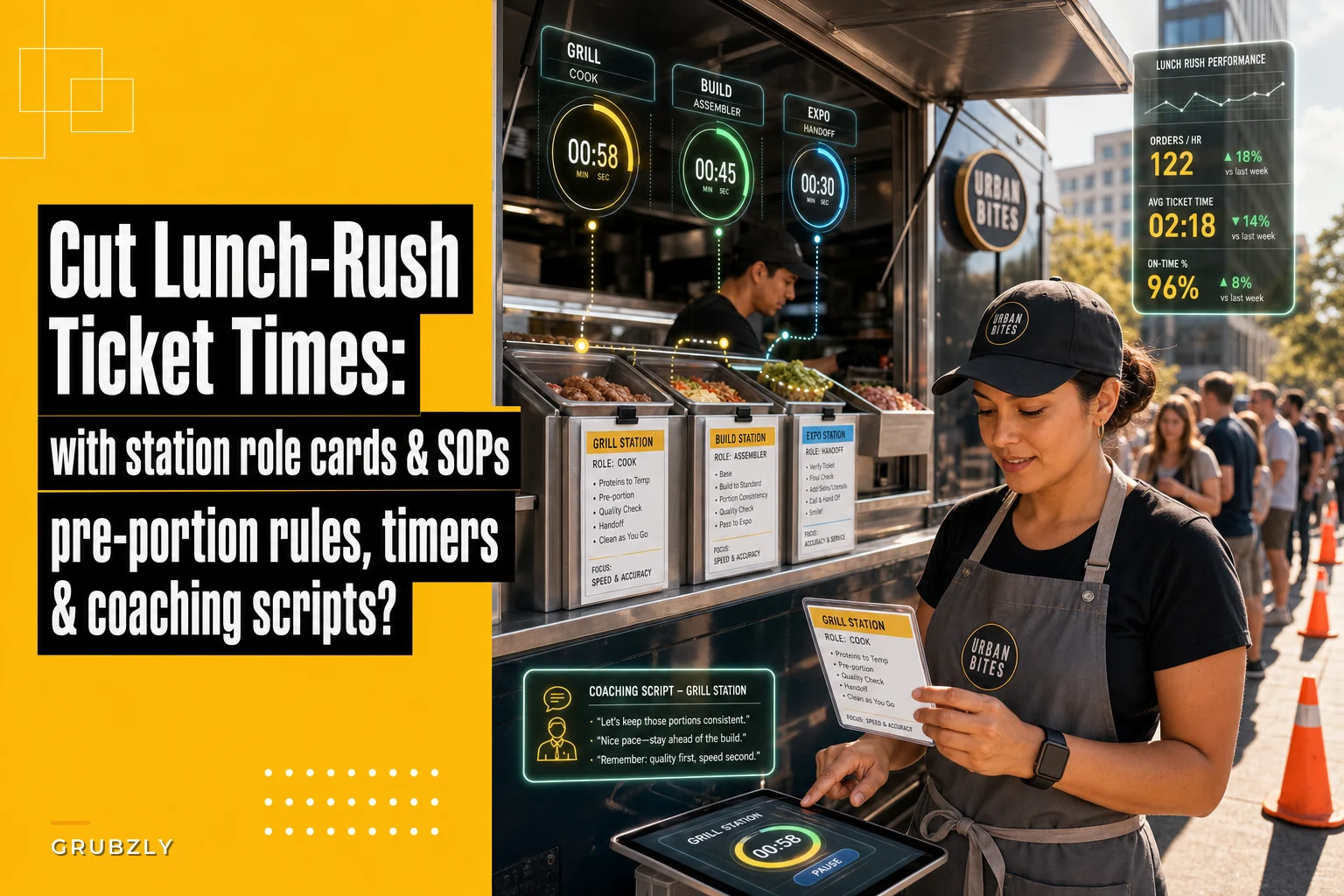

Your truck runs smooth at 11:30am. Orders flow, everyone knows their spot, food comes out clean. Then noon hits and suddenly your grill person is reaching across the cashier to grab tortillas while your prep station backs up with half-cut vegetables and your expediter is asking where the extra sauce cups went.
The lunch rush turns competent teams into chaos. Not because they're bad at their jobs, but because food truck staffing SOP peak service breaks down when everyone tries to do everything at once.
When orders stack, staff abandon their stations to help wherever looks busiest. Your cashier starts assembling tacos. Your grill cook runs to grab more cheese from the cooler. Your prep person jumps on register. Within minutes, nobody owns anything and ticket times balloon from 6 minutes to 18.
Most food trucks run on informal roles that dissolve under pressure. Everyone "helps out" but nobody has clear ownership of specific tasks, pre-portioned inventory, or measured workflows. You end up with four people making one burrito while three other orders sit waiting.
Station chaos: why your best workers become your biggest bottleneck
Watch any food truck during peak hours and you'll see the same pattern. The person who's fastest at assembly naturally gravitates toward helping everywhere. They bounce between grill, prep, and window, creating a dependency where nothing moves without them.
This hero-ball approach feels productive in the moment. Your star employee cranks through tasks, covers gaps, keeps things moving. But they've become a roaming bottleneck. Every station waits for them to circle back. Meanwhile, other staff hesitate to own their zones because they know the fast person will jump in anyway.
The coordination overhead is what kills you. Staff spend more time asking questions and waiting for handoffs than actually producing food. "Did you already add the cilantro?" "Where'd you put the wrapped burritos?" "Who's watching these quesadillas?" Each clarification adds 15-30 seconds. Multiply that across 40 lunch orders and you've added 10-20 minutes to your service window.
Station overlap creates quality issues too. When multiple people touch the same order without clear handoff points, mistakes compound. One person seasons the meat, another re-seasons it. Someone starts an order, someone else finishes it differently. Customers get inconsistent products and remakes eat into your already compressed timeline.
In a 160-square-foot truck kitchen, undefined roles mean constant physical collisions. People literally run into each other trying to access the same prep areas, reaching across stations, shuffling around to grab ingredients. Every crossover move adds friction.
The compound effect of missing pre-portion systems
Pre-portioning seems like extra morning work until you watch someone portion chicken during a lunch rush. They're standing at the prep station with a scale, carefully measuring 4-ounce portions while eight orders back up behind them. That single bottleneck cascades through everything downstream.
Stop losing sales to poor planning.
Grubzly helps you plan routes, track inventory, and maximize daily sales effortlessly.
- Real-time route optimization
- Inventory tracking & alerts
- Mobile sales & reporting
No credit card required
Without pre-portioned ingredients, every order becomes a multi-step production. Your taco assembly that should take 45 seconds stretches to 2 minutes because someone's measuring meat, weighing cheese, portioning salsa. The variability also wrecks food cost consistency—rushed portions run heavy, eating directly into margins.
Pre-portion proteins, cheeses, and sauces during morning prep so assembly never requires weighing during the rush.
The refrigeration shuffle compounds delays. Staff open and close the same containers dozens of times per hour. Each access adds 5-10 seconds plus the risk of contamination or temperature abuse. By the end of lunch service, your proteins have been in and out of temperature enough times that food safety starts getting questionable.
Pre-portioning extends beyond proteins and cheese. Sauces, garnishes, sides. When your cashier has to squeeze individual sauce cups during service or your grill cook stops to portion chips for each order, these micro-delays add up fast. A busy lunch might include 200+ individual portioning tasks that could have been handled during morning prep.
Temperature management suffers too. Large containers of ingredients sitting on the prep line warm up fast in a confined truck. Smaller, pre-portioned containers rotate faster, hold temperature better, and reduce waste from ingredients that sat out too long.
Building micro-SOPs that actually work in 8 square feet
Standard operating procedures written for restaurants fall apart in food trucks. You don't have space for a prep cook to maintain six feet of workspace or dedicated stations that never overlap. Your SOPs need to account for the reality of working shoulder-to-shoulder in a metal box.
Start with movement patterns. Map out the physical flow for each station during peak service. Your grill person should be able to complete 80% of their tasks without taking more than one step in any direction. This means organizing tools, ingredients, and handoff points within arm's reach. If they're walking to the back of the truck for tortillas every third order, you've got a flow problem.
Here's a quick visual guide to help the team understand station flow.
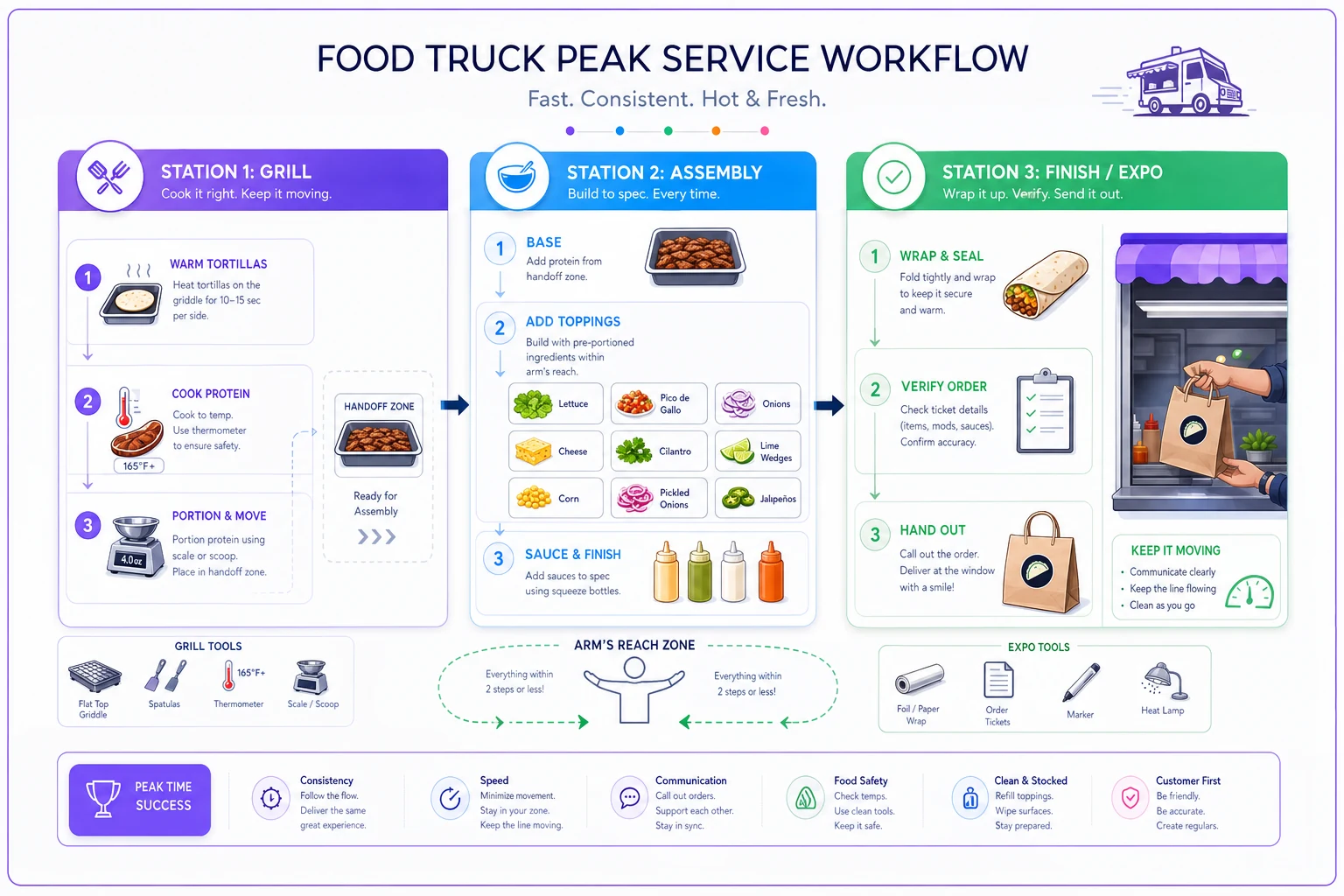
Write SOPs in 30-second chunks. Traditional procedures that say "prepare chicken tacos according to recipe card" don't help during rush. Break it down: "Station 1: Heat tortilla (10 sec), place in basket, add chicken from bin #3 (5 sec), signal Station 2." These micro-steps clarify exactly who does what and when handoffs occur.
Include contingency protocols. What happens when you run out of pre-portioned chicken? Who refills the sauce station? How do you handle a special request without disrupting flow? Your SOPs should answer these questions before they come up, not during the lunch rush while customers wait.
Build in quality checkpoints that don't slow service. Instead of checking every item at the end, embed quick visual checks at each handoff. Station 1 verifies protein portion before passing. Station 2 confirms toppings match ticket. Station 3 does final wrapper check. Distributed checks catch mistakes early without creating a bottleneck at the window.
Equipment placement matters too. If your SOP says to temp-check proteins every 30 minutes but the thermometer lives in a drawer behind three people, it won't happen. Every tool mentioned in your procedures needs a designated, accessible spot that doesn't require anyone to move out of position.
Time-motion reality: what 4 minutes actually means
Four minutes sounds reasonable for a burrito until you break down the actual motion. Grab tortilla (5 seconds), warm it (20 seconds), add rice (8 seconds), add beans (8 seconds), add protein (10 seconds), add cheese and toppings (15 seconds), roll it (15 seconds), wrap it (10 seconds), mark it (5 seconds). That's already 96 seconds for just the assembly, assuming zero delays.
It rarely flows that cleanly. Add transition time between orders, clarification on modifications, reaching for ingredients, and suddenly your 90-second burrito takes 4-5 minutes. Multiply this across concurrent orders and you understand why ticket times explode during rushes.
The key metric isn't total time—it's active work time versus waiting time. Track a single order through your truck. How much time does it spend actually being worked on versus sitting in queue? Most trucks find their 12-minute ticket times include maybe 3-4 minutes of actual production and 8-9 minutes of waiting or transition.
Station handoff points are where you lose the most. If Station 1 produces items every 45 seconds but Station 2 processes them every 60 seconds, you'll develop a growing queue. After 10 orders, Station 2 is running 2.5 minutes behind. These timing mismatches create the backup patterns you see during every rush.
Motion efficiency matters more in tight spaces. Every extra reach, turn, or step multiplies across hundreds of repetitions. Your grill person reaching across the prep station 40 times during lunch means 40 opportunities for collision, spillage, or delay. If you actually measured the distance traveled during a two-hour lunch, you'd probably find staff walking the equivalent of half a mile inside the truck.
A shift run-sheet that prevents hero-ball
11:30 AM Setup Positions:
-
Station 1 (Grill)
Owns proteins, tortilla warming, temperature monitoring. Never leaves grill zone during rush.
-
Station 2 (Assembly)
Owns build process, portioning from bins, sauce application. Only handles items passed from Station 1.
-
Station 3 (Finish/Expo)
Owns final wrapping, order verification, packaging, window handoff.
-
Float (Register/Support)
Owns customer interaction, payment, pre-portion refills, and emergency station coverage.
Peak Service Rules (12:00-1:30 PM): Nobody switches stations except for documented breaks. If Station 2 runs behind, Float supports but doesn't take over. If equipment fails, follow breakdown protocol without abandoning position. This feels rigid, but it prevents the musical chairs that destroys throughput.
Include specific trigger points for adaptation. "When window queue exceeds 6 orders, Float stops taking new orders for 60 seconds to clear backup." "If any station falls more than 3 orders behind, implement catch-up protocol: upstream station pauses new starts until downstream clears." Getting this language written down in advance matters—because nobody makes good process decisions when they're in the weeds.
Build in communication protocols that don't require shouting. Station 1 places completed items in the designated zone and taps the counter—no verbal callout needed. Station 2 slides assembled items left to signal ready for wrapping. Physical cues work better than verbal communication in a loud, cramped environment.
Your run-sheet should also specify recovery procedures. After the rush ends at 1:30 PM, who restocks what? Who cleans which surfaces? Who reconciles inventory? Without clear post-rush assignments, your team spends 20 minutes figuring out what needs doing instead of preparing for dinner service.
Simple coaching scripts that stick during chaos
"Watch your station, trust the system" sounds good in theory but falls apart when orders pile up. Coaching needs to be specific, immediate, and tied to something staff can actually see themselves.
Instead of "work faster," try: "Count your motions for this next burrito. Can you eliminate two reaches?" That gives them something concrete to focus on. They become aware of inefficient movement patterns and self-correct. After a few orders, that awareness becomes habit.
For quality consistency: "Check your last three portions against the portion cup. Running heavy or light?" This self-audit takes five seconds but recalibrates portioning without feeling like criticism. Staff often don't realize they're over-portioning until they see the physical comparison.
Address station creep immediately but positively: "I see you wanting to help at prep—that means you're ahead at grill. Great pace. Keep that zone humming and prep will catch up." Acknowledges good intentions while reinforcing station discipline.
For coordination issues: "Call out your handoffs for the next five orders, then we'll go back to silent." Sometimes teams need verbal reinforcement to reestablish rhythm, but don't let it become permanent chatter that adds noise without value.
Create specific milestone moments: "We just cleared eight orders in under 10 minutes—that's your new record for Tuesday lunch." These micro-wins build team momentum and make abstract metrics feel real. Staff remember hitting records much better than they remember average service times.
The real numbers: from 18-minute disasters to 7-minute consistency
Here's what this looks like in practice. A taco truck doing roughly 45-50 lunch orders daily was averaging 14-18 minute ticket times during peak periods before implementing station cards and SOPs. Orders would stack, quality suffered, and they'd regularly have customers walk away from the line.
| Metric | Before | After |
|---|---|---|
| Average ticket time | 14-18 minutes | 7-8 minutes |
| Peak hour orders served | ~22 | ~31 |
| Food cost variance | 34% | 29% |
| Daily lunch revenue | ~$420 | ~$580 |
The improvement came from eliminating redundant motions and wait times, not from working faster. The team actually reported feeling less stressed despite serving more customers. Clear roles meant less decision fatigue and fewer collision points.
One specific win: their previous system had everyone grabbing tortillas from the same warmer, creating constant conflicts. They assigned tortilla warming exclusively to Station 1, who pre-warmed 5-6 at a time during known rush patterns. That single change eliminated around 40 reaching conflicts per lunch service.
When rigid stations actually hurt more than help
Station discipline works beautifully until it doesn't. If you're running a fusion truck with dramatically different prep requirements per menu item, rigid stations might create more problems than they solve. A Korean-Mexican truck can't have the same person always handle kimchi and carne asada—the techniques and timing are too different.
Ultra-low volume services don't benefit from rigid stations either. If you're serving 15-20 customers across a three-hour window, the overhead of maintaining distinct stations exceeds the efficiency gains. Better to run with two utility players who flex across all tasks.
Equipment failures or staff callouts obviously disrupt station assignments. But don't abandon the system entirely. Pre-plan consolidated stations. "If down to two people: Station A handles grill and assembly, Station B handles finish and register, with modified handoff points at the center rail."
Seasonal menu changes might require station restructuring. Your summer menu with lots of cold items needs different flow patterns than a winter menu heavy on grilled items. Plan these transitions during slow periods, not mid-service when you realize the stations don't align with your new offerings.
Some situations just demand flexibility over efficiency. Catering setups, food festivals with limited menus, or special routes through dense districts might benefit more from responsive teamwork than rigid roles. Know when to flex and when to stay disciplined.
Building better without the software investment
You can implement most of these improvements with laminated cards and dry-erase markers. Print station cards listing the 10-12 core responsibilities for each position. Tape them where staff can see them during service. Add checkboxes for critical tasks that often get missed during rushes.
Create pre-portion guides using cheap deli containers and permanent markers. Mark fill lines directly on containers for consistent portions. Color-code lids by ingredient type. This visual system works better than written portion guides that nobody reads during service.
A simple kitchen timer becomes your time-motion tracking tool. Set it for 5-minute intervals during rush. At each alarm, quickly note how many orders cleared. This rough tracking identifies bottleneck patterns without complex measurement systems. You'll spot which 5-minute blocks consistently lag.
Build accountability without micromanaging. Post a simple performance board showing yesterday's average ticket time, today's goal, and current performance. Update it every 30 minutes during service. Teams naturally compete against their own previous numbers when the metrics are visible.
That said, managing all these moving parts—SOPs, timing data, portion tracking, performance patterns—through purely manual systems eventually hits a ceiling. Laminated cards get lost, timing logs pile up unanalyzed, and institutional knowledge walks out the door when experienced staff leave.
This is where operational software actually makes sense. Not to replace human judgment, but to capture and systematize workflows you've already proven effective. When your station SOPs live in a centralized platform new hires can access on their phones, training accelerates. When portion rules flag variances automatically, consistency improves without constant supervision. The best implementations start manual, prove the concept, then bring in digital tools where they add clear value—automated reorder points when pre-portioned inventory runs low, shift performance dashboards that surface coaching opportunities, mobile-accessible run-sheets that update based on staff availability.
Making the peak service shift permanent
The changes that cut your lunch rush from 18 minutes to 7 minutes aren't temporary fixes—they're operational foundations that scale with growth. When you add a second truck, these same station disciplines and SOPs transfer directly. New staff onboard faster because roles are defined, not figured out through trial and error.
Your peak service improvements compound over time. Better portion control doesn't just save food cost during lunch—it improves inventory predictability, reduces waste, and simplifies ordering. Clear station ownership doesn't just speed up service—it reduces staff stress, improves retention, and makes your operation more resilient when someone calls out.
The time-motion insights reveal optimization opportunities beyond just lunch rush too. Maybe your morning prep takes too long because ingredients are stored in the wrong sequence. Maybe your evening cleanup drags because nobody owns specific zones. The same measurement and assignment principles apply across every service period.
Most importantly, these systems create capacity you didn't know you had. That same 3-person crew struggling to serve 45 orders can handle 65+ with proper station discipline. Not through heroic effort, but through systematic efficiency. Every saved second compounds across dozens of orders, turning previous bottlenecks into smooth workflows.
The food truck business is hard enough without compounding it through operational chaos. When every person knows exactly what they own, portions are consistent and ready, and handoffs flow without communication overhead—that's when you stop fighting your operation and start building on it. The lunch rush becomes just another service period instead of a daily crisis. And those 18-minute ticket times become a story you tell new hires about how things used to be before you got serious about operations.
Ready to drive your food truck business forward?
Join 2,000+ food truck operators relying on Grubzly to boost efficiency, increase sales, and delight customers.