


Private catering gigs can either become your most profitable revenue stream or your worst operational nightmare. The difference usually comes down to preparation systems that actually scale with event size.
Most food truck operators treat catering like a bigger version of regular service. Multiply the recipes, hope you brought enough supplies, scramble through the event trying to keep up. But catering operates on completely different logic than street service. Your margins disappear fast when you're hauling extra staff, renting equipment, and managing complex logistics without proper systems in place.
The trucks that consistently profit from catering run the same operational playbook: scaled packing lists tied to headcount, templated run-sheets that prevent chaos, and deposit structures that protect against last-minute changes.
Why catering prep breaks differently than regular service
Street service gives you flexibility. Run low on pulled pork? Push the brisket special. Line getting long? Speed up or close early. Catering locks you into promises. You can't tell a wedding party you're out of their main course, or that service is running late because your prep math was wrong.
The operational stress compounds because catering disrupts your entire business flow. You're pulling inventory from regular service, dedicating prep time that affects tomorrow's route, and often operating in unfamiliar environments with different equipment constraints. Without systems that account for these disruptions, you end up eating into profits just to deliver on what you promised.
Think about a 150-person corporate lunch. Your standard truck setup handles maybe 40 orders an hour comfortably. Now you need to serve triple that in a concentrated window. Your regular prep portions assume orders spread across menu items throughout the day. Corporate catering often means 150 portions of the same three items, which completely breaks your usual inventory math.
The financial exposure gets worse when clients change details. A "small adjustment" from 100 to 125 guests means 25% more food cost, extra staff hours, and possibly equipment rental. Without proper contracts and deposits covering these scenarios, you absorb those costs directly from your margins.
Building your food truck catering checklist from contract to cleanup
Profitable catering starts with contracts that actually protect your operations. Generic catering agreements miss critical mobile-specific clauses. Your contract needs to cover truck positioning requirements, power access, weather contingencies, and service window flexibility based on travel time.
Stop losing sales to poor planning.
Grubzly helps you plan routes, track inventory, and maximize daily sales effortlessly.
- Real-time route optimization
- Inventory tracking & alerts
- Mobile sales & reporting
No credit card required
Deposit structures should reflect your actual cost exposure, not some industry standard built for brick-and-mortar restaurants. A restaurant might take 25% deposits because their fixed costs stay constant. Your catering requires dedicated inventory purchases, route disruption opportunity costs, and often equipment rentals. Structure deposits to cover at minimum:
-
50% of food costs based on guaranteed headcount
-
Full equipment rental costs upfront
-
Non-refundable booking fee covering route disruption (usually $200–400 depending on your market)
-
Staged payment with final balance due before service starts
Your scaled packing system needs real math, not rough estimates. Create packing multipliers for every menu item that account for service style differences. Buffet service typically needs 1.15x portions versus plated service because people serve themselves larger portions. Outdoor summer events need 1.3x beverages compared to indoor spring events. These multipliers come from tracking actual consumption across dozens of events.
Build your packing lists in layers:
Core service items (scales with headcount):
-
Primary food ingredients at portion weight x headcount x service multiplier
-
Serviceware at headcount x 1.2 for breakage buffer
-
Napkins at headcount x 2.5 for outdoor events
Fixed event items (same regardless of size):
-
Serving utensils (2 sets per dish for rotation)
-
Chafing fuel calculated by service duration
-
Display materials and signage
-
Backup propane tanks
Contingency supplies (scales partially):
-
Extra serviceware at 10% of headcount
-
Backup ingredients for top 3 items at 5% of headcount
-
Emergency proteins that work across multiple dishes
These multipliers come from tracking actual consumption across dozens of events.
Menu scaling rules that protect margins while preventing waste
Standard recipe scaling destroys profits because it ignores operational reality. Doubling a recipe doesn't mean doubling every ingredient linearly. Spices and seasonings follow logarithmic curves. Cooking oils have absorption maximums. Vegetables have different prep waste ratios at scale.
Create scaling bands for your menu items:
| Portion Range | Protein Scaling | Vegetable Scaling | Seasoning Scaling |
|---|---|---|---|
| 10–25 portions | Base recipe | Base recipe | Base recipe |
| 25–50 portions | 95% | 110% | 85% |
| 50–100 portions | 92% | 115% | 75% |
| 100+ portions | 88% | 120% | 70% |
These percentages reflect real prep dynamics. When you're breaking down 50 pounds of chicken versus 10, your yield improves because you develop rhythm. But vegetable prep creates more waste at scale because quality control means rejecting more pieces.
Labor calculations can't follow simple multiplication either. One person can prep proteins for 100 servings in roughly the same time as 60 servings once they hit rhythm. But plating 100 desserts takes nearly exactly 100 times the single-portion time because each one requires individual attention.
Map your menu items into labor complexity tiers:
-
Batch items (soups, braises)
Labor scales at 0.6x rate
-
Assembly items (tacos, sandwiches)
Labor scales at 0.9x rate
-
Individual items (plated dishes)
Labor scales at 1.0x rate
-
Complex items (decorated desserts)
Labor scales at 1.1x rate
Your pricing has to account for all of this. That's why catering menu prices look different than street prices multiplied by headcount. The cost structure is genuinely different.
Staffing rotas that scale without breaking the bank
Catering staff requirements follow a step function, not a smooth curve. You can handle 40 guests with your regular 2-person crew. At 41 guests, you suddenly need a third person for service flow. At 80 guests, you need four people whether it's 80 or 95. Understanding these break points is where profitability actually lives.
Build your staffing matrix around service styles:
| Guest Count | Buffet Staff | Stations Staff | Plated Staff |
|---|---|---|---|
| Under 40 | 2 | 2 | 3 |
| 40–75 | 3 | 4 | 4 |
| 75–125 | 4 | 5 | 6 |
| 125–200 | 5 | 6 | 8 |
These numbers assume your regular crew efficiency. New staff typically operate at around 70% efficiency their first event, closer to 85% their second, and reach full capacity by their third. Factor that training curve into your labor costs.
The hidden staffing cost comes from tomorrow's impact. If your catering event runs until 10 PM, your morning prep cook probably can't open at 5 AM. Either you're paying overtime, bringing in additional staff, or compromising tomorrow's service. Build those downstream costs into your catering labor math.
Smart operators create catering-specific roles that don't disrupt regular operations. Train a dedicated catering captain for private events who knows your systems but operates independently from your regular crew. Pay slightly above regular wages to maintain their availability.
Day-of run-sheets that eliminate scrambling
Your run-sheet turns chaos into choreography. Most operators create a new run-sheet for each event from scratch, which wastes time and introduces inconsistency. Build templated run-sheets for each service style that only need number adjustments.
Here's a quick visual of the day-of run-sheet workflow.
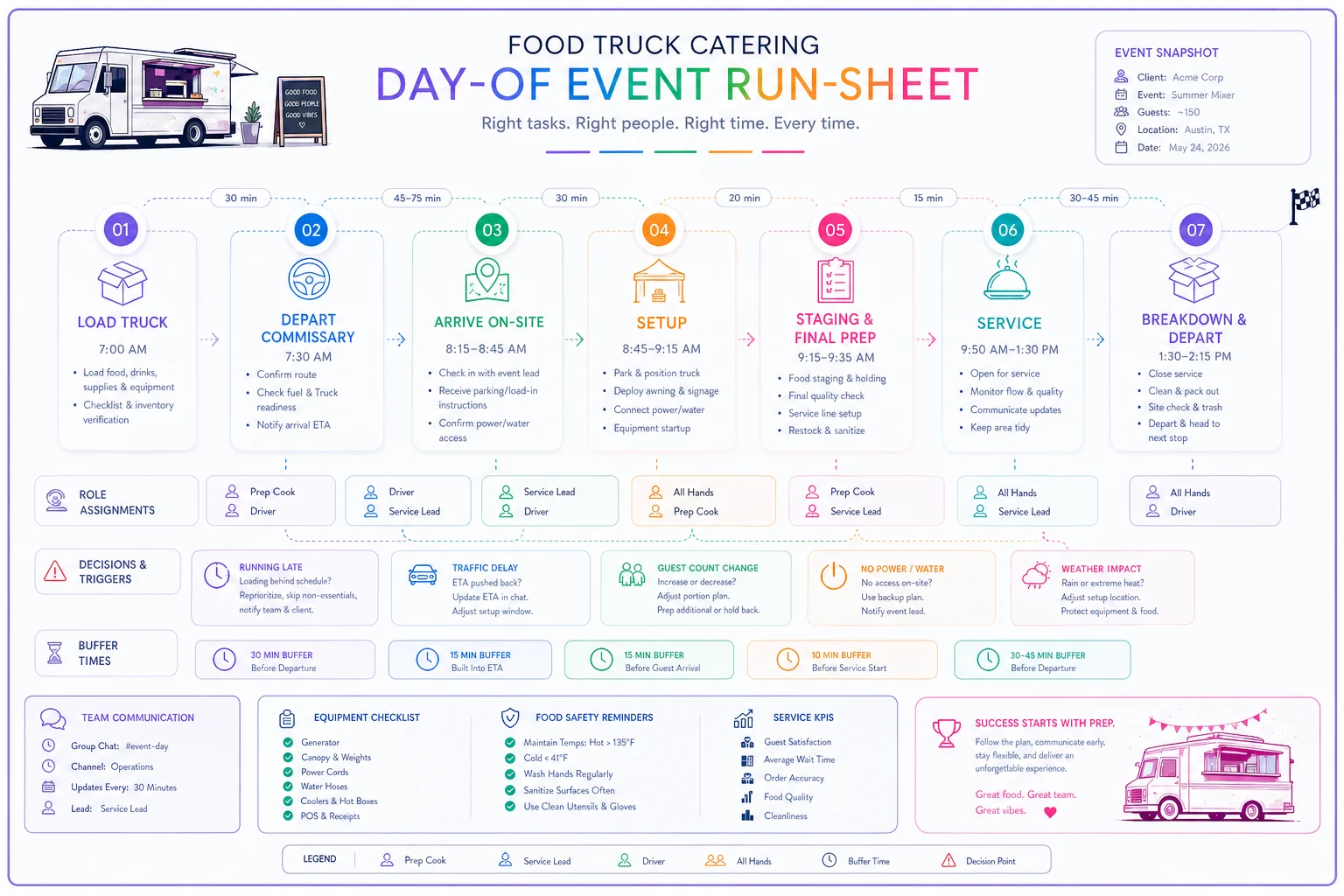
Work backward from service time:
``
[CATERING DAY-OF TIMELINE]

Service minus 6 hours → Truck loaded, final inventory check
Service minus 4 hours → Depart commissary (includes traffic buffer)
Service minus 2 hours → Arrive on-site, begin setup
Service minus 1 hour  → Hot items in holding, cold items staged
Service minus 30 min  → Final plating prep, staff briefing
Service time          → Begin service
Service + duration    → Begin breakdown
Service + duration +45 min → Truck loaded, site cleared
``
Each block needs specific task assignments and confirmation checkpoints. Prep cook confirms protein temps at service minus 90 minutes. Service lead confirms table setup at service minus 45 minutes. These checkpoints prevent the cascading delays that destroy catering timelines.
Include explicit "circuit breaker" actions in the run-sheet so staff know which tasks to drop first if running behind.
Include decision triggers in your run-sheet too. If you're not loaded by service minus 5.5 hours, what gets cut? If traffic delays you 30 minutes, which setup steps can compress? If the client adds 20 guests on arrival, what's your maximum service capacity without quality dropping? These aren't hypotheticals — they happen regularly enough that you need answers before you're standing in a parking lot trying to think clearly.
Equipment and supply calculations by event type
Equipment needs vary a lot by venue and service style. An outdoor wedding requires different gear than a corporate conference room lunch. Your standard truck setup covers basic service, but catering demands supplementary systems.
Outdoor events add:
-
Weighted tent walls for wind management
-
Coolers with 1.5x normal ice (higher melt rate outdoors)
-
Backup generators or extended power cables
-
Hand washing stations beyond standard requirements
Indoor corporate requires:
-
Carpet protection mats for high-traffic paths
-
Quieter service equipment
-
Professional display risers and serving platters
-
Discrete waste management systems
Multi-station service needs:
-
Duplicate serving utensils for each station
-
Additional chafing dishes or warmers
-
Separate beverage stations to prevent crowding
-
Backup equipment at roughly 30% of primary setup
Track actual equipment usage across events. A 200-person wedding might only use 160 plates if it's cocktail style, but a 100-person corporate lunch might need 130 plates for the longer service window. Those patterns directly inform your packing multipliers over time.
Common catering disasters and their prevention systems
The client changes headcount two days before the event. Your standard ingredients might handle 10% variation, but a jump from 75 to 100 guests breaks your prep plan entirely. Contractual language should require 72-hour notification for changes above 10%, with automatic pricing adjustments for shorter notice.
Power failure kills your hot holding capacity. Always identify two power sources during site visits. Run equipment load calculations accounting for startup surge. Your contracts should specify minimum power requirements and include a clause for client-provided generator backup if their systems fail.
Weather turns your outdoor event into chaos. Establish clear weather thresholds in contracts. Wind above 25 mph allows service modification. Rain requires covered service areas provided by the client. Temperature above 95°F permits menu modifications for food safety.
Venue restrictions discovered on arrival are a nightmare. That historic mansion doesn't allow propane. The corporate plaza requires special insurance certificates. The beach venue has no vehicle access to the service area. Your site visit checklist must probe for these limitations, with contracts requiring full disclosure of venue restrictions before signing.
Time cascade failures compound fast. Your prep runs 30 minutes late, which delays loading, which hits traffic, which compresses setup, which affects food quality. Build buffer time at each stage, but also establish circuit breakers — points where you stop trying to catch up and modify service to match available time instead.
Margin protection strategies beyond basic pricing
Your catering pricing can't just multiply regular menu prices. The operational burden requires different margin structures. Start with true cost calculations that include route opportunity cost, prep labor disruption, and equipment allocation.
Weekend events carry higher opportunity costs. Your Saturday afternoon catering might prevent hitting three profitable brewery stops. Calculate average revenue per stop using your demand forecasting systems, then add that opportunity cost into your catering minimums.
Build pricing tiers that encourage profitable event types:
-
Tier 1 (Premium)
Full-service weekend events, complex menus
-
Tier 2 (Standard)
Weekday lunch service, simple menus
-
Tier 3 (Volume)
Large corporate contracts, repeat clients
Each tier maintains different margin targets. Premium tier might run 65% gross margins to offset complexity. Volume tier might accept 45% margins for predictable, recurring revenue.
Service minimums should reflect your true break-even including commissary disruption, tomorrow's prep impact, administrative burden, and insurance and permit costs. Most trucks land somewhere in the $1,500–2,000 range for full-service catering, but your specific cost structure might justify something higher or lower. Don't just copy what the truck down the street charges.
Post-event systems that capture lessons and improve operations
Every catering event generates operational data that improves future events. Without systematic capture, those lessons disappear. A 15-minute post-event review prevents repeated mistakes better than any amount of in-event scrambling.
Track actual versus planned metrics:
-
Food quantities used versus packed
-
Service time versus scheduled
-
Staff hours versus estimated
-
Equipment usage versus planned
-
Customer satisfaction scores
These variances refine your scaling multipliers and packing lists. After 20 or so events, patterns emerge. Corporate lunches consistently use around 85% of dessert portions. Wedding cocktail hours need 130% of appetizer estimates. Those insights directly improve profitability on the next booking.
Document venue-specific intelligence too. That convention center's loading dock requires 24-hour advance scheduling. The country club has a closer power outlet behind the maintenance shed. The beach park's "vehicle access" requires 4WD in soft sand. This kind of institutional knowledge sounds minor until you're scrambling at 11 AM trying to figure out why your chafing setup isn't working.
When catering makes sense versus when to pass
Not every catering opportunity deserves a yes. Having clear criteria for accepting or declining events protects your core business while keeping profitable opportunities on the calendar.
Accept events that meet minimum revenue thresholds after true cost calculation, allow adequate preparation time without disrupting regular service, match your operational capabilities and equipment, include protective contract terms and appropriate deposits, and fit your brand and service quality standards.
Decline events that require equipment or skills you don't have, compress timelines beyond safe operation, demand liability or risk you can't properly insure, conflict with more profitable regular service opportunities, or show red flags like reluctance to sign contracts or pay deposits.
The temptation to accept every catering request eventually undermines profitability. Better to execute fewer events well than to struggle through incompatible ones.
Building systems that make catering sustainable
The difference between catering occasionally and building a profitable catering operation comes down to having systematic approaches that you actually use consistently. Your food truck catering checklist becomes the foundation for execution that protects margins while delivering quality.
Modern operational software helps codify these systems. Instead of recreating packing lists and run-sheets from scratch each time, AI-powered platforms can automatically generate scaled lists from your templates, track actual consumption to refine multipliers, calculate true event profitability including hidden costs, and store venue-specific intelligence for future bookings.
Start with one event type you can execute really well. Master that operation completely before expanding. Each successful event builds your reputation and your operational confidence.
Catering success doesn't come from heroic effort during events. It comes from systematic preparation that turns complexity into routine execution. Your contracts protect margins, your packing lists prevent scrambling, your run-sheets eliminate chaos, and your post-event reviews continuously sharpen the whole operation. That's how catering stops being an occasional disruption and becomes a genuine competitive advantage.
Catering success doesn't come from heroic effort during events. It comes from systematic preparation that turns complexity into routine execution. Your contracts protect margins, your packing lists prevent scrambling, your run-sheets eliminate chaos, and your post-event reviews continuously sharpen the whole operation. That's how catering stops being an occasional disruption and becomes a genuine competitive advantage.
Ready to drive your food truck business forward?
Join 2,000+ food truck operators relying on Grubzly to boost efficiency, increase sales, and delight customers.