

September's numbers landed harder than most operators expected. The Reuters coverage of the September inflation data showed food‑away‑from‑home prices ticking up again, and the USDA's Food Price Outlook nudged its forecasts upward for the months ahead. For a sit‑down restaurant with a locked quarterly contract on proteins, that's annoying. For a food truck buying perishables every three or four days at near‑retail prices, it hits the P&L almost immediately.
This isn't a "the economy is scary" post. The macro story is just the entry point. What actually matters is that your cost basis moved while your menu prices probably didn't — and that gap is coming out of your margin right now, stop by stop.
The margin leak most operators don't see until month‑end
Price pressure on a truck doesn't show up as a dramatic line item. It shows up as a slow drift. Your protein vendor adds forty cents a pound. Your produce invoice is $38 higher than last week with the same order. Your cheese went up and the distributor "forgot" to flag it. None of these feel like emergencies. Added together across a month, they quietly erase the cushion you were counting on.
Trucks running thin per‑stop margins — say $180 to $260 profit on a decent lunch stop — can lose 15–25% of that margin to ingredient creep without noticing, because the daily cash still looks fine. The register's full. Sales are up slightly. But sales being up while food cost climbs faster is exactly how an operator ends a quarter wondering where the money went.
The underlying problem isn't inflation itself. It's that most trucks have no fast feedback loop between what ingredients cost this week and what they're charging and prepping this week. The costing lives in someone's head or a spreadsheet nobody opened since spring. When input prices are flat, that lag is forgivable. When prices are actively drifting up, the lag is the whole problem.
Start with the three stops that actually carry you
Before touching menu prices or renegotiating anything, pull your last four to six weeks of stop‑level performance and sort it honestly. Not by revenue — by profit after food and labor for that specific stop.
Stop losing sales to poor planning.
Grubzly helps you plan routes, track inventory, and maximize daily sales effortlessly.
- Real-time route optimization
- Inventory tracking & alerts
- Mobile sales & reporting
No credit card required
Almost every truck has a distribution that looks roughly like this:
| Stop type | Share of revenue | Share of actual profit | What usually happens |
|---|---|---|---|
| Anchor stops (recurring, high‑traffic) | ~40% | ~55–65% | Reliable, worth protecting first |
| Guaranteed‑fee events / catering | ~20% | ~25–30% | Underweighted, best margin insulation |
| Marginal public stops | ~30% | ~10–15% | Break‑even or worse when costs rise |
| "We've always done it" stops | ~10% | near zero or negative | Pure habit, killing you quietly |
Operators pour energy into the marginal public stops because that's where the hustle feels real, while the guaranteed‑fee bookings — which barely move when ingredient costs rise — get treated as occasional bonuses instead of the margin anchor they actually are.
When input prices are climbing, a fixed catering fee is worth more than it was a month ago, because your downside is capped. You agreed to $1,400 for the event; if your food cost on it rises $40, you absorb a rounding error. On a public stop, rising food cost with soft foot traffic can flip you negative with no warning.
The low‑effort move: shift one or two of your weakest recurring public stops toward replacement with guaranteed‑fee work over the next month. You don't need to blow up your whole route. Just stop defending the two worst stops on your board.
Tighten perishable par levels before you touch anything else
Spoilage is inflation's best friend. When ingredients were cheap, tossing a third of a case of tomatoes at the end of the week stung a little. At today's prices, that same waste is a real chunk of a stop's profit walking into the trash.
The fastest margin recovery available to most trucks isn't pricing — it's cutting par levels on the three or four items you consistently over‑buy and under‑sell. This usually happens with highly perishable produce, specialty proteins, and anything tied to a slow‑moving menu item you keep "just in case."
A tight par‑tightening pass you can run this week:
-
Pull waste logs (or reconstruct them) for the last 3 weeks. If you don't log waste, eyeball your end‑of‑week tosses for the next two shifts and write it down. Rough is fine.
-
Flag any item you threw out more than twice. Those are your over‑par items.
-
Cut their order quantity by 15–20% for two weeks and watch for actual stockouts — not fear of stockouts, actual ones.
-
If you stock out, add back half of what you cut. If you don't, hold the lower par.
-
Re‑run the whole thing monthly while prices are drifting.
Most trucks find they can trim par on two or three items permanently and never notice a lost sale. That's margin recovered with zero price change and zero customer pushback.
One caution: don't tighten par on your anchor menu item. Running out of your signature dish at your best stop costs you far more in reputation and repeat business than the saved spoilage is worth. Tighten the edges, protect the core.
Renegotiate at the micro level — not the handshake level
The instinct when invoices climb is to find a cheaper supplier and switch everything. That's usually a mistake, because switching your whole produce or protein supply mid‑season introduces quality variance and prep surprises right when you can least afford them.
A better move is micro‑negotiation on your top‑cost line items only. You probably have three or four ingredients that make up the bulk of your food spend. Those are the only ones worth a real conversation. For the long tail of small items, switching vendors saves pennies and costs you consistency.
What actually works in these conversations:
-
Ask for a standing price on your top two items in exchange for order consistency. Vendors value predictable volume. "I'll commit to this quantity every week — can you hold the price through December?" lands better than vague loyalty talk.
-
Request a 48‑hour heads‑up on any price increase. This alone is worth a lot. It lets you adjust prep or pricing before the cost hits, instead of discovering it on the invoice.
-
Flag substitutions you'll accept in advance. If a vendor can swap in a comparable cut or a different produce variety when prices spike, you stay flexible without emergency scrambling.
This is also where seasonal flexibility earns its keep. Leaning on what's actually in season and locally abundant is one of the most reliable ways to blunt price shocks on produce‑heavy menus. If you haven't built that muscle yet, the supplier‑flex seasonal produce sourcing playbook walks through how to set up substitution rules so a price spike on one item becomes a menu swap instead of a margin hit.
Pricing moves that don't scare off your regulars
You'll likely need to recover some cost through price. The fear is always the same — that a price bump drives away the regulars who make your anchor stops work. In practice, the risk is overstated if you move the right things.
A few patterns that hold up:
Raise the add‑ons and extras, not the hero item. Customers anchor hard on the price of your main dish. They barely track the cost of extra protein, a side, a sauce upgrade, or a drink. A 50‑cent to $1 bump across add‑ons spreads the increase across many tickets without triggering the "this got expensive" reaction.
Bundle instead of discount. A combo that pairs your hero item with a higher‑margin side at a price that feels like a deal protects your margin better than straight‑up raising the hero price. You're guiding the mix toward items you make money on.
Trim portion drift before raising price. A lot of trucks have quietly let portions creep up over time — the scoop got bigger, the pour got heavier. Returning to your actual spec portion recovers cost invisibly. Nobody complains that the portion went back to what it was supposed to be.
The mistake to avoid: a flat across‑the‑board price increase on every item at once. That's the version customers notice and resent. Spread, bundle, and portion‑correct instead.
A real scenario
A two‑truck taco operation running a mix of office‑park lunches and weekend events watched their food cost percentage climb from the low 30s to around 38% over about six weeks as produce and protein prices moved. Daily sales looked fine, so nobody flagged it until the month‑end close came in soft.
They didn't do anything dramatic. They cut par on cilantro, limes, and a slow‑moving fish option that was spoiling most weeks. They raised their add‑on protein and guac prices by about a dollar, left the base tacos alone, and dropped their two weakest public stops in favor of chasing two recurring catering slots with better guaranteed margins.
Over the next six weeks food cost settled back toward the low 33% range, and the weekend catering shift added a more predictable chunk of profit. No dramatic revenue jump — their top line barely moved. But the margin they were quietly bleeding came back, which was the entire point.
Keeping the feedback loop fast enough to matter
The reason these moves work isn't that they're clever. It's that they close the lag between cost and action. When prices drift monthly, a truck that reacts monthly stays ahead. A truck that reacts quarterly keeps getting surprised at close.
The practical bottleneck is usually visibility. If your costing, stop‑level profit, and waste are all living in separate places — a POS export here, a notebook there, invoices in a folder somewhere — you can't see the drift fast enough to respond. Keeping stop performance, ingredient costs, and inventory in one connected workflow pays off not because software is magic, but because a tight loop means you adjust in days instead of discovering problems in weeks. The operators who weather price pressure best aren't the ones with the cheapest suppliers. They're the ones who notice the drift early enough to do something small about it.
Keep a one‑page weekly cost snapshot for your top three stops to make quick decisions.
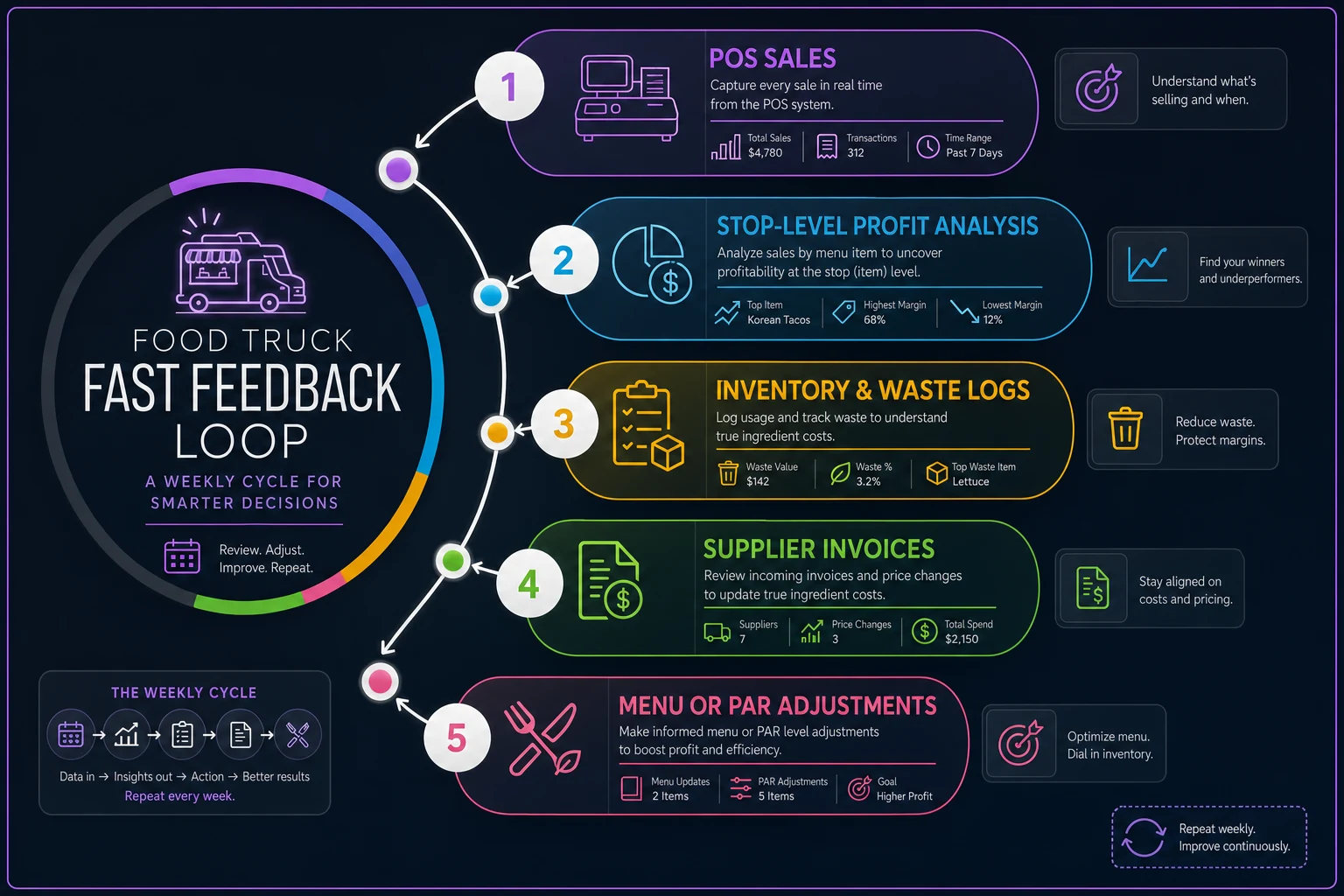
A quick visual of the loop you'll want to tighten.
When to act aggressively vs. when to hold
Not every price uptick deserves a response. A few guardrails:
-
Act fast when the increase is on a top‑three cost item and the forecast says continued pressure. That's a structural change, not noise — tighten par and adjust pricing now.
-
Hold when it's a one‑off spike on a minor item. Chasing every small wobble wears out your crew and confuses your menu.
-
Don't re‑price if your portions are drifting. Fix the portion first; you may not need the price bump at all.
-
Don't drop an anchor stop to chase events unless the anchor is genuinely break‑even. Reliable beats shiny when margins are tight.
Price pressure is going to be the operating weather for a while, based on where the forecasts sit. The trucks that treat it as a rolling adjustment — small par cuts, micro‑negotiations, a steady tilt toward guaranteed‑fee work, and smart add‑on pricing — barely feel it. The ones waiting for prices to "go back to normal" keep absorbing the difference out of their own margin, one quiet invoice at a time.
Start with the two worst stops on your board and the three items you throw out most. That's your whole first week. Everything else can follow once those are handled.
Ready to drive your food truck business forward?
Join 2,000+ food truck operators relying on Grubzly to boost efficiency, increase sales, and delight customers.