


Most food truck owners plan their menu around what sells. Fewer plan their sourcing around what actually shows up. And that gap — the one between "my menu needs 40 lbs of heirloom tomatoes a week" and "my supplier can only get me 18 lbs this week, and the price jumped 30%" — is where seasonal produce quietly eats your margin alive.
The problem isn't that produce prices swing. Everyone knows they swing. The problem is that most trucks are locked into a single-supplier, single-SKU mindset with no pre-built plan for the week the swing hits. You find out at 6am when the delivery is short, and now you're texting three suppliers while trying to prep a lunch service.
This playbook is about building sourcing flexibility before the swing — a supplier scorecard, a fallback SKU list, short-term lock language you can drop into a real conversation, and simple decision rules so you're not improvising with a spatula in one hand and your phone in the other.
Why seasonal produce sourcing breaks food trucks specifically
Restaurants have walk-in coolers, storage, and enough volume to negotiate real contracts. A food truck has a tiny cold hold, buys in awkward mid-size quantities, and runs menus that often lean hard on one or two hero ingredients. That combination makes you uniquely exposed.
The pattern that keeps showing up: a truck builds its identity around something seasonal. A summer corn-and-avocado bowl. A fall squash taco. When that item is 22% of your sales and the ingredient goes short or spikes, you can't just quietly 86 it — customers came for that thing. So you eat the higher price, or you serve a lower-quality version, or you run out by 1pm and lose the back half of your rush.
The financial damage isn't really the produce line item. It's the ripple:
-
You pay peak spot-market price because you didn't lock anything
-
Quality drops, and your best item now gets mediocre reviews
-
You stock out mid-shift and lose covers you already paid staff for
-
You over-order the following week out of panic and eat spoilage
Any one of these on its own is annoying. Stacked across a 12-week peak season, they add up to real money — often the difference between a strong summer and a break-even one.
The supplier scorecard: stop rating suppliers by gut feel
Most operators "know" which supplier is reliable and which is flaky, but that knowledge lives in their head and disappears the moment things get stressful. A scorecard forces it onto paper so you can make cold decisions during a hot week.
Stop losing sales to poor planning.
Grubzly helps you plan routes, track inventory, and maximize daily sales effortlessly.
- Real-time route optimization
- Inventory tracking & alerts
- Mobile sales & reporting
No credit card required
Score each produce supplier monthly on five factors, 1–5:
| Factor | What you're actually measuring | Weight |
|---|---|---|
| Fill rate | % of ordered quantity actually delivered | 30% |
| Quality consistency | How often product arrives usable, not marginal | 25% |
| Price stability | How wildly their price moves week to week | 20% |
| Substitution honesty | Do they warn you before swapping, or surprise you? | 15% |
| Responsiveness | How fast they answer when you need something fast | 10% |
The weighting matters more than the scores. Fill rate and quality together sit at 55% — because a cheap supplier who shorts you or sends bruised product isn't actually cheap. A supplier who's slightly pricier but hits fill rate every week is worth more during peak season than a bargain vendor who gambles on your behalf.
Any supplier scoring below 3.5 weighted goes on "backup only" status — you don't build a menu commitment around them. Anyone at 4.2+ is a primary you can lean on. That one line of policy prevents the classic mistake of putting your signature summer item on the shoulders of your cheapest, flakiest vendor.
Run the scorecard on the same day each month so you catch trends rather than reacting to one bad week.
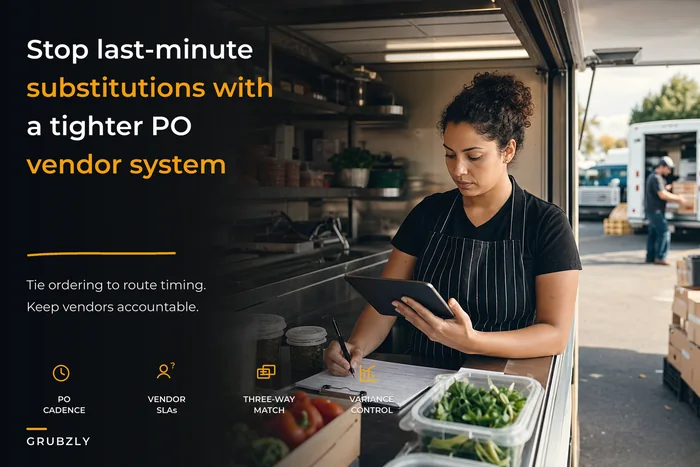
A related discipline is your ordering cadence and SLA structure, which pairs directly with this scorecard. If you haven't tightened those, the commissary procurement system for preventing last-minute substitutions covers the vendor SLA and PO cadence side that makes scorecard data reliable in the first place.
The fallback SKU list: pre-approved swaps you decide when calm
The worst time to decide on a substitution is the morning it's forced on you. Under pressure, people either accept whatever the supplier offers or over-correct with something that changes the dish entirely.
A fallback SKU list is just a pre-built table: for each hero ingredient, you decide in advance what you'll swap to, in what order, and what it does to your cost and recipe.
| Primary SKU | Fallback 1 | Fallback 2 | Cost impact | Recipe/prep change |
|---|---|---|---|---|
| Heirloom tomato | Vine-ripe cluster | Roma (roasted) | +$0 / -$0.40 per portion | Roma needs roasting; adds 15 min prep |
| Local sweet corn | Frozen roasted corn | Canned fire-roasted | -$0.25 / -$0.55 | Frozen holds fine; canned needs rinse + char |
| Hass avocado | Green-tip Hass (2-day ripen) | Avocado crema (batch) | +$0 / -$0.30 | Crema stretches yield, changes texture |
The value isn't the specific swaps — it's that you decided the ceiling ahead of time. You already know Roma is acceptable and canned corn is a last resort. So when the 6am short-delivery text hits, you don't debate. You check the list, pick the highest fallback that's available, and move.
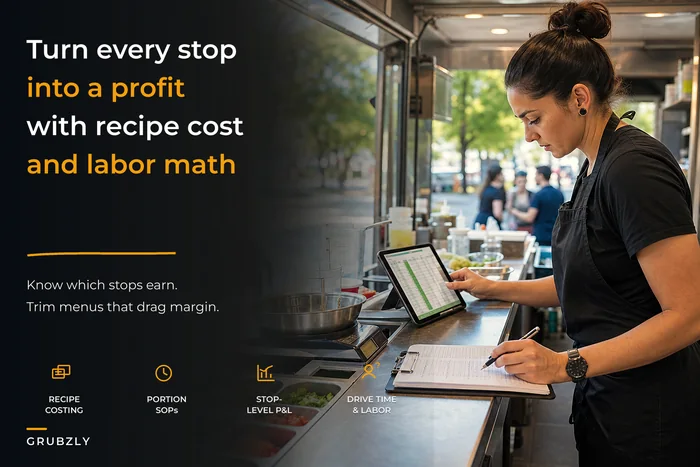
The cost column also feeds your pricing logic. If the fallback lowers cost (roasted Romas vs. heirlooms), you don't need to touch price. If it raises cost, you already know before service whether the swing threatens the item's margin. This ties straight into per-item profitability — if you haven't costed your hero items down to the portion, the recipe costing and per-stop P&L approach is worth doing before you build fallbacks, because you can't judge a swap's margin impact without a baseline.
Short-term lock clauses: the negotiation most trucks skip
Trucks assume they're too small to negotiate produce pricing. Sometimes that's true for annual contracts. But short-term locks — 2 to 6 weeks — are very achievable, and they're exactly the tool for seasonal swings.
> "For the next four weeks I'll commit to a standing weekly order of [X lbs] of [item] if you hold the price at [Y]. If the market drops below that, I'd like to move with it. If it spikes, you protect me at the locked rate."
This is a one-directional lock — you're protected on the upside, you float on the downside. Suppliers accept these more than you'd expect during peak season, because a guaranteed standing order is genuinely valuable to them when demand is chaotic. You're trading volume commitment for price certainty.
Short-term locks make the most sense when the item is a hero SKU with high sales share, you have reliable weekly volume you're confident you'll actually use, and the market is entering a known volatile window like early summer or late fall. They're a bad idea when the item is a minor garnish, your weekly volume is unpredictable, or the supplier scored below 3.5 — locking price with a flaky vendor just guarantees you're locked into disappointment.
That last point matters. A lock is only as good as fill rate. Locking price with a supplier who then shorts you 40% of the volume is worse than no lock — you've committed and still got burned.
Sample short-term lock PO template
Keep the paperwork light. A short-term lock doesn't need a lawyer; it needs to be written down so nobody "remembers it differently" in week three.
SHORT-TERM SUPPLY AGREEMENT (Produce) Vendor: _ Buyer (Truck): Item / SKU: ___ Locked unit price: $ per Standing weekly quantity: Lock period: weeks (Start: / End: _)
Price terms:
-
Price held at locked rate if market rises.
-
Buyer may request market rate if it drops below locked price.
Fill terms:
-
Minimum acceptable fill
____% of ordered quantity.
-
If fill drops below minimum, buyer may source elsewhere with no penalty for that week's shortfall.
Substitution:
-
Vendor must notify buyer of any substitution BEFORE delivery.
-
Approved fallback SKUs
_
Signatures / confirmation (text or email acceptable): _
The fill-rate floor and substitution-notice line are the two clauses that actually protect you. Price locks get all the attention, but a locked price with surprise substitutions and 60% fill isn't protection — it's a false sense of one.
Decision rules: the part that keeps you calm during a swing
Most of the bad calls in a short-delivery morning happen because someone is deciding emotionally at 6am. The fix is making the process mechanical enough that there's nothing to decide — just steps to follow.
-
Check fill. Did you get at least your minimum acceptable quantity for hero items? If yes, proceed normally. If no, go to step 2.
-
Check the fallback list. Is fallback 1 available today from a backup supplier? If yes, order it, adjust prep, done.
-
Check the cost impact. Does the fallback keep the item above its margin floor at current menu price? If yes, run it silently. If no, go to step 4.
-
Decide
absorb, adjust, or pull. If the item is a hero SKU and pulling it would hurt more than a temporary margin dip, absorb it for the day. If it's a mid-tier item, consider a small feature-price bump or a limited-quantity ("while it lasts") framing.
-
Log it. Note what happened — which supplier, what shortfall, what you swapped to. This log feeds next month's scorecard.

A simple visual like this keeps the team aligned on the morning steps without needing a long explanation.
That last step is the one everyone skips and the one that compounds the most. A single short delivery is noise. Three months of logged shortfalls turn into a scorecard that tells you, objectively, which supplier to drop before next season — instead of relearning the same lesson every year.
A quick checklist to build this before your next peak season
Getting this set up isn't a weeks-long project. You can knock out a first version in an afternoon, and it doesn't require any special software — a shared spreadsheet or even a notes doc works fine. What matters is that the decisions exist somewhere other than your head before the pressure hits.
-
[ ] Score every current produce supplier on the five-factor scorecard
-
[ ] Tag each as primary (4.2+), usable, or backup-only (under 3.5)
-
[ ] Identify your top 3–5 hero ingredients by sales share
-
[ ] Build a fallback SKU list for each hero, with cost and prep impact noted
-
[ ] Draft short-term lock language for hero items entering volatile windows
-
[ ] Set fill-rate floors and substitution-notice terms in writing
-
[ ] Create a simple shortage log (date, supplier, item, shortfall, action taken)
-
[ ] Review the log monthly and update scores
Peak week should be execution, not improvisation. This is how you make that happen.
Real scenario: the corn-heavy summer truck
A taco truck running a heavy summer schedule built its top seller around local sweet corn — roughly 30% of summer sales rode on two corn-forward items. Their single supplier had good corn but wildly inconsistent fill during July heat, sometimes landing 20–30% short with no warning.
Before the fix, a short-corn week meant either 86-ing the item by early afternoon or buying panic-priced backup corn at a premium. Food cost on those items drifted into the low 40s% on bad weeks. Over the peak, the stockouts and premium buys were running somewhere in the range of a few hundred dollars a week in lost sales, plus spoilage from over-ordering the week after.
They did three things: scored the supplier (a 2.8 — great quality, terrible fill), added a fallback list where frozen roasted corn was pre-approved as an acceptable swap, and put a four-week short-term lock on a second supplier with a 90% fill floor.
The result wasn't dramatic on paper, but it was the difference between a stressful season and a clean one. Stockouts on the corn items basically stopped. Food cost on those items settled back into the low 30s%. And the panic-buying spiral — over-order, spoil, repeat — went away because they were reacting from a plan instead of from fear.
The point isn't perfect sourcing — it's fewer bad decisions under pressure
Seasonal swings will always happen. You can't out-negotiate the weather or force a bad harvest to cooperate.
The scorecard tells you who to trust. The fallback list tells you what to swap. The short-term lock protects your hero items where it counts. And the decision rules keep you from turning one short delivery into a week of chaos. Build these once, refine them each season, and seasonal produce stops being the thing that quietly decides whether your summer was profitable.
Build these once, refine them each season, and seasonal produce stops being the thing that quietly decides whether your summer was profitable.
Ready to drive your food truck business forward?
Join 2,000+ food truck operators relying on Grubzly to boost efficiency, increase sales, and delight customers.