

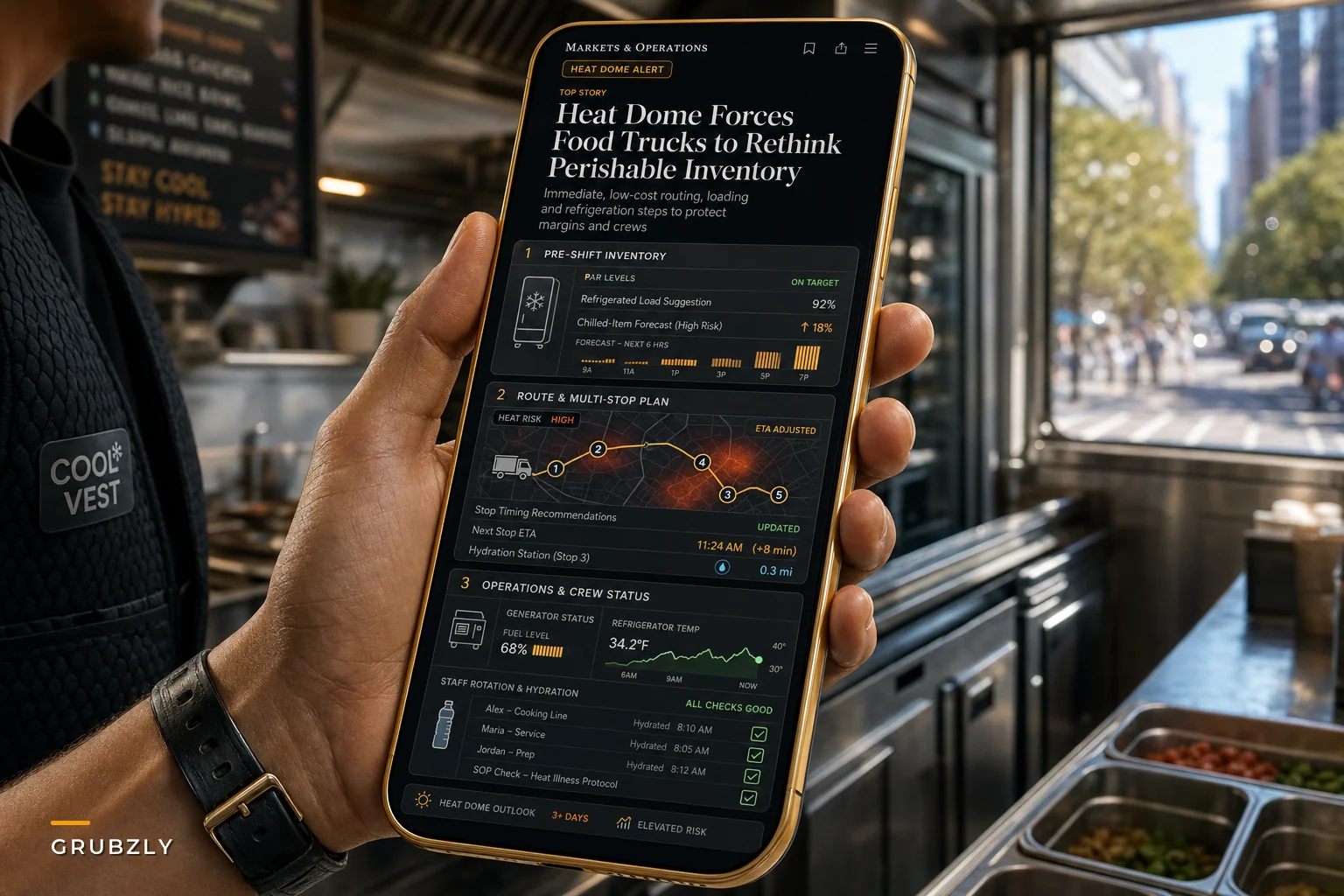

The heat dome settling over the central and eastern US this week isn't just uncomfortable—CNN reports it's bringing heat indexes up to 115°F across multiple states. For food truck operators, that means your refrigeration units are about to work overtime while your staff sweats through 12-hour shifts inside what is essentially a metal box on wheels.
Last summer, a taco truck owner in Phoenix told me they lost $1,800 worth of prepped proteins in a single afternoon when their refrigeration couldn't keep up with 118-degree ambient temps. Generator running full throttle, burning through $90 in fuel just to keep the compressor alive—and they still had to dump everything at 3pm. They had three catering gigs booked that weekend.
This week's heat dome stacks a combination of operational problems that most food truck owners genuinely aren't ready for. Your refrigeration draws more power, your generator burns more fuel, your produce wilts faster, dairy hits danger zones quicker, and your crew risks heat exhaustion every time they step into that truck.
The hidden math of heat-related food waste
Running a food truck in normal weather means managing somewhere around 8–12% food waste. Push ambient temps above 95°F for multiple days, and that number can spike to 25% or higher if you're not actively adjusting.
Cold holding temps creep up in ways that catch people off guard. Every time you open a door you're letting in a wall of hot air that takes 15–20 minutes to cool back down. Open that reach-in cooler 40 times during lunch rush, and you're essentially running a slow spoilage experiment.
Pre-prepped items deteriorate faster than you'd expect too. That cilantro-lime crema you made yesterday morning? At 95°F ambient, its safe window shrinks from four days to maybe 36 hours. House-made salsa verde that normally lasts a week—cut that in half.
The danger zone gets worse. Between 40°F and 140°F, bacteria doubles roughly every 20 minutes under normal conditions. Above 90°F ambient, that process accelerates. A container of diced tomatoes sitting on your prep counter for 45 minutes during setup could already be compromised before service even starts.
Proteins are where things get expensive fast. Ground beef, chicken, and seafood need constant monitoring. One temp spike above 41°F for more than an hour and you're not just looking at waste—you're looking at potential liability.
Refrigeration physics vs. your profit margin
Most food truck refrigeration systems are spec'd for around 85°F ambient. They'll hold safe temps up to about 95°F if you're careful. Above that, you're fighting physics with undersized equipment.
Stop losing sales to poor planning.
Grubzly helps you plan routes, track inventory, and maximize daily sales effortlessly.
- Real-time route optimization
- Inventory tracking & alerts
- Mobile sales & reporting
No credit card required
A typical setup includes:
-
1–2 reach-in coolers (usually 6–12 cubic feet each)
-
1 prep cooler with cold rail
-
Maybe 1 small freezer
-
Total refrigeration capacity
around 800–1,200 BTU/hour
When outside temps hit 105°F, those units work roughly 40% harder just to maintain temperature. The generator that normally burns 0.5 gallons per hour can jump to 0.7–0.8 gallons. At current fuel prices, that's an extra $35–50 per day just in generator fuel before you account for anything else.
The part that catches people off guard: refrigeration failure cascades. When one unit struggles, the heat it generates makes adjacent units work harder. Your prep cooler fighting to stay cold makes your reach-in run longer cycles. Everything compounds, and it happens faster than you'd think.
Building your heat dome survival checklist
Pre-shift inventory adjustments
Reduce fresh prep volumes by 30–40%
-
Cut prep amounts for anything with less than 48-hour shelf life
-
Focus on items you can prep in smaller batches throughout the day
-
Prioritize ingredients that handle temperature fluctuation better
Stage inventory based on thermal zones
-
Keep proteins in the coldest spot—usually the back of the bottom shelf
-
Move dairy away from door zones
-
Position produce where it gets the most air circulation
Create temperature buffer zones
-
Pre-chill all containers overnight
-
Freeze water bottles to use as thermal mass inside coolers
-
Keep backup ice on hand—budget $40–60 per day for the extra bags
Route and schedule modifications
The standard 11:30am–1:30pm lunch rush becomes a real problem when pavement temps hit 140°F. Operators who do well through heat events tend to restructure their day:
Early morning prep and service
-
Start prep at 5am instead of 7am
-
Open for breakfast or early lunch around 9
30am
-
Close main service by 2pm when possible
Location selection hierarchy
-
Shaded spots with power hookups—eliminates generator heat entirely
-
Spots near buildings that block afternoon sun
-
Parks with tree cover
-
Avoid
open parking lots, plaza areas, anywhere with reflective surfaces
Multi-stop route planning
-
Maximum 2 hours at any single location
-
Build in 30-minute cooling breaks between stops
-
Avoid stops more than 15 minutes from your commissary
A BBQ truck I watched tried to power through a 6-hour brewery event last July in 102°F heat. They shut down after 3 hours when their brisket temp spiked and their generator overheated. Lost the rest of the day's revenue and had to comp the brewery for not fulfilling their contract.
Use this quick workflow during heat events.
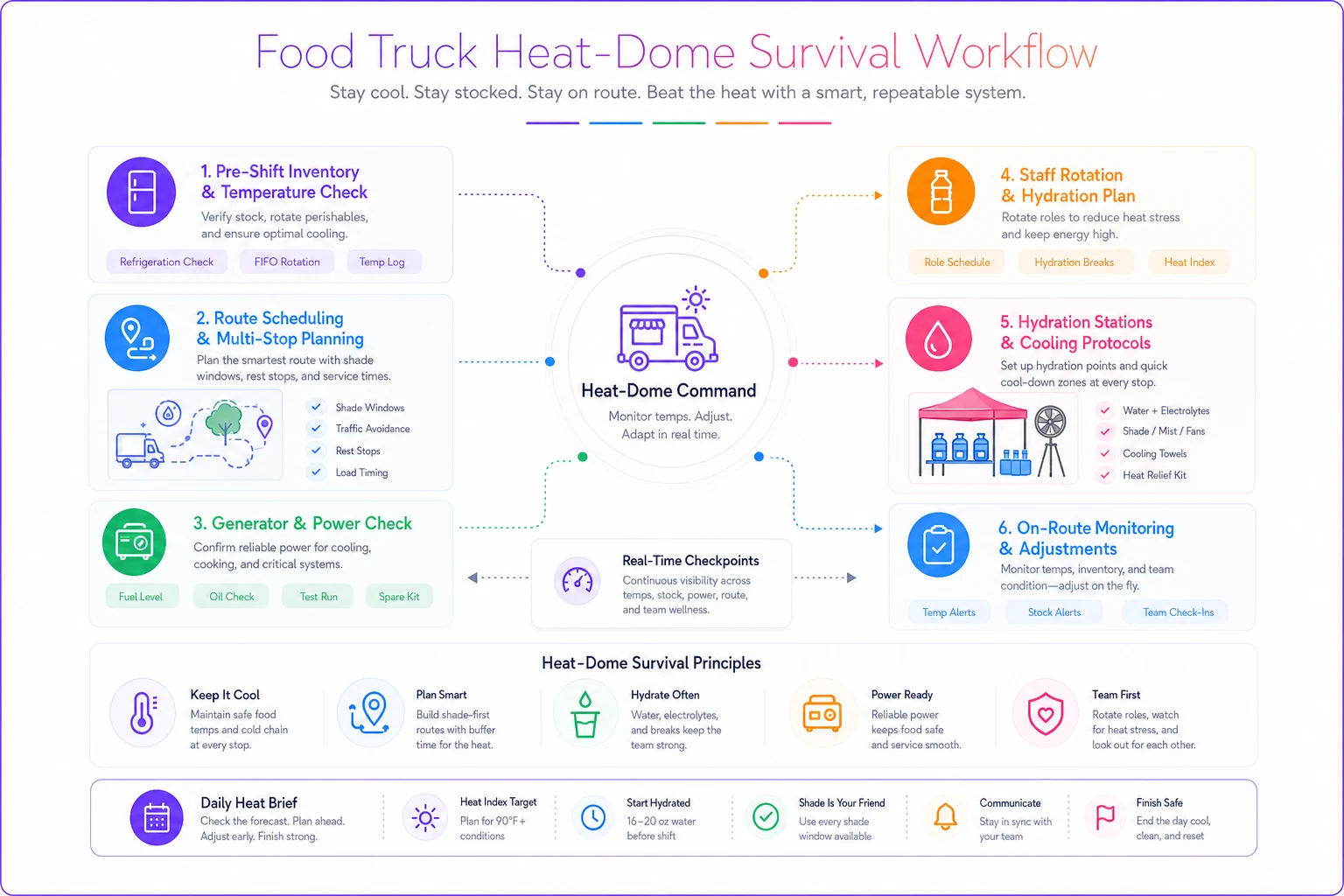
The checklist above is the core operating flow: prep less, stage smart, pick cooler locations, shorten stops, and watch your generator closely.
Staff safety protocols that actually work
Food truck heat safety isn't just about avoiding lawsuits. It's about keeping your team functional through brutal conditions. One person down with heat exhaustion means you're instantly operating at half capacity.
The 20/10/5 rotation rule
During anything above 95°F:
-
20 minutes maximum inside the truck
-
10 minutes mandatory break in shade or AC
-
5 minutes for hydration check
Set phone timers. Make it a system, not a suggestion.
Hydration tracking
Forget "drink when you're thirsty." By the time someone's thirsty working inside a hot truck, they're already behind.
Mandatory intake schedule:
-
16oz water every hour minimum
-
Electrolyte drink every 3rd hour
-
No caffeine after 10am
-
No energy drinks at all during heat events
A simple tracking sheet on a clipboard works fine:
| Time | Staff 1 | Staff 2 | Electrolyte? |
|---|---|---|---|
| 9am | ✓ | ✓ | - |
| 10am | ✓ | ✓ | - |
| 11am | ✓ | ✓ | ✓ |
| 12pm | ✓ | ✓ | - |
Early warning signs checklist
Train your team on these before someone actually goes down:
-
Stopped sweating (treat this as an immediate emergency)
-
Confusion about simple tasks
-
Stumbling or poor coordination
-
Headache combined with nausea
-
Flushed face with cool or clammy skin
An operator I know in Vegas built a "heat kit" for around $200: instant cold packs, electrolyte powder, cooling towels, a box fan, and a basic thermometer. He credits it with preventing three potential hospital trips last summer.
Set phone timers for the 20/10/5 rotation to make it automated and consistent during busy shifts.
Keeping staff safe keeps your operation running—treat these protocols as mandatory during heat events.
Menu engineering for heat waves
Your regular menu probably won't survive a heat dome intact. Smart operators shift their offerings temporarily to match what customers actually want and what's operationally feasible under the conditions.
Items that sell significantly more during heat waves:
-
Cold beverages (obviously)
-
Anything with watermelon
-
Salads and cold sandwiches
-
Frozen treats
-
Lighter proteins—fish tacos over beef burritos, that kind of thing
Items to temporarily 86:
-
Heavy cream-based sauces
-
Anything requiring extended hot-holding
-
Complex multi-component dishes
-
Mayo-based items
-
Delicate greens that wilt quickly
Prep method adjustments:
-
Switch grilled chicken to poached (can be prepped cold)
-
Use more pickled vegetables—longer shelf life
-
Lean on shelf-stable ingredients where you can
-
Reduce portion sizes slightly—people genuinely eat less in extreme heat
A Korean fusion truck I worked with last summer built a "heat wave menu" with five items instead of their usual twelve. Revenue went up roughly 15% because they executed faster and wasted less. They brought the full menu back once temps dropped below 90°F.
Real-time inventory tracking becomes critical
During normal operations, checking temps every few hours is fine. During a heat dome, that's not enough. The difference between catching a spike at 42°F versus 45°F can save you hundreds of dollars in prevented waste.
This is where having a real system for tracking your perishable inventory matters. You need timestamps, temp logs, and clear visibility into what's actually at risk.
A simple tracker looks like this:
| Item | Morning Temp | Noon Temp | 3pm Temp | Status | Action |
|---|---|---|---|---|---|
| Chicken breast | 38°F | 39°F | 41°F | Watch | Move to back |
| Shredded cheese | 37°F | 38°F | 39°F | Safe | - |
| Prep vegetables | 39°F | 41°F | 43°F | Risk | Use first |
| Sauce batch #3 | 38°F | 40°F | 44°F | Dump | Discard |
The key isn't just tracking—it's having clear thresholds that remove the decision-making from the moment. Hits 43°F, it's "use immediately." Hits 45°F, it's gone. No debate in the middle of a lunch rush.
Generator and equipment management
Your generator is your lifeline during heat events, and most food truck operators don't realize it needs different care when temps climb above 95°F.
Daily generator checklist for extreme heat:
-
Check oil level twice daily (heat thins oil faster)
-
Clean air filter every 2 days—dust and heat together cause clogging
-
Position with at least 4 feet of clearance on all sides for airflow
-
Add an auxiliary cooling fan if temps exceed 100°F
-
Keep spare fuel filters on hand
Power load management:
-
Avoid running all equipment simultaneously
-
Turn off non-essential lights during peak heat
-
Consider battery-powered fans instead of electric where possible
A Vietnamese banh mi truck owner showed me his setup last August—he'd installed a $300 auxiliary radiator fan system on his generator. Said it dropped generator temp by about 20 degrees and saved him from two shutdowns that had happened the week before.
Keep a close eye on both the generator and the cooling pathways to prevent cascading failures.
Financial impact and insurance considerations
A typical food truck operating through a 5-day heat dome is looking at real additional costs:
Additional costs:
-
Extra fuel
$40–60 per day
-
Additional ice
$40–50 per day
-
Increased food waste
$100–200 per day
-
Lost revenue from shortened hours
$200–400 per day
-
Potential equipment repairs
$500–2,000 per incident
That's roughly $1,900–3,600 in heat-related costs for a 5-day event, not counting potential equipment failure.
Insurance gaps worth checking:
-
Does your policy cover food loss from equipment failure?
-
Is heat-related equipment breakdown covered?
-
What's your business interruption coverage?
-
Are heat-related health incidents covered for staff?
Most standard food truck policies have exemptions for "extreme weather" that specifically exclude heat. One operator found out the hard way that their $3,000 compressor failure wasn't covered because heat damage was classified as "gradual deterioration."
Technology and monitoring
Old-school thermometers work, but Bluetooth temperature sensors—around $25 each—can alert your phone before problems escalate. Drop one in each cooler and you're getting notifications rather than discovering issues after the fact.
Basic operational software can help track patterns over time too. When you're logging temps, tracking waste, and monitoring equipment performance, you start seeing things—like your reach-in always spikes around 2pm, or certain menu items consistently spoil faster during heat events. That kind of data is useful the next time a heat dome rolls through.
A simple spreadsheet does the job. Purpose-built tools designed for mobile food operations can automate some of the flagging and pattern recognition, which matters when you're already stretched thin managing everything else. The goal either way is having enough information to make the right call when every degree counts.
The week after: recovery and lessons learned
Once the heat dome passes, the work isn't done. Post-heat recovery determines whether you're profitable for the month or underwater.
Immediate post-heat tasks:
-
Deep clean all refrigeration coils
-
Replace air filters
-
Check and document all equipment operation
-
Calculate actual food loss vs. prevented loss
-
Review which menu items survived best
-
Document which locations worked and which didn't
Team debrief questions:
-
Which protocols actually got followed?
-
What equipment failed or struggled?
-
Which menu modifications worked?
-
Where did we lose the most money?
-
What would we do differently?
The food trucks that consistently make it through extreme weather aren't lucky—they're systematic. They track what works, adjust based on data, and treat heat prep as seriously as food safety. That consistency is what separates the operations that come out roughly even from the ones that are still recovering two weeks later.
Building heat resilience into your operation
The difference between trucks that do fine in extreme heat and trucks that barely survive comes down to preparation and the ability to adjust quickly. You can't control the weather, but you can control how you respond to it.
Start with the basics: reduce inventory, adjust routes, protect your staff. Then build toward more sophisticated approaches—menu engineering, power management, temperature monitoring. Each heat event shows you something about your operation's weak points.
With federal heat safety resources now tracking these events more closely, heat domes are becoming more frequent and more intense. This isn't a once-a-summer problem anymore. It's a regular operational challenge that needs built-in procedures, not improvised responses.
A food truck in Austin that's survived eight years of Texas summers put it plainly: "We treat heat weeks like a different business model entirely. Different menu, different hours, different locations, different expectations. Once you stop fighting the heat and start working with it, it gets manageable."
That's not a bad way to think about it. The trucks making it through these heat domes aren't just surviving—they're building operational knowledge that makes them more durable over time. They know which equipment needs upgrading, which menu items hold up best under pressure, and which protocols their teams will actually follow when things get tough. When the forecast shows triple digits next time, they won't be scrambling. They'll have a plan that's already been tested.
Start small, test changes during less severe heat, and codify what works. Heat resilience is operational work—do it deliberately and you'll protect profits and people.
Ready to drive your food truck business forward?
Join 2,000+ food truck operators relying on Grubzly to boost efficiency, increase sales, and delight customers.