

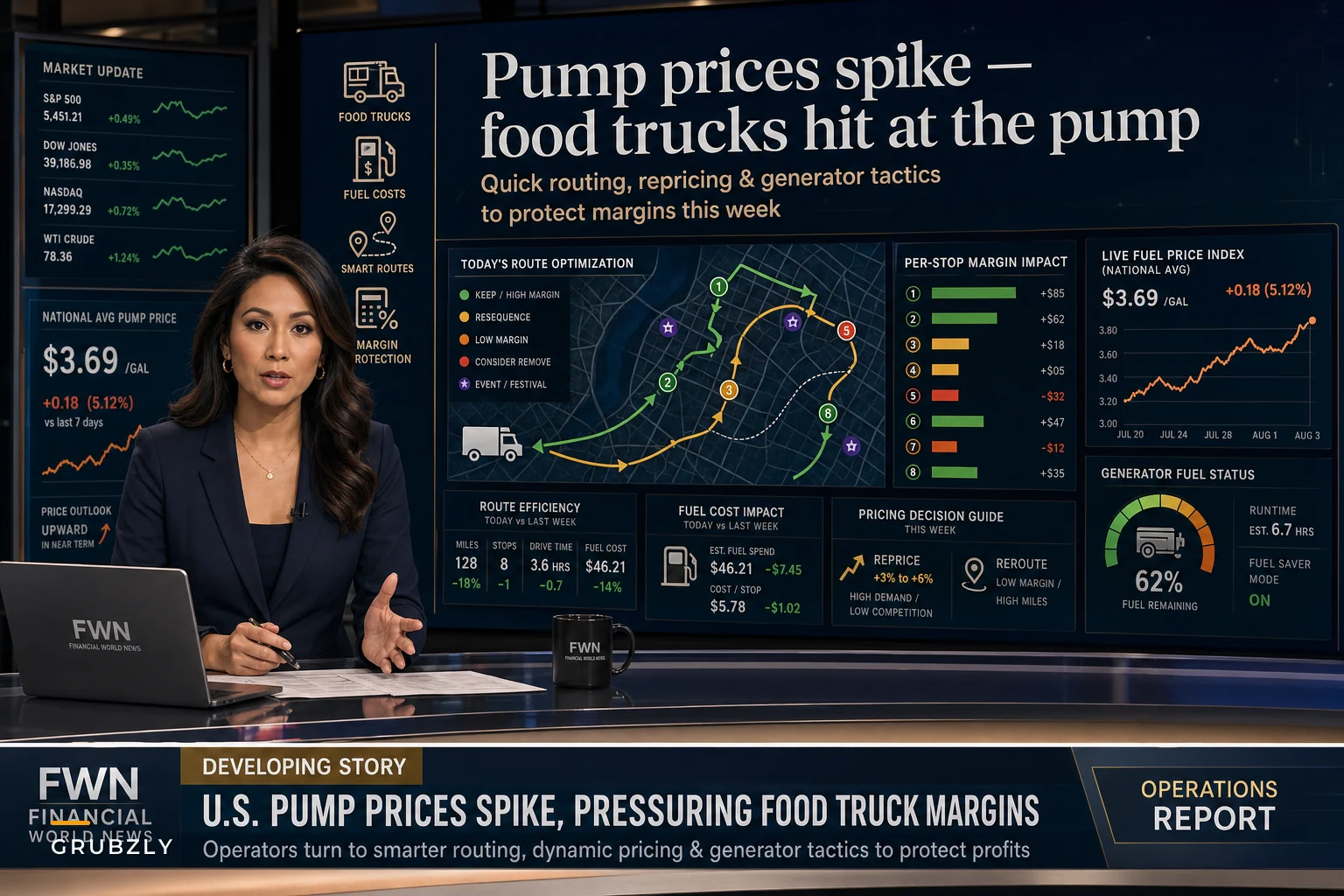

Gas prices crossed $4 nationally this week, with diesel hitting $4.35 in major metro areas. Reuters reported yesterday that renewed Middle East supply disruptions pushed pump prices up 18% in just two weeks. For food trucks running 80-100 miles daily plus generators for 6-8 hours, that's an extra $35-50 hitting your daily operating costs right now.
Most operators absorb these spikes for weeks before doing anything, watching margins evaporate while hoping prices come back down. But fuel costs for food trucks don't stop at the tank — they ripple through generator burns, commissary runs, supplier delivery fees, and eventually force a choice between eating the cost or raising prices and losing customers.
The trucks that survive without torching their margins don't wait. They adjust routing immediately, tweak generator habits, implement surge pricing on high-fuel days, and know exactly which stops can handle a 50-cent bump versus which ones will disappear over a quarter.
Your real fuel burn goes way beyond what shows at the pump
Food trucks burn fuel in ways that brick-and-mortar restaurants never have to think about. There's the obvious drive miles between stops, but also idling in traffic downtown, generator fuel during service, extra commissary runs when you understock, and those profit-killing detours when your regular spot gets poached by another truck.
A typical taco truck running five stops across a 25-mile radius burns roughly:
-
4-5 gallons driving between stops
-
2-3 gallons in generator fuel during service
-
1-2 gallons in traffic and repositioning
-
Another gallon on commissary runs
At $4.20 per gallon, that's $42-50 daily in fuel alone. When prices spike to $4.80, you're looking at $48-58. Doesn't sound catastrophic until you multiply by 25 operating days — suddenly you're down $200-250 monthly before you've touched a single menu item.
The hidden burns hurt worse. That private event 35 miles out that looked profitable at $3.50 gas? Now you're underwater once you factor round-trip fuel plus generator time. The suburban office park that orders heavy? Their twice-weekly delivery now comes with supplier fuel surcharges that cut straight into your margins before you've sold a thing.
Three stops that kill profits when fuel spikes — and which ones actually get better
Downtown office workers handle small bumps without blinking — they're expensing lunch or earning enough that 75 cents doesn't register. But they'll leave instantly if quality drops or wait times increase because you cut staff to offset fuel costs.
Stop losing sales to poor planning.
Grubzly helps you plan routes, track inventory, and maximize daily sales effortlessly.
- Real-time route optimization
- Inventory tracking & alerts
- Mobile sales & reporting
No credit card required
College campus stops work differently. Students notice every quarter increase, but they're captive audiences with limited alternatives. They'll grumble about paying $11 instead of $10 for a loaded burrito, but if you're the only truck on campus at 11pm, they'll still buy.
Construction sites and blue-collar stops are the trickiest. These customers are intensely price-sensitive but also loyal in a way downtown crowds aren't. They'll follow you through a 50-cent increase if you're upfront — "diesel's up, everything costs more to get here" — but sneak prices up without saying anything and you'll lose the whole crew permanently.
Brewery and food hall spots can actually improve during fuel spikes. These customers already expect premium pricing, and your $14 Korean BBQ bowl looks reasonable next to the brewery's $18 burger. You're also often plugged into venue power, which eliminates generator costs entirely.
The worst mistake is applying blanket price increases across all stops. Your downtown loop can absorb a dollar increase that would wreck your industrial park route. Track order volumes by stop for a couple weeks after any price change — if volume drops more than 15%, you've pushed too hard for that demographic.
Reroute first, reprice second: the sequencing that saves your customer base
Knee-jerk price increases destroy customer relationships you spent months building. Before touching menu prices, go after routing inefficiencies.
Pull your last month's actual routes — not what you planned, but what you actually drove. Map them honestly. Every food truck running multiple stops has at least 15-20% wasted miles hiding in the daily pattern. Maybe you're backtracking through downtown because you hit stops in the order you registered them rather than geographic sequence. Or you're burning six miles round-trip for a construction site that orders maybe $80 worth on a good day.
Start with stop consolidation. That 11am spot averaging $120 in sales — can you push them to your 12:30 slot two blocks away? Customers adjust to schedule changes faster than price increases. Combine your 2pm and 3pm suburban stops into one 2:30 stop. You'll lose a few regulars but save 8 miles plus repositioning time.
Kill marginal routes entirely during spike periods. The Wednesday farmers market 18 miles out that brings $250 in sales? After fuel, time, and the opportunity cost of skipping closer stops, you're barely breaking even. Take those Wednesdays to work dense commercial areas where you can park once and serve 150 people without moving.
Industrial breakfast routes often hide the worst fuel economics. Driving 20 miles out at 6am to serve 30 construction workers, burning fuel half-asleep, then racing back for lunch prep — calculate the real hourly profit after fuel. A lot of breakfast routes actually lose money once gas crosses $4.
Here's a simple visual to follow for rerouting and stop consolidation.
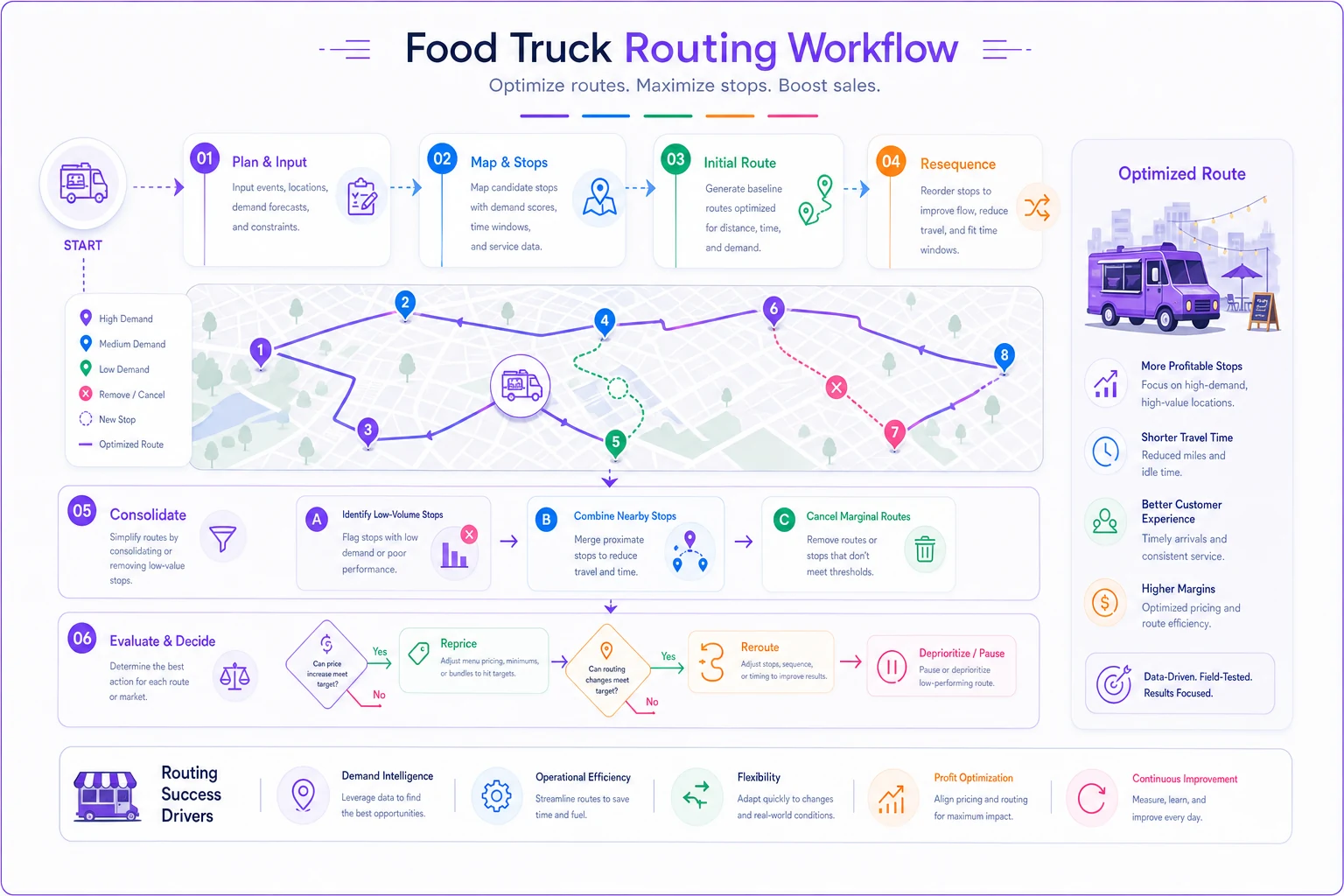
The visual shows where to cut mileage and which decision points trigger price changes.
Generator economics: why running at 70% capacity costs less than you think
Generators burn money in ways most operators never properly calculate. A 7kW Onan burns around 0.5 gallons per hour at half load but jumps to 0.8 gallons at full load. Running all your equipment simultaneously doesn't just burn more fuel — it burns disproportionately more per unit of power generated.
| Equipment | Load | Fuel burn |
|---|---|---|
| 7kW Onan | half load | 0.5 gallons per hour |
| 7kW Onan | full load | 0.8 gallons per hour |
| 2kW portable | n/a | 0.1 gallons per hour |
Running your generator at 70% capacity instead of maxing it out saves roughly 0.2 gallons per hour. Across a 6-hour service day, that's 1.2 gallons — around $5 daily or $125 monthly. Not life-changing, but it adds up when you're already getting squeezed at the pump.
Stagger equipment use (pre-heat in stages) to avoid the startup surge that spikes fuel burn.
Sequence your equipment usage. Don't run the fryer, grill, and warming lights simultaneously if you can alternate. Pre-heat in stages rather than firing everything at once. That initial startup surge when you flip everything on at the same time drinks fuel fast.
Shore power changes the math entirely. Every hour you're plugged into venue power instead of running your generator saves $3-4 in fuel costs. Breweries, food halls, and some office complexes offer truck hookups — sometimes free, sometimes $20-30. If you're serving 4+ hours, paying $30 for shore power beats burning $16-20 in generator fuel plus the wear on your equipment.
The generator mistake that gets a lot of operators: running it during prep and cleanup. You don't need 7kW to run LED lights and charge your phone. A small 2kW portable generator runs around $400 and sips fuel at 0.1 gallons per hour — it handles all your non-cooking power needs fine. Save the big generator for actual service hours.
Dynamic pricing without losing regulars: the Wednesday surcharge model
Nobody wants to be the truck that changes prices daily. But absorbing fuel spikes silently kills the business slowly, and your customers are already watching prices at the grocery store. The solution is somewhere between fixed pricing and chaos: structured surge pricing that customers can actually anticipate.
The Wednesday surcharge model works because it's predictable and transparent. Every Wednesday, check AAA's fuel price average. If gas exceeds $4.00, add a 50-cent fuel surcharge across all items. If it exceeds $4.50, make it 75 cents. Post the policy clearly and stick to it.
Customers accept transparent fuel surcharges far better than hidden price increases. "Fuel surcharge: 50¢ (gas at $4.20)" on the menu board gets nods. Silently raising your taco price from $3 to $3.50 gets resentment and abandonment.
Some operators implement stop-based surge pricing — downtown stops handle a dollar surcharge that would kill suburban routes. Construction sites accept fuel surcharges but revolt against anything framed as "premium location pricing." Know your stops.
Test split pricing on combo meals versus individual items. Instead of adding 50 cents to every item, add a dollar to combo meals only. A $10.50 combo becoming $11.50 lands differently than $3 tacos becoming $3.50, even when the math is similar. Psychology matters more than logic when customers are deciding whether to come back.
Never surprise customers with checkout surcharges. If you're adding fuel costs, display it prominently before they order. The fastest way to lose regulars is making them feel ambushed at payment.
The stops you should drop immediately when diesel hits $4.50
Some routes become mathematical impossibilities at certain fuel prices. That suburban office park 22 miles from your commissary might work at $3.50 gas but bleeds money at $4.50. The question isn't whether customers love you there — it's whether the numbers support showing up.
Calculate your real per-stop fuel cost including:
-
Round-trip miles from commissary
-
Generator hours at that stop
-
Positioning miles between this and adjacent stops
-
Return journey fuel if it's your last stop of the day
Any stop requiring more than 15 miles round-trip solo needs to clear at least $200 in sales to justify itself at $4+ fuel prices. Factor fuel, time opportunity cost, equipment wear, and the sales you'd make at closer stops instead.
Office complexes with a single anchor tenant get dangerous during spikes. Driving 18 miles to serve one company ordering $150 worth — what happens when they have an all-hands meeting, a summer Friday, or just decide to cater instead? You've burned $12 in fuel to make zero.
Special event commitments made at lower fuel prices can torpedo your margins mid-season. That weekly jazz festival 30 miles out seemed smart at $3.20 gas, but now you're locked into a money-losing route through peak season. Calculate the penalty for breaking the commitment versus the loss from continuing — sometimes eating the cancellation fee beats bleeding out over three more months.
The rural weekend festival circuit suffers especially hard during spikes. Driving 40+ miles, running generators for 8 hours, competing with 20 other trucks for price-sensitive customers. Unless you're the only BBQ truck at a vegan festival, these routes rarely survive $4+ fuel.
Subscription models that lock in revenue while floating fuel costs
Pre-sold subscription meals handle fuel price volatility better than almost any routing optimization. When customers prepay for weekly meals, you've locked revenue while maintaining pricing flexibility for future subscribers.
The model that works: sell 5-meal packages for $55-60, redeemable over two weeks. Customers get a small discount, you get guaranteed revenue, and you know exactly how many meals to prep and where demand is coming from. No gambling on whether that office park orders enough to justify the drive.
Where operators mess up subscription economics during fuel spikes: locking in annual pricing without fuel adjustment clauses. Sell monthly packages with clear terms — "pricing valid for 30 days, subject to fuel surcharge if gas exceeds $4.25." Customers who prepay understand they're locking in the base price, not immunity from market conditions.
Route subscription customers differently than walk-ups. Designate subscription pickup windows — 11:45-12:00 for subscribers, 12:00-1:30 for regular service. This lets you knock out 20-30 subscription pickups in 15 minutes without the order-taking slowdown. Essentially two different businesses running off one truck.
Some trucks create "fuel co-ops" with regular customers. Groups of 10 or more who commit to weekly orders get locked pricing regardless of fuel costs. In exchange, they accept limited menu options and specific pickup times. An office that guarantees 15 orders every Tuesday at noon is worth protecting from surge pricing.
The subscription mistake that kills: offering delivery without serious volume minimums. Unless an office commits to 25+ meals, delivering subscription orders destroys your margins. Make them come to you, or charge delivery fees that actually cover costs — usually $30-40 minimum for any dedicated delivery run.
Building fuel reserves into your weekly cash flow cycle
Fuel spikes hurt most when you're running tight cash flow, forcing you to absorb cost increases immediately rather than adjusting strategically. Operators who get through price spikes without panic built their buffer before the crisis hit.
Every week, regardless of current fuel prices, add a 10% fuel reserve to your operating calculations. If you're spending $300 weekly on fuel, operate as if you're spending $330. That extra $30 goes into a designated fuel reserve account. After 10 weeks, you've got a $300 buffer — roughly one full week of fuel costs sitting ready.
That reserve buys you time. When fuel jumps 60 cents per gallon overnight, you have two weeks to implement strategic changes rather than panic reactions that damage customer relationships.
Track fuel as a percentage of revenue, not just raw dollars. Most food trucks should keep fuel under 8% of gross revenue. If you're pushing 10-12%, you're either running inefficient routes or underpricing for your service areas. At 15%, you're essentially running a fuel-burning operation with food attached.
Implement weekly fuel reconciliation. Every Sunday, calculate:
-
Actual fuel spent
-
Miles driven
-
Revenue per mile
-
Fuel cost per dollar of revenue
When fuel cost per revenue dollar increases 20%, that's your trigger for route and pricing adjustments. Don't wait until you're already underwater.
The Tuesday morning route audit that keeps fuel from killing margins
Tuesday mornings work well for route audits — you've got Monday's fresh data and enough time to adjust for the rest of the week. Pull your actual routes from last week, not what you planned but what you actually drove. Most operators discover they're covering 20-30% more miles than they thought.
Start with your stop-to-stop transitions. That downtown lunch circuit hitting four stops — map the actual path you drove. Operators often fall into comfortable patterns rather than efficient ones. Simply resequencing stops can save 3-5 miles daily, which works out to $5-8 in fuel or $125-200 monthly just from changing the order you visit the same stops.
Identify your "hope stops" — places you drive to hoping for sales without confirmed demand. That corporate campus where you sometimes get 20 orders but often get 5? Calculate the fuel cost of the empty runs. Hope stops get cut first when fuel spikes.
Check your commissary trips. Are you making daily runs because you understock? Every extra commissary trip costs $8-12 in fuel plus an hour of time. Overbuying by 10% and managing waste beats multiple commissary runs every week.
Your data-driven routing system becomes critical when margins tighten. Knowing exactly which routes work at different fuel price points lets you adjust immediately rather than discovering losses weeks later through P&L reviews.
Fuel hedging strategies from trucks running 100+ miles daily
High-mileage operators have developed fuel hedging tactics that smaller operations should borrow. Not trading oil futures — practical stuff to smooth out fuel cost volatility.
Fleet fuel cards with volume discounts start making sense around 300 gallons monthly. EFS and Comdata cards knock 3-8 cents off per gallon and give you weekly billing instead of daily cash drain. That's $10-25 saved monthly, plus better cash flow visibility.
Bulk fuel purchasing for generators makes sense if you have storage. A 100-gallon auxiliary tank runs $400-600 but lets you buy when prices dip rather than when you're desperate. Some operators split bulk storage with other trucks to reduce individual cost and risk.
Partnering with complementary trucks on route sharing works better than most operators expect. If another truck covers your area on different days, coordinate schedules — you take Monday, Wednesday, Friday; they take Tuesday, Thursday, Saturday. Both trucks save fuel while maintaining coverage. Customers adjust to schedule changes faster than losing their favorite truck entirely.
The warehouse membership fuel strategy is underused: Costco and Sam's Club fuel runs 20-30 cents cheaper than regular stations. The membership pays for itself in two fill-ups. Time your runs for off-peak hours — early morning or late evening when lines are short.
Some operators pre-buy fuel contracts with local suppliers, locking in prices for 500-1,000 gallons at current rates. This requires capital and storage but eliminates price volatility for 6-8 weeks of operation. Split contracts with other trucks to reduce individual exposure.
Why Wednesday's $4.20 gas means changing Thursday's route now
Fuel price spikes create delayed reactions that faster operators can exploit. When prices jump Wednesday, most trucks don't adjust until the following week. That gap creates opportunity for anyone willing to move immediately.
Audit Thursday and Friday's planned routes right away. Cancel marginal stops before you drive them, not after losing money on them. That suburban office park expecting you Friday — if the math doesn't work, call them Thursday morning with options: "Fuel's up 60 cents — I can do delivery for a 20-meal minimum, or you're welcome at our downtown stop."
Competitors who don't adjust quickly often abandon remote routes, creating temporary monopolies. If you're the only truck willing to temporarily absorb fuel costs at an isolated office complex, use that as leverage: "I need 25 guaranteed orders to make this drive work at current fuel prices." Most locations would rather guarantee volume than lose food truck service entirely.
Same-week menu adjustments for generator-intensive items make sense too. Fried options that require 20 minutes of fryer time — adding a 50-cent "preparation surcharge" immediately is easier to explain than a blanket menu price increase. Customers understand that energy-intensive cooking costs more when fuel spikes.
The coordination opportunity most operators miss: partner with other affected businesses. That craft coffee truck also getting squeezed on fuel? Run combined stops, park adjacent, share customer traffic, split location fees. Customers get variety, you both reduce per-stop fuel costs.
Contact your regular catering clients immediately with surcharge notices for upcoming events. "Events booked after July 20 include a $30 fuel surcharge due to current prices." Better to lose a marginal gig now than eat $50 in fuel costs at the event next month.
Turning fuel crisis into competitive advantage
While competitors are panicking, this is actually a decent time to fix things you've been ignoring. Every fuel crisis forces you to look at routes, stops, and processes you've been running on autopilot.
Those marginal stops you finally cut? They were probably losing money even at lower fuel prices — you just hadn't run the numbers honestly. The routing efficiency you tightened up? Keep it when prices drop and pocket the savings. The generator discipline you developed out of necessity? That's permanent margin improvement.
Fuel spikes also shake out weak competitors. The truck that was barely surviving at $3.50 disappears at $4.50, leaving their stops open. Build a list of competitor routes and be ready to move on their best stops when they fold. That downtown office building they served every Tuesday — you can add it to your route with minimal deviation.
Customer communication during fuel crises builds loyalty that's hard to earn otherwise. The truck that explains surcharges transparently, offers alternatives, and maintains quality despite getting squeezed earns real respect. People remember who disappeared when things got hard versus who found ways to keep showing up.
Document what you learn during this spike. Which stops absorbed price increases? Which routes survived cuts? Which operational changes actually worked? This becomes your playbook for next time — and there's always a next time.
The trucks that come out ahead through fuel volatility don't just survive the spike. They emerge leaner and better positioned when stability returns. Your competition is hoping prices drop quickly. You're building systems that work regardless of what's showing at the pump.
Ready to drive your food truck business forward?
Join 2,000+ food truck operators relying on Grubzly to boost efficiency, increase sales, and delight customers.