


Most food truck operators don't lose money on permits because they forget to renew. They lose money because their permit knowledge lives inside one person's head, three email inboxes, and a glovebox folder that's slowly turning into a science experiment.
The pattern repeats constantly: a truck runs clean for eighteen months, expands into a second city for weekend events, adds a couple of festival gigs, and then one Saturday morning a market coordinator asks for the current health permit and the mobile food facility number — and nobody on the truck can find either one. The event turns them away. That's an $1,800 day gone, plus the deposit, plus the standing invite for next season that quietly evaporates.
That's not a paperwork problem. That's a systems problem. Once you're operating across more than one jurisdiction, the number of things that can silently expire, conflict, or go missing grows faster than most operators expect. A real food truck permit management system isn't a folder — it's a set of connected workflows that tell you what's active, what's about to lapse, and who's responsible for fixing it before it becomes a closed stop.
Below is where these systems actually break, because the failure points are more predictable than they look.
Why permits fail differently once you leave your home city
Single-city operators usually get away with a loose approach. You know your county health department, you know your fire marshal's inspection cadence, and the renewal notices land in the same inbox every year. The whole thing fits in your head.
The moment you add a second jurisdiction, three things change at once — and this is where most operators underestimate the complexity:
Permit types stop matching up. One city wants a Mobile Food Facility permit tied to a commissary agreement. The next county wants a separate health permit plus a temporary event permit for each festival. A third has a fire suppression inspection that's completely independent of the health cycle. You're no longer tracking "the permit." You're tracking a matrix of permit types × jurisdictions, and each cell has its own renewal window and its own issuing office.
Renewal timelines stop lining up. Your home city might renew annually every January. The neighboring county renews on the anniversary of your application date — which could be some random Tuesday in August you've long forgotten. Event permits might need to be filed 14 days out, or 30, depending on the organizer. When these cycles don't sync, you get a rolling series of near-misses instead of one clean renewal season.
Ownership gets fuzzy. In a one-truck operation, you handle permits. Add a second truck and a couple of part-time staff, and suddenly it's unclear whether the owner, the manager, or nobody is watching the Riverside County renewal. Permits fall through the cracks precisely during the growth phase — when everyone assumes someone else has it covered.
The through-line: permit failures aren't usually about laziness. They're about a tracking system that worked fine at one scale and quietly stopped working at the next.
The central permit tracker: one source of truth or nothing
If you take one thing from this article, make it this — you need a single central tracker that every permit flows through, and it has to answer four questions instantly:
Stop losing sales to poor planning.
Grubzly helps you plan routes, track inventory, and maximize daily sales effortlessly.
- Real-time route optimization
- Inventory tracking & alerts
- Mobile sales & reporting
No credit card required
-
What permits do we currently hold?
-
Which jurisdiction and which stop does each one enable?
-
When does each one expire?
-
Who owns the renewal?
Most operators think they have this because they have a folder of PDFs. A folder doesn't answer questions — it just stores documents. The difference matters. A real tracker is a live table you can scan in thirty seconds and know exactly where you stand.
Here's a minimal structure that actually works across multiple cities:
| Permit / License | Jurisdiction | Enables | Issue Date | Expiry | Renewal Lead Time | Owner | Status |
|---|---|---|---|---|---|---|---|
| Mobile Food Facility | Home County Health | All home-city stops | 01/12 | 01/12 | 45 days | Owner | Active |
| Commissary Agreement | Home County Health | Home MFF requirement | 01/12 | 01/12 | 30 days | Owner | Active |
| Health Permit | North County | Weekend market route | 08/03 | 08/03 | 30 days | Manager | Renew soon |
| Fire Suppression Cert | Home Fire Marshal | Cooking on-site | 04/22 | 04/22 | 60 days | Owner | Active |
| Temporary Event Permit | City Festival Office | Summer festival series | per event | per event | 14 days each | Manager | Pending |
| Seller's Permit | State | Tax on all sales | 06/01 | — | N/A | Owner | Active |
Notice what this table forces you to do. It separates enables from expiry, so you can see that a lapsed commissary agreement doesn't just cost you a document — it invalidates your Mobile Food Facility permit, which shuts down every home-city stop. Those dependency chains are exactly what operators miss when everything lives in a folder.
The renewal lead time column is the one people skip, and it's the most important. A permit that "expires in January" and one that "needs to be filed 45 days before it expires and takes three weeks to process" are two completely different deadlines. Your tracker should be built around the file-by date, not the expiry date.
A simple visual of the tracker and triggers helps teams see responsibility at a glance.
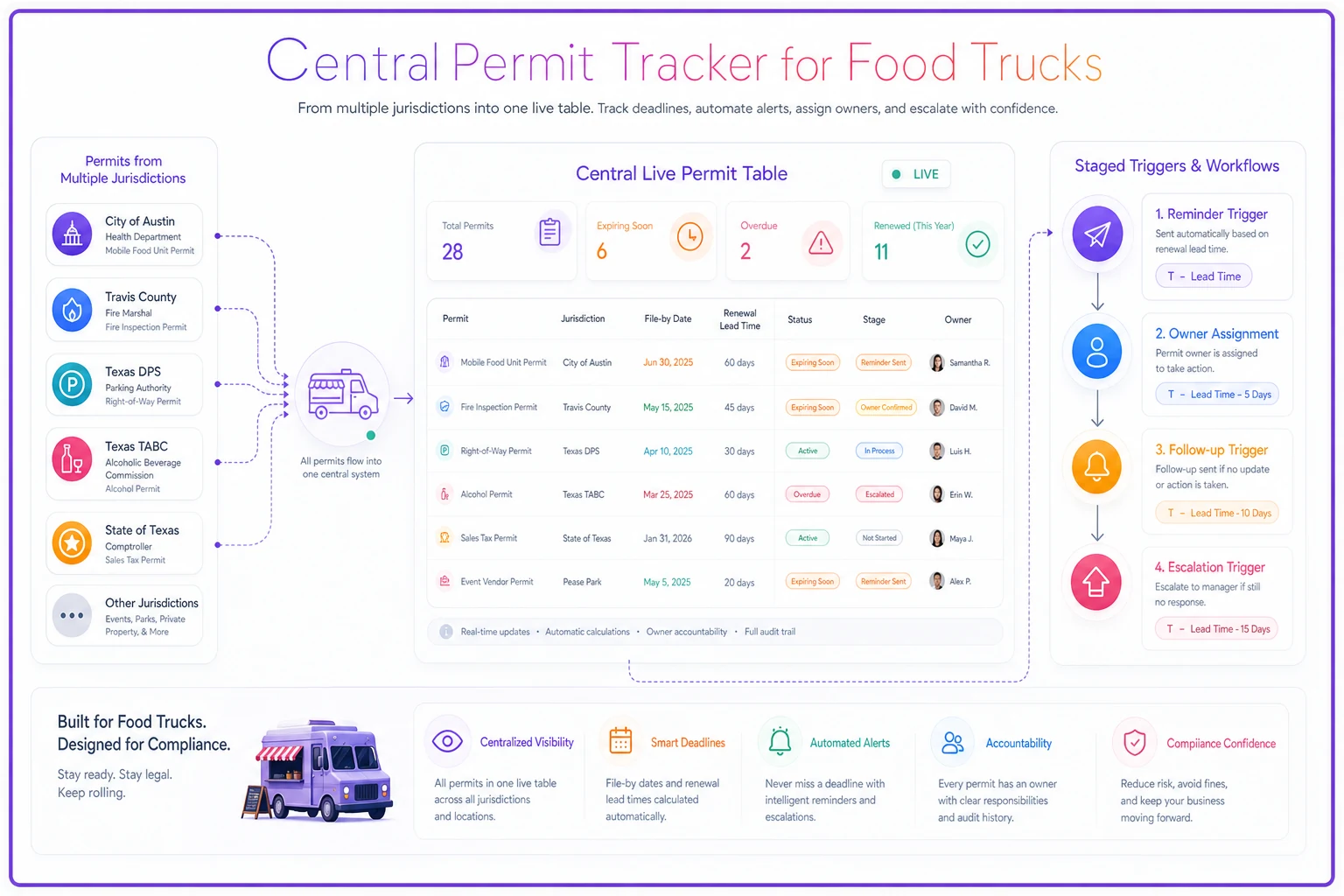
That visual ties the table to the actions it needs: who files, when they file, and what a missed dependency would break.
The renewal SLA matrix: turning deadlines into triggers
A tracker tells you the state of things. It doesn't act. The piece that actually prevents lapses is a renewal SLA matrix — a set of rules for when action has to start and who it lands on.
Think of it as three trigger stages per permit:
-
First trigger (lead time + buffer) The owner gets a heads-up. For a health permit with a 30-day processing window, this might fire at 60 days out. Nothing urgent yet — just "start gathering documents."
-
Second trigger (action deadline) This is the real one. If the renewal hasn't been submitted by this date, you're now at risk of missing stops. This fires at, say, 35 days out.
-
Escalation trigger (danger zone) If it's still not handled, this jumps to a second person — a partner, a co-owner, whoever the backstop is. No single point of failure.
A two-truck operation working four cities typically has somewhere around 10 to 12 active permits and licenses across all jurisdictions. Without staged triggers, most operators treat every renewal as a fire drill — someone notices an expiry is two weeks out and scrambles. After mapping each permit to a lead time and a first-trigger date, renewals spread into a manageable rhythm of one or two per month instead of a chaotic clump every quarter.
Build the first trigger with an extra buffer beyond published processing times when a jurisdiction's turnaround is unpredictable.
This is where an operational platform earns its place. Manually watching a dozen different lead-time windows across four jurisdictions is exactly the kind of thing that breaks the moment life gets busy. Setting expiry triggers inside a shared system — with automated reminders that escalate if nobody acts — takes the "remembering" out of the equation entirely. The point isn't automation for its own sake; it's that a lapsed permit should be operationally impossible to sneak up on you.
Jurisdictional checklists: because no two cities want the same thing
The tracker and the SLA matrix handle timing. Jurisdictional checklists handle content — what each city actually requires, which varies more than most operators expect.
The mistake is treating "renew the North County permit" as one task. It's not. It's a bundle: updated commissary letter, current fire cert, proof of insurance naming the county, a completed application form, and a fee paid through a specific portal that only accepts payment on business days. Miss any one piece and the whole renewal stalls.
-
[ ] Current health permit copy (color scan, both sides)
-
[ ] Commissary agreement dated within the last 12 months
-
[ ] Fire suppression inspection certificate (must be under 12 months old)
-
[ ] Certificate of insurance naming the city as additional insured
-
[ ] Completed MFF application (this year's form, not last year's — cities change them)
-
[ ] Seller's permit number
-
[ ] Manager food safety certification on file
-
[ ] Fee paid via city portal (allow 3 business days to clear)
These checklists aren't just for renewals. They're your fastest answer when a market coordinator asks for documentation on the spot, and they're what you hand a new manager so they can run a renewal without you. A checklist that lives only in your head can't be delegated — and un-delegatable work is exactly what caps a growing operation.
The handoff pack: what relief staff need when you're not there
Here's a failure point almost nobody plans for: you're sick, or on the road, or dealing with a truck that broke down, and someone else has to run a stop — including proving the truck is legally allowed to be there.
Relief staff don't need your whole system. They need a handoff pack — a tight bundle that lets them answer any permit question at a stop without calling you five times.
-
A one-page permit summary — a printed version of the tracker table, showing what's active and what enables each stop.
-
A physical and digital copy of every current permit, organized by city, so they can produce the right document in under a minute.
-
A "who to call" sheet — the issuing office phone numbers, the commissary contact, and your insurance agent, in case something needs verification on the spot.
-
A short script for common situations — what to say if an inspector shows up, what to do if a coordinator questions a permit, and the hard rule that if a required permit can't be produced, the stop doesn't operate. That last line prevents a well-meaning fill-in from running an unpermitted stop and turning a paperwork gap into a fine or a suspension.
Operators who handle this well keep the handoff pack updated as part of the same renewal workflow — when a permit renews, the pack gets refreshed. When it lives in a shared platform, the relief person pulls up the current version instead of digging through whatever was printed six months ago. Legal readiness shouldn't depend on which person is standing at the window.
How this connects to the rest of your operation
Permits don't live in isolation. Your permit matrix directly shapes where you're allowed to route, which means it feeds straight into route planning. There's no point optimizing a weekly route plan for dense urban zones if two of the stops on it sit in a jurisdiction where your permit lapsed last month. The routing decision and the permit status are the same decision, viewed from two angles.
The same goes for events and catering. A festival series you booked in March needs its temporary event permits filed 14 days before each date — and if that trigger isn't connected to the same system that tracks your bookings, you'll find yourself confirmed for an event you're not actually permitted to work.
When permits, routes, and bookings live in one operational picture, conflicts surface before they cost you. When they live in separate places, they only surface at the stop, in front of a coordinator, on the day.
When a full system is overkill — and when it isn't
Not every operator needs the whole apparatus above.
If you run one truck in one city with two or three permits total, a well-maintained spreadsheet with calendar reminders is genuinely fine. Don't build a four-city SLA matrix for a two-permit operation. The overhead isn't worth it and you'll stop maintaining it within a month.
The system becomes worth it the moment any of these are true: you're operating in more than one jurisdiction, you have more than about six active permits and licenses, someone other than the owner might need to run a stop, or you're doing event and festival work with per-event permitting. Those are the conditions under which "it's all in my head" starts costing real revenue.
An operator planning to stay small and local, with a stable single-city permit set, is better off spending their energy elsewhere. The failure mode there isn't complexity — it's just forgetting one annual renewal, which a single recurring calendar alert solves.
A real scenario
A two-truck operation working a home city plus three nearby jurisdictions for weekend markets and a summer festival circuit had about nine active permits and a handful of per-event temporary permits on top. Their tracking was an email folder and the owner's memory.
Over one summer they lost two market days — one because the fire suppression cert had lapsed and the market required proof, another because a temporary event permit was filed two days late and got rejected. Between lost sales, forfeited deposits, and one apologetic offer to comp the organizer, those two misses ran somewhere around $3,000, plus the intangible hit of a coordinator who stopped returning calls.
The fix wasn't complicated. They built a central tracker, mapped each permit to a file-by date with a 60-day first trigger, and wrote one jurisdictional checklist per city. The handoff pack meant their weekend manager could produce any document without calling the owner. The following season they didn't miss a single stop for a permit reason — and renewals stopped being a source of Saturday-morning panic and became a quiet monthly task that took maybe twenty minutes.
The real takeaway
Permit management feels like admin, which is exactly why it gets neglected until it bites. But operationally, your permits are your right to generate revenue at each stop. A lapsed permit isn't a paperwork inconvenience — it's a closed location, a forfeited deposit, and sometimes a relationship you don't get back.
The operators who never get surprised aren't the ones with better memories. They're the ones who stopped relying on memory entirely — who put every permit into one tracker, wired every renewal to a trigger that fires early enough to matter, wrote down what each city actually requires, and made sure any person standing at the window could prove the truck belongs there. Build that once, keep it current, and permits move from being the thing that ruins a Saturday to the thing you barely think about.
Ready to drive your food truck business forward?
Join 2,000+ food truck operators relying on Grubzly to boost efficiency, increase sales, and delight customers.