


Tip money causes more crew friction on food trucks than almost anything else, and it's rarely about the total dollar amount. It's about fairness perception and record-keeping gaps. When your card reader dumps $180 in tips onto one shift's batch three days late, and your grill cook remembers working the busy Saturday but the payout doesn't reflect it, that's when the "you're stealing from us" conversations start.
The tricky part for mobile teams is that the standard tip-pooling advice assumes a fixed location, reliable POS syncing, and a back office. You have none of that. Your tips arrive as a messy mix of cash in a jar and card tips that reconcile whenever the POS finally talks to the server. So this is a food truck tip pooling policy that survives dead zones, tiny crews, and the kind of scrutiny a state labor auditor brings.
The core problem: your tips exist in two systems that don't agree
On a truck, tips split into two flows that behave completely differently.
Cash tips are immediate, physical, and undocumented unless you write them down on the spot. Card tips are documented but delayed — sometimes by hours, sometimes days, depending on when your reader syncs. If your POS runs offline during a park shift and syncs at 9pm when you get back to the commissary, the card tip totals for that shift don't "exist" in any system until then.
This gap is where disputes are born. A typical example: a crew of three works a festival. They pool cash at the end of the night and split it three ways on the spot — easy. But the $240 in card tips doesn't post until Monday. By the time it's split, one person has quit, another swears the totals are wrong, and nobody wrote down who actually worked which hours. Now you're reconstructing a pay decision from memory, and memory always favors the person telling the story.
The fix isn't a fancier system. It's deciding your rules before the money shows up, and recording the inputs at the moment they happen — not the payouts.
Pick a pooling model that matches a 2–4 person truck
Most tip-pooling frameworks were written for restaurants with servers, bussers, bartenders, and hosts. On a truck you've got maybe a window person, a cook, and an owner who floats. The role-based "points" systems built for restaurants collapse into pointless complexity at this scale.
Stop losing sales to poor planning.
Grubzly helps you plan routes, track inventory, and maximize daily sales effortlessly.
- Real-time route optimization
- Inventory tracking & alerts
- Mobile sales & reporting
No credit card required
Here's how the realistic options compare for small mobile crews:
| Model | How it works | Best for | Main weakness |
|---|---|---|---|
| Even split (hours-weighted) | Total pool ÷ total hours worked, paid per hour | 2–4 person crews with similar roles | Feels unfair if one person clearly drove more sales |
| Flat even split | Pool ÷ number of people on shift | Very short shifts, single events | Punishes anyone who came early / stayed late |
| Role-weighted points | Assign points per role, split by points | Crews with a clear service vs. prep divide | Overkill for 3 people; sparks "why is my role worth less" fights |
| Owner-excluded pool | Owner takes no tips; crew splits everything | Owner-operated trucks with hired staff | Owner must genuinely not work a tipped role |
For most trucks, hours-weighted even split is the sweet spot. Simple enough to explain in one sentence, and it defuses the biggest complaint — "I worked longer and got the same as someone who left early." The person who did a 9-hour festival day gets proportionally more than the person who covered a 3-hour lunch.
One thing worth flagging: owners and managers legally cannot take a share of a tip pool in most jurisdictions if they perform managerial duties. This trips up owner-operators constantly. If you're running the truck, doing payroll, and hiring — you're likely a manager under the law, and taking pool money can turn a small dispute into a wage claim. When in doubt, exclude yourself from the pool and pay yourself through the business, not the tip jar.
The offline-friendly on-shift SOP
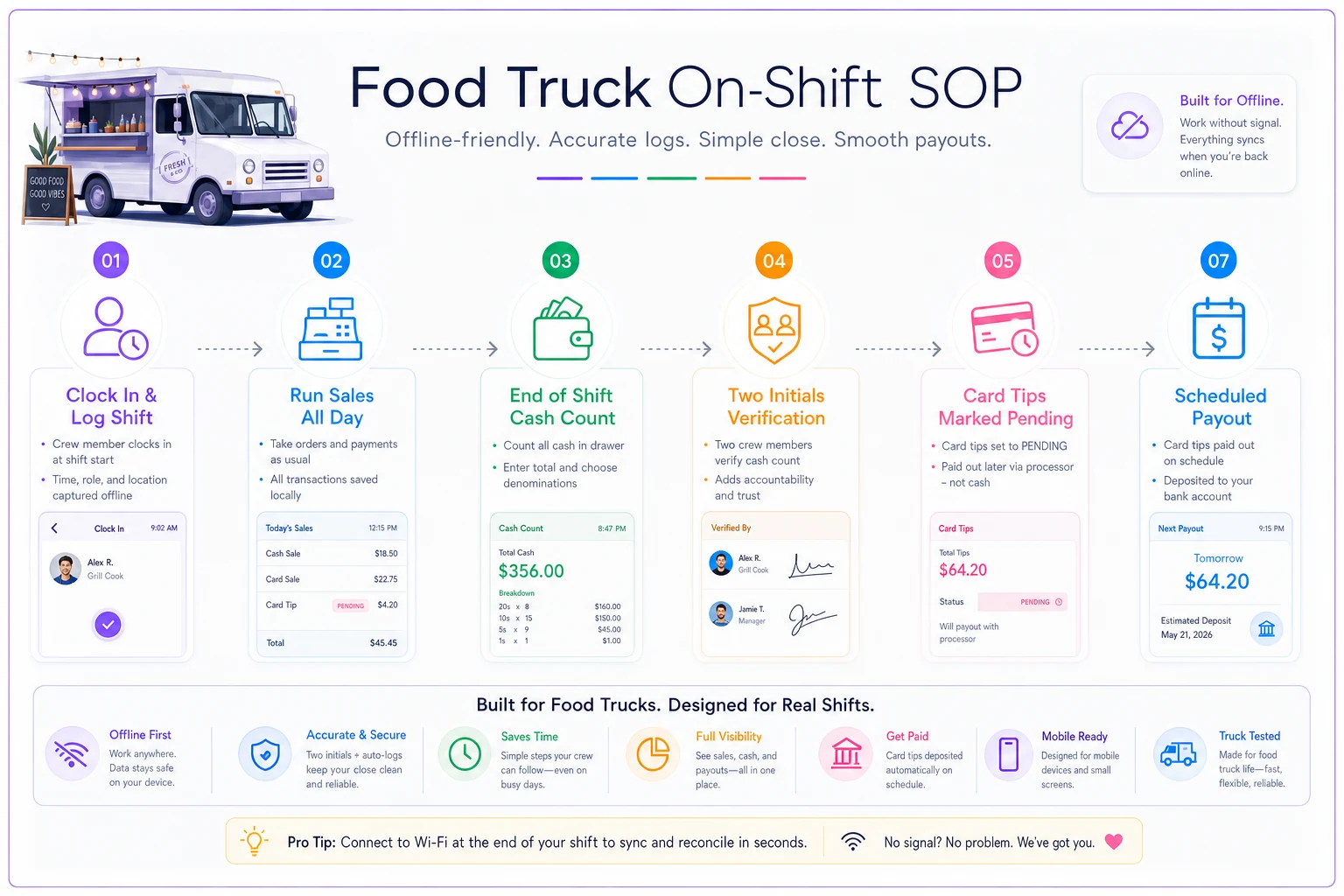
The whole system falls apart at one specific moment: the end of a shift in a location with no signal, when the card tip totals aren't available yet. Here's the SOP that handles it.
-
Log hours at clock-in and clock-out on paper or a phone note. Name, start time, end time. This is the single most important record because it drives the hours-weighted split. Do it even if you think you'll remember. You won't.
-
Count cash tips at the end of shift, in front of the crew. Write the total on the same sheet. Two people initial it. This one habit kills roughly 80% of "the count was wrong" arguments before they start.
-
Do NOT split card tips on-site if the POS hasn't synced. Record cash-only distribution now, and mark card tips as "pending sync." Trying to guess card totals from memory is how you create a debt you'll end up paying twice.
-
Reconcile card tips the same day the POS syncs. When batch totals post, apply the same hours-weighted formula to the card portion and record who's owed what.
-
Pay out card tips on a fixed cadence — either same-day once synced, or bundled into the next payroll run. Pick one and don't change it mid-week.
The reason this works is that it separates the decision (the split formula, agreed in advance) from the timing (when money is actually available). Crews don't get angry about delays if the formula is transparent and the delay is predictable. They get angry when both the amount and the timing feel improvised.
Quick visual of the SOP workflow.
A quick note on the physical reality of shift days: a lot of these record-keeping failures happen because the day already went sideways — a generator died, the truck overheated, someone left early to deal with a breakdown. If your shifts are chaotic, your tip records will be too. Tightening up the operational side, like having a solid preventative maintenance schedule and emergency repair SOP, indirectly protects your tip records by keeping shifts predictable enough to log properly.
Payroll integration: three ways trucks actually handle it
The card-tip portion has to end up on a paycheck, because those tips are taxable wages and your payroll needs to reflect them. How you route them matters. Here are three real patterns:
Pattern A — Tips as separate payroll line, same-week payout. Card tips get logged per employee during the week, then added to the regular payroll run as a distinct "tips" earning line. Cash tips get reported by the employee (they're required to) and recorded so withholding is correct. This is the cleanest for tax purposes — everything runs through one system, and your quarterly filings won't have surprises.
Pattern B — Card tips paid immediately, cash tracked for reporting. Some trucks pay card tips out in cash at end of week from the register, then just report the amounts to payroll for tax purposes. This keeps crew happy with fast money but requires disciplined reporting or you'll misstate wages. The risk: if you pay card tips in cash and forget to report them, you've created an under-withholding problem that lands on you.
Pattern C — Everything through the next payroll cycle. Both cash and card tips get logged and paid entirely through payroll on your normal cadence. Slowest to the crew's pocket, but the tightest paper trail. Works best when your team trusts the system and isn't living shift-to-shift.
A realistic example of how the numbers look on Pattern A: say a two-person truck pulls a week with $1,120 in combined tips (cash + card), and the two crew worked 34 and 22 hours. Hours-weighted, the 34-hour person gets about $680 and the 22-hour person about $440. On the paycheck, that shows as a tips line separate from base wage, with withholding applied to the full amount. No jar math, no memory, no argument.
Communication templates tuned to intermittent syncing and small teams
Most tip disputes are actually communication failures dressed up as money problems. Crews assume the worst when they don't know when they'll get paid or how the number was reached. A few short, reusable messages fix most of it.
> "Tips get pooled and split by hours worked. Cash we count and split at end of shift. Card tips take a day or two to land because of how the reader syncs, then they get split the exact same way and paid on [Friday]. You'll always see the hours and totals."
> "Shift close [date/location]: Cash tips $ split now. Card tips pending POS sync, will reconcile [when] and pay [when]. Hours logged: [name] h, [name] _h."
> "Card tips from [date] posted: $ total. Split by hours: [name] $, [name] $___. Paid on [date]. Reply if your hours look off."
The last line — reply if your hours look off — matters more than it sounds. It invites correction while the memory is fresh, instead of three weeks later when nobody can prove anything. Giving people a defined moment to object actually reduces objections, because they feel heard and stop stockpiling grievances.
When this makes sense — and when it doesn't
When hours-weighted pooling is the right call:
-
You run a genuinely collaborative crew where everyone touches the customer experience
-
Shifts vary in length and you want fairness without arguments
-
You're an owner willing to exclude yourself from the pool
When pooling is a bad idea:
-
You have one employee. There's nothing to pool — just pay them their tips.
-
Your state has restrictive tip-pooling rules that make it more trouble than it's worth for tiny teams (some jurisdictions have specific requirements about who can be in a pool).
-
You have deep skill gaps where one person's sales clearly drive tips and the others resent sharing — in that case, individual tips or a lighter pool may keep the peace better.
Who should NOT DIY this:
If you're crossing state lines for events, or you've got a mix of 1099 contractors and W-2 staff in the same tip flow, don't wing it. Contractor-vs-employee classification interacts with tip rules in ways that get expensive fast. That's a "spend an hour with a payroll pro" situation, not a "figure it out from a blog post" situation.
Real scenario: a two-truck taco operation
A small taco operation running two trucks at weekend markets had a recurring end-of-month blowup. Card tips synced late and inconsistently — sometimes the second truck had no signal until it got back to the lot near midnight. The owner was splitting tips from memory, and one crew member kept insisting she was being shorted.
They changed exactly three things: a paper hours-log clipped to each truck, an on-the-spot cash count with two initials, and a fixed Friday card-tip payout using an hours-weighted split. Nothing high-tech. The card tips that used to get split "roughly" now got split by a formula everyone could see.
The month-end arguments stopped almost entirely. The crew member who felt shorted turned out to have been right on two occasions — the memory-based splits had genuinely underpaid her by around $30–$40 total — and once the paper trail existed, that just stopped happening. The owner also stopped dreading payout day. No revenue miracle, just a friction source that quietly went away.
Keeping the records that actually protect you
If a labor dispute ever escalates, the thing that saves you is documentation of hours and tip totals — not your intentions. Hold onto:
-
Shift hour logs (name, in, out) for every shift
-
End-of-shift cash tip counts with initials
-
Card tip reconciliation records tied to POS batch totals
-
Payroll records showing tips reported and paid
-
Your written tip policy, signed by each crew member at hire
Keep these for at least the retention period your state requires — often three to four years for wage records, but check yours. The whole point is that when someone challenges a payout eight months later, you're not defending your memory. You're pointing at a record.
So much of this comes back to shift logging because a food truck day has too many moving parts to reconstruct afterward. Between routing, power management, and the general chaos of service, the tip records are the first thing that slips. If your shifts routinely run long or unpredictable because of power and generator problems, that operational instability quietly corrupts your pay records too — because nobody's logging hours when they're scrambling to keep the lights on.
The one habit that prevents most disputes
Decide the split rule before the money exists, and record the inputs the moment they happen.
Hours at clock-out. Cash at end of shift with two initials. Card tips reconciled the day they sync, using the same formula every single time.
Small crews don't have HR to referee fights or lawyers on retainer for wage claims. What they do have is the ability to be radically transparent and boringly consistent — which, on a food truck, beats any complicated points system. Get the rule clear, get the records honest, and the tip jar stops being the thing that blows up your crew.
Ready to drive your food truck business forward?
Join 2,000+ food truck operators relying on Grubzly to boost efficiency, increase sales, and delight customers.