
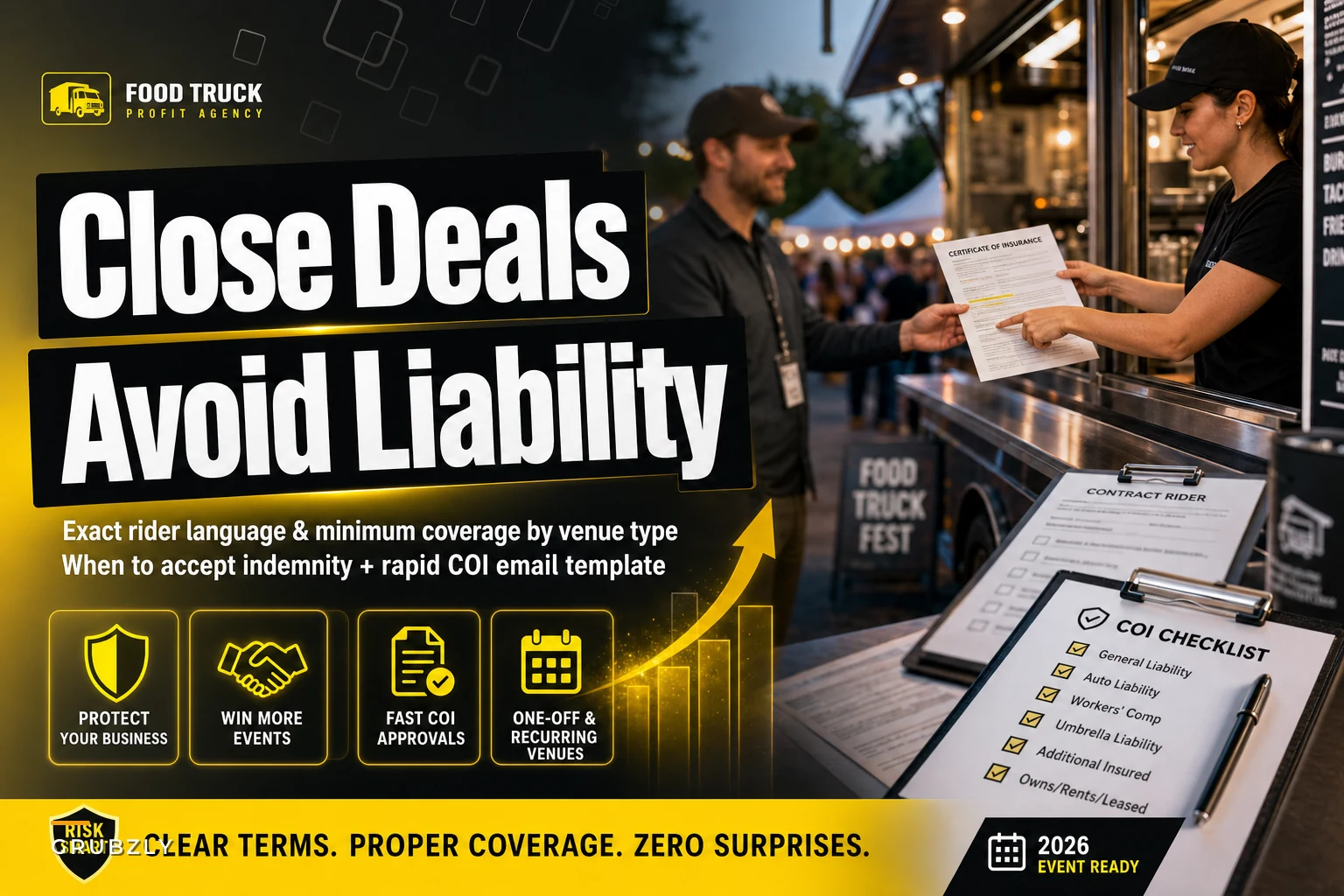

The email that ruins a Saturday usually shows up Thursday afternoon: "Hi — just doing final walkthrough for the festival. Can you send your COI naming us as additional insured by end of day? We need $2M aggregate and waiver of subrogation." You're prepping for a 300-cover weekend and now you're on hold with your broker while the event coordinator hints they'll pull your spot.
COI scrambles are almost always avoidable. The certificate itself takes minutes to issue. What eats the day is that nobody read the rider carefully when the booking was confirmed, so the coverage requirements surface at the worst possible moment — and sometimes they surface wrong, with demands that don't match what your policy actually says.
This post is a working reference. You'll get coverage minimums broken out by venue type, the exact rider language worth pushing back on, a decision framework for venue indemnity demands, a fillable checklist, and a copy-paste COI email your crew can fire off without calling you first.
The two documents everyone confuses
Before anything else: the rider and the COI are different things, and mixing them up is where most operators get burned.
The rider (or event contract addendum) is the language you agree to. It says what coverage you'll carry, who gets named, what happens if someone slips on your grease, and who eats the cost when something goes wrong. It's negotiable. You sign it once and it governs the whole relationship.
The COI (Certificate of Insurance) is just proof that the coverage in the rider actually exists. Your insurer or broker issues it. It's a snapshot — it doesn't create obligations, it documents them.
The mistake operators make constantly: treating the COI as the finish line and never actually reading the rider clauses. Then the certificate gets rejected because the rider demanded "additional insured on a primary and non-contributory basis" and the standard COI the broker sent doesn't reflect that endorsement. Now you're re-issuing on a deadline.
Read the rider first. The COI is downstream of it.
Coverage minimums by venue type
Not every gig needs the same coverage, and overpaying for coverage a farmers market will never check is its own quiet leak. Here's a realistic breakdown of what different venue types typically demand versus what they'll actually verify.
Stop losing sales to poor planning.
Grubzly helps you plan routes, track inventory, and maximize daily sales effortlessly.
- Real-time route optimization
- Inventory tracking & alerts
- Mobile sales & reporting
No credit card required
| Venue type | Typical GL requirement | Auto liability | Named additional insured? | Waiver of subrogation? | Verified before event? |
|---|---|---|---|---|---|
| Farmers market / weekly street spot | $1M per occurrence | Often not asked | Sometimes | Rarely | Loosely — usually once |
| Small private event (backyard, office park) | $1M / $2M aggregate | $1M | Usually | Sometimes | At booking |
| Brewery / bar recurring lot | $1M / $2M | $1M | Usually | Sometimes | Once, then annual renewal |
| Corporate campus | $2M / $4M | $1M+ | Yes | Often | Strictly, every time |
| Festival / large public event | $2M / $4M+ | $1M+ | Yes | Yes | Strictly, day-of walkthrough |
| University / hospital / municipal | $2M–$5M | $1M+ | Yes | Yes | Strictly, often with liquor/product riders |
Worth noting: the gap between what a venue demands and what they actually verify tells you a lot about how much friction you'll hit. Farmers markets ask for plenty and check almost nothing. Municipal and university venues check everything, often twice, and will hold your setup at the gate over a missing waiver of subrogation. Build your prep around the verifiers, not the demanders.
Build your prep around the verifiers, not the demanders.
Product liability deserves a mention here. Because you serve food, some venues — especially schools and hospitals — want product liability spelled out separately, not just folded into general liability. If your policy bundles them, get your broker to state that explicitly on the certificate. "GL includes products/completed operations" is the language that heads off a rejection.
Rider language worth reading line by line
Riders are where you either protect yourself or quietly sign away your margin on a bad claim. A few clauses show up over and over.
Additional insured. Standard and reasonable. The venue wants to be covered if a claim arises from your operation on their property. Fine — just make sure the language says "as respects operations of the vendor." You don't want to be underwriting the venue's own negligence.
Primary and non-contributory. This means your policy pays first, before the venue's insurance kicks in. Also standard for larger venues. It requires a specific endorsement, so if you see this, flag it to your broker before the event so the COI reflects it. This is the number-one cause of last-minute certificate rejections.
Waiver of subrogation. Your insurer gives up the right to go after the venue to recover money it paid out — even if the venue caused the loss. Insurers usually allow it, sometimes for a small premium bump, but it's genuinely giving something up. Reasonable for recurring venues you value. Worth a closer look for a one-off.
Indemnification / hold harmless. The clause that matters most and gets read least. We'll break it out below because the details decide whether one bad slip-and-fall is an insurance claim or a business-ending event.
When to accept venue indemnity demands (and when to push back)
Indemnification clauses come in three flavors. Knowing which one you're signing is the single most valuable thing in this post.
1. Limited / mutual indemnity — accept this. Each party covers the harm they cause. You indemnify the venue for claims arising from your negligence; they indemnify you for theirs. Fair, and you should sign it without much fuss.
2. Intermediate indemnity — read carefully, usually acceptable. You cover claims from your operations except those caused by the venue's sole negligence. Common for corporate and festival venues. Generally fine, but confirm the "except sole negligence" carve-out is actually in there. If it isn't, ask for it.
3. Broad-form indemnity — push back hard. You agree to cover all claims connected to the event, including ones caused entirely by the venue. A guest trips on the venue's broken step 50 feet from your truck? Under broad-form, that's somehow your problem. In many states this is unenforceable, but "unenforceable" still means a legal fight you're paying for. Never sign broad-form without a carve-out for the venue's negligence.
-
One-off event, low value, broad-form demand → decline or negotiate. The gig isn't worth the exposure.
-
Recurring venue you rely on, intermediate demand with carve-out → accept, and get your broker to confirm your policy actually covers the indemnity you're agreeing to (this is contractual liability coverage — most GL policies include it, but verify).
-
Any venue, broad-form with no carve-out → send back a redline. A simple one: "Vendor's indemnification obligation shall not apply to claims arising from the negligence or willful misconduct of the Venue."
The quiet trap: signing an indemnity broader than your insurance covers. If the rider makes you liable for something your policy excludes, you're personally on the hook for the gap. Match the two.
Sample rider clauses you can adapt
These are starting points, not legal advice — run anything you're unsure about past someone who does this for a living. But having reasonable language ready speeds up negotiation considerably.
Additional insured (balanced): > "Vendor shall name Venue as additional insured on Vendor's general liability policy, as respects liability arising out of Vendor's operations at the event. This coverage shall not extend to liability arising from Venue's own negligence."
Indemnity (mutual, protective): > "Each party shall indemnify and hold the other harmless from claims, damages, and expenses arising from that party's own negligent acts or omissions. Neither party shall be obligated to indemnify the other for the other party's sole negligence or willful misconduct."
Insurance requirement (reasonable cap): > "Vendor shall maintain commercial general liability insurance of not less than $1,000,000 per occurrence / $2,000,000 aggregate, including products and completed operations coverage. Certificate of Insurance to be provided no later than [X] days prior to event."
Notice the last line — building a lead time into the rider is how you stop the Thursday-afternoon scramble from ever starting.
The rapid-response COI email your crew can send
The goal is that a certificate request can be handled by whoever's holding the phone, not just you. Store this in a shared notes app or your ops platform so any team member can copy, fill three fields, and send.
To your broker: > Subject: RUSH COI needed — [Business Name] — event [DATE] > > Hi [Broker Name], > > We need a certificate of insurance issued today for an upcoming event. > > Certificate holder / additional insured: [Venue legal name + address, exactly as written in the rider] > Event date & location: [date, venue address] > Coverage required: [e.g. $1M/$2M GL, $1M auto] > Special endorsements requested: [additional insured / primary & non-contributory / waiver of subrogation — copy directly from the rider] > Send certificate to: [venue contact email] and cc [your ops email] > > Rider language is attached/pasted below so the wording matches exactly. Please confirm ETA. Thank you — this is time-sensitive. > > [Rider insurance section pasted here]
Two things make this work. First, pasting the exact rider language means your broker issues language that matches what the venue will check — no back-and-forth. Second, cc'ing the venue directly means the moment it's issued, they have it. You've removed yourself as the bottleneck.
For anything involving on-site incidents after the fact, the same discipline around documentation applies — the on-truck evidence checklists and incident escalation tree pair naturally with this, because a clean COI process is worthless if the claim itself is poorly documented.
The fillable pre-booking checklist
Run this the moment a booking is confirmed — not the week of. Every "no" is a phone call you want to make now, calmly, instead of on a deadline.
-
[ ] Rider received and read in full (not just skimmed for the dollar amount)
-
[ ] Coverage minimums identified and confirmed against current policy limits
-
[ ] Certificate holder name + address copied exactly as the venue wrote it
-
[ ] Additional insured requirement noted — and is it "operations of vendor" only?
-
[ ] Primary & non-contributory required? → flagged to broker
-
[ ] Waiver of subrogation required? → flagged to broker, cost confirmed
-
[ ] Indemnity clause classified
mutual / intermediate / broad-form
-
[ ] If broad-form → redline sent with negligence carve-out
-
[ ] Product/completed-operations coverage confirmed if food-service venue (school, hospital)
-
[ ] Liquor liability required? (relevant if you serve or the event does)
-
[ ] COI lead-time noted on your calendar (issue 3–5 days before, not day-of)
-
[ ] Contractual liability coverage confirmed to match the indemnity you signed
-
[ ] Signed rider + issued COI saved to shared folder, labeled by venue + date
Here's a simple workflow to follow for COI prep.
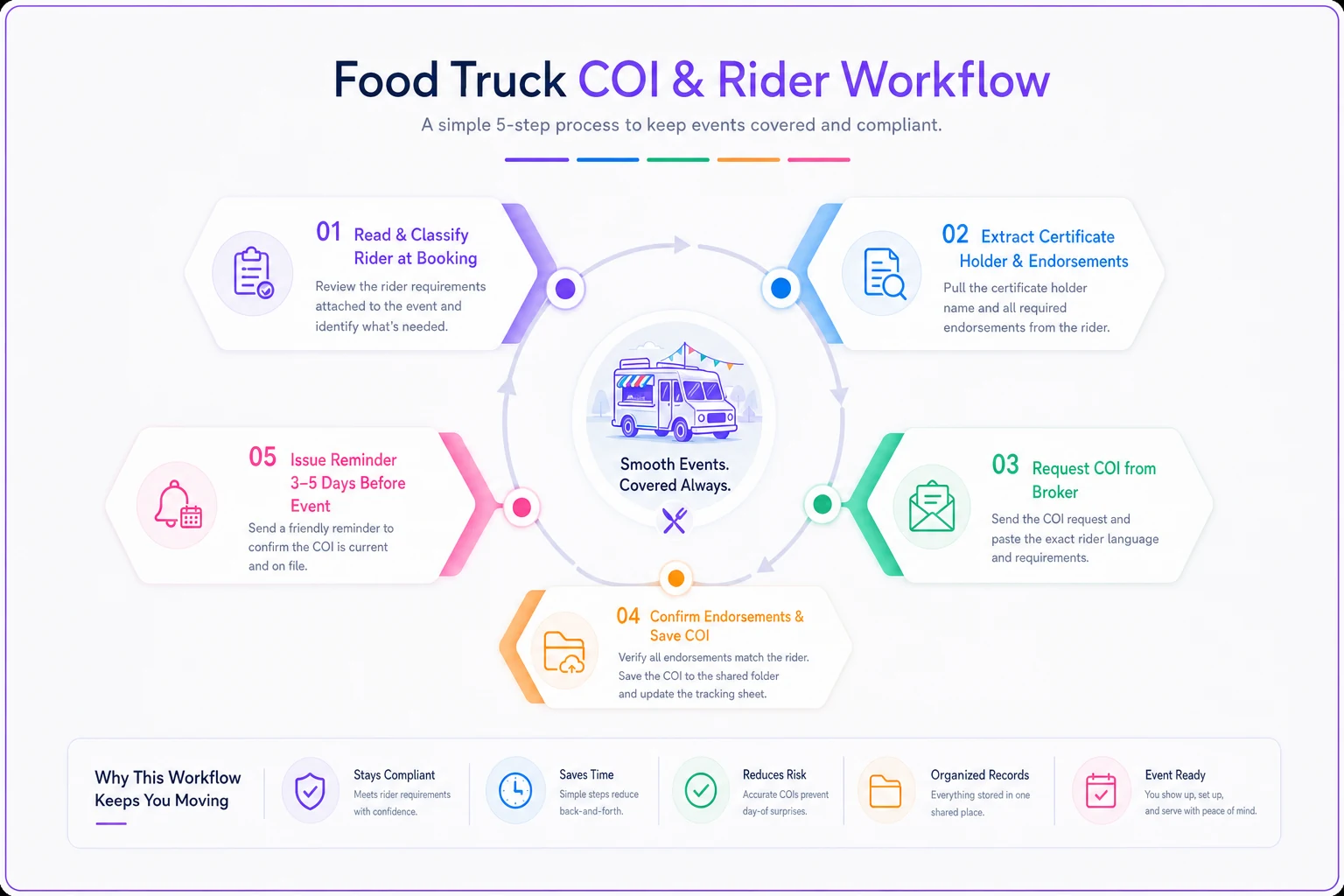
The single highest-leverage item on that list is the lead-time reminder. If you issue certificates three days out as a standing habit, the day-of walkthrough email becomes a formality instead of a crisis.
A real scenario
A two-truck taco operation ran a mix of breweries and a few corporate campuses. Their COI process was informal — the owner handled every request personally, usually the day it came in.
Over one summer they nearly lost two gigs. A university food-service event bounced their certificate because it lacked waiver of subrogation, which their broker only added after a same-morning call, with the truck already loaded. A second time, a corporate campus rejected a COI because the additional insured entity name was slightly off — the venue's parking-management LLC was the actual holder, not the company name on their website.
They changed two things. They built a one-page rider summary for each recurring venue — coverage limits, exact holder name, required endorsements — kept in a shared folder any crew member could reach. And they moved certificate issuance to a standing five-days-before-event rule. The rush requests basically stopped. Over the following season they didn't have a single day-of COI scramble, and the broker relationship improved because requests stopped arriving as emergencies.
Nothing exotic. They just moved the work earlier and made the details reachable by the whole team instead of living in the owner's head.
Where recurring venues change the math
One-off events and recurring venues call for different handling. For a one-off, your bias is caution — you're weighing a single fee against exposure, so a bad indemnity clause is easy to walk away from. For a recurring venue that's 20% of your revenue, you'll accept more (waivers, primary/non-contributory, stricter indemnity) because the relationship is worth it. But you should also standardize it once and stop re-negotiating every booking.
Operators who handle this cleanly tend to keep a small library: signed riders and issued COIs organized by venue, with renewal dates flagged so annual policies don't lapse mid-season. Whether that lives in a labeled folder, a shared drive, or an ops platform you already use for bookings and routes matters less than the fact that it's not buried in one person's inbox. When a venue emails asking for last year's paperwork, you want it findable in under a minute — same principle that makes scaled catering run-sheets work: the prep is done before the pressure hits.
Closing thought
COI and rider problems feel like paperwork, but they're really a timing problem. The document takes minutes to produce; it's the when and the who reads it that decide whether a Thursday email is a shrug or a scramble.
Read the rider at booking, classify the indemnity honestly, match your coverage to what you're signing, and put the details somewhere your whole crew can reach them. Do that consistently, and the certificate becomes the easy part it was always supposed to be.
COI and rider problems feel like paperwork, but they're really a timing problem. The document takes minutes to produce; it's the when and the who reads it that decide whether a Thursday email is a shrug or a scramble.
Read the rider at booking, classify the indemnity honestly, match your coverage to what you're signing, and put the details somewhere your whole crew can reach them. Do that consistently, and the certificate becomes the easy part it was always supposed to be.
Ready to drive your food truck business forward?
Join 2,000+ food truck operators relying on Grubzly to boost efficiency, increase sales, and delight customers.