

Most food truck operators think about insurance twice a year: when they renew, and when something goes wrong. The problem is that the moment something goes wrong is exactly when your policy either works for you or quietly works against you — and by then you can't change how you handled it.
A food truck insurance claims workflow isn't a document you file away. It's a set of habits that live on the truck, in your team's phones, and in your head. Vendors who come out of a claim with their premium mostly intact and their payout moving fast are the ones who captured the right evidence in the first hour and made a clean, unemotional decision about who to call. The ones who get burned usually improvised.
Below is how this actually breaks in the field, and the pieces you can put to use tomorrow.
Why claims go sideways for mobile vendors specifically
Brick-and-mortar restaurants have fixed cameras, a fixed address, and a landlord's insurance overlapping theirs. Food trucks have none of that. Your risk moves at 45 mph, parks in a different lot every day, and serves hundreds of strangers a shift near a hot fryer and a propane line.
That mobility creates three problems a normal restaurant never deals with:
-
Jurisdiction confusion. An incident at a private event in one city, a slip on a public sidewalk in another, and a highway collision between stops all get handled differently — and your policy may respond differently too.
-
Evidence that literally drives away. The other party, the witness, the wet floor, the faulty outlet at the event venue — gone in minutes once you pack up.
-
Overlapping coverage nobody sorts out until it's a fight. Auto liability, general liability, product liability, and the event organizer's policy can all touch the same incident. Whose insurer pays first is not a question you want to answer for the first time during the claim.
The money isn't usually lost on the incident itself. It's lost in the gap between the incident and the report — the hours where nobody documented anything and the story got fuzzy.
The three incident categories, and why they don't get treated the same
Not every incident is a claim, and not every claim needs the same response. Lumping them together is the first mistake. Here's the split that actually matters operationally.
Stop losing sales to poor planning.
Grubzly helps you plan routes, track inventory, and maximize daily sales effortlessly.
- Real-time route optimization
- Inventory tracking & alerts
- Mobile sales & reporting
No credit card required
| Incident type | Common examples | Evidence that decays fastest | First call, usually |
|---|---|---|---|
| Vehicle / transit | Collision between stops, backing into a bollard, someone hits your parked truck | Other driver info, scene position, road conditions | Auto insurer, then police report |
| Bodily injury (customer or public) | Slip near your service window, burn from hot food, allergic reaction, awning collapse | Witness contact, the physical hazard, what the person said at the scene | Depends on severity — see decision tree |
| Property / product | Small fire, generator damage, food that made someone sick, damage to a venue | Photos before cleanup, the actual product/batch, temperature logs | Depends — often counsel before insurer |
Your instinct in the moment is to treat every incident like a car accident — exchange info, call insurance, done. But a customer injury or a product complaint runs on a completely different clock. What you say and who you notify first can shape the entire claim. More on that in the decision tree.
On‑truck evidence capture: the checklist that lives on the truck
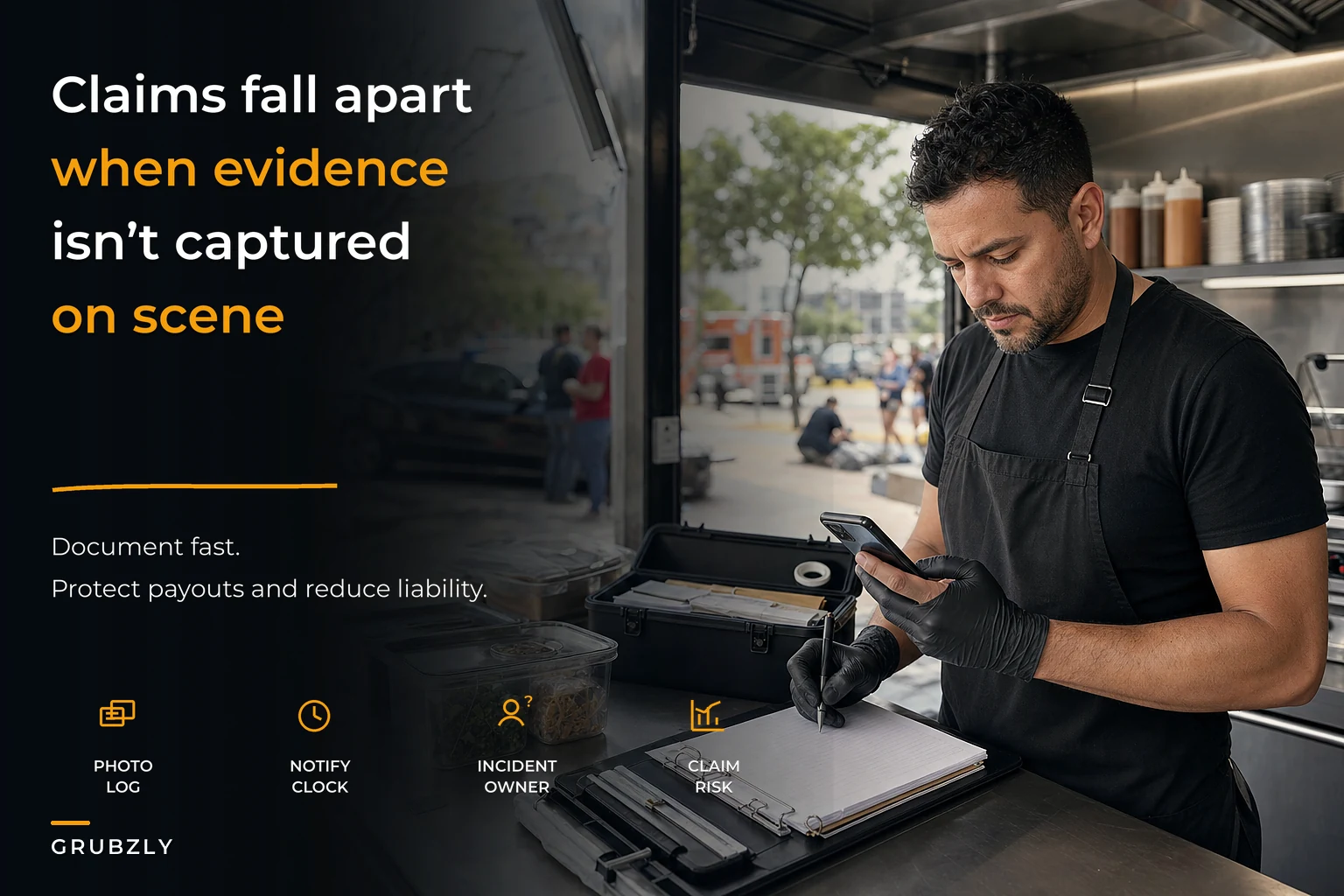
The single biggest predictor of a clean claim is whether evidence got captured in the first 15 minutes. After that, memory degrades, people leave, and the scene changes. This has to be a physical or phone-based checklist your team can run without you standing there.
Keep this laminated near the register or pinned in your team chat. Every person who works the window should know it.
Immediate (first 5 minutes):
-
Make sure everyone is safe first. Stop service if needed. Nothing below matters more than this.
-
Take wide photos of the whole scene before anyone cleans or moves anything — the spill, the truck position, the crowd, the setup.
-
Take close photos of the specific hazard or damage.
-
If anyone is hurt, note the time and offer help, but do not admit fault or speculate out loud. "We're going to document everything and take care of this" is fine. "I'm so sorry, that was our fault" is not.
Within 15 minutes:
-
Get names and phone numbers of at least two witnesses who aren't your staff.
-
Photograph the other party's ID, license plate, or insurance card if it's a vehicle incident.
-
Screenshot your GPS location and timestamp (most phones embed this in photos automatically — confirm location services are on).
-
Note weather and ground conditions.
-
If it's a product or food issue, bag and label the actual item and pull the relevant temperature and prep logs. The same rigor you'd apply for surprise inspection readiness is exactly what protects you in a product claim.
Before you leave the stop:
-
Write a one-paragraph raw note of what happened while it's fresh. Time, place, sequence. No conclusions.
-
Confirm which staff were on which station.
-
If it's an event, get the organizer's contact and note whether their equipment, power, or setup was involved.
The mistake people make is trusting memory over capture. An operator who "remembers exactly what happened" three weeks later has usually reconstructed a version that feels true but has gaps an adjuster will find in five minutes. Photos and timestamps don't reconstruct. They record.
The escalation decision tree: when to notify your insurer vs. call counsel
This is the part most vendors get wrong, and it costs them either money or coverage. Notifying too fast on something minor can raise your premium for an incident that never becomes a real claim. Notifying too slow — or notifying the wrong party first — can void coverage or leave you exposed.
Visual summary of the escalation logic below.
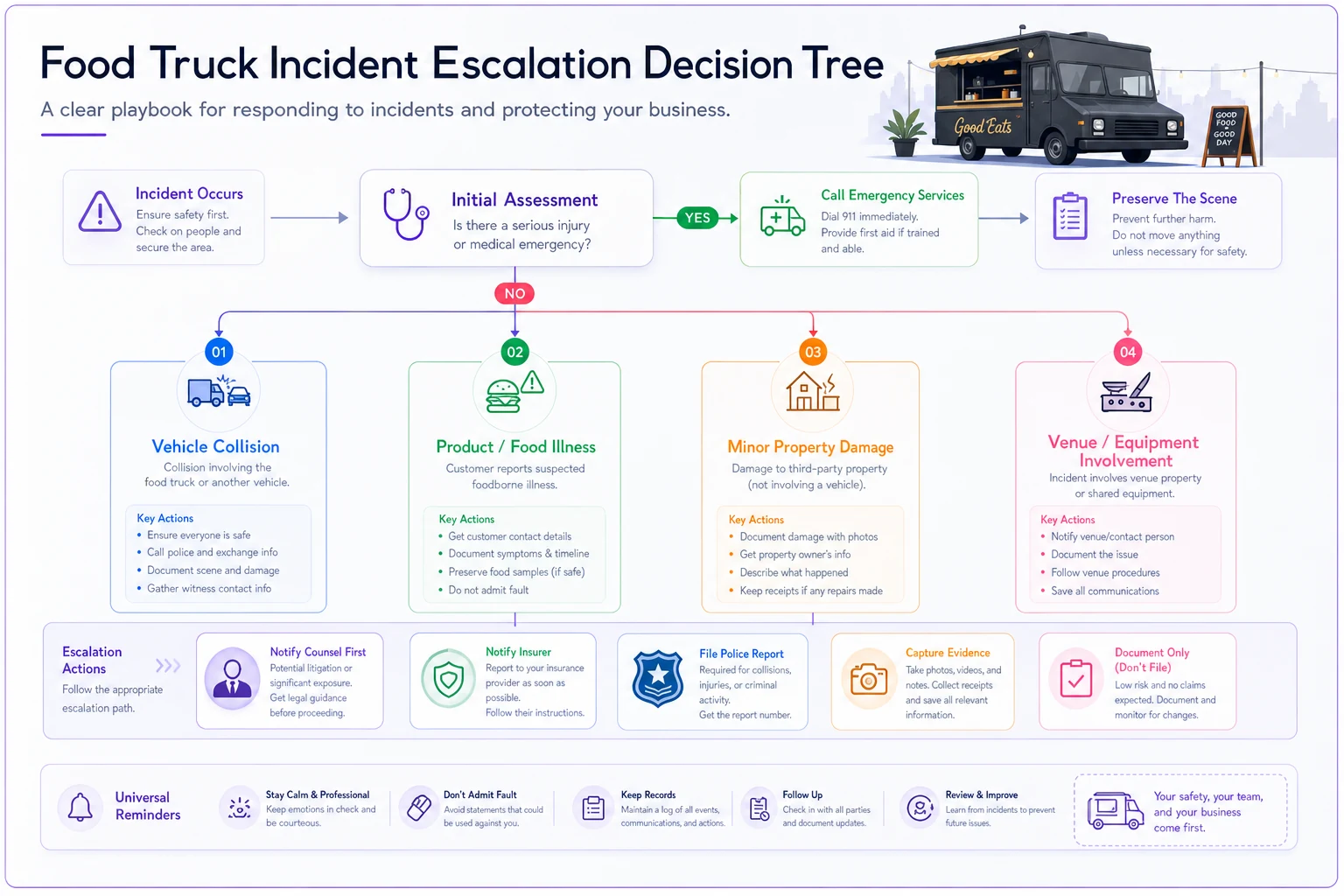
Step 1 — Is anyone seriously injured, or is there ambulance or hospital involvement? → Yes: Notify counsel first if the injury looks significant, before making detailed statements. Then notify your insurer promptly. Do not negotiate or offer anything to the injured party. Do capture evidence. → No: Continue.
Step 2 — Is it a vehicle collision with another party, or property damage above your deductible? → Yes: File a police report if applicable, then notify your auto insurer within the window your policy requires. Standard claim path. → No: Continue.
Step 3 — Is there any product or food illness complaint, or an allergen incident? → Yes: Preserve the product and logs immediately. Notify your insurer — but if the complainant mentions a lawyer, medical treatment, or "getting this on record," loop in counsel before responding in writing. Food illness claims can escalate quietly for weeks. → No: Continue.
Step 4 — Minor property damage, no injury, no third party? → This is often a document but don't file situation. Capture everything, keep it in a file, and decide later. Many small events never become claims, and a filed claim you withdraw still shows up in your history.
Step 5 — Anything involving a venue, event organizer, or their equipment? → Document whose equipment, power, or space was involved. There may be a shared liability question, and their insurer might be primary. Don't assume it's on you until you know.
The core principle: notify counsel before making detailed written or recorded statements whenever injury, illness, or a lawyer is mentioned. Notify your insurer within policy windows for anything you actually intend to claim. Document everything regardless — you can escalate a documented incident later, but you can never recreate one you ignored.
When "just call insurance right away" is actually bad advice
Filing a claim for every scratch and spill is how operators end up non-renewed or priced out. A cluster of small claims looks worse to an underwriter than one clean year with a single larger claim. If damage is under your deductible and there's no injury or third party, you're often better off documenting it thoroughly and paying out of pocket. The evidence file protects you if it grows into something; the non-claim protects your premium.
When to stop improvising and get counsel involved
Any time someone is transported for medical care, any time an allergen or foodborne illness is alleged, any time a lawyer's name comes up, any time a venue tries to push liability onto you — that's the line. A short call with counsel before you send that "here's what happened" email has saved operators far more than it costs.
A sample incident report you can actually fill out on a phone
Adjusters and lawyers both reward specificity and penalize vagueness. A usable incident report has a fixed structure so nobody has to think about what to record while under stress. Here's the skeleton:
-
Date, exact time, and location (address + GPS + which stop on the route)
-
Incident type (vehicle / injury / product / property)
-
What happened — sequence only, no fault language. "Customer stepped off curb toward window at approximately 12:40 and slipped on wet pavement" — not "the ground was too wet and it was our fault."
-
People involved — names, roles, contact info, and who was on which station
-
Witnesses — at least two, with phone numbers
-
Evidence captured — list of photos taken, logs pulled, items bagged
-
Actions taken at the scene — first aid offered, service stopped, cleanup timing
-
Statements made — record what you actually said, honestly
-
Follow-up needed — insurer, counsel, venue, report number
-
Who filed this and when
When every incident gets logged the same way, patterns start showing up — a recurring hazard at one venue, a menu item that keeps generating complaints, a stop with a bad curb. Those patterns are how you prevent the next claim, not just clean up the last one.
A real scenario
A two-truck taco operation working weekend events and weekday office parks had a customer report a burn from a spilled hot drink at a busy lunch stop. The staff on shift were solid on food safety but had no incident process. They cleaned up, apologized at the scene, took no photos, and got no witness info. Three weeks later a demand letter arrived.
Because there was nothing documented — no scene photos, no witnesses, no record of what the cup temperature or lid situation actually was — the operator had nothing to push back with. The insurer settled to avoid a fight, the claim landed on the record, and at renewal the general liability premium jumped by a few hundred dollars and stayed elevated. Call it a $1,200–$1,500 hit over the next couple of years for an incident that, with photos and two witnesses, might have been defensible or settled for far less.
After that, they built a laminated capture checklist and a phone-based report template. About four months later there was a second minor incident — a slip near the window during rain. This time they had wide and close photos within minutes, two witness numbers, a timestamped note, and a completed report before they left the stop. The complaint never turned into a claim; the documented file was enough for the person to drop it. Same type of incident, completely different outcome. The only variable that changed was the workflow.
Where this connects to the rest of your operation
Claims readiness isn't a standalone binder. It's woven into systems you probably already have — or should.
Your temperature and prep logs are claim evidence for any food-related incident. Your permit and compliance records establish that you were operating legally at that location, which matters more than most people realize when liability is in question. If your permitting is a mess, that's a separate exposure worth fixing with a proper multi-city permit management system. And your daily reconciliation habits — the same discipline behind clean POS and cashflow records — are what let you prove revenue and downtime if you ever file for business interruption after a fire or a wreck that pulls the truck off the road.
Operators who handle claims well aren't lucky. They capture the same way every time, decide who to call based on the type of incident rather than panic, and keep their evidence organized enough that a documented file can either kill a bad claim or fast-track a legitimate one.
How to actually make this stick
A checklist nobody runs is worthless. The version that works lives where the work happens: laminated on the truck, saved as a note template on every staff phone, and rehearsed once so people aren't reading it for the first time during a crisis.
Assign one person per shift to own evidence capture so it's never ambiguous who is responsible.
-
Assign it. One person per shift owns evidence capture. Not "someone" — a name.
-
Keep the report short enough to finish before you leave the stop. If it takes ten minutes, it gets skipped.
-
Store reports somewhere central and searchable, not in someone's camera roll. When you can pull up every incident by venue, date, or type, the recurring problems become obvious. Centralizing logs, permits, and incident records in one place — rather than scattered across phones and notebooks — turns a pile of paperwork into something that actually protects you.
-
Review incidents monthly. Even the ones that went nowhere. That's your early warning system for the venue, the menu item, or the setup that's going to cause trouble eventually.
The goal isn't to turn your team into paralegals. It's to make the first fifteen minutes automatic, so that when something goes wrong — and over enough shifts, something will — you're recording instead of improvising, and deciding instead of panicking. That difference is usually worth far more than the policy itself.
The goal isn't to turn your team into paralegals. It's to make the first fifteen minutes automatic, so that when something goes wrong — and over enough shifts, something will — you're recording instead of improvising, and deciding instead of panicking. That difference is usually worth far more than the policy itself.
Ready to drive your food truck business forward?
Join 2,000+ food truck operators relying on Grubzly to boost efficiency, increase sales, and delight customers.