

Every tiny crew has a hidden single point of failure, and it's usually a person. On most two or three-person trucks, there's exactly one human who knows how to prime the fryer, one who can run the window without freezing, and one who actually understands the POS modifiers. The day that person texts "food poisoning, so sorry" at 6:40am, your whole operation becomes a coin flip.
Cross-training is the obvious answer, and most operators already "kind of" do it. The problem is they do it informally — "oh yeah, Marco can grill if he has to" — and informal cross-training collapses under pressure. When it's 12:15 and the line is 14 deep, nobody is "kind of" learning the grill. They're flailing, tickets are backing up, and your reliable person is doing two jobs badly instead of one job well.
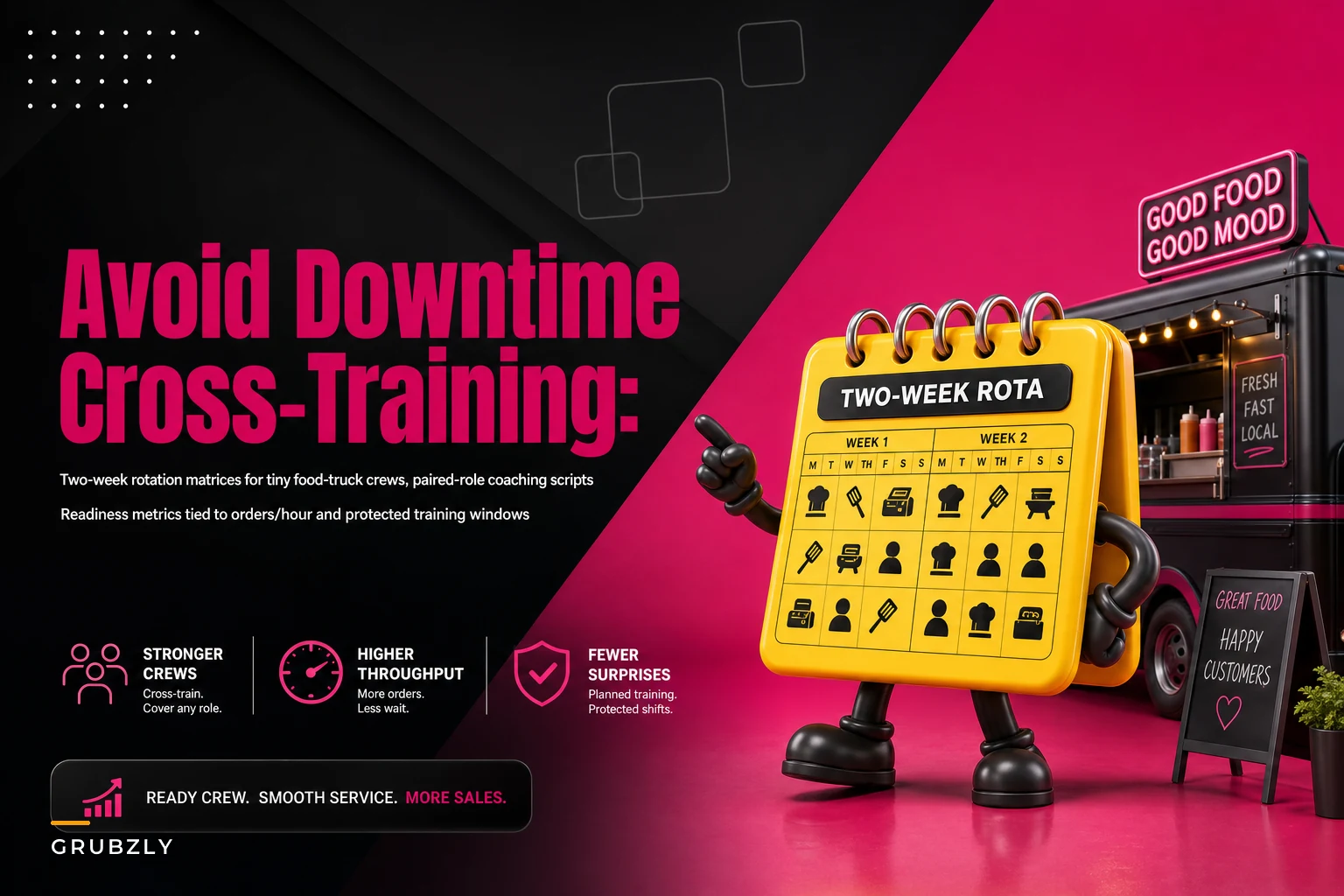
This post is about cross-training that actually holds. Not a vague "everyone should know everything" goal, but a real rotation system: a cross-training matrix, 2-week rota templates, paired-role coaching scripts, and simple readiness metrics tied to throughput so you know whether it's working. The whole thing is built for crews of two to four people, where you can't afford to pull someone offline for a week of training.
Why informal cross-training never sticks on small trucks
The reason "Marco can grill if he has to" doesn't protect you is that it was never tested under load. He flipped a few burgers on a slow Tuesday. He's never run the grill through a 90-order lunch window while also calling out tickets. There's a massive gap between has done it once and can hold the station when it matters, and informal training lives entirely in that gap.
There's also a motivation problem baked into small crews. Your best griller doesn't want to train someone on the grill because training slows them down and the trainee's mistakes land on their numbers. The person with the most knowledge is quietly incentivized to hoard it. Nobody says this out loud, but you can see it in how training never quite happens even when everyone agrees it should.
And then there's the plain scheduling reality: you're running lean on purpose. Pulling someone aside to learn a new station feels like a luxury during a shift, and after the shift everyone's exhausted. So cross-training gets pushed to "next week" permanently, until the day someone's out and you remember why it mattered.
The fix isn't more willpower. It's structure that makes cross-training happen during normal shifts, in small pieces, with a clear way to measure when someone is genuinely ready.
The cross-training matrix: your actual starting point
Before any rotation, you need an honest map of who can do what. A cross-training matrix is just a grid — stations down the side, people across the top, competency level in each cell. Simple, but most trucks have never written it down, and writing it down is where the gaps jump out at you.
Stop losing sales to poor planning.
Grubzly helps you plan routes, track inventory, and maximize daily sales effortlessly.
- Real-time route optimization
- Inventory tracking & alerts
- Mobile sales & reporting
No credit card required
| Level | What it means | Can they cover a rush? |
|---|---|---|
| 0 — None | Never done the station | No |
| 1 — Shadowed | Watched it, understands the flow | No |
| 2 — Assisted | Can do it with someone next to them | Only with backup |
| 3 — Solo-slow | Runs it alone, but slows during peak | In a pinch, with ticket-time hit |
| 4 — Solo-rush | Holds the station through full peak | Yes |
Now map your crew. A typical three-person taco truck matrix might look like this:
| Station | Ana | Marco | Devon |
|---|---|---|---|
| Window / POS | 4 | 1 | 2 |
| Grill / protein | 2 | 4 | 0 |
| Assembly / line | 3 | 3 | 4 |
| Prep / restock | 4 | 2 | 3 |
| Open/close | 4 | 2 | 0 |
The second you fill this in, the danger lights up. The window is a single point of failure — only Ana is at level 4, and Marco is a hard 1. Open/close is worse: Devon can't do it at all, so any shift where Ana and Marco are both out is literally impossible to run. That's not a staffing opinion, that's the matrix telling you where you'll get hurt.
The goal isn't to get every cell to level 4 — that's unrealistic and unnecessary. The goal is at least two people at level 3+ on every critical station. Critical usually means window, grill, and open/close. Prep can survive with one strong person and a decent backup. Your matrix tells you exactly which two or three cells to work on first.
Picking your training targets (not everything at once)
The mistake that kills cross-training programs before they start: trying to level everyone up on everything simultaneously. On a tiny crew, you can realistically improve one or two cells per two-week cycle without wrecking service. So you prioritize.
Rank your weak spots by one question: If this person doesn't show up tomorrow, how badly are we hurt? A single-covered window is a five-alarm problem because a frozen window backs up the entire truck. A weak prep backup is a two-alarm problem — prep happens before the rush and you have slack to recover.
For the matrix above, the first two-week cycle is obvious: get Marco from window-1 to window-3, and get Devon started on open/close. Everything else waits. Trying to also fix Marco's prep and Devon's grill in the same two weeks means all four efforts get done halfway, which means none of them actually hold.
This is the same logic behind mapping staffing to ticket velocity and menu complexity — you don't staff for the whole menu at once, you staff for what drives the actual bottleneck. Cross-training works the same way. Fix the station that chokes throughput first.
The 2-week rotation template
Two weeks is the sweet spot for a training cycle on a small crew. One week is too short to build real speed; a month is long enough that life gets in the way and the plan falls apart. Two weeks gives you roughly 8–10 service windows to move someone from level 1 to level 3 on a single station.
The structure: the trainee works their normal station for most of the shift, but takes over the target station during a defined, protected window each day, with the station expert right next to them. You're not throwing them in cold at peak. You're giving them graduated exposure.
Here's a sample two-week rota for getting Marco onto the window:
Week 1 — shadow and assist (off-peak only)
| Day | Marco's window exposure | Who's backing him |
|---|---|---|
| Mon | Watch Ana run open rush (11:00–11:30) | Ana (lead) |
| Tue | Take window during slow window (2:00–3:00) | Ana beside him |
| Wed | Off | — |
| Thu | Take window 1:30–3:00, Ana handles any pileup | Ana beside him |
| Fri | Take window full off-peak, Ana on assembly | Ana within reach |
Week 2 — assist into peak
| Day | Marco's window exposure | Who's backing him |
|---|---|---|
| Mon | Window 11:30–12:00 (early peak) | Ana beside him |
| Tue | Window 12:00–12:30 (full peak) | Ana beside him |
| Wed | Off | — |
| Thu | Window 11:45–12:45 solo, Ana on grill nearby | Ana audible but not beside |
| Fri | Window full peak solo, Ana observing and timing | Ana observing |
By the end of week two, Marco has run the window through full peak with the expert watching. That final Friday is your assessment — not a certificate, but a real test under the only condition that actually matters: a packed line.
The critical design detail is the protected window. You decide in advance which 30–60 minute block is the training block, and you accept that tickets might run a little slower during it. That's the cost of redundancy, and it's a small cost compared to a dead shift when someone calls out. Protecting the window also stops the expert from snatching the station back the moment it gets busy, which is the most common way these rotations fail.
Here's a simple workflow to visualize the two-week rotation.
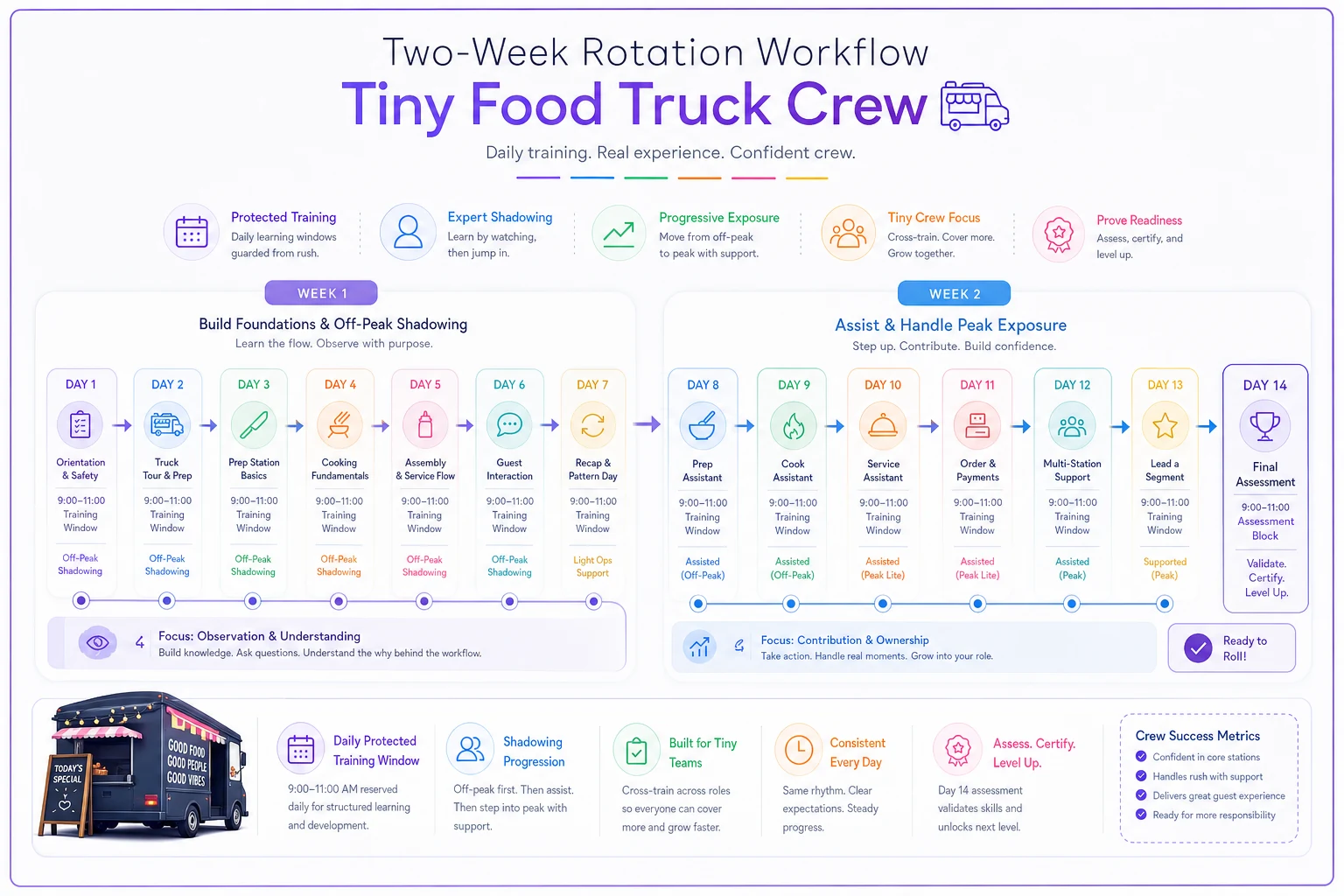
This visual helps teams agree on the protected block and the gradual exposure sequence without overcomplicating the plan.
Paired-role coaching scripts
Most on-the-job training produces bad habits because the expert doesn't actually know how to teach — they just do the job fast and expect the trainee to absorb it by osmosis. A coaching script fixes this by giving the expert a handful of exact phrases to use at specific moments. It takes the teaching off vibes and onto a rhythm.
These are short on purpose. Nobody's reading a paragraph mid-rush. Trigger phrases paired with moments.
Window coaching script (Ana → Marco):
-
Before the block "Your job this block is to greet, enter, and call the ticket back. I'll handle any payment weirdness and anything you don't recognize. Don't stop the line to ask me — flag it and keep moving."
-
When he hesitates on a modifier "Ring it as the base item, add a note, keep going. We fix it on the pass, not at the window."
-
When the line builds "Greet the next three people out loud so they know they're seen. Buys us time."
-
When he makes a mistake (say nothing until the gap) then: "That order — you forgot to ask drink. Add it to your greet next time." Never correct him mid-order in front of the customer.
-
After the block "Two things that went well, one thing to fix tomorrow." Then actually name them.
Grill coaching script (Marco → Devon):
-
Before the block "Watch the timer, not me. Your pull times are 3 and 6. If you're unsure, pull early and I'll check it."
-
When he's behind "Don't speed up — hold your pace, I'll slide in on the backlog." Panic-cooking is how undercooked proteins happen.
-
When he overloads the surface "Max is six patties up, then stop. A full grill you can't track is slower than a half grill you can."
-
After the block "Where did you feel behind?" Let him diagnose first, then fill in the gaps.
The "two things that went well, one thing to fix" close is the part people skip, and it's the part that actually makes the next day better. Without it, the trainee repeats the same mistakes and the expert gets frustrated that "they're not getting it." They're not getting it because nobody told them specifically what to change.
This ties into how station role cards and time-motion SOPs cut ticket times — the coaching scripts are basically how you transfer those role cards into a second person's hands, instead of leaving them locked in one head.
Readiness metrics tied to throughput
"He seems fine on the window now" is not a readiness metric. The only honest measure of station readiness is whether throughput holds when that person runs it. So you tie readiness to tickets, not feelings.
The simplest version: measure the trainee's ticket time during their solo block against the expert's baseline for the same station and daypart. You already have ticket timestamps in your POS. If Ana runs the window at roughly a 4-minute average order-to-handoff during peak, and Marco's solo Friday comes in around 5 minutes, that's a 25% slowdown — a real "solo-slow / level 3" result. Good enough for coverage, not yet level 4.
A clean readiness checklist for calling someone "coverage-ready" on a station:
-
[ ] Has run the station solo through a full peak window at least twice
-
[ ] Peak ticket time within ~30% of the expert's baseline
-
[ ] Zero critical errors in the last solo block (wrong protein, missed allergen flag, comped order from confusion)
-
[ ] Can open or close the station unassisted (if applicable)
-
[ ] The expert would personally feel okay leaving mid-shift with this person running it
That last checkbox is the real gate. If your window expert says "honestly, I'd still be nervous leaving Marco alone at lunch," he's not coverage-ready yet, no matter what the ticket times say. Numbers filter out false confidence; the expert's gut filters out false data. You want both.
Track this somewhere visible. A shared sheet or your scheduling tool works — the point is that readiness levels are written down and updated, not floating in someone's memory. When a crew tracks station readiness the same way they track inventory, cross-training stops being a vague intention and becomes a number that goes up. This is also where keeping the matrix in a shared operations tool instead of on a whiteboard pays off: when someone hits level 3 on a station, the schedule builder can actually flag shifts that have zero coverage on the window.
A real scenario: the two-person breakfast truck
A breakfast-and-coffee truck running a fixed weekday office-park stop, two people: the owner on the window and espresso, one employee on the griddle and assembly. Classic setup, classic trap — the owner was the only one who could run the espresso machine and the POS, and the employee was the only one who could run the griddle cleanly.
The breaking point came when the owner caught a stomach bug and tried to run the truck anyway. The griddle employee attempted the window and espresso simultaneously. Ticket times blew out from the usual 3 minutes to somewhere around 7–8 minutes. The line, normally 25–30 orders in the morning peak, visibly shrank as people walked off. They did maybe 60% of a normal morning's sales, and the owner went home sicker.
The fix was one focused two-week cycle: get the griddle employee to level 3 on espresso and POS, protected 30-minute block each morning during the slower 9:15–9:45 tail. Week one was shadow-and-assist, week two moved the block earlier into the 8:30 peak. By the end, the employee's solo espresso-and-window ticket time landed around 4 minutes — slower than the owner's 3, but nowhere near the 7–8 minute collapse.
A month later the owner's car broke down and he was 40 minutes late. The employee opened and ran the first peak solo. Not perfectly — a few drinks were slower — but the line held, nobody walked off, and the morning's sales came in close to normal. The two-week investment paid for itself in a single morning that used to be a guaranteed disaster.
When this makes sense — and when it doesn't
Cross-training rotations are worth the effort when you're genuinely lean (two to four people), when a single absence can tank a shift, and when you have a few predictable slow windows to use as protected training blocks. That describes most fixed-stop and event trucks.
When it's a bad idea to push hard on it: during your absolute busiest season, when you have zero slack and a training block means losing real sales. Run your cross-training cycles in shoulder seasons or slower weeks, bank the redundancy, and coast on it through the crush. Starting a training rotation during peak is how you get resentment and bad habits at the same time.
Who should skip the formal version: solo operators, obviously. And trucks with very high turnover should fix the turnover first — cross-training someone who quits in three weeks is just donating training time to your competitors. Get your crew stable enough to stay a season, then build the redundancy.
Getting started this week
You don't need the whole system running on Monday. You need the matrix. Spend twenty minutes filling in the grid honestly — stations down the side, your people across the top, a 0-to-4 in every cell. The gaps will embarrass you a little, and that's the point. The embarrassing cells are your roadmap.
Pick the one station where a single absence hurts most. Build a two-week rotation for one trainee on that one station, with a protected off-peak block and the expert on a coaching script. Measure the final solo block against the expert's ticket time. That's one cycle. Do it, then pick the next cell.
Redundancy on a tiny crew isn't built by hoping everyone learns everything eventually. It's built two weeks at a time, one station at a time, measured in ticket times instead of good intentions — so the morning someone texts "can't make it" stops being the morning your whole operation holds its breath.
Ready to drive your food truck business forward?
Join 2,000+ food truck operators relying on Grubzly to boost efficiency, increase sales, and delight customers.