
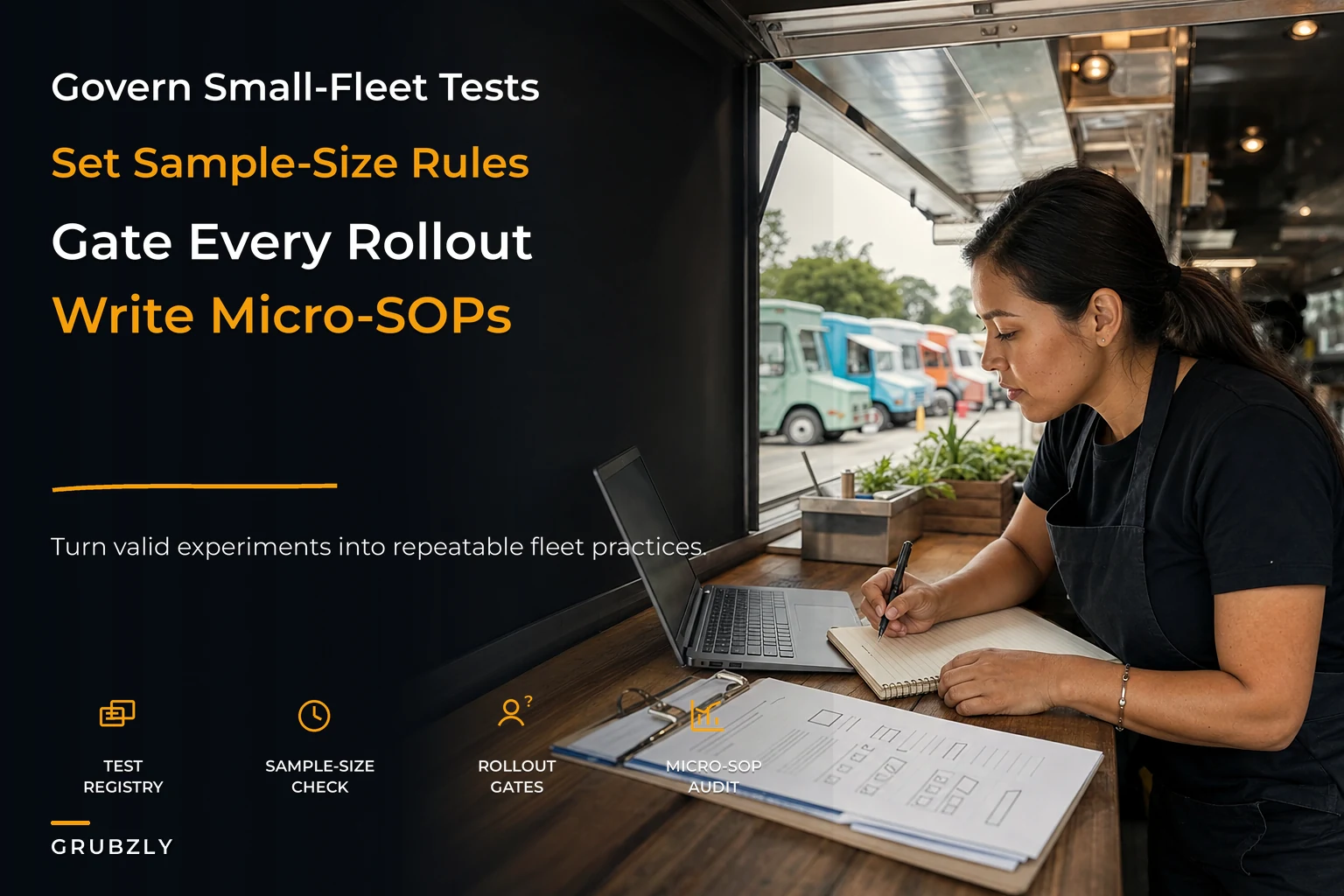

Most food truck operators are running experiments all the time without calling them experiments. You swapped the fry seasoning. You tried a new stop on Thursdays. You bumped the combo price by a dollar at the stadium. You added a second window person at lunch. Every one of these is a test — you just never wrote down what you were testing, what "working" meant, or what you'd do if it did.
That's fine when you have one truck and you can hold everything in your head. It falls apart the second you have three trucks, two commissary crews, and a manager who ran a "quick test" on Saturday that nobody else knew about. Now you've got conflicting signals, half-baked rollouts, and that one stop where the price is different and nobody remembers why.
This is what food truck experiment governance actually solves. Not bureaucracy — the opposite. It's a lightweight set of rules that lets a small fleet try things, trust the results, and turn the winners into actual standard practice instead of folklore.
Why small fleets break on experiments (even when every test is "successful")
There's a pattern that quietly kills momentum. A single truck tests something, it looks great, word spreads, and three weeks later half the fleet is doing it — except each truck is doing a slightly different version, nobody measured the baseline, and when sales dip the next month you can't tell if it was the new thing or the weather.
The core problem isn't the ideas. Food truck operators are genuinely good at generating ideas. The problem is that at fleet scale, an untracked experiment is indistinguishable from random noise, and random noise gets treated as truth.
-
Your conditions change every day. A new upsell script "works" at the office park and flops at the brewery. If you don't record where and when you tested, you're comparing apples to parking lots.
-
Your sample sizes are tiny. A single truck might do 80–140 tickets a day. One good day can look like a win when it's just variance.
-
Everybody has write access. On a small crew, any manager can change the menu, the price, the prep. Without a shared place to log tests, you get five private experiments running on top of each other.
The operators who grow smoothly aren't the ones with the best ideas — they're the ones who can tell which of their ideas actually worked, and then make the winner stick everywhere.
The three failure modes, in order of damage
Before building any kind of system, it helps to name what's actually going wrong. Most experiment problems in small fleets fall into one of three buckets.
Stop losing sales to poor planning.
Grubzly helps you plan routes, track inventory, and maximize daily sales effortlessly.
- Real-time route optimization
- Inventory tracking & alerts
- Mobile sales & reporting
No credit card required
| Failure mode | What it looks like | What it costs you |
|---|---|---|
| The ghost test | Someone changed something, nobody logged it, results are unexplained | You chase phantom causes; you can't repeat wins or avoid repeating losses |
| The false win | Tiny sample, one good day, declared a success, rolled out fleet-wide | You bake variance into your SOPs and wonder why "proven" changes underperform |
| The orphan win | A real, valid result that nobody ever turned into a standard procedure | Your best discovery dies when the person who ran it quits or forgets |
The first two are measurement problems. The third is a governance problem — and it's the most expensive one, because you paid for the learning and threw away the receipt.
The whole point of a governance pipeline is to catch each of these at a different stage: the ghost test at registration, the false win at the sample-size gate, and the orphan win at the rollout gate.
A registry: the one habit that fixes half of this
You don't need software to start. You need a single shared list where every intentional change gets logged before it runs. Call it the experiment registry. One row per test.
At minimum each row should capture:
-
What's changing (the fry seasoning, the $1 combo bump, the second window)
-
Where and when (which trucks, which stops, which dates)
-
The one metric that decides it — pick exactly one primary metric
-
The current baseline for that metric (what it is now, before you change anything)
-
Who owns it and who's allowed to call it
The "pick exactly one primary metric" rule does more work than people expect. The moment a test has three success metrics, every result is a "win" on something, and nothing ever fails. If you're testing an upsell script, the metric is average check at that stop — not check, and ticket time, and customer vibes. Pick the one you actually care about and commit to it.
Use a shared spreadsheet with one row per test and columns for the fields above so logging takes under a minute.
The registry's real value isn't the data, it's the pause. Making someone write down the baseline before they change anything forces the one question most tests skip — "what is it right now?" Half of all food truck experiments fail simply because nobody knew the starting number.
Minimum detectable effect: stop testing things you can't possibly measure
This is the part most operators have never heard of, and it's the one that saves you from months of wasted tests.
Minimum detectable effect (MDE) is just this: given how much your numbers naturally bounce around, how big does a change have to be before you could actually see it in your data? If your daily sales already swing ±20% depending on weather and foot traffic, a change that improves sales by 3% is invisible. You will never be able to prove it with a food truck's volume. It's not that the change doesn't help — it's that you can't measure whether it helped, so running a formal test is a waste.
The practical rule for small fleets: only run tests on things you expect to move the metric by a meaningful chunk. If you can't articulate why the change should move the number by at least 8–10% on something as noisy as daily revenue, don't dress it up as an experiment. Just make the change if it's low-risk, or leave it alone.
A typical example: an operator wants to test whether switching to a nicer clamshell container increases repeat visits. Repeat-visit rate at the truck level is incredibly noisy and slow to measure. The honest MDE is enormous — the container would have to drive a huge behavior change to even be detectable. That's a sign this isn't a test you can win with data. Make the call on cost and customer feedback instead, and save your experiment slots for things you can actually measure, like a price change or a menu swap where the signal is strong and fast.
The upside of thinking in MDE: you stop running twelve experiments at once and start running the two or three that can actually produce a clear answer.
Sample-size rules you can actually follow in a truck
Nobody on a food truck is running a power calculation between orders. The governance here has to be rules of thumb, not statistics homework.
Here's a framework that holds up for mobile operations:
-
Count in stop-days, not days. One truck at one stop for one service is a single unit. A test that ran at one stop for three Fridays is three stop-days — that's a weak sample, not a trend.
-
Set a minimum before you start. For anything revenue or check-average related, a reasonable floor is 8–12 comparable stop-days before you even look at results. Fewer than that and you're reading noise.
-
Match your comparison. Compare the test stop to itself (before vs after) and to a control stop you didn't change, run on the same days. If both stops went up, it was probably the weather, not your genius.
-
Kill the peeking habit. Decide the end date up front. Checking results daily and stopping the moment it looks good is the single most common way small operators fool themselves.
The discipline that matters most is number 4. In real operations, the test ends the day someone sees a good number and declares victory — which means every test ends on a lucky day by definition. Writing the end date into the registry when you start removes that temptation entirely.
Worth naming: tests on price and menu reach a verdict fast because the effect is usually large relative to the noise. Tests on loyalty, branding, and retention take forever and often can't be resolved at a single truck's volume at all. Spend your experiment energy accordingly.
Rollout gates: turning a valid test into a standard that sticks
This is where the orphan-win problem gets solved, and it's the step almost everyone skips. A test that passed its metric is not a rollout. It's a candidate. Between "this worked" and "every truck does this" there should be a short gate.
A rollout gate is a checklist that a winning experiment has to clear before it becomes standard practice:
-
- [ ] Did it beat its pre-declared primary metric by more than the minimum detectable effect?
-
- [ ] Did it clear the minimum sample (stop-days), not just one lucky service?
-
- [ ] Did the control stop confirm it wasn't just a good week everywhere?
-
- [ ] Are there any side effects? (A price bump that lifted check average but tanked ticket count isn't a win.)
-
- [ ] Can it be written as a one-page micro-SOP that a new hire could follow?
-
- [ ] Who owns the rollout and who trains the other trucks?
Only after all boxes are checked does the experiment get converted into a micro-SOP — the single-page procedure that goes into your operations binder. And the SOP should carry a short note of why it exists: the test, the dates, the result. That audit trail is what keeps the next manager from "re-testing" something you already settled, and what lets you roll it back cleanly if conditions change.
A simple gate-to-rollout workflow looks like this:
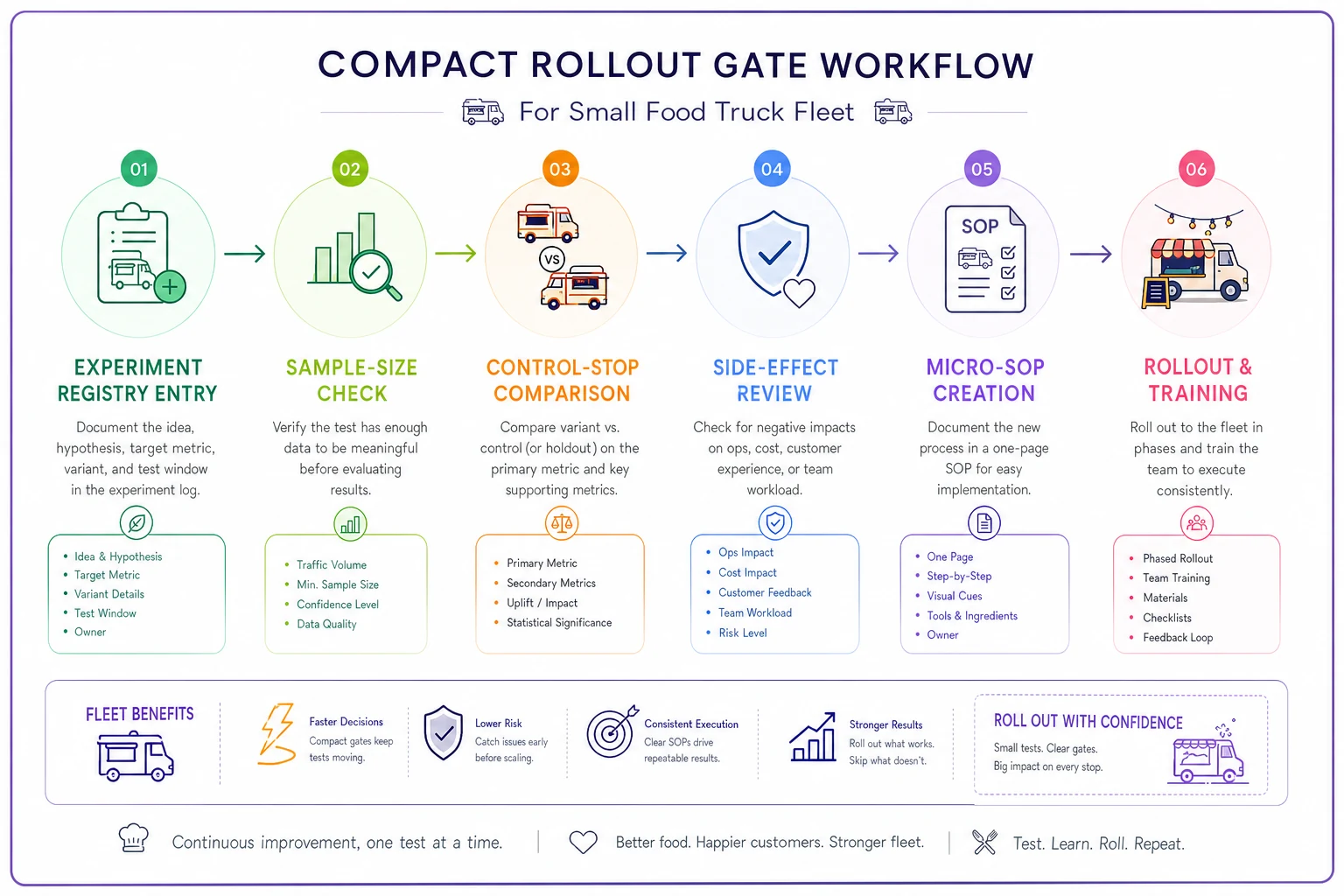
This is also where experiment governance connects to the rest of your operation. A winning price test doesn't just become a number — it becomes signage, scripts, and a POS change. If you've already built disciplined practices around low-friction, safe dynamic pricing by stop, a validated price experiment slots straight into that system. Same with throughput tests: a validated change to your window flow should feed directly into your express-lane and prepay workflows rather than living as a one-off on one truck.
A real scenario: the "double combo" test
A three-truck taco operation wanted to test a bundled combo (two tacos + drink at a set price) aimed at lifting average check during the lunch rush.
Before governance, they'd have run it on one truck, seen a good Friday, and rolled it out everywhere. Instead they logged it properly. Baseline average check was sitting around $13–14 across their lunch stops. They ran the combo at one truck's office-park stop and kept a nearly identical second stop as a control, over about ten lunch services.
Results: the test stop's average check moved to roughly $15.50, while the control stop drifted around $13–14 the whole time. The lift held across the full run, not just the good days. Ticket times stayed flat because the combo was easy to ring and assemble — no side effect. It cleared the gate.
They converted it into a one-page SOP: combo pricing, the exact window script, and the POS button setup, with the test dates noted at the bottom. Then they rolled it to all three trucks over the following two weeks. The quiet win here wasn't the extra dollar-fifty a ticket — it was that when one manager later asked "should we drop the combo, it feels slow," they had the original data and could answer without re-running anything.
Without the registry and the gate, that combo is a rumor. With it, it's a standard.
When this makes sense — and when it's overkill
Governance isn't free. It adds a little friction to every change, and friction is the last thing a two-person truck needs on a Saturday.
This makes sense when:
-
You're running more than one truck, or one truck with multiple managers who make changes independently.
-
You keep having "wait, why did we start doing this?" conversations.
-
You've rolled out changes fleet-wide that quietly underperformed.
-
You want to scale and you can feel that your current "just try stuff" approach won't survive a fourth truck.
This is overkill when:
-
You're a single owner-operator on one truck who makes and remembers every change. Log the big ones, skip the ceremony.
-
The change is trivial and reversible (a new hot sauce on the condiment bar). Just do it.
Who should NOT formalize this yet: brand-new trucks still finding their core menu and base operations. Your early months should be messy, fast experimentation. The time for governance is when you have enough stability that a bad rollout actually costs you — and enough complexity that you can't track experiments in your head anymore.
Keeping the whole thing lightweight
The failure mode of experiment governance is that it becomes a process nobody uses. If logging a test takes longer than running it, people stop logging. Keep the registry to one screen. Keep the gate to one checklist. Make the micro-SOP genuinely one page.
As you add trucks, the main thing that changes is coordination — you need one shared registry everyone can see, so two managers don't unknowingly run opposite tests at the same stop. This is where keeping experiments in a shared operational system instead of someone's notebook starts to matter, mostly so that baselines, control stops, and rollout status live in one place everyone trusts. The tool is secondary; the shared source of truth is the point.
The operators who scale cleanly aren't running more experiments than everyone else. They're running fewer, cleaner ones — logging the baseline, respecting the sample size, checking the control, and converting the real winners into procedures that outlive whoever discovered them. That's the entire discipline. Everything above is just making it hard to skip the steps that matter.
Ready to drive your food truck business forward?
Join 2,000+ food truck operators relying on Grubzly to boost efficiency, increase sales, and delight customers.