

Most food truck operators price their menu once, print the board, and leave it alone for months. Which makes sense when you're slammed and the board is bolted to the truck. But that single flat price quietly leaves money on the table during your best windows and forces you to eat spoilage during your slow ones.
The frustrating part is that the moment you hear "dynamic pricing," you picture surge-pricing outrage, angry Yelp reviews, and some customer photographing your board to post online. That fear keeps a lot of trucks stuck on flat pricing forever.
But pricing by stop doesn't have to mean surge pricing. Done right, it's mostly invisible — it lives in bundles, limited add-ons, and small time-boxed offers that feel like a deal, not a penalty. This post covers the low-friction version: what actually works stop-to-stop, how to word your signage so nobody feels gouged, how often to test changes, and how to connect your pricing moves to spoilage so you stop throwing product in the bin at 8pm.
The core mistake: treating every stop like it has the same demand curve
A truck runs a downtown lunch stop Monday through Thursday, a brewery Friday night, and a Saturday farmers market. Same menu, same prices, all week.
The downtown lunch crowd has 40 minutes and basically zero price sensitivity — they want speed and they're either expensing it or grabbing it between meetings. The brewery crowd is three beers in, in no rush, and would happily buy loaded fries and a dessert if you put it in front of them. The farmers market crowd is browsing, comparing prices, and half of them are "just looking."
Charging all three the same way means you're underpricing the lunch rush, under-selling the brewery, and possibly overpricing the market. Flat pricing pretends these are the same business. They aren't.
The insight most operators miss: pricing by stop isn't really about the price number. It's about matching your offer structure to how each crowd actually buys. The lunch crowd wants a fast bundle. The brewery crowd wants add-ons. The market crowd wants a low-stakes entry point. Same food, three different packaging strategies.
Three low-friction tactics that don't trigger backlash
There's a hierarchy of pricing moves from "customers never notice" to "customers might get annoyed." Stick to the low-friction end and you capture most of the upside with almost none of the risk.
Stop losing sales to poor planning.
Grubzly helps you plan routes, track inventory, and maximize daily sales effortlessly.
- Real-time route optimization
- Inventory tracking & alerts
- Mobile sales & reporting
No credit card required
| Tactic | Friction level | Best stop type | What the customer perceives |
|---|---|---|---|
| Bundles / combos | Very low | Lunch rush, families | "I'm getting a deal" |
| Limited-time add-ons | Low | Breweries, evening events | "Ooh, that sounds good" |
| Peak-window pricing on 1–2 items | Medium | High-demand events with no competition | Neutral to slightly negative |
| Straight surcharge on everything | High | Almost never | "They're gouging me" |
The two worth leaning on hardest are bundles and limited-time add-ons, because both raise your average ticket while making the customer feel like they gained something.
Bundles that raise ticket without looking like a price hike
A bundle works because it hides individual item margins inside a single number. If your taco is $4, a drink is $3, and chips are $2.50, that's $9.50 à la carte. Bundle it at $10.50 with "taco + chips + drink" and most customers read it as a convenience deal, even though you just captured a dollar in attach revenue you'd otherwise have lost when they skipped the drink.
The trick is building the bundle around the item people were already going to skip. Drinks and sides are the classic choices — high margin, frequently abandoned. The bundle isn't discounting anything; it's rescuing an attach sale that wasn't happening anyway.
For a lunch rush specifically, a two-item combo also speeds up the line. Customers stop deliberating between eleven options and just point at "Combo B." That throughput gain is worth as much as the margin at a stop where the line dies at the 45-minute mark.
Limited-time add-ons for slow, social crowds
Add-ons shine where people aren't in a hurry. A brewery stop or an evening event is where a $4 "tonight only: brisket queso upgrade" or a $3 dessert special quietly lifts tickets. Nobody feels overcharged because the base menu price never moved — you just offered something extra.
"Tonight only" or "this stop only" does real work here. It creates a reason to say yes now, and it gives you cover to not offer it at your price-sensitive market stop the next morning. That's the elegant part: a limited-time add-on lets you price differently by stop without ever printing two different prices for the same item.
Signage wording: the difference between "deal" and "gouge"
Wording is where most of the backlash risk actually lives. The exact same $1 difference reads as either a discount or a penalty depending on the frame.
Rules that hold up in the field:
-
Frame everything as the customer gaining, never as them paying more. "Add fries + drink for $4" not "Combo surcharge $4."
-
Anchor to the bundle, not the discount math. Don't write "$9.50 value for $10.50" — that just exposes the upsell. Write "Lunch Combo — $10.50."
-
Use scarcity honestly. "Tonight only" and "while it lasts" are fine if they're true. If customers catch you running the same "limited" special every single day, you lose the trust that makes it work.
-
Never explain your pricing on the board. No "prices higher at events due to demand." That sentence has killed more goodwill than any actual price increase. The board states what things cost. It doesn't apologize or justify.
-
Keep peak-window changes off the permanent board. If you run a small bump on one item, put it on a clip-on card or chalk insert, not your main menu. It reads as "event special," not "they changed the price on me."
Customers rarely remember your prices with much precision. They remember whether they felt treated fairly. A brewery crowd will happily pay $4 for a queso upgrade they'd never think twice about — but that same crowd will remember for months that you added a visible "peak surcharge" line. The number matters less than the frame.
Tying pricing to spoilage: guardrails by stop and time
This is where pricing stops being a marketing lever and becomes an inventory tool. The end-of-day spoilage problem and the pricing problem are essentially the same problem viewed from two different angles.
If you know you're carrying 30 portions of a perishable protein into a stop and history says you'll sell around 18, you have a choice: watch 12 portions die, or move them with a time-boxed offer before they die.
-
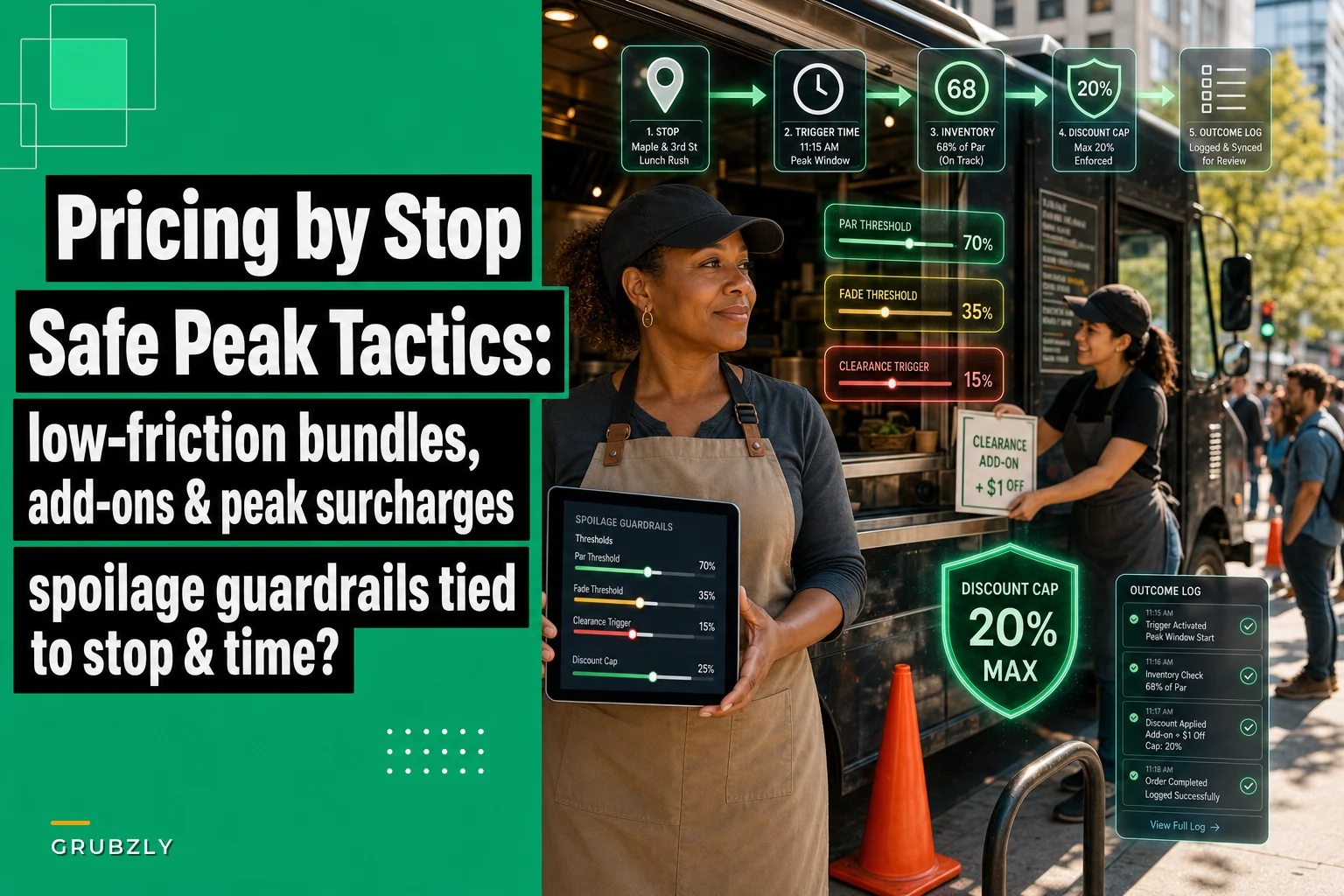
Set a par-and-fade threshold per perishable item, per stop. Brisket has a hard "must sell or discount" clock based on holding time and remaining stock.
-
Define a trigger time. For an evening stop, that might be 60–90 minutes before close. If remaining portions exceed projected remaining demand, the trigger fires.
-
Deploy a pre-planned clearance add-on, not a panic discount. Instead of slashing the entree price — which trains regulars to wait for the drop — turn the excess into a limited add-on or a "last call" bundle. "Last 10 brisket bowls — add a drink free" moves product while protecting your base price.
-
Cap how deep you'll go. A guardrail is a floor. If you're willing to take brisket down to break-even but no lower, that number gets decided before service, not in an 8pm panic.
-
Log what triggered and what cleared. So next week's prep order shrinks and you carry less excess into that stop in the first place.
The mistake most operators make is discounting reactively and inconsistently — dropping prices at different times, by different amounts, under pressure. Regulars pick up on that pattern fast and start showing up late for the fire sale, which cannibalizes full-price sales earlier in the day. A pre-defined, quiet clearance mechanism avoids training that behavior entirely.
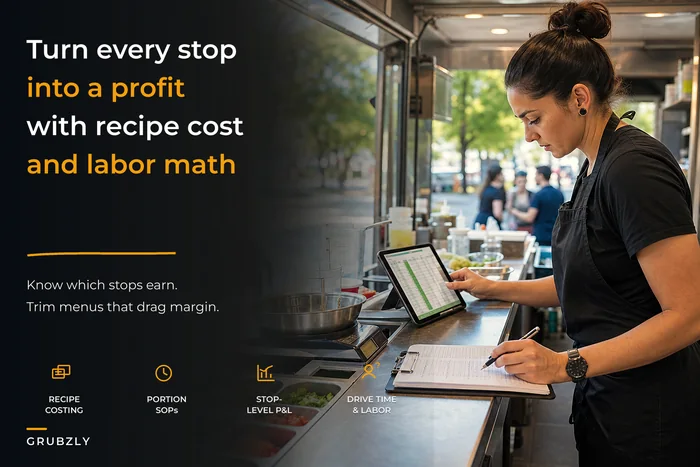
If you want to work through the perishable-prep side of this, it connects directly to the costing work in turning menu choices into profit by stop with recipe costing and portion SOPs — you can't set a sane clearance floor if you don't know your per-portion cost at that stop.
Use this simple flow when spoilage triggers.
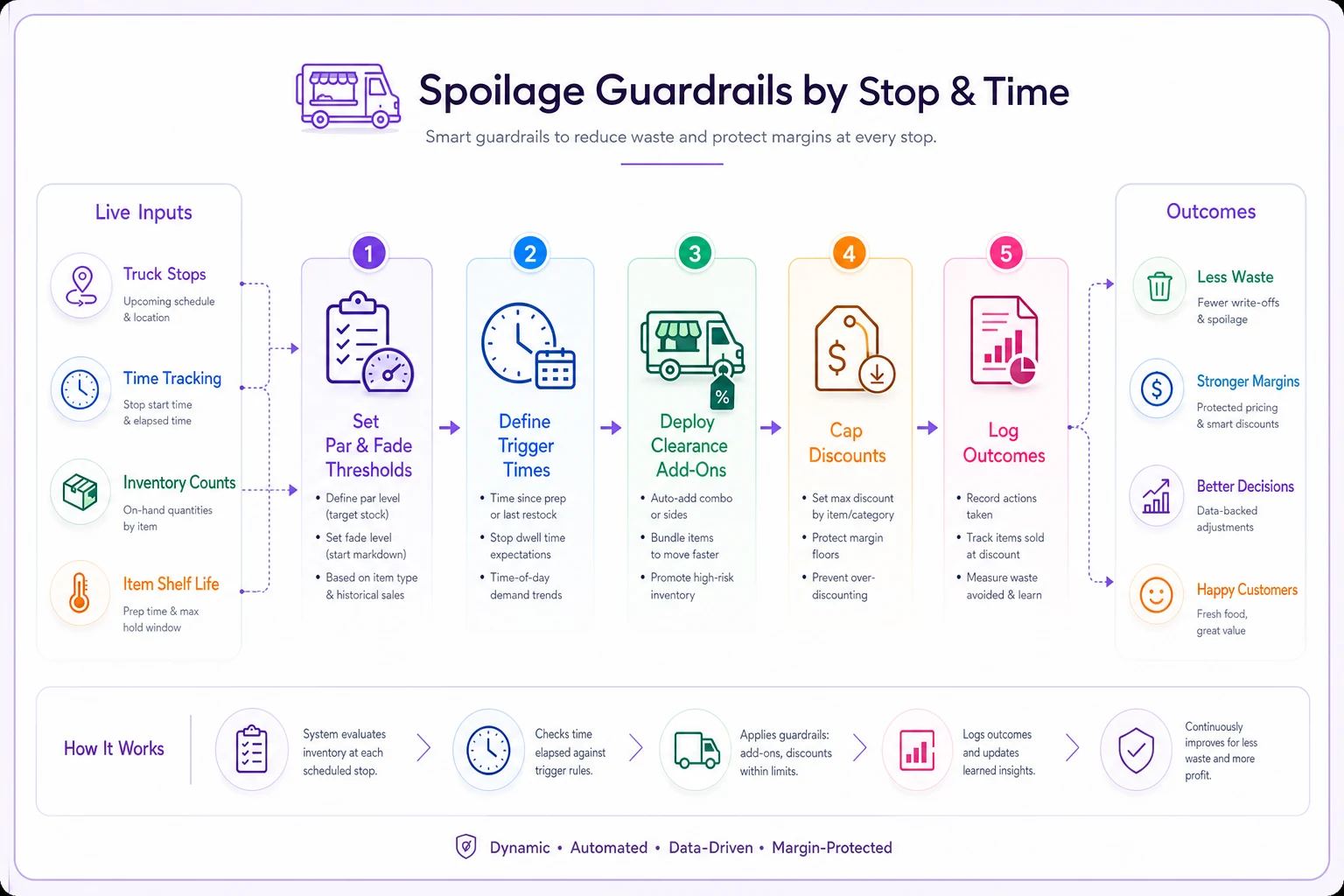
A simple flow to follow when you need to clear excess perishable stock without training customers to wait for discounts.
Experiment cadence: how to test without confusing your regulars
Most operators either never test pricing, or change everything at once and can't tell what worked. Both approaches fail.
-
Change one thing per stop, per two-week window. Test a bundle at the lunch stop while holding everything else steady. Two weeks is long enough to smooth out a rained-out day or a slow Tuesday.
-
Never run experiments on your two best regular stops at the same time. Pick one experiment stop at a time so a bad test doesn't tank a whole week of revenue.
-
Measure attach rate, not just total sales. The real question with a bundle isn't "did revenue go up" — weather and foot traffic swamp that signal. It's "did the percentage of orders that include a drink or side go up." That's a cleaner read on whether the offer actually worked.
-
Kill losers fast, keep winners boring. Once a bundle wins, lock it in and stop tinkering. Regulars like predictability at their home stop.
Measure attach rate, not just total sales.
A realistic testing rhythm: weeks 1–2 test a combo at the downtown stop, weeks 3–4 test an evening add-on at the brewery, then compare both against your baseline. You're running maybe one meaningful pricing experiment at a time across your route, not twelve simultaneously.
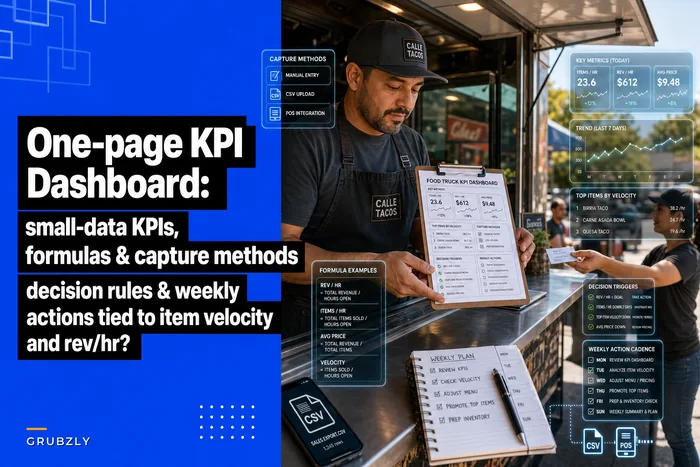
This is also where a simple metrics habit pays off. If you're already tracking a one-page KPI dashboard for weekly decisions, add "average ticket by stop" and "attach rate by stop." Those two numbers tell you almost everything about whether your pricing-by-stop moves are actually doing anything.
A real scenario
Business: A single taco truck running four fixed weekly stops — two weekday downtown lunches, a Friday brewery, a Saturday market.
The problem: Flat pricing everywhere. Average ticket sat around $11 across all stops. The brewery crowd was clearly under-monetized — people lingering, buying one taco, leaving. The truck was tossing roughly 10–15 portions of protein most Saturdays because market sales were soft and hard to predict.
What changed:
-
Downtown got a two-taco lunch combo with chips and a drink, framed purely as a combo, no discount math on the board.
-
The brewery got a rotating "tonight only" loaded add-on at $4.
-
Saturday got a spoilage guardrail
90 minutes before close, excess protein converted into a "last call" bundle instead of a panic price cut.
Rough outcome after about six weeks: Average ticket at the brewery moved from around $11 to the $14–15 range, mostly on add-on attach. The downtown ticket nudged up about a dollar while the line actually moved faster. Saturday spoilage dropped to a handful of portions instead of a dozen-plus, and the reactive discounting stopped entirely. No customer complaints about pricing — because from the customer's side, nothing got more expensive. They just got offered more things to say yes to.
When this makes sense — and when it doesn't
When pricing by stop is worth it:
-
You run distinct stop types with clearly different crowds and dwell times.
-
You have recurring spoilage at specific stops.
-
Your average ticket varies wildly by stop but your pricing doesn't.
When it's probably a bad idea:
-
You're at a single recurring stop with the same loyal crowd every day. They'll notice inconsistencies quickly, and there's not much demand variation to exploit anyway. Just price it well once.
-
Your menu is already dead simple — one or two items. Bundles need enough SKUs to combine meaningfully.
-
You can't yet measure attach rate or ticket by stop. Testing without baseline data is worse than not testing — you'll draw wrong conclusions and change the wrong things.
Who should skip peak-window pricing entirely: anyone whose stops are competitive and price-comparable — a market with three other trucks selling similar food, for example. A visible price bump just sends the crowd to the truck next door. Stick to bundles and add-ons, which competitors usually aren't matching, and leave surge pricing alone.
The takeaway
Pricing by stop works best when it's the least dramatic thing on your truck. The wins come from packaging — bundles that rescue attach sales, add-ons that fit a relaxed crowd, and a quiet spoilage guardrail that moves excess before it goes to waste — not from visible surcharges that make people feel squeezed.
Test one change at a time, watch attach rate more than total revenue, and word every sign so the customer feels like they're gaining something. Get those pieces right and you'll raise your average ticket at the stops that can bear it, cut the spoilage at the stops that drag you down, and never once have someone photograph your board to complain about it.
Ready to drive your food truck business forward?
Join 2,000+ food truck operators relying on Grubzly to boost efficiency, increase sales, and delight customers.