

Not every event carries the same risk. A corporate lunch park with 200 badge-holders and a dedicated power drop is a completely different situation than a beer festival with 8,000 attendees, open flame cooking demos, and a 12-truck row packed shoulder-to-shoulder. Yet most operators run the exact same prep for both — same insurance, same contract, same day-of plan.
That mismatch is where the expensive surprises live. A fryer incident at a quiet farmers market might cost you a cleanup and an awkward conversation. The same incident at a crowded festival, standing next to a propane manifold near a crowd funnel, can turn into a claim, a venue ban, and a liability fight that drags on for a year.
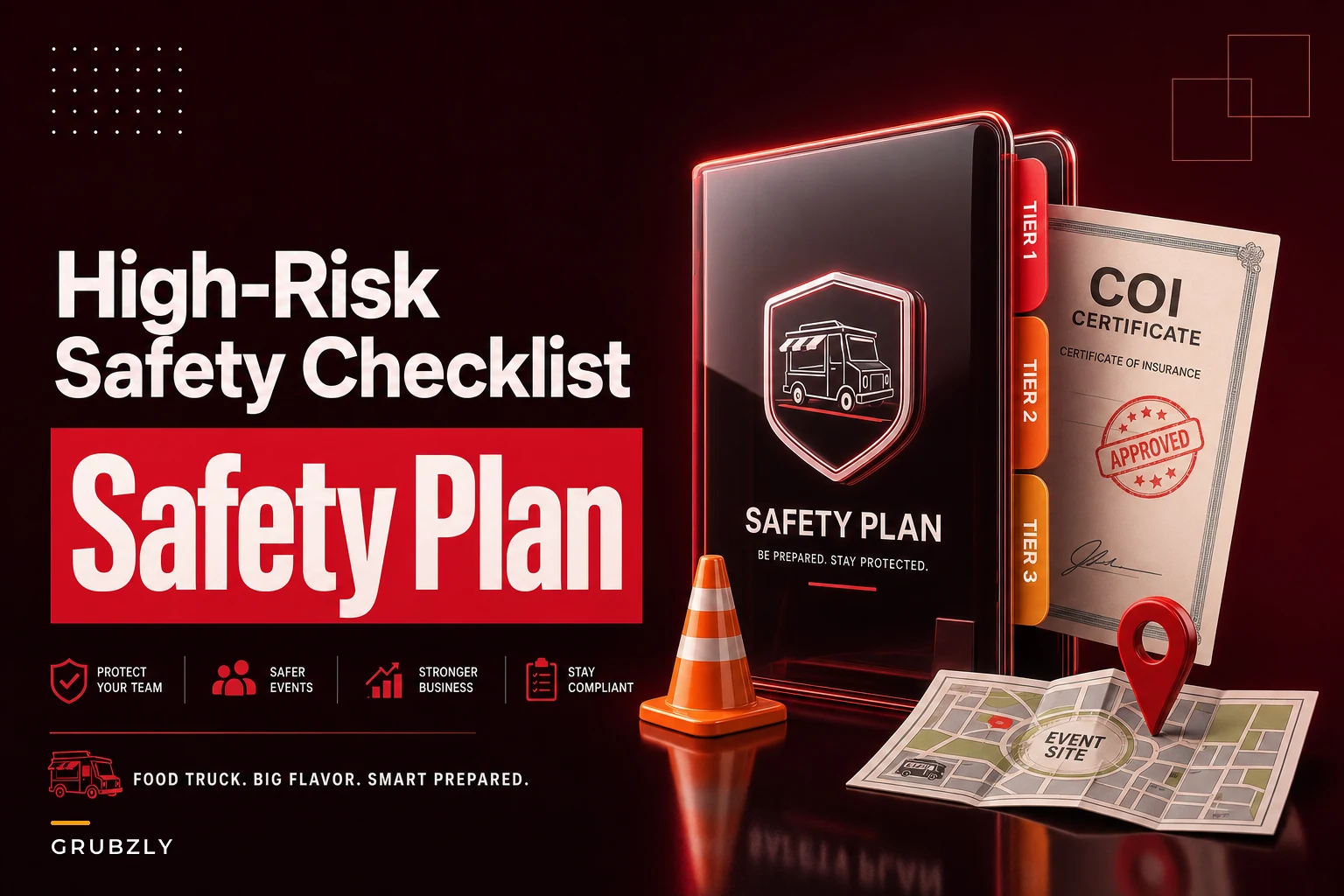
This piece gives you a food truck high risk event checklist that actually scales with exposure. You tier the event first, then apply the right mitigation, the right contract clauses, the right day-of scripts, and — critically — you know exactly which event types trigger a call to your insurer before you roll out.
Start by tiering the event, not the checklist
The mistake almost everyone makes is treating "safety prep" as one fixed list. You either do it or you don't. But risk isn't binary — it's layered. The smarter move is to score each booking into a tier, then let the tier dictate how much prep is actually justified.
Here's a tiering model that works well for mobile vendors. Score the event on four exposure factors, then take the highest tier that applies.
| Exposure factor | Tier 1 (Low) | Tier 2 (Elevated) | Tier 3 (High) |
|---|---|---|---|
| Crowd size | Under 500 | 500–3,000 | 3,000+ |
| Cooking method | Flat-top, no open flame | Fryer / limited flame | Open flame, live demo, charcoal |
| Power / fuel setup | Dedicated drop or small gen | Shared generator | Propane manifold, shared high-load power |
| Crowd proximity | Open layout, space to move | Moderate density | Packed rows, choke points, alcohol served |
One rule: the highest single factor sets the tier. A tiny 300-person event is still Tier 3 if you're running a live open-flame demo next to a propane bank. Density plus alcohol plus flame is the combination that burns people — literally and financially.
A typical example: a truck books a "small private party, 250 guests." Sounds like Tier 1. But it's an outdoor wedding, the caterer wants a flaming dessert station, and the only power is a shared generator feeding four vendors. That's Tier 3 on two factors. Prep accordingly, or you're the one holding the claim.
What each tier actually requires
Once you've scored the booking, the prep writes itself. The goal isn't to over-prepare every event — that burns time and money you don't have. It's to match effort to exposure.
Stop losing sales to poor planning.
Grubzly helps you plan routes, track inventory, and maximize daily sales effortlessly.
- Real-time route optimization
- Inventory tracking & alerts
- Mobile sales & reporting
No credit card required
Tier 1 — Low exposure
-
Standard COI on file, venue listed where required
-
Fire extinguisher serviced and visible (check the tag date)
-
Basic first-aid kit stocked
-
One staff member who knows where the propane shutoff is
-
Grease and waste disposal plan confirmed
Tier 1 is mostly about not letting routine safety lapse. The failure here isn't dramatic — it's an expired extinguisher tag that a passing inspector flags, or a grease spill nobody planned to clean up. If you want a deeper look at baseline risk systems, the operational risk playbook for mobile food vendors covers the fundamentals that keep these things from slipping through the cracks.
Tier 2 — Elevated exposure
-
Everything in Tier 1, plus
-
COI endorsed with the venue/organizer as additional insured
-
Confirmed spacing between trucks (minimum clearance in writing)
-
Shared-generator load confirmed and documented before connecting
-
Fire blanket on board, second extinguisher staged at the serving side
-
A designated "safety lead" per shift who is not also running the window
-
Written clause in the booking covering power failure and who pays for lost product
Tier 3 — High exposure
-
Everything above, plus
-
Insurer notified in advance (more on the triggers below)
-
Umbrella/excess liability verified for the day's limit
-
Fire marshal or event safety officer contact confirmed in writing
-
Open-flame or demo setup inspected and signed off before service
-
Crowd-flow plan
where the line forms, where it exits, no choke point at the fryer
-
Pre-event safety briefing with the full crew, documented with a photo of the signed sheet
-
Spill, burn, and evacuation scripts printed and posted inside the truck
The jump from Tier 2 to Tier 3 is where operators get lazy, because Tier 3 events are usually the big-money bookings and nobody wants to add friction to a good contract. But the size of the payday is the size of the exposure. A festival that nets you $4k–$6k in a day also puts you next to the most people, the most fuel, and the most ways to get sued.
Contract clauses that actually protect you
Most operators miss this: your protection is written long before the event, in the booking agreement. If the contract is silent on liability allocation, power failure, or indemnification, you inherit the risk by default.
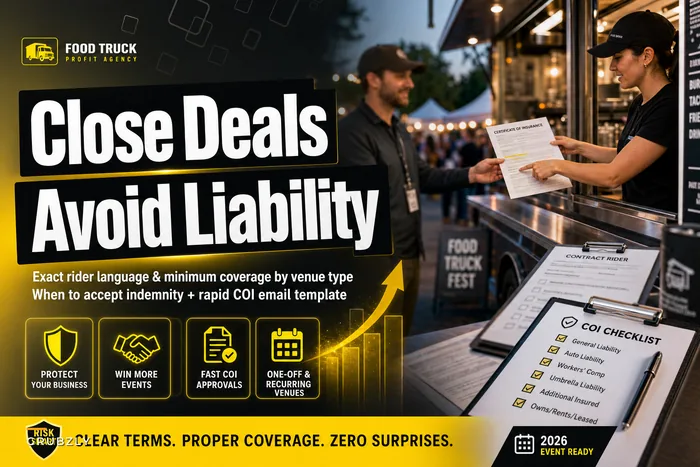
The contract rider and COI side of this deserves its own deep read — the contract rider and COI checklist for one-off events and recurring venues breaks down the full document stack. What follows are the specific clauses tied to high-risk exposure.
Indemnification (mutual). You want each party responsible for its own negligence. Watch for one-sided language that makes you responsible for everything that happens at the event, including the organizer's crowd control failures.
> Sample language: "Each party shall indemnify and hold harmless the other party from claims, damages, and liabilities arising out of the indemnifying party's own negligence or willful misconduct. Vendor's liability shall be limited to incidents arising directly from Vendor's food preparation and service operations."
Power and utility failure. On shared generators, you need the contract to say who covers spoiled inventory and lost sales if the power drops.
> Sample language: "Organizer shall provide continuous power meeting the agreed specification ( volts / amps). In the event of power interruption exceeding 30 minutes caused by Organizer-supplied utilities, Organizer shall reimburse Vendor for documented perishable loss at cost."
COI / additional insured. For Tier 2 and 3, the organizer should be named as additional insured on your general liability.
> Sample COI language to request from your broker: "Certificate holder [Organizer legal name] and [Venue legal name] are named as Additional Insured with respect to General Liability arising out of operations performed by the Named Insured, per written contract. Coverage is primary and non-contributory where required by written agreement."
Fire and open-flame compliance. On Tier 3, add a clause confirming the organizer has secured any required fire permits and that your demo setup was approved.
Cancellation for unsafe conditions. You want the right to shut down and leave without penalty if conditions become genuinely dangerous — a crowd surge, an overloaded power bank, a fire marshal order.
> Sample language: "Vendor reserves the right to cease operations and vacate the premises without penalty if, in Vendor's reasonable judgment or at the direction of a fire marshal or safety official, continued operation poses an imminent safety hazard."
The insurer-notification trigger — the part people skip
This is the single most overlooked item on any high-risk event prep. Many general liability policies have conditions requiring advance notice for high-exposure activities — large crowds, open flame, alcohol-adjacent service. Skip the notice and you risk a coverage dispute at the exact moment you need it most.
Call your insurer or broker in advance when any of these are true:
-
Crowd exceeds 3,000 attendees
-
You're running open flame, charcoal, or any live cooking demo beyond your normal setup
-
Alcohol is served at the event (even if not by you)
-
You're adding a temporary structure, tent, or stage element
-
The organizer's contract requests coverage limits higher than your standard policy
-
The event is a type you've never done before (new exposure = new call)
-
The venue requires you to waive subrogation or accept their indemnity terms
The workflow is straightforward: as soon as a booking scores Tier 3, it isn't "confirmed" until two things happen — the COI is issued with the right endorsements, and your broker has acknowledged the event in writing. No acknowledgment, no roll-out. Treat it like a permit.
On timing: give your broker at least 5–7 business days. Additional insured endorsements and higher-limit confirmations aren't instant, and the worst version of this is realizing on Friday that your Saturday festival needs a $2M limit you don't have.
Day-of comms scripts your crew can actually use
When something goes wrong at a packed event, people freeze or improvise — and improvising in front of a crowd is how a small incident becomes a scene. Short scripts fix this. Print them, tape them inside the truck, and run through them in the Tier 3 pre-event briefing.
Minor burn / staff injury: > "Step back from the line. [Name], take over the window. I'm handling this. Grabbing the first-aid kit — if this needs more than a bandage, I'm calling the event medic at [number]."
Grease or fuel spill near the crowd: > "Service paused for 2 minutes, folks — cleaning a spill, keeping it safe. Back to you shortly." (To crew:) "Cones out, nobody steps through it, [Name] grabs the absorbent."
Small fire at the cooking station: > (To crew, loud and clear:) "Fire. Killing propane now. Extinguisher. [Name] — move the line back ten feet." (To crowd:) "We need everyone to step back, please. We've got it handled."
Power failure on a shared generator: > (To crowd:) "Quick power hiccup — we'll be cooking again in just a minute." (To crew:) "Log the time. Photo the generator panel. Hold hot product, pull anything that's dropped below temp."
The point of scripting isn't to sound polished — it's to give your crew a default action so nobody wastes the first critical minute deciding what to do. The crowd-facing line buys you calm; the crew-facing line buys you execution.
A real scenario
A two-truck taco operation booked a regional music festival — roughly 7,000 attendees over a weekend, shared high-load power across the vendor row, and a contract that said almost nothing about liability. They'd done farmers markets and office parks for two years and ran the festival on the same prep.
Day one, a shared generator overloaded mid-afternoon. Refrigeration dropped for about 40 minutes. They lost a solid chunk of prepped protein and had to pull product they weren't sure about — somewhere in the $600–$800 range in inventory, plus lost sales during the dead window. The contract was silent, so they ate all of it. Worse, their insurer later flagged that the event's open-flame demo stage — two trucks down — wasn't something they'd been notified about, which opened an uncomfortable coverage conversation that thankfully didn't become a claim.
The following season they tiered every booking. Festivals automatically hit Tier 3. The power-failure clause went into every multi-vendor contract, the broker got notified five days out on anything over 3,000 people, and the crew ran a five-minute safety briefing before service. When a generator wobbled again that summer, they logged the time, photographed the panel, and the organizer reimbursed the documented loss — because the contract now said they had to. Same incident, completely different outcome.
When heavy prep is a bad idea
Tiering cuts both ways. Over-preparing a Tier 1 event is its own kind of waste — you don't need additional-insured endorsements and a scripted safety briefing for a quiet Tuesday office lot. Burning your broker's goodwill with notification requests for every small booking also means they stop treating your real Tier 3 calls as urgent.
The operators who get this right built the tiering once and let it run. The booking gets scored, the scoring picks the prep, and nobody re-litigates it every time. You're not trying to make every event feel high-stakes — you're trying to make sure the genuinely high-stakes ones never get treated as routine.
Keeping it consistent as you grow
The hard part isn't knowing the checklist — it's running it the same way across multiple trucks, multiple crews, and a booking calendar that's always moving. One operator remembers to notify the broker; another doesn't. One crew does the briefing; the other skips it when they're running late. That inconsistency is where the gaps open.
Tracking bookings, COI status, and event tier in one operational system — rather than across a mix of texts, spreadsheets, and someone's memory — is what closes those gaps. When the tier is attached to the booking and the required steps are visible to whoever's running the truck that day, the prep stops depending on who happened to remember. AI-powered operational software can handle this kind of structured tracking well: flag the tier automatically based on booking details, surface the right checklist, and create a clear paper trail without anyone having to chase it down manually.
Here's a simple workflow graphic that maps booking intake to checklist and broker notification.
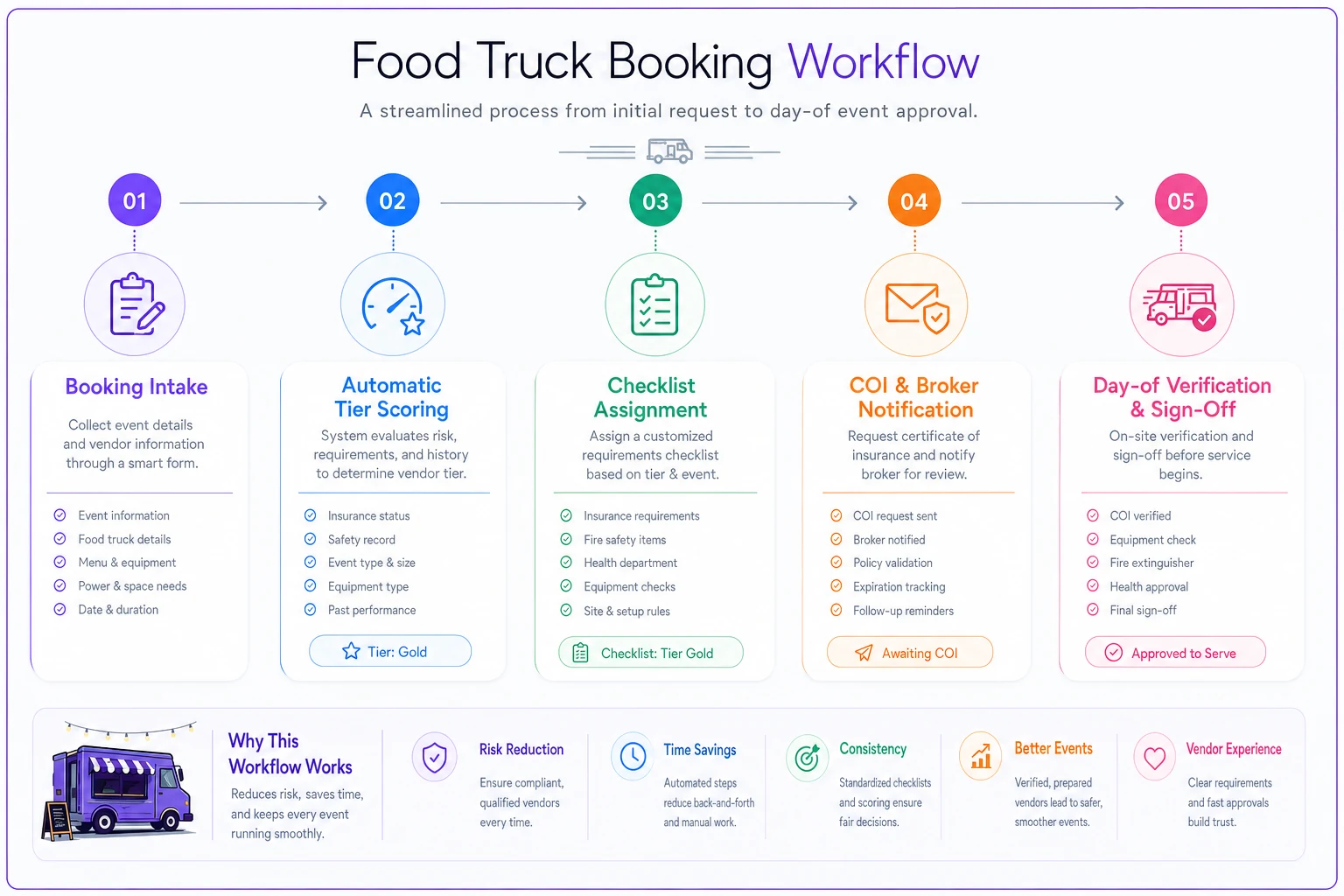
Flag Tier 3 bookings automatically in your ops system so broker notifications aren't missed.
The checklist is only as good as your ability to run it the same way every single time. Score the exposure, match the prep, write the clauses before you sign, and pull the insurer trigger before you roll.
Do that consistently and the biggest events on your calendar become the ones you're most prepared for — not the ones that keep you up at night.
Ready to drive your food truck business forward?
Join 2,000+ food truck operators relying on Grubzly to boost efficiency, increase sales, and delight customers.