

Most food trucks don't lose money on bad events. They lose money on mediocre partnerships that looked fine on paper and ate a full Saturday for $420 in sales minus fuel, labor, and the catering gig they turned down.
Pop-up invites rarely arrive as obvious yes-or-no decisions. A brewery DMs you. A farmers market coordinator emails. A new retail plaza "wants to build a food scene." Everything sounds friendly, the host is excited, and you don't want to be the jerk who asks about foot traffic numbers before saying thanks. So you say yes based on vibes, and three weekends later you're staring at a POS report wondering why you felt busy but made nothing.
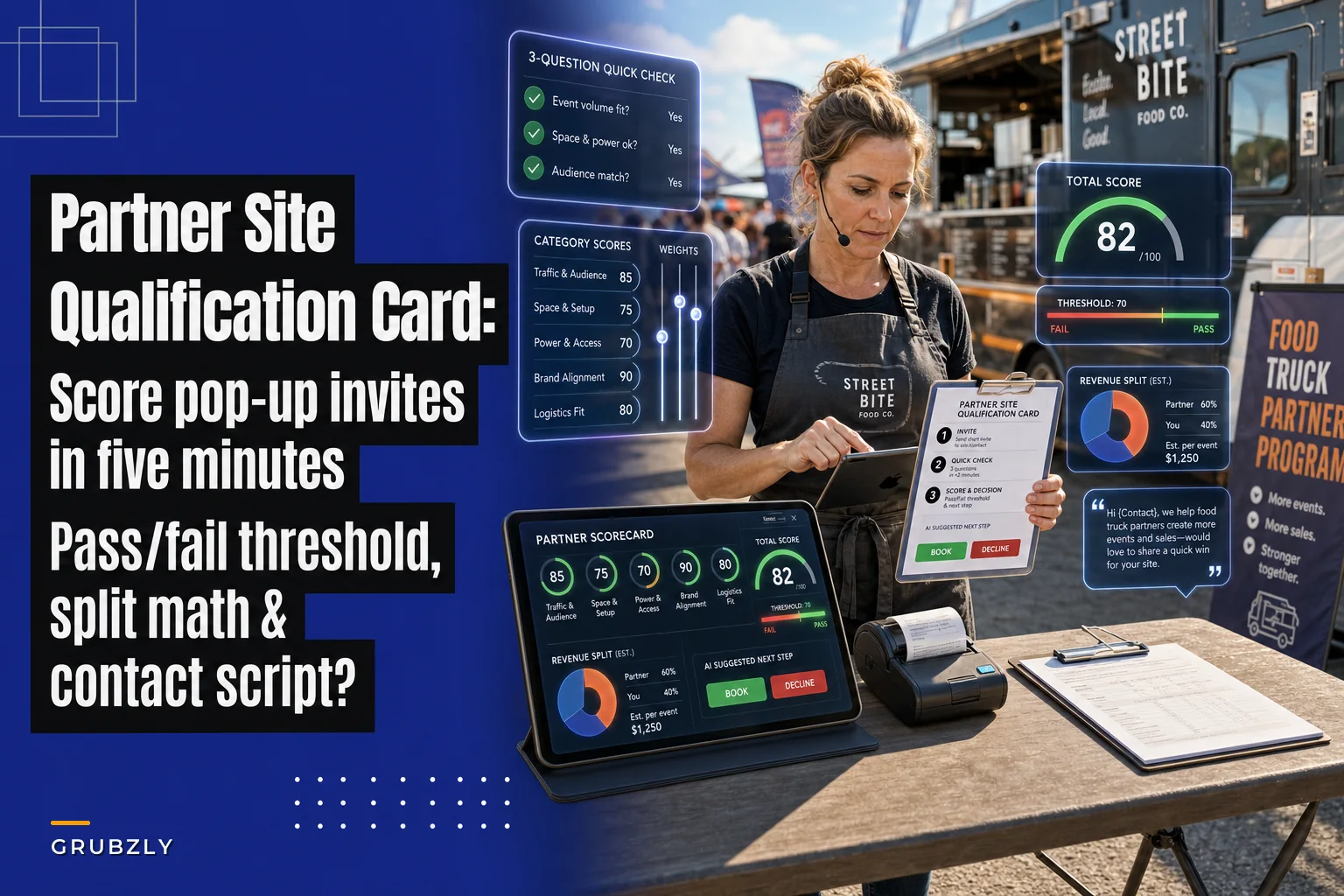
A qualification card fixes this by moving the decision off your gut and onto one page. Score it, apply a threshold, and either book it or decline it in roughly five minutes. The whole point is to cut low-value partnerships before you've invested emotional energy into them — because once you've had two friendly calls with a host, saying no gets weirdly hard.
Why pop-up partnerships quietly bleed you
The math on a weak partner site is almost never obvious in the moment.
You get invited to a Sunday pop-up at a new-ish brewery. They say they "do 200-300 people on a good day." You show up, there are 60 people spread across five hours, half of them already ate before coming. You sell about $380. Variable costs plus three hours of a staffer plus fuel runs close to $240. Add the opportunity cost — you declined a smaller private event that would've cleared $600 net — and that friendly brewery just cost you real money while feeling like a nice afternoon.
-
They say yes to anything that fills an empty slot, treating "something" as better than "nothing" — even when something loses money.
-
They never ask what the revenue split actually is until they're already parked.
-
They judge a site by how nice the host is, not by how many hungry people walk past.
-
They don't track which partner types historically worked, so every new invite gets evaluated from scratch.
The fix isn't to become suspicious of everyone. It's to have a repeatable screen so the good partners pass fast and the time-wasters get a polite decline before they've cost you anything.
The one-page qualification card
Here's the structure. It fits on a single sheet, and you fill it out either while reading the invite or during a quick call with the host. Every category gets scored 0-5, then multiplied by a weight — because not all factors matter equally.
Stop losing sales to poor planning.
Grubzly helps you plan routes, track inventory, and maximize daily sales effortlessly.
- Real-time route optimization
- Inventory tracking & alerts
- Mobile sales & reporting
No credit card required
| Category | What you're actually measuring | Weight | Score (0–5) |
|---|---|---|---|
| Expected foot traffic | Realistic headcount during YOUR serving window, not their peak day | ×3 | |
| Buyer intent | Are people there hungry and ready to buy, or already fed? | ×3 | |
| Revenue terms | Flat fee, % split, or free — and how that nets out | ×2 | |
| Exclusivity | Are you the only truck, or one of six fighting for the same crowd? | ×2 | |
| Setup friction | Power access, parking, load-in distance, permit burden | ×1 | |
| Date value | Is this slot better or worse than your alternative that day? | ×2 | |
| Host reliability | Have they run events before? Do they promote? | ×1 |
The two ×3 categories — foot traffic and buyer intent — are the ones that actually predict revenue. Everything else is friction and margin. If a site scores low on both of those, nothing else saves it, which is why they carry the most weight.
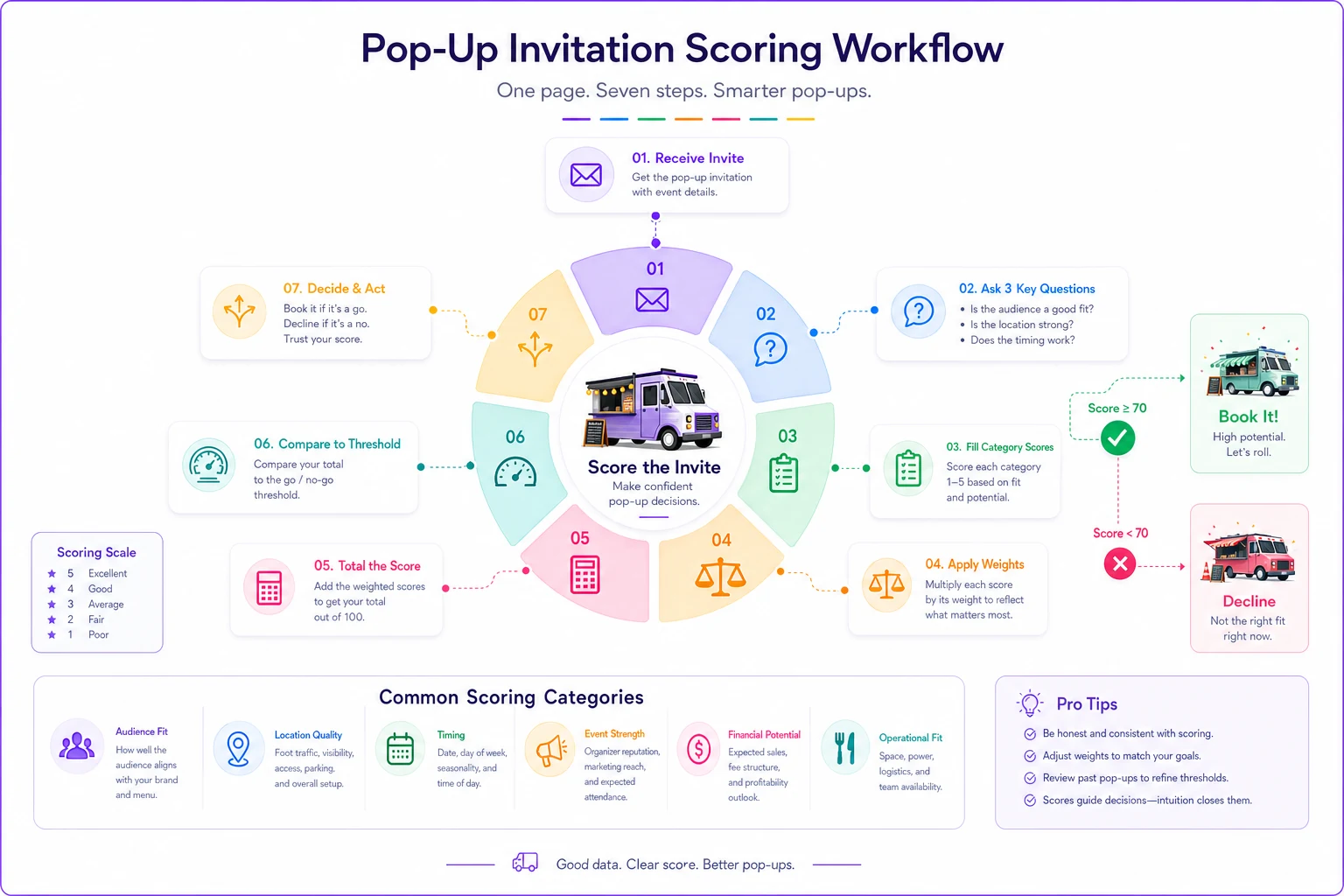
Max possible score is 70. Your pass/fail threshold sits at 45. Below that, it's an automatic decline unless there's a strategic reason — a brand-new venue you want to test, or a host who controls other sites you want access to.
Visual workflow of scoring and deciding whether to book a pop-up:
Max possible score is 70. Your pass/fail threshold sits at 45. Below that, it's an automatic decline unless there's a strategic reason — a brand-new venue you want to test, or a host who controls other sites you want access to.
How to score the two categories that matter most
Foot traffic is where hosts inflate the most, so score it against your window, not their whole day. If a brewery claims 250 visitors over eight hours but you're only there 1-5pm, the relevant number is maybe 90-120 — and only a fraction of those are in buying mode. Ask directly: "How many people are typically on-site between 1 and 5 on a Sunday?" If they can't answer that, it's a 1 or a 2, not a 3.
Buyer intent separates a food-focused event from a backdrop event. A rib cook-off? Intent is low for you — people came to eat ribs, not your tacos. A beer release with no outside food allowed and a crowd that's been there for two hours? Intent is a 5. This is the single most mispriced factor in pop-up decisions, because trucks constantly confuse "lots of people" with "lots of buyers."
Sample revenue-split math (run this before you commit)
Scoring tells you whether to show up. The revenue math tells you whether the terms are worth it. Run a quick projection on any site that clears the threshold.
-
Projected buyers
140 × 0.25 = 35 orders
-
Gross sales
35 × $14 = $490
-
Host cut (15%)
–$73.50
-
Food cost (roughly 30%)
–$147
-
Labor (one staffer, 5 hrs)
–$90
-
Fuel + consumables
–$35
-
Net to you
roughly $145
Now compare terms. A flat-fee site charging $75 with the same traffic nets you around $218 — because the percentage split scales your cost up exactly when you do well. Percentage splits punish your best days. A 20% split on a $1,200 brewery Saturday hands the host $240, while a $100 flat fee on that same day costs you $100. Flat fees are better the busier you expect to be; percentage splits only protect you when you're genuinely unsure the event will perform.
That's the actual decision hiding inside "what's the split?" — not just how much, but which structure matches your traffic confidence.
The pre-stop contact script
Most trucks skip this part: a short, scripted conversation before you agree, designed to pull the three numbers you need and give you a clean exit if the answers are bad. Keep it friendly — you're not interrogating anyone, you're just doing basic diligence.
-
"Hey, thanks for thinking of us — this sounds like it could be a good fit. Before I lock it in, mind if I ask three quick things?
-
Roughly how many people are usually on-site during the hours I'd be serving?
-
Are other food vendors going to be there, or would we be the main food option?
-
How does the fee work — is it a flat rate, a percentage, or complimentary for vendors?
-
Perfect. Let me check it against our schedule and I'll confirm by [tomorrow]. Really appreciate it."
That last line matters. Never commit on the call. A 24-hour window lets you run the card and the math without pressure, and it gives you a face-saving way to decline. "We ran the numbers against our other commitments that day and it's not going to work for us this time — but please keep us in mind for your bigger events" is a decline nobody takes personally.
If the host dodges all three questions or gets cagey about the split, that's your answer. Hosts who run good events know their numbers cold.
A quick scoring walkthrough
Two real-feeling invites, same weekend.
Invite A — new coffee shop grand opening, Saturday: Foot traffic during your window: they say 300, realistically maybe 70 in a steady trickle → 2 (×3 = 6). Buyer intent: coffee crowd, grazing, not meal-hungry → 2 (×3 = 6). Revenue: free slot → 4 (×2 = 8). Exclusivity: only truck → 4 (×2 = 8). Setup: curbside, easy → 4 (×1 = 4). Date value: prime Saturday you could spend elsewhere → 2 (×2 = 4). Host reliability: first event ever → 2 (×1 = 2). Total: 38. Decline.
Invite B — established brewery, Sunday beer release: Foot traffic: 140 confirmed from past releases → 4 (×3 = 12). Buyer intent: no outside food, crowd stays 3+ hours → 5 (×3 = 15). Revenue: $75 flat → 3 (×2 = 6). Exclusivity: one other truck → 3 (×2 = 6). Setup: tight lot, generator needed → 2 (×1 = 2). Date value: Sunday, lighter alternatives → 3 (×2 = 6). Host reliability: runs monthly, promotes hard → 5 (×1 = 5). Total: 52. Book it.
The nice-looking grand opening fails. The slightly-annoying-setup brewery passes easily. Without the card, most operators would pick the opposite based on how pleasant the host sounded.
When the threshold is worth overriding
A scoring system shouldn't become a cage. There are legitimate reasons to take a site that scores below 45:
-
Testing a new venue type you have no data on. Take one low-stakes shot to learn whether the format works for your menu.
-
A gatekeeper relationship — the host also manages three high-traffic sites, and this small event is effectively your audition.
-
A genuinely dead calendar day where even thin margin beats sitting in the commissary. "Something beats nothing" is only true when nothing is actually your alternative.
Override consciously, write the reason on the card, and then check whether it paid off. That's how your scoring gets sharper over time instead of staying a guess.
Who should not bother with this
If you're only doing one or two events a month and you already know your venues well, a formal card is probably overkill — you've already internalized the screen. This matters most for trucks fielding a steady stream of unsolicited invites, running multi-stop weekends, or growing past the point where one person can remember every past event's actual numbers.
It also doesn't replace route-level thinking. A site can pass the card and still be a bad fit because it wrecks your driving day — pairing this with a tighter weekly route plan for dense urban zones keeps you from booking a profitable stop that costs two hours of dead mileage to reach. And for anything edging toward a catered or private format, the deposit-and-run-sheet discipline in the food-truck catering playbook matters more than a quick qualification score.
Real scenario: a two-truck taco operation
A small taco operation running two trucks was saying yes to nearly every invite — breweries, markets, office plazas, charity days. They felt constantly booked and were still barely clearing their weekend targets.
They built a version of this card and started scoring every invite, with the three-question script as the gate. Over about two months they declined roughly a third of incoming pop-ups — mostly grand openings and low-intent "community" events that had been quietly losing money. They reinvested those freed-up Saturdays into two repeat brewery slots and one recurring office-park lunch that consistently scored in the high 50s.
The honest result wasn't a dramatic revenue explosion. Total event count actually dropped. But net per event went up noticeably, staff stopped grinding full days for weak returns, and the owners stopped giving their best Saturdays to events that never deserved them. Fewer stops, more money — that's usually what qualifying well actually looks like.
Keeping the card alive
Print a stack, or keep a copy in your phone notes, and fill one out for every invite — even the ones you're sure about. The sure ones take thirty seconds and build your scoring instinct over time. After each event, jot the actual result next to your projection so you learn which categories you're consistently over- or under-scoring. Within a season you'll notice your foot-traffic guesses for certain host types are always optimistic, and you'll adjust the number accordingly.
The goal was never to be rigid about a number. It's to make the low-value partnership decision in five minutes, with a polite exit ready, so you stop spending your best serving days on events that were never going to pay.
The goal was never to be rigid about a number. It's to make the low-value partnership decision in five minutes, with a polite exit ready, so you stop spending your best serving days on events that were never going to pay.
Ready to drive your food truck business forward?
Join 2,000+ food truck operators relying on Grubzly to boost efficiency, increase sales, and delight customers.