



Sharing a generator at a festival sounds efficient until the money conversation starts. Four trucks split a 20kW unit for a nine-hour street fair, everyone assumes the load was "about even," and by teardown one operator is convinced they got charged for someone else's fryer bank. Nobody wrote anything down at the start. Nobody knows what the meter read when they plugged in. And now the guy who organized the shared rental is texting everyone a Venmo request with a number nobody can verify.
That fight is completely avoidable, and it has almost nothing to do with trust. It's a documentation gap. When you can't prove the starting meter reading, you can't prove your share, and whoever holds the fuel receipt effectively sets the price.
This is a tight, practical SOP for the handover moment specifically — the ten minutes before you plug in and the ten minutes after you unplug. Get those two windows right and the disputes mostly disappear.
Where the money actually leaks in shared power
The disputes almost never come from the total fuel cost. They come from allocation. A generator burns what it burns. The argument is always about who owes what percentage of it.
Nobody logged the pre-shift meter reading. If the hour meter — or the sub-meter on your circuit — wasn't photographed before anyone drew power, the split gets negotiated after the fuel is already gone. That's backwards. You're debating memory instead of numbers.
The load was assumed equal when it wasn't. A coffee truck pulling a couple grinders and a fridge is not drawing the same as a truck running two flat-tops, a fryer, and a walk-in cooler compressor cycling all day. Splitting fuel four ways evenly punishes the low-draw operators every single time.
One person paid for fuel and became the bank. Whoever fronts the diesel or propane ends up chasing everyone else. Without a reconciliation sheet, they either eat the difference or kick off a group-chat argument. Neither outcome is great for getting invited back next season.
The fix isn't a better relationship with the other operators. It's a shared reading, an agreed method for splitting, and a signoff that everyone physically initials before the first burger hits the grill.
The pre-shift meter verification: the ten minutes that prevent everything
Before you draw a single watt, this happens. All operators present, phones out.
Stop losing sales to poor planning.
Grubzly helps you plan routes, track inventory, and maximize daily sales effortlessly.
- Real-time route optimization
- Inventory tracking & alerts
- Mobile sales & reporting
No credit card required
-
Confirm what you're metering. Is there one hour meter on the generator, or does each truck's circuit have its own sub-meter or kWh clamp? This changes everything. If it's one hour meter for the whole unit, you're splitting by agreed load share. If each circuit is individually metered, you split by actual consumption. Decide which before the shift, not after.
-
Photograph the starting reading. Hour meter reading, or each sub-meter's kWh, with a timestamp visible. One photo per meter. Send it to the group chat so there's a distributed record, not just one person's phone.
-
Note the fuel state. If the tank is topped at start, write "full at 7:12am." If you're running propane cylinders, count and label them. You cannot reconcile fuel you didn't measure at the start.
-
Confirm the split method in writing. "Even 4-way" or "load-weighted 40/25/20/15" — whatever it is, everyone agrees to it now and initials it. This is the single most skipped step and the single biggest source of teardown arguments.
-
Assign the meter reader. One person owns the readings for the day. Not four people casually glancing. One.
Ten minutes. The reason it works is that it moves the negotiation to the front of the day, when everyone is calm, instead of the back, when everyone is exhausted and counting cash.
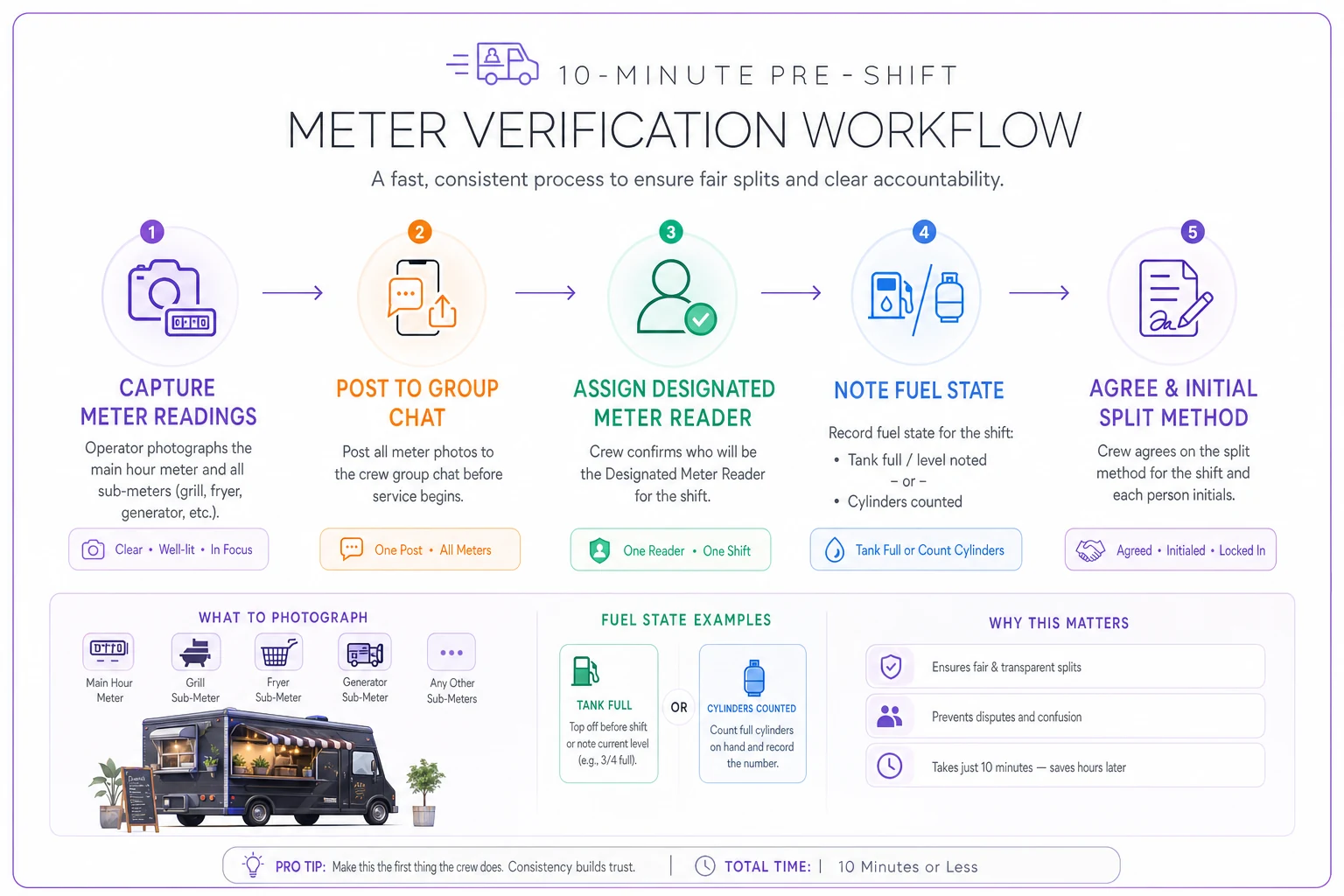
A couple clear photos and initials at the start prevent most teardown arguments.
Choosing your split method (this is the real decision)
Most fights trace back to using the wrong method for the setup. Here's how the common approaches compare.
| Split method | How it works | Best when | Where it goes wrong |
|---|---|---|---|
| Even split | Total fuel ÷ number of trucks | All trucks run genuinely similar equipment | Punishes light-draw trucks; coffee cart pays same as a double-fryer truck |
| Load-weighted (nameplate) | Split by each truck's rated amp/watt draw | Circuits aren't individually metered | Nameplate ≠ actual use; a truck that idled half the day still pays full share |
| Metered actual (sub-meter) | Split by each circuit's measured kWh | Each truck has its own clamp/sub-meter | Requires the hardware; not always available at the site |
| Base + usage hybrid | Flat base fee per truck for the generator rental, then fuel split by load or meter | Mixed-size trucks sharing a rented unit | Slightly more math, but by far the fairest |
The hybrid is what experienced operators drift toward once they've been burned once. The rental cost gets split evenly — everyone benefits from the generator existing — and the fuel gets split by actual or weighted load. That separation stops the coffee truck from subsidizing the fryer truck while still sharing the fixed cost fairly.
The metering checklist for handover
Print this. Laminate it. Tape it to the generator. Every operator ticks their line.
-
[ ] Meter type confirmed (single hour meter / individual sub-meters)
-
[ ] Starting reading photographed with timestamp
-
[ ] Photo posted to shared group chat
-
[ ] Fuel state at start recorded (full / cylinders counted)
-
[ ] Split method agreed and initialed by all operators
-
[ ] Designated meter reader named
-
[ ] Mid-shift check time agreed (usually one reading around peak)
-
[ ] Emergency contact for the generator owner/renter saved by all
-
[ ] Overload behavior discussed (what to shed first if it trips)
That mid-shift reading matters more than people think. If the generator trips at 1pm and someone re-fuels, you want a reading before and after so the top-up doesn't blur the numbers. A single reading around peak load also settles the "who was actually running heavy" question with data instead of opinions.
Laminate and tape the checklist to the generator so it's visible and durable through the day.
Coordinating the fuel side of this connects directly to your own fuel and generator management plan for back-to-back events — the shared setup doesn't replace your own reserve planning, it sits on top of it.
The reconciliation template
At teardown, one person fills this out. Here's the structure with sample rows for a four-truck day sharing a rented 20kW diesel unit.
Event: Riverside Street Fair — Saturday Generator: 20kW diesel, rented (shared) Rental cost: $180 (split even, 4 ways = $45 each) Fuel purchased: 14.2 gal diesel @ $4.35/gal = $61.77 Split method: Base + load-weighted fuel
| Truck | Load weight | Fuel share | Rental share | Total owed | Paid by | Status |
|---|---|---|---|---|---|---|
| Smoke & Barrel (2 flat-tops, fryer, cooler) | 40% | $24.71 | $45.00 | $69.71 | — | Owes organizer |
| Taco Libre (griddle, warmer, fridge) | 25% | $15.44 | $45.00 | $60.44 | — | Owes organizer |
| Green Bowl (blender, fridge, POS) | 20% | $12.35 | $45.00 | $57.35 | — | Owes organizer |
| Bean Machine (2 grinders, fridge) | 15% | $9.26 | $45.00 | $54.26 | Fronted rental + fuel | Collects |
| Totals | 100% | $61.77 | $180.00 | $241.77 |
The load weights were the ones initialed at 7am, not invented at 6pm. That's the whole point. Because the split method was locked before the shift, the reconciliation is just arithmetic — nobody's opinion enters into it.
One note on the weights: if you don't have sub-meters, estimate them honestly at the start based on equipment, and write them down. An imperfect number everyone agreed to beats a precise number nobody trusts.
Handover signoffs
The signoff is what turns a friendly assumption into a record. Two signoffs per day.
Start-of-day signoff. All operators initial: starting reading confirmed, split method agreed, fuel state noted. Photo attached. This is your defense if anyone questions the numbers later.
End-of-day signoff. All operators initial: ending reading confirmed, total fuel confirmed, individual shares confirmed. Once everyone initials the reconciliation sheet, the payment isn't up for renegotiation.
The physical act of initialing does something a group chat doesn't — it forces each person to actually look at the number before agreeing to it. "I'll pay you later" is not a signoff. Initials next to a specific dollar figure is.
The emergency failure playbook
Shared power fails at the worst possible time, and when it does, the cost questions get messy fast. Decide the answers before it happens.
If the generator trips from overload: Follow the agreed load-shedding order immediately. Usually that means non-cooking loads first — extra fridges tolerate a few minutes down better than a half-cooked line. Reset, and log a reading. If one truck caused the trip by adding an unplanned appliance, note it. That affects the fuel math and any future load agreements.
If the generator dies completely: Whoever holds the generator owner's contact calls immediately. Meanwhile, log the reading at failure time so fuel is reconciled up to that point. If a replacement gets brought in, treat it as a new metering event — fresh starting reading, fresh signoff. Don't blend two units into one sheet.
If someone runs an appliance they didn't declare at start: A truck adds a second fryer mid-day that wasn't in the load agreement. Log it, note the time, and adjust their load weight for the portion of the day it ran. The mid-shift reading you took at peak is what makes this calculation fair instead of a shouting match.
If nobody logged the starting reading (it happens): Fall back to an even split for the day and treat it as the cost of the mistake. An even split everyone reluctantly accepts is better than a weighted split nobody can verify. Then don't do it again.
A real scenario
A group of four trucks working a recurring Saturday market had the same argument three weeks running. The organizer truck fronted a shared 22kW unit and diesel, then split everything evenly. The two lighter-draw trucks — a coffee cart and a smoothie truck — kept quietly feeling overcharged, because they clearly weren't pulling what the two grill-heavy trucks were.
Nobody had a starting reading. Nobody had an agreed method. Every week the reconciliation was a text thread that ended with someone paying under protest.
They switched to base + load-weighted starting the next week. Rental cost split four ways evenly, fuel split 40/30/20/10 based on equipment they agreed on Saturday morning, starting hour-meter photographed and posted at open. The whole handover added maybe twelve minutes to setup.
The dollar amounts barely changed — total fuel was roughly the same $55–$65 range each week. What changed was that the coffee cart's share dropped from around $30 (even split) to about $16 (weighted), and nobody argued anymore, because everyone had initialed the split at 8am. All four trucks re-upped for the fall market instead of two of them quietly shopping for their own generators.
The lesson wasn't that even splits are always unfair. Sometimes they're genuinely fine. The problem was the unwritten split, regardless of method.
When shared power actually makes sense — and when it doesn't
It makes sense when the site has room for one properly-sized unit, the trucks trust each other enough to sign off on readings, and the combined load sits well under the generator's rating with headroom to spare. Sharing a rental beats four trucks each hauling their own small unit with four separate fuel runs.
It's a bad idea when one truck's draw is heavy enough that it eats most of the capacity — at that point they should just rent their own, because you're not really sharing, you're subsidizing. It's also a bad idea if the group won't commit to the ten-minute handover process. If they won't photograph a meter, they'll fight about the bill.
Who should skip it entirely: high-volume catering operators running full kitchens at scale. If you're managing power as part of a large private booking, keep it isolated — it fits better into your own private-event run-sheet and packing playbook than into a shared festival split.
The part nobody wants to hear
Most trucks that end up in shared-power disputes had the same setup as the ones that didn't. Same generator, same event, same fuel prices. The only difference was whether someone spent ten minutes at the start writing down a number and getting four sets of initials on it.
You don't need special equipment. You need a photo of the meter, an agreed method in writing, and two signoffs. Keep the reconciliation sheet from every shared event in one place — after a full season you'll have real load data on your own truck, which makes next year's weighting conversations a lot shorter.
The generator will burn what it burns. Your job is just to make sure that when the bill comes, the split is already decided, already signed, and already fair.
Ready to drive your food truck business forward?
Join 2,000+ food truck operators relying on Grubzly to boost efficiency, increase sales, and delight customers.