

Most food truck owners treat every supplier the same way. One Google Sheet, one price column, one phone number, maybe a text thread going back eighteen months. That works fine right up until your tortilla guy triples his minimum order, your protein distributor gets bought out, or the one bakery making your brioche buns decides Friday deliveries are no longer their problem.
The issue isn't bad suppliers. It's that there's no system for ranking them. And without that, you end up spending equal energy managing the napkin vendor and the single source for the ingredient your whole menu depends on. That's backwards. Your attention, your contract language, and your emergency cash should all flow toward the suppliers whose failure actually shuts you down.
This is what supplier governance for a food truck really comes down to: figuring out where the real risk lives and building different rules for different tiers instead of pretending every supplier is interchangeable.
Why "treat everyone the same" quietly breaks your operation
The pattern tends to show up the same way. A truck starts with six or seven suppliers. The owner knows all of them personally. Everything runs on relationships and goodwill, and honestly, at that size, that's fine. Relationships are the system.
Then the truck adds a second stop, maybe a catering line, maybe a commissary shared with other operators. Suddenly there are eighteen suppliers. The owner still knows most of them, but not all. Nobody wrote down which ones are actually critical. When the aioli base supplier goes out of stock during a 200-plate wedding gig, the scramble is pure chaos — no pre-decided backup, no contract clause forcing notice, no contingency cash set aside for that specific risk.
The failure isn't the stockout. Stockouts happen. The failure is that nothing in the operation distinguished that supplier from the guy selling you paper towels. One of those you can replace in an afternoon. The other one is wearing your menu around its neck.
What breaks at scale is the assumption you can hold all of this in your head. At one truck, you can. At three trucks and a catering calendar, you can't, and what falls out of your head is almost always the stuff that matters most — because critical suppliers are often the quiet, reliable ones you stopped thinking about.
The supplier segmentation matrix
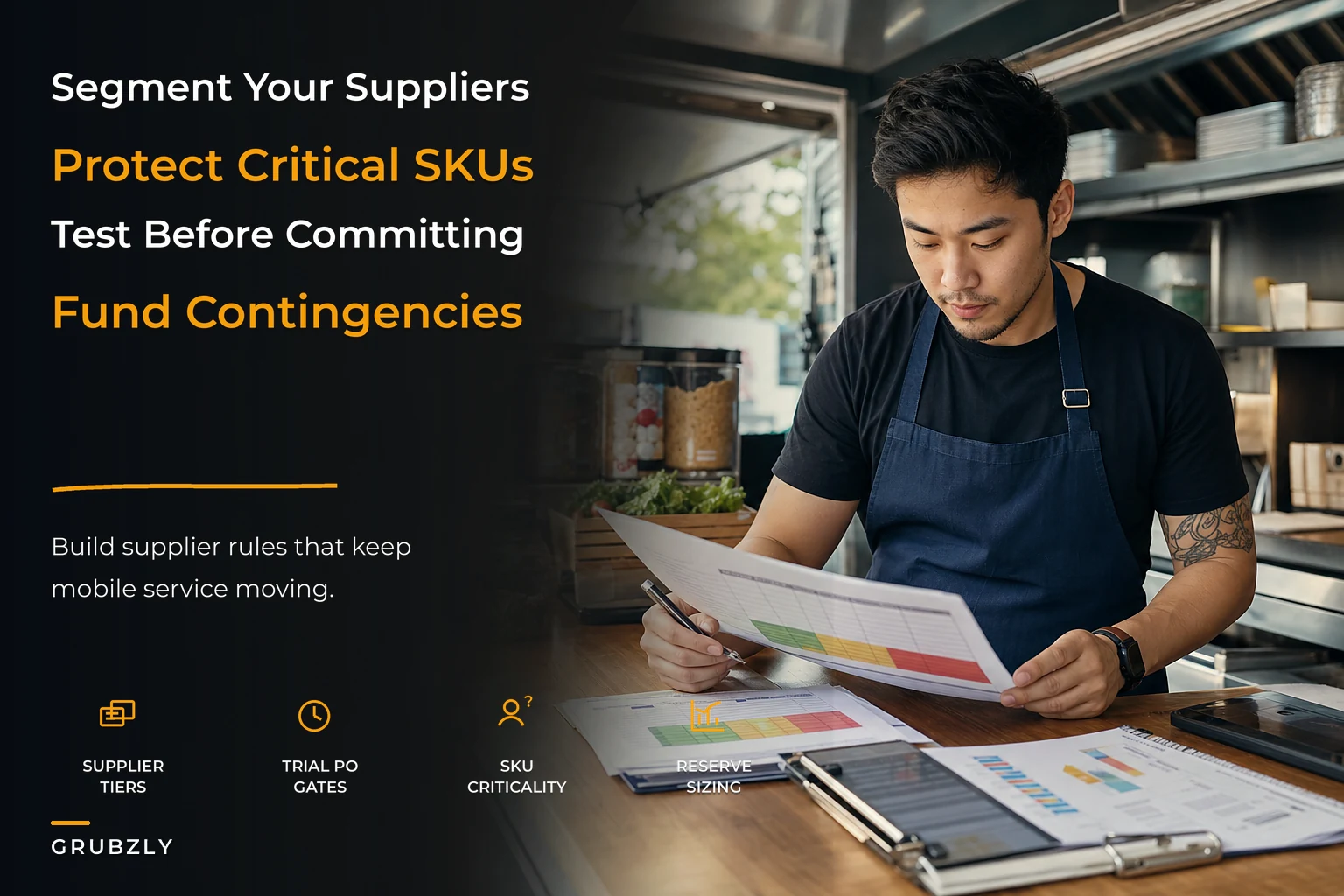
Segmentation sounds corporate, but it's just a way of sorting suppliers so you know how much effort each one deserves. You're scoring on two axes that actually matter for a mobile kitchen:
Stop losing sales to poor planning.
Grubzly helps you plan routes, track inventory, and maximize daily sales effortlessly.
- Real-time route optimization
- Inventory tracking & alerts
- Mobile sales & reporting
No credit card required
-
Replaceability — how fast and painlessly could you swap this supplier out?
-
Operational impact — if they vanish tomorrow, how much of your revenue or menu goes with them?
Score each supplier 1–5 on both, multiply, and you get a rough priority number. The number matters less than which quadrant they land in. Here's the working matrix:
| Tier | Replaceability | Impact | What it means | How you manage them |
|---|---|---|---|---|
| Critical / Sole-source | Low (hard to replace) | High | Menu or revenue depends on them, no easy backup exists | Full contract, backup supplier pre-qualified, contingency cash set aside |
| Strategic | Medium | High | Important to the menu but switchable with notice and effort | Written SLA, onboarding clause, quarterly check-in |
| Transactional | High | Medium–Low | Commodity goods, multiple sources available | Price-shop freely, light paperwork, no cash reserve |
| Trial / Unproven | Unknown | Varies | New supplier not yet pressure-tested | Trial PO with explicit exit terms before any volume commitment |
The useful insight here is that most owners spend their energy in the wrong quadrant. They haggle hard over transactional suppliers — paper goods, commodity produce — because it feels like saving money. Meanwhile their one critical supplier has no contract at all, just a handshake and a hope. You can save forty bucks a month on napkins or you can protect the ingredient driving sixty percent of your tickets. Those aren't equally good uses of a Tuesday.
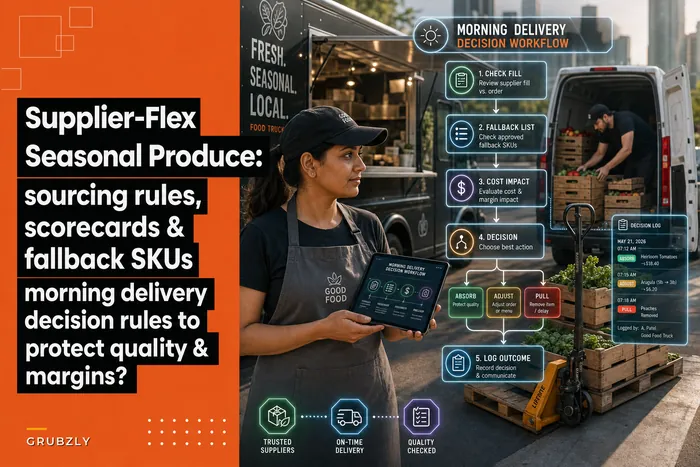
If your menu leans on seasonal produce, your critical tier will shift throughout the year — that churn is its own management problem, and there's more on handling it in the supplier-flex seasonal produce sourcing playbook.
Running the scoring without overthinking it
You don't need a weekend to do this. Pull your supplier list, and for each one answer two questions:
-
If this supplier called tomorrow and said "we're done," how many days until I have a working replacement? (Under 2 days = high replaceability. Over a week = low.)
-
What percent of my weekly revenue touches this supplier's goods? Rough is fine.
Anything that's slow to replace and touches a big chunk of revenue is automatically Critical. Those names get real contracts and real cash backing. Everyone else gets lighter treatment.
A quick warning sign you've scored it wrong: if your Critical tier has more than four or five suppliers, you're being too generous. Truly critical, hard-to-replace suppliers are rare. A long list usually means you've mislabeled strategic suppliers as critical, which spreads your contingency cash too thin to protect anything.
Tiered contract language that matches the tier
Different tiers deserve different paperwork. A transactional supplier doesn't need a six-page agreement — a clean PO is enough. A critical supplier needs clauses that force communication before a problem lands on your prep table.
What most owners miss: the point of a supplier contract for a small operation isn't to win a lawsuit. You're not going to sue your bun supplier. The point is to create notice. The single most valuable clause in any food truck supplier agreement is the one requiring them to tell you X days before anything changes — price hikes, discontinued items, delivery schedule shifts, minimum order changes. Notice is what turns an emergency into a plan.
Copyable contract rows
For Trial / Unproven suppliers:
> Trial Order Clause: This purchase order is a trial. Buyer commits to no minimum volume beyond this order. Buyer may discontinue ordering at any time with no penalty. Supplier agrees to match quoted pricing for a minimum of [30] days from first delivery.
> Quality Exit Clause: If delivered goods fail to meet the agreed spec (quality, temperature, pack size) on [2] or more of the first [5] deliveries, Buyer may cancel all outstanding orders at no cost and return unused goods for full credit.
For Strategic and Critical suppliers:
> Change Notice Clause: Supplier agrees to provide written notice at least [14] days before any change to pricing, product availability, pack size, minimum order quantity, or delivery schedule.
> Delivery Window Clause: Supplier commits to delivery within the agreed window of [day/time]. If supplier cannot meet the window, supplier will notify Buyer no later than [__ hours] prior, allowing Buyer to arrange backup.
> Allocation / Shortage Clause: In the event supplier cannot fulfill the full order, supplier will notify Buyer at least [48] hours before the scheduled delivery and will prioritize Buyer's standing order over spot/one-time buyers.
For Critical / Sole-source only:
> Onboarding & Transition Clause: Supplier agrees to maintain current pricing and terms for [60] days following any notice of termination, giving Buyer time to transition to an alternate source.
> Recipe/Spec Continuity Clause: Supplier will notify Buyer at least [30] days in advance of any reformulation, ingredient change, or sourcing change to the supplied product.
That last one matters more than it looks. A supplier quietly changing their cheese blend or swapping the oil in a base product can throw off your whole recipe cost and flavor profile without anyone announcing it. For a critical ingredient, you want to hear about reformulations before they show up on your prep table.
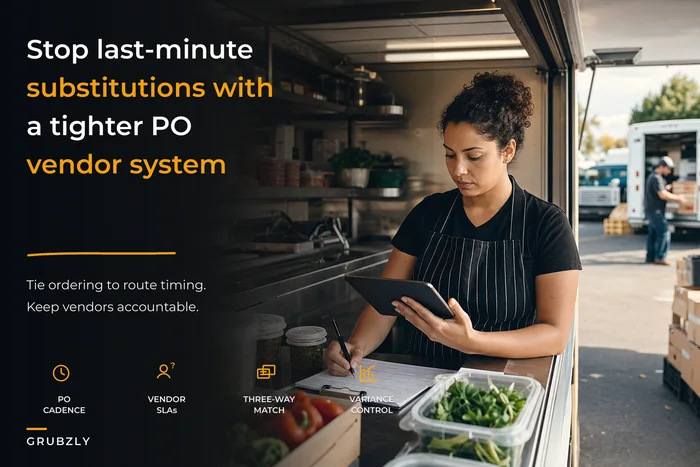
The broader framework for SLAs, PO cadence, and holding suppliers to these terms is covered in the piece on commissary procurement systems that prevent last-minute substitutions — the contract language above is the governance layer that sits on top of that cadence.
The onboarding clause nobody writes but everybody needs
When you bring on a new supplier, there's a dangerous window — usually the first month or two — where you've started depending on them but haven't seen how they behave under pressure. The onboarding clause is a formalized trial period where you deliberately keep your old supplier warm.
In practice: for the first 30–45 days with a new critical supplier, keep ordering a small volume from your previous source. Yes, it costs a little more. It's cheap insurance. The number of trucks that fully switched to a cheaper supplier, dropped the old one entirely, and got burned in week three is not small. Keeping the old relationship on life support for a month means your backup is already live when you need it — not a cold contact you have to renegotiate from scratch.
The onboarding period is also when you test the notice clauses. Did they give you heads-up on the first late delivery, or did you find out when the truck didn't show? A supplier that ignores the notice clause during the honeymoon phase will ignore it forever. Better to learn that while you still have one foot out the door.
Sizing your contingency fund for critical SKUs
For every Critical / Sole-source supplier, you should carry a specific contingency reserve — cash set aside to cover emergency sourcing at worse pricing, on short notice, without disrupting service.
This is not your general emergency fund. It's earmarked, calculated, and tied to specific SKUs. When you blend it into your general reserve, it quietly gets spent on a generator repair, and then the day you need to source emergency protein at a 40% premium, the money's gone.
A simple sizing method
For each critical SKU, estimate:
-
Weekly spend on that SKU — what you normally pay.
-
Emergency premium — how much more it costs buying on short notice from a non-preferred source. For most food inputs this runs 25–50% above normal pricing.
-
Coverage window — how many weeks it realistically takes to re-establish stable supply at normal pricing. Usually 2–4 weeks.
Your reserve for that SKU is roughly:
> Weekly spend × Emergency premium × Coverage window
Round contingency estimates up to the nearest hundred to avoid shortfalls.
A realistic example: Say your core protein runs about $900 a week, it's sole-sourced, and in a pinch you'd pay roughly 35% more buying from a backup distributor while you sort out a new contract. Figure three weeks to stabilize.
$900 × 1.35 × 3 weeks ≈ $3,645 in extra cost over a three-week disruption. Round it and park around $3,500–$4,000 specifically against that SKU.
Do this for each critical SKU and add them up. For most single-truck operations, the whole critical-SKU contingency reserve lands somewhere in the $6k–$12k range. That number tends to surprise owners, and that surprise is the point — it's an honest measure of how exposed you actually are. If the number feels huge, that's a signal to pre-qualify backup suppliers so you can shrink the emergency premium, not a reason to look away.
When heavy supplier governance is worth it — and when it isn't
Not every truck needs this whole apparatus. Building contracts and contingency funds takes time and ties up cash, and there's a point below which it's genuinely overkill.
When this actually makes sense:
-
You run catering or large events where a stockout means refunding a customer and burning your reputation.
-
Your menu is built around one or two signature items with specialty ingredients that aren't on every distributor's truck.
-
You've grown past the point where you personally know every supplier's reliability.
-
You're running more than one truck or sharing a commissary, so a supplier failure cascades across multiple schedules.
When it's a bad idea / overkill:
-
You're a single truck with a flexible menu where almost any ingredient has three substitutes.
-
All your suppliers are large distributors with deep inventory — replaceability is already high across the board.
-
You're pre-revenue or barely breaking even, in which case parking $4k against one SKU might genuinely be the wrong use of thin cash. In that case, the segmentation matrix still helps — you just skip the funded reserve and lean harder on pre-qualified backups.
Who should skip this entirely: brand-new operators who haven't yet figured out which ingredients actually drive sales. You need a few months of real ticket data before you can honestly score operational impact. Guess too early and you'll fund a reserve for the wrong SKU.
Keeping the whole thing current without it becoming a chore
The hidden failure mode of any supplier governance system is that it goes stale. You score everyone in January, and by June your menu's changed, a new supplier joined, your old backup went out of business, and the matrix is a museum piece.
A workflow that survives contact with a real operation looks roughly like this: the matrix lives somewhere shared, not on one person's laptop. Supplier scores get a quick review whenever the menu changes seasonally or whenever a new supplier is added. The contingency reserve gets reconciled against actual spend once a quarter — if protein costs crept up, the reserve should too.
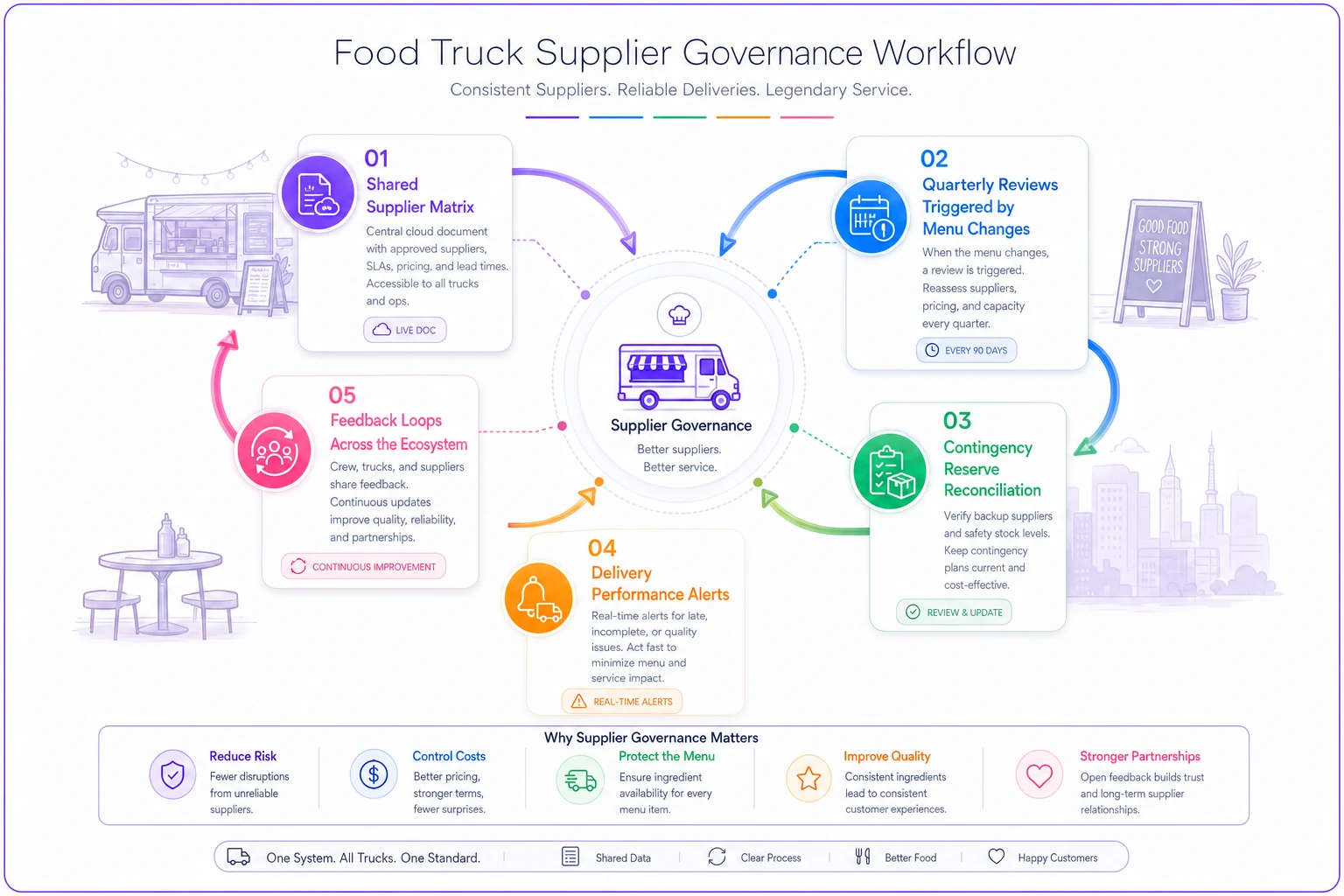
This diagram shows how supplier records, PO history, and delivery performance connect.
This is where operators running multiple trucks naturally shift from spreadsheets to a lightweight business management platform. Nothing flashy — the value is just that supplier records, PO history, delivery performance, and notice-clause terms all sit in one place the whole crew can see, instead of scattered across texts and memory. When a critical supplier's deliveries start slipping, you want that pattern to surface on its own rather than waiting for someone to notice after the third bad week. The governance is yours; the tooling just keeps it from rotting.
Pulling it together
Supplier governance for a food truck isn't about paperwork for its own sake. It's about being honest about where your real risk lives, then matching your effort to that risk — light touch for commodity stuff, real contracts and real cash for the handful of suppliers who could actually take you down.
Sort your suppliers into tiers. Write notice clauses into the critical ones so problems arrive as plans instead of surprises. Trial new suppliers before you lean on them, and keep the old source warm during onboarding. Then size a specific reserve for each critical SKU so an emergency sourcing situation is an inconvenience, not a crisis.
Do that, and the day your irreplaceable supplier calls with bad news — and eventually one will — you'll already know your backup, you'll already have the cash, and you'll already have the notice window to use it. That's the whole game.
Ready to drive your food truck business forward?
Join 2,000+ food truck operators relying on Grubzly to boost efficiency, increase sales, and delight customers.