

Here's the frustrating math most food truck operators live with: you serve 400 people at a Saturday festival, take their money, hand them a killer burrito, and never see 395 of them again. The five who come back do so by accident — they happened to spot your truck at a different event.
That's not a loyalty problem. It's a capture problem. You had every one of those customers standing two feet away, phone in hand, in a good mood, holding food they just paid for. The moment they walked off, you lost any ability to reach them again.
The usual advice — "collect emails!" — falls apart the second you try it at a real event. The line's twelve deep, the venue Wi-Fi is garbage, your card reader is already fighting for signal, and nobody's typing their email into a laggy form on a cracked phone screen. So capture gets skipped entirely, and the idea dies.
This post is about fixing that one specific thing: event customer reactivation for food trucks, built around the reality that connectivity at events is unreliable, your crew is slammed, and customers won't give you more than four seconds of attention.
Why capture fails at events specifically
Capture at a brick-and-mortar spot is easy. People linger, there's stable Wi-Fi, you can have a tablet by the register. Events break all three of those assumptions.
The connectivity problem is the real killer. At a packed festival, cell towers get saturated. Your POS might already be running in offline mode (if it isn't, that's a separate problem — your reconciliation will bite you later). Any capture method that needs a live internet connection at the moment of capture is going to fail intermittently, which is worse than failing completely, because you won't know which contacts actually saved.
Then there's the attention window. A customer at a food truck window is in transaction mode, not sign-up mode. They want their food and they want to move so the person behind them can order. Anything that adds friction — "can you fill out this form?" — gets a polite no, or a fake email typed just to make you stop asking.
And crew bandwidth. During a lunch rush at a corporate park event, your two-person line is moving a ticket every 40–50 seconds. Nobody has a spare hand to run a separate capture conversation. If capture isn't baked into the existing flow, it won't happen.
The design constraints are pretty clear: capture has to be fast, offline-tolerant, and part of the existing transaction, not bolted on top of it.
The capture methods that actually survive events
Not all capture is equal. Here's how common options hold up under real event conditions.
Stop losing sales to poor planning.
Grubzly helps you plan routes, track inventory, and maximize daily sales effortlessly.
- Real-time route optimization
- Inventory tracking & alerts
- Mobile sales & reporting
No credit card required
| Method | Speed | Works offline? | Consent clean? | Best for |
|---|---|---|---|---|
| QR code to a hosted form | Medium | No (needs their data + your form to load) | Yes if form has checkbox | Slow-traffic events, good signal |
| Verbal "text us to join" short code | Fast | Yes (SMS queues on their phone) | Yes (their text = opt-in) | High-traffic, bad signal |
| Paper slip / fishbowl | Fast | Yes | Weak, messy to transcribe | Backup only |
| Receipt-based opt-in at POS | Fast | Depends on POS | Yes if worded right | If your POS supports it offline |
| Tablet form at window | Slow | No | Yes | Never, at busy events |
The winner for most trucks at busy events is the text-to-join short code. The customer texts a keyword (like TACOS) to your number. Their phone queues the message if signal is bad and sends it when they walk toward the parking lot where reception improves. You don't need a live connection at the window at all. And the act of texting you is the consent — it's the cleanest opt-in record you can get.
The QR code is a solid second option but only when traffic is slow enough that people can stand and wait for a form to load. At a jammed event, a QR that spins on a loading screen is a dead capture.
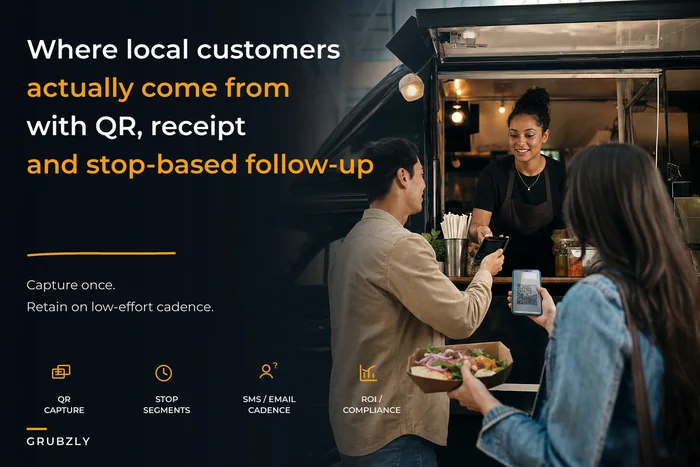
One thing worth noting: trucks with the best capture rates don't rely on signage alone. They have the person handing over the food say one line. Signage gets ignored; a human voice at the window doesn't. There's more on acquisition mechanics in where local customers actually come from — but for events specifically, the verbal nudge is doing most of the work.
Capture templates you can print and tape to the truck
Keep these short. The whole point is that a tired crew member can say them without thinking.
Window script (said while handing over food): > "If you want $2 off next time you catch us, text TACOS to this number — takes five seconds." Signage on the window (large, readable from the line): > Text TACOS to (555) 012-3456 → get $2 off your next order Receipt line (if your POS prints custom text): > Loved it? Text TACOS to (555) 012-3456 for a return deal + where we'll be next.
Notice the offer is concrete ($2 off) and the action is trivial (text one word). "Join our mailing list" converts terribly. "Text this word, get money off" converts because the value is immediate and the effort is near-zero.
Offline-friendly consent that holds up
Consent is where a lot of operators get sloppy, and it's the part that can actually get you fined under SMS marketing rules. The good news: the text-to-join method handles consent cleanly because the customer initiated contact. But you still need a proper confirmation and opt-out in your first reply.
> "Thanks for joining [Truck Name]! You'll get occasional texts about deals + where we're parked. Msg&data rates may apply. Reply STOP to opt out, HELP for help. Here's your $2-off code: TACO2."
A few things that matter here:
-
The opt-out language (STOP/HELP) is non-negotiable. It needs to be in the first message.
-
"Occasional" sets expectations — people opt out when they feel spammed, and that one word quietly lowers the threshold.
-
Rates disclosure keeps you compliant.
-
The reward code is in the same message, so there's instant payoff for joining.
If you're using QR-to-form instead, the consent checkbox needs to be unchecked by default and the language explicit: "I agree to receive marketing texts/emails from [Truck Name]. Opt out anytime." Pre-checked boxes are a compliance liability and kill trust anyway.
For the offline reality: your capture tool should queue inbound opt-ins locally and timestamp them, then sync and send the confirmation when connectivity returns. The timestamp is your proof of consent — keep that record. This is the same offline-then-reconcile logic behind offline-first loyalty workflows, just applied to contact capture instead of punch cards.
The three-message cadence (and why only three)
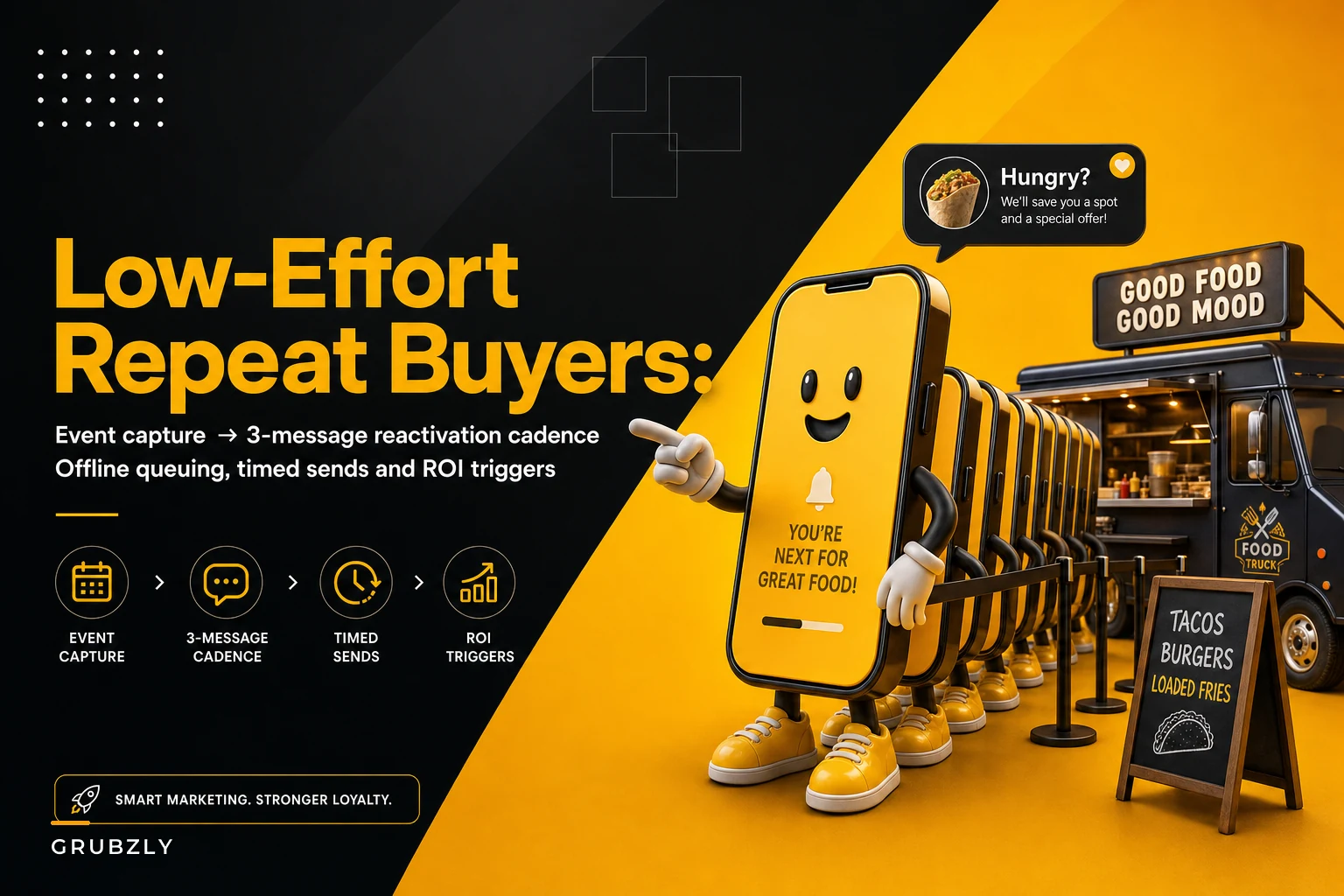
Most operators either send nothing or blast their whole list every week until everyone opts out. Three messages, spaced deliberately, hits the sweet spot: enough to convert a return visit, not enough to feel like spam.
The cadence runs per capture event, not per calendar. Someone who joined at Saturday's brewery event starts their own three-message clock from that Saturday.
Message 1 — The immediate confirmation + reward (fires on sync, within hours of capture) This is the consent reply above. It delivers the $2-off code while the memory of your food is still fresh. Goal: lock in the reward and set expectations.
Message 2 — The "where we'll be next" nudge (2–4 days later) > "Hey — [Truck Name] here. We're at [Next Event/Location] this [Day] 11a–3p. Bring code TACO2 for $2 off. Hope to see you!" Timing matters here. Too soon and they haven't gotten hungry again; too late and they've forgotten you entirely. The 2–4 day window lines up with the natural "I want that again" craving cycle. Also worth noting: tie this message to an actual upcoming stop within reasonable distance of where you captured them. Don't tell a festival crowd about a location they'll never drive to.
Message 3 — The last-chance reward expiry (7–10 days after capture) > "Last call on your $2-off code TACO2 — expires Sunday. Catch us at [Location] or check [link] for our schedule. 🌮" The expiry creates urgency and, just as importantly, gives the message a reason to exist. A deadline converts fence-sitters. After message 3, this person moves off the active cadence and into your general schedule list — lower frequency, opt-in already established.
Why not message 4, 5, 6? Because conversion from a single event capture drops off a cliff after about ten days. People who were going to come back have come back. Keeping the pressure on past that point just drives opt-outs, which permanently burns a contact you worked to earn.
Email vs SMS in this cadence
SMS carries the load for events because open rates are high and the messages are short and time-sensitive. Email works better as a lower-frequency backup for people who gave an email instead of a phone number, or for a monthly "here's our full schedule" roundup. If you captured both, use SMS for the three-message cadence and move them to the monthly email after. Don't run both channels on the same aggressive three-message clock — that's how you start feeling like spam.
ROI trigger rules: knowing what's actually working
This is the part most trucks skip entirely, and it's what tells you whether any of this is worth the effort. You need a few simple measurement rules and some triggers for when to adjust.
The core measurement rules:
-
Capture rate per event = opt-ins ÷ estimated transactions. Track this per event type. A brewery crowd might convert at 18% while a farmers' market converts at 6%. That tells you where capture effort actually pays off.
-
Redemption rate = codes redeemed ÷ codes sent. This is your real return signal. If you're sending 200 codes and seeing 4 redemptions, something in the offer or the cadence is broken.
-
Reactivation value = redemptions × average ticket. The dollars the whole system actually generated.
-
Cost per reactivation = (SMS costs + discount given) ÷ redemptions.
ROI trigger rules — the "when to act" logic:
-
If capture rate at an event type is below ~5%, your window script or signage isn't landing. Fix the verbal prompt before blaming the offer.
-
If redemption rate is below ~3%, the problem is usually timing or offer size. Try moving message 2 earlier, or bump the discount.
-
If an event type produces capture but near-zero redemption, those customers probably can't easily reach your other stops. Either return to that event more often or stop spending capture effort there.
-
If redemption rate is above ~10%, that event type is a goldmine — prioritize booking more like it, and consider a slightly bigger offer to pull in more of the crowd.
A quick worked example. Say you work a food festival, serve roughly 380 people, and capture at 12% — that's about 45 opt-ins. Over the three-message cadence, redemption comes in around 9% — roughly 4 return visits. At an average ticket of around $14, that's about $56 in directly attributed reactivation from one event's capture, minus maybe $8 in discounts and a few bucks in SMS. Modest per event. But run that across 15–20 events a season and you're building a reachable customer base of several hundred people you can nudge toward every future stop. The compounding list is the real asset, not any single event's return.
A tight workflow to run it without thinking
CAPTURE-TO-REACTIVATION FLOW
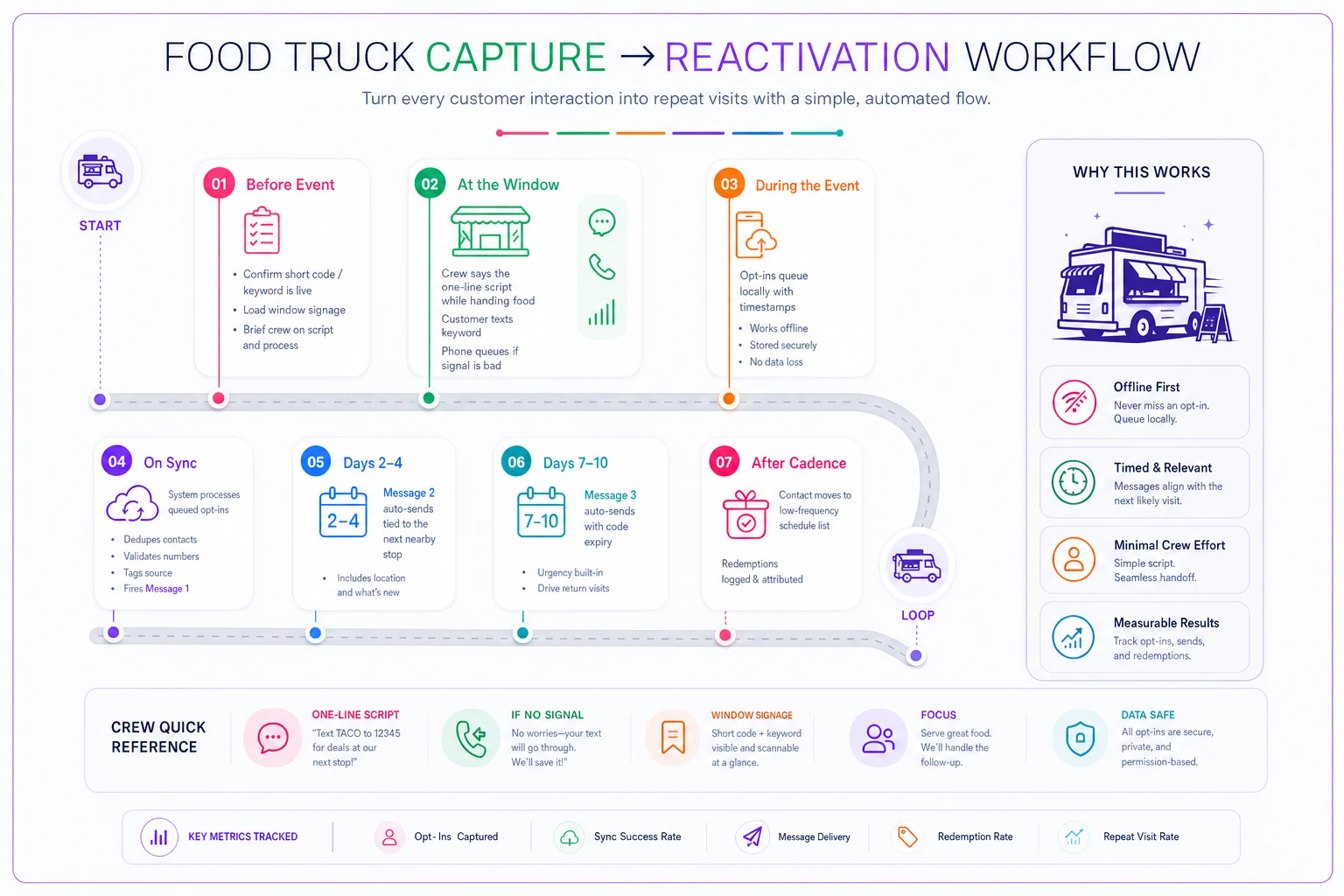
Running this by hand is possible — a spreadsheet of opt-ins, a calendar reminder to send batch texts — but the dedupe and the timed sends are where manual effort collapses after a busy weekend.
This is exactly the kind of repetitive, timing-dependent work that AI-assisted operational tools handle well: queuing offline captures, deduping contacts across events, firing the three messages on schedule, and rolling up redemption data so you're not hand-counting codes. The value isn't the automation for its own sake — it's that the cadence actually runs instead of dying in a spreadsheet you meant to update.
When this is worth it — and when it isn't
This makes sense if:
-
You work a mix of events and recurring stops, so captured customers have realistic chances to return.
-
Your average ticket and margin are high enough that a handful of return visits per event matters.
-
You're at enough events per season to build a list worth having.
This is a bad idea if:
-
You only do one-off events in far-flung towns you'll never revisit. Capturing people who can't physically return just builds a dead list.
-
You don't have the discipline to honor opt-outs and keep frequency low. A poorly run SMS list damages your brand faster than no list at all.
-
Your margins are so thin that even a $2 discount on a return visit loses money — fix pricing first.
Who should skip it entirely: a truck that works a single fixed location daily. You don't need event reactivation; you need regular loyalty, which is a different system entirely.
A short real scenario
A two-truck taco operation working mostly weekend events and a Tuesday office park had the classic problem: great event sales, zero repeat visibility. They added the text-to-join line at the window and the three-message cadence, nothing fancier.
First month, across six events, they captured somewhere around 210 contacts — far more than the handful of emails they used to scrape. Redemption on the three-message cadence ran just under 10%, so maybe 18–20 return visits that wouldn't have happened otherwise. Not life-changing revenue in month one. But by the end of the season they had a reachable list in the low four figures, and their Tuesday office stop started seeing familiar faces who'd first found them at a weekend festival and gotten a "we're nearby this week" text. The repeat visits stopped being accidental.
The takeaway
Events hand you hundreds of warm customers and then let them evaporate the moment they walk away.
The fix isn't a fancy loyalty program — it's a capture method that survives bad signal, a consent flow that's clean and offline-tolerant, three well-timed messages, and a couple of measurement rules that tell you which events are actually worth your effort. Keep each piece simple enough that a slammed two-person crew can run it on a Saturday, and the compounding list of reachable customers becomes one of the most valuable things your truck owns.
Keep each piece simple enough that a slammed two-person crew can run it on a Saturday, and the compounding list of reachable customers becomes one of the most valuable things your truck owns.
Ready to drive your food truck business forward?
Join 2,000+ food truck operators relying on Grubzly to boost efficiency, increase sales, and delight customers.