

Your food truck local customer acquisition system doesn't work like a restaurant's. You can't rely on foot traffic finding a fixed location. You can't count on Yelp reviews bringing people back to your address. You're chasing customers across different stops, competing for attention at each one, and trying to turn one-time festival attendees into Tuesday lunch regulars.
Most food truck operators treat customer acquisition like throwing spaghetti at a wall. Post on Instagram when you remember. Hand out business cards that get tossed. Run a Facebook ad for that one event. The trucks pulling consistent $8k–$12k weeks have built operational systems that capture customers at the exact moment they're most interested — when they're standing at your window with food in hand.
The difference between a truck scraping by at $2k weeks and one clearing $10k isn't just better tacos. It's understanding that every customer touchpoint needs an operational workflow behind it. Not marketing theory. Actual step-by-step processes your team can execute while juggling orders, managing inventory, and navigating between stops.
The three capture points that actually matter
Food trucks have exactly three moments to capture customer information that leads to repeat business. Miss these windows and you're basically starting from scratch at every stop.
| The three capture points that actually matter |
|---|
| The ordering window |
| The waiting area |
| The eating zone |
The ordering window is your highest-intent capture point. The customer is literally handing you money. They want your food. This is when a simple "Want to skip the line next time?" pitch actually works. What kills most trucks here is trying to do too much — download our app, follow us on Instagram, join our email list, check our website. The customer just wants their burrito. You've got maybe 8 seconds while their card processes.
Keep the ordering-window ask to one clear, single-step action with an immediate benefit.
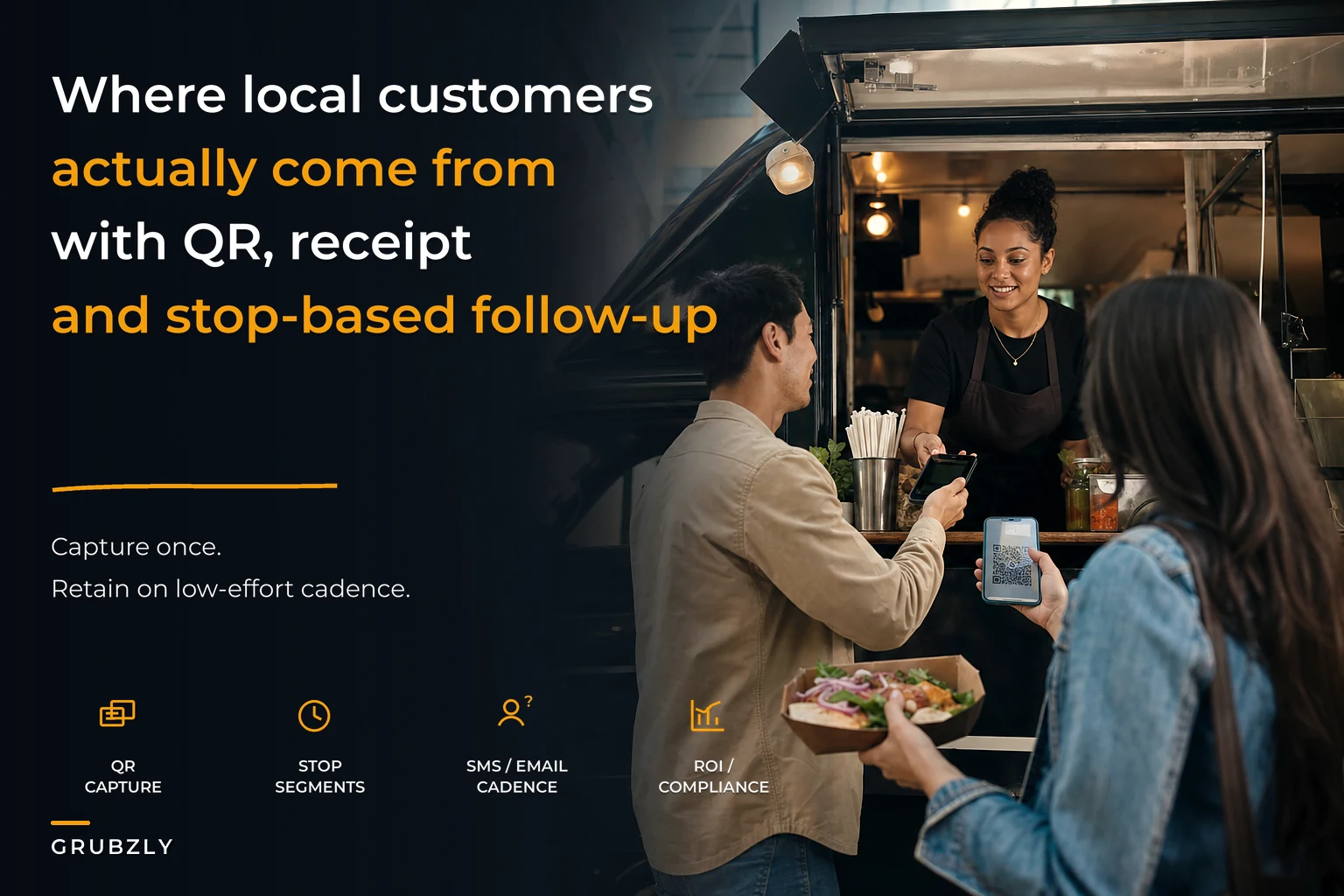
QR codes on the receipt work better than anything else. Not a generic "follow us" code. A specific offer: "Text TACOS to get tomorrow's location 2 hours early." One action, clear benefit, takes 4 seconds. Around 23% of lunch customers will scan it if the offer is location-specific. That number drops to 6% for generic "join our newsletter" codes.
The waiting area catches the other 40% who won't scan at the window. They're standing around for 3–7 minutes waiting for their order, bored, phone already out. That same QR code on your truck wrap — positioned at eye level where people naturally stand — gets another 12–15% signup rate. But only if someone's occasionally mentioning it: "While you're waiting, scan that code to grab tomorrow's secret menu item."
The eating zone catches the satisfied customers. The ones sitting on a curb or standing around finishing their meal. Different message here: "Rate today's special, help us pick tomorrow's." People who just enjoyed their food are weirdly passionate about having input on future menus. Gets about 8% participation, but these tend to become your most engaged customers.
Stop type determines everything
A downtown lunch stop operates nothing like a brewery night. Your capture strategy, messaging, and follow-up cadence all need to match where you're parked.
Stop losing sales to poor planning.
Grubzly helps you plan routes, track inventory, and maximize daily sales effortlessly.
- Real-time route optimization
- Inventory tracking & alerts
- Mobile sales & reporting
No credit card required
Office building lunch stops serve the same 100–300 people every weekday. These customers want consistency and speed. Your QR code should promise early location alerts and pre-order capability. Text them Monday night about Tuesday's menu. Wednesday morning about that afternoon's location change. Keep it operational — "Parked on 3rd instead of 4th today due to construction." These customers convert at around 40% to regular weekly buyers if you nail the communication rhythm.
Event and festival crowds need different treatment. They're probably never eating from your truck again unless you give them a reason. Capture should focus on "Find us at your office" messaging. Your QR leads to a simple form: "Where do you work? We'll text you when we're nearby." Then you segment by office location and only message when you're actually going to be within walking distance. Otherwise you're just spam.
Bar and brewery stops want entertainment value. "Tonight's secret menu item" or "Show this text for free chips" type offers. These customers check their phones constantly. They share food pics with friends. Make your messages screenshot-worthy. "Reply with your worst pickup line for 20% off" gets 5x the engagement of "Tuesday special: $2 off combos."
Residential neighborhood stops are all about routine. Same families every week, kids who know your truck. These areas respond to family meal deals and "next week's special" pre-orders. One truck we worked with does $3k every Thursday in one neighborhood just from pre-orders placed Monday night via text.
The segmentation rules that prevent list decay
Your list becomes worthless without segmentation. Trucks building 2,000-person email lists that get 0.5% open rates are blasting everyone about every stop. The brewery crowd doesn't care about your Tuesday downtown lunch spot. The office workers won't drive to the suburbs for dinner service.
Capture location determines initial segment. QR scan at downtown stop goes to the downtown list. Simple. But then you need behavioral rules that shift people between segments.
Someone who hasn't engaged with six downtown lunch messages probably changed jobs or moved offices. Move them to event-only messaging. Someone who suddenly starts responding to brewery night messages after ignoring lunch spots? Shift their primary segment. Most operational software handles this automatically based on engagement patterns.
Stop-based timing matters more than almost anything else. Downtown lunch people need tomorrow's location by 9pm tonight and a reminder at 10am tomorrow. Brewery crowds want a 4pm "heading to [location] at 6pm" message. Residential families need Thursday afternoon alerts about Friday dinner service.
One system that consistently works: tag customers with their last three interaction points. Someone who bought at Stop A, opened a message about Stop B, and clicked a link for Stop C gets messages about all three location types. Someone who only ever interacts with Stop A messages gets just those. Keeps your messages relevant without complex personas.
The weekly cadence that doesn't annoy
Food truck customers have weird communication tolerance. They'll happily get daily texts about lunch locations but unsubscribe immediately from weekly newsletter emails. Every message needs to feel operational, not promotional.
-
Monday evening
Next day's downtown stops and menus. Just facts. "Tomorrow: 11:30am at 5th & Pine (north side), 12:45pm at Cascade Tower. Menu: Korean BBQ bowls, veggie bibimbap, kimchi fries."
-
Tuesday morning
Location confirmation or changes. "On schedule for 5th & Pine. Running kung pao chicken as bonus special."
-
Wednesday
Thursday and Friday schedule. Include weather contingencies. "Thursday usual spots. Friday: Moved to covered location at 1st Ave garage if rain."
-
Friday afternoon
Weekend locations plus any catering gigs that sell individual meals. "Tomorrow: Greenwood Farmers Market 9am–2pm. Sunday: Brewery row starting 4pm."
-
Sunday evening
Week recap and next week preview. This is your only real marketing message. Share a photo from the week, announce next week's special, maybe drop a cooking tip. Keep it under 200 words.
The magic is matching message type to channel. Text for operational updates — location, menu, delays. Email for weekly recaps and event announcements. Social for food photos and personality. Mixed channels lose people. Pick one primary and stick to it.
ROI benchmarks that matter for mobile operations
Customer acquisition ROI looks different for mobile food than brick-and-mortar. You're not measuring foot traffic conversion or table turns. You're measuring stop efficiency and customer portability.
A solid food truck local customer acquisition system should generate 15–20 repeat customers per regular stop within 8 weeks. People buying at least twice monthly from that specific location. If you're hitting a downtown lunch spot every Tuesday and Thursday, you want 15–20 people buying most Tuesdays or Thursdays by week 8.
Those 15–20 regulars typically mean $300–$500 in predictable revenue per stop. Multiply by stops per week and you've got your baseline. A truck hitting 10 stops weekly with 15 regulars each is looking at $3k–$5k in repeat business before walk-ups, events, or catering.
Acquisition cost should stay under $3 per regular customer. That includes paid advertising, SMS costs, email platform fees, and time managing the system. Most trucks can hit $1.50–$2 per acquisition just through operational capture — QR codes, receipt messages, verbal mentions.
The real ROI shows up in order predictability. Trucks with solid repeat customer systems can predict next week's revenue within 15%. That means better inventory planning, confident staffing decisions, and the ability to test new menu items without gambling the whole week on it.
Privacy rules and practical compliance
Food trucks operate in multiple jurisdictions, sometimes in a single day. Your customer data system needs to work everywhere, including offline.
Explicit opt-in at point of capture is non-negotiable. Your QR code or signup form needs clear language: "Message frequency varies. Reply STOP to cancel. Standard rates apply." This isn't legal advice — check your local requirements — but this covers most bases. Print it directly under the QR code, not buried in terms somewhere.
Store customer preferences locally and sync when connected. If someone texts STOP while you're offline in a dead zone, your system needs to catch that preference as soon as you reconnect. Same with email unsubscribes. Nothing kills trust faster than messaging someone who opted out.
Age verification for alcohol-related events. If you're messaging about brewery nights or wine festival appearances, you need age gates on those segments. Simplest approach: separate QR codes for 21+ events with age verification questions built into the form.
Data portability means customers can request their info anytime. Keep it simple — a standard export of their contact info, preference settings, and message history. Most operational platforms handle this automatically, but you need a manual backup process. A spreadsheet works.
Delete requests need 48-hour fulfillment. When someone asks to be removed entirely — not just unsubscribed — you've got two days to wipe them from all systems. POS, email platform, SMS service, any spreadsheets. Make a deletion checklist and follow it every single time.
When connectivity drops (and it will)
Your acquisition system needs to work when parked under a bridge, at rural events, or when cell towers get overwhelmed at festivals. Offline capability isn't optional.
QR codes should lead to a page that loads even on terrible connections. Strip everything except the form fields — no images, minimal CSS, no video backgrounds. The entire page should be under 50KB. That loads in 2–3 seconds even on a struggling signal.
Cache customer responses locally when your tablet or phone can't sync. The customer thinks their info went through, and it uploads once you're back online. Prevents the awkward "can you fill this out again?" conversation that kills conversion.
Print backup cards for total dead zones. Sounds old-school, but it works. Simple cards with "Text TRUCK to 55555" that people save for when they have service. About 30% of cards result in signups, compared to 15–20% for QR codes. Physical cards also get shared — people hand them to coworkers or stick them on office bulletin boards.
Train staff to handle offline capture. When systems are down, they need a paper signup sheet and a process for entering data later. Date, time, stop location, name, and phone number. That's it. Don't try to capture emails or preferences on paper — get the minimum and follow up later.
The Tuesday regular versus Saturday wanderer problem
Not all customers are worth the same acquisition effort. The Tuesday regular spending $12 twice a week for 40 weeks generates $960 annually. The Saturday festival wanderer who bought once generates $12. Your system needs to identify and nurture the right people.
Stop frequency predicts customer value better than any other metric. Someone who shows up three times in two weeks will likely become a regular. Someone who bought once and never engaged with messages probably won't. Shift your effort accordingly.
A simple scoring system that works: First purchase = 1 point. Second purchase within 14 days = 3 points. Third purchase within 30 days = 5 points. Opened three messages = 1 point. Clicked a pre-order link = 2 points. Anyone hitting 6 points gets your premium treatment — early menu releases, special offers, maybe a birthday discount.
The wanderers need different handling. They might never buy again, but they're useful for building event buzz. Add them to an event-only segment that gets 2–3 messages monthly about festivals, catering, or new locations. Some convert to regulars when you eventually show up near their office.
Don't waste acquisition spend on wanderers. The craft beer crowd that follows trucks from spot to spot will find you anyway. Focus acquisition effort on converting lunch spot walk-ups into Tuesday–Thursday regulars.
Building the actual automation
The gap between theory and working system is where most trucks fail. You need processes that run themselves while you're prepping tomorrow's mise en place.
Start with your KPI tracking foundation. Add customer acquisition metrics: daily signups by location, message engagement by segment, and weekly repeat rate. This becomes your system dashboard.
Here's a simple workflow diagram that shows how capture, merge, segmentation, automation, and reconciliation fit together.
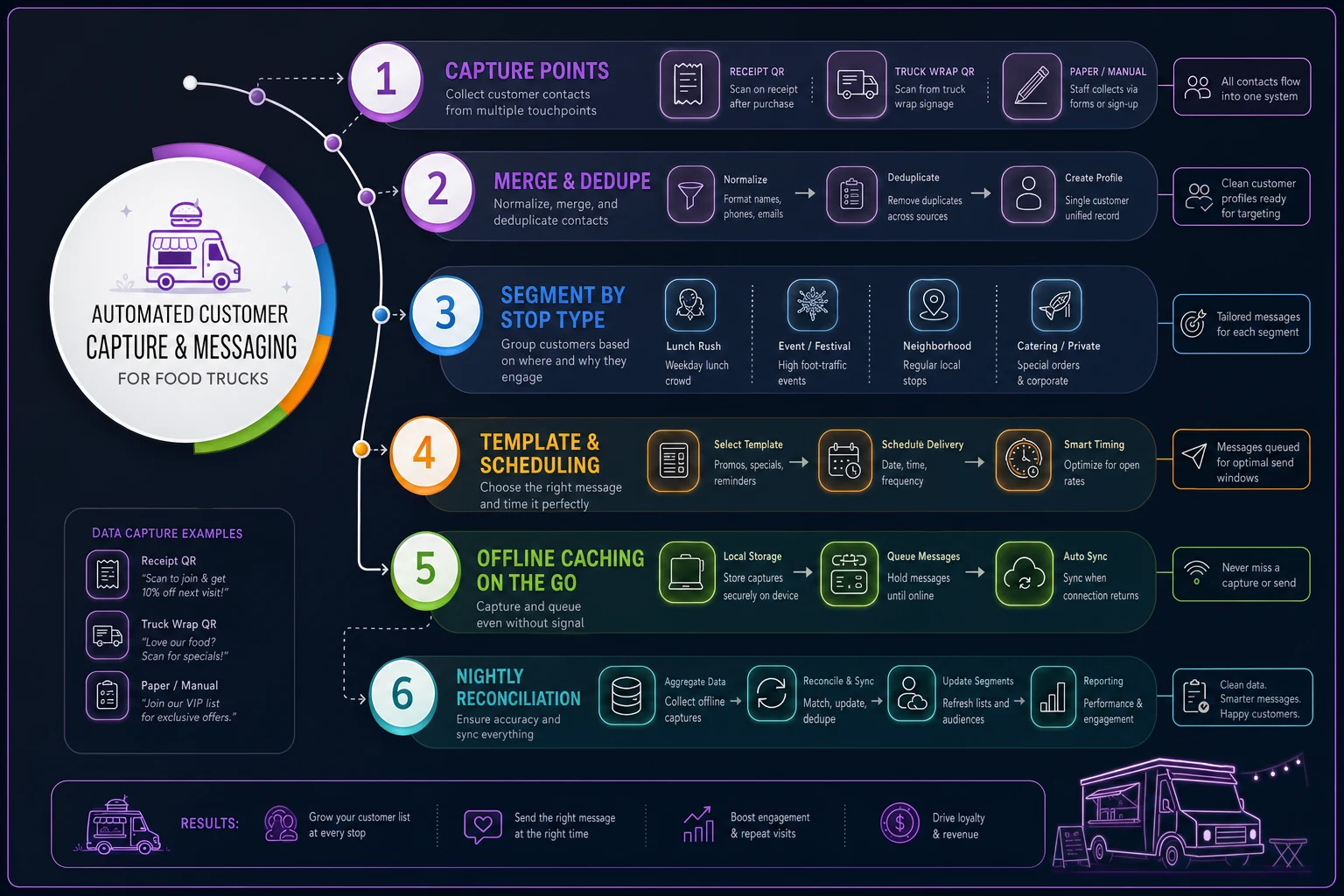
Your POS probably has basic customer capture, but it won't handle food truck complexity. You need something that connects your various capture points — QR codes, POS emails, manual signups — into one place. AI-powered operational software actually helps here because it can recognize when the same customer signs up multiple ways and merge their profiles automatically, without you touching anything.
Message automation needs branching logic based on stop types. Customer at downtown lunch gets downtown lunch messages. Same customer shows up at brewery night and now they get both. Doing this manually is impossible at scale — this is where automation earns its keep.
Build templates for common situations: location changes, new menu items, weather delays, special events. Your system should let you pick a template, modify it if needed, and send to the right segment in under 30 seconds. During lunch rush, that's realistically all the time you have.
The reconciliation process matters when you're dealing with offline captures. Every night, your system needs to merge the day's paper signups, QR scans, and POS captures. Deduplicate based on phone numbers. Update segment tags based on capture location. Flag anything weird for manual review.
Real results from structured acquisition
One taco truck in Seattle went from $3k to $8k weekly revenue in four months using this exact approach. Great food, zero customer retention. Every day felt like starting over.
They started with QR codes on receipts. Simple offer: "Skip tomorrow's line — text TACO to get early location alerts." First week, 67 signups. By week 4, they had 340 active subscribers.
Segmented into three groups: downtown lunch (180 people), neighborhood dinner (95 people), and weekend events (65 people). Each got different messages at different times. Downtown got daily 10am location confirmations. Neighborhood got Thursday afternoon weekend plans. Event people got monthly festival announcements.
The interesting part was pre-orders. Not through any fancy app — just people replying to texts. "Save me 2 Korean bowls for noon pickup." The truck started setting aside a cooler for pre-orders. By month 3, pre-orders were 30% of lunch revenue.
Average customer value went from $12 (one-time purchase) to $86 (buying roughly 7 times over 2 months). Acquisition cost was nearly zero — just the $50 monthly SMS platform fee divided by new signups.
Building a food truck local customer acquisition system isn't about following restaurant marketing playbooks or generic small business advice. It's about creating operational workflows that capture customers when they're actually interested, segmenting based on where they interact with you, and automating messages that provide genuine value.
The trucks succeeding aren't the ones with the biggest Instagram following. They're the ones that turn the chaos of mobile food service into predictable customer relationships. Every QR scan tagged with location and time. Every message sent based on stop-specific timing. Every customer treated differently based on their behavior.
Most trucks won't build this because it feels like too much work upfront. They'd rather hope good food and social media posts will somehow create regulars. The math is simple though: 15 regulars per stop, 10 stops per week, $10 average order, buying twice weekly. That's $3k in predictable weekly revenue before a single walk-up.
The tools exist to automate 90% of this. AI-assisted platforms can handle segmentation, message timing, and offline reconciliation without you thinking about it. The hard part is committing to the process — making QR codes part of your workflow, training staff to mention them, and actually messaging customers consistently.
Start with one stop. Your busiest lunch location. Put up a QR code, capture 20 customers, and message them twice this week about tomorrow's location. Watch how many show up specifically because of your message. That's your proof of concept. Scale from there.
Ready to drive your food truck business forward?
Join 2,000+ food truck operators relying on Grubzly to boost efficiency, increase sales, and delight customers.