

Health inspections hit food trucks differently than brick-and-mortar restaurants. You're working in a 120-square-foot kitchen where every surface multitasks, temperature zones overlap, and your prep station doubles as your service counter within seconds. When an inspector shows up mid-rush at a downtown lunch spot, there's no back office to organize paperwork, no manager's desk with neatly filed logs.
The inspection game for mobile operations comes down to micro-routines. Not the big annual prep sessions where you deep clean and reorganize documents. The daily three-minute checks that become muscle memory. The laminated cards tucked behind your order screen. The photo timestamps that prove your cold holding stayed at 38°F during that brutal August service.
After watching hundreds of food truck operators navigate surprise inspections, the pattern is pretty clear. Operators who pass consistently don't have better equipment or more experienced staff—they have better habits baked into their regular workflow. Their teams know exactly what to check, when to check it, and what to say when asked.
Why Food Trucks Fail Inspections (It's Not What You Think)
Most operators assume they fail because of equipment problems or cleanliness issues. Documentation and procedural violations are far more common—things that were actually done correctly but couldn't be proven in the moment.
Your cooler maintained proper temps all morning, but the temperature log shows a four-hour gap because your opener forgot to initial after the breakfast rush. Your sanitizer bucket tested at correct PPM twenty minutes ago, but nobody logged it. Your newest crew member washed their hands properly but couldn't explain the procedure when the inspector asked.
The cramped environment makes this worse. In a restaurant kitchen, you might have a clipboard station or a dedicated corner where logs live. In a truck, the temperature log might be wedged between the register and the napkin dispenser, test strips might be in a drawer under the flat top, and your newest employee might be working alone during the inspection because you stepped out to pick up supplies.
Mobile operations also face inspection scenarios restaurants don't. You might get inspected at your commissary at 6 AM during loadout, at a festival at 2 PM during peak service, or at a brewery at 8 PM during breakdown. Each location brings different challenges—no running water at the farmer's market, limited space at an office park, a crowd of customers at the festival watching the whole thing unfold.
The Three-Check System That Actually Works
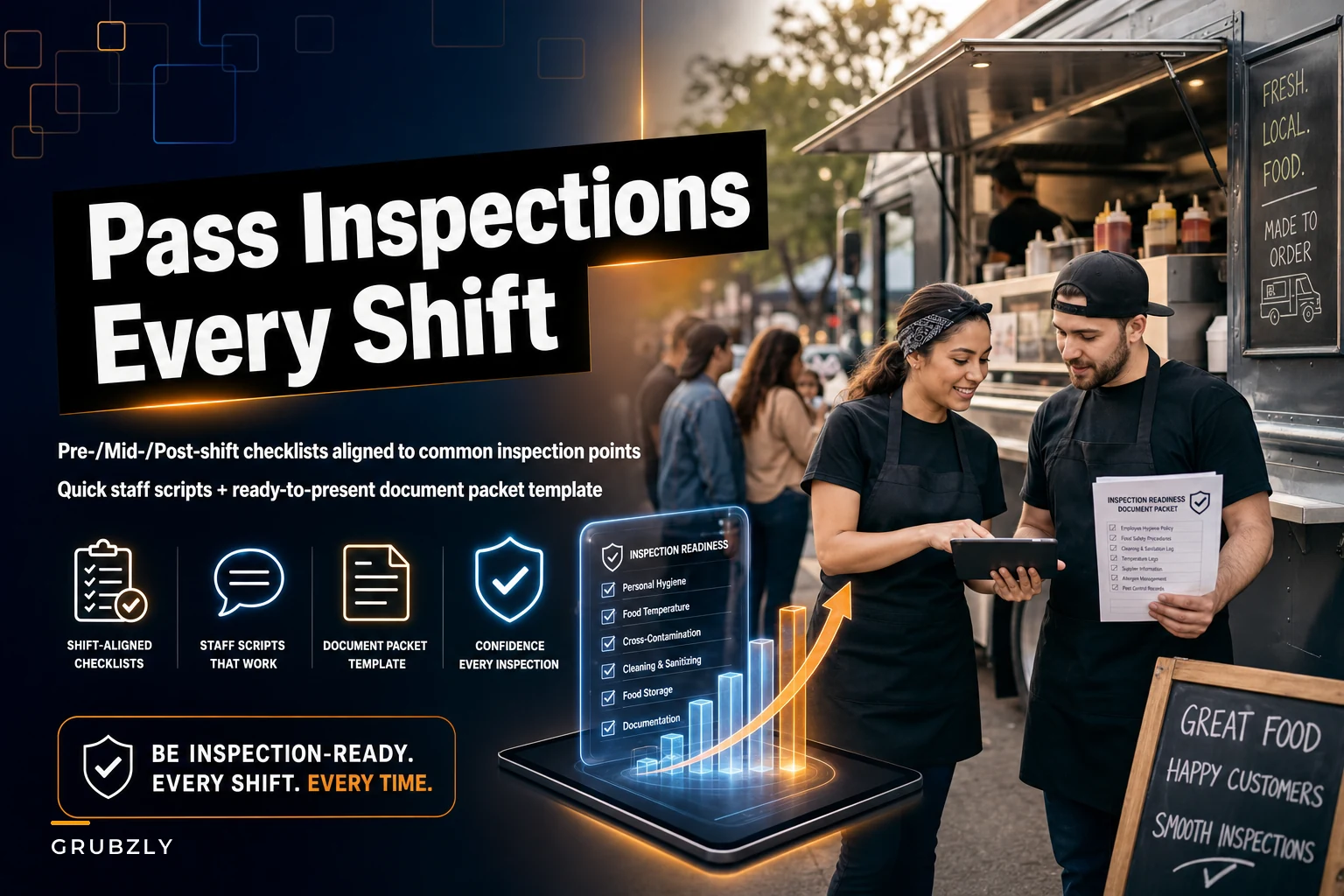
Forget the 50-point inspection checklist that takes thirty minutes. In real operations, you need something your team will actually use between cutting onions and taking orders. The most effective approach breaks inspection readiness into three micro-checks aligned with your natural workflow.
Stop losing sales to poor planning.
Grubzly helps you plan routes, track inventory, and maximize daily sales effortlessly.
- Real-time route optimization
- Inventory tracking & alerts
- Mobile sales & reporting
No credit card required
Pre-shift — 3 minutes, 5 points: Your opener already checks equipment temps when they fire up the truck. Add a photo habit: snap the thermometer reading in your reach-in showing 38°F at 8:47 AM. That timestamp becomes evidence. Check sanitizer concentration with a test strip and photograph it against the color chart. Initial the temp log taped inside the cooler door. Verify your handwash station has soap, towels, and signage. Count that you have three probe thermometers—one for the line, one backup, one for receiving.
Mid-shift — 90 seconds, happens during the slow period: Around 1:30 PM when lunch dies down, run the critical recheck. Test sanitizer buckets again because morning concentration changes as towels go in and out. Probe check the last batch of rice in the steam table. Initial the temp log. Quick scan for violations that developed during service—boxes on the floor, personal drinks on the prep surface, a cutting board that needs swapping.
Post-shift — 4 minutes, sets up tomorrow: During breakdown, document the day's safety chain. Final temp checks on all refrigeration with photos. Sanitizer bucket concentration one more time. Check that all logs are complete—fill any gaps now while you still remember. Reset your inspection packet in the correct spot. Restock test strips, thermometer batteries, and spare logs.
This works because it aligns with what your team already does. They're checking temps anyway—now they're documenting it. They're mixing sanitizer anyway—now they're testing it. The micro-check is just capturing work that's already happening.
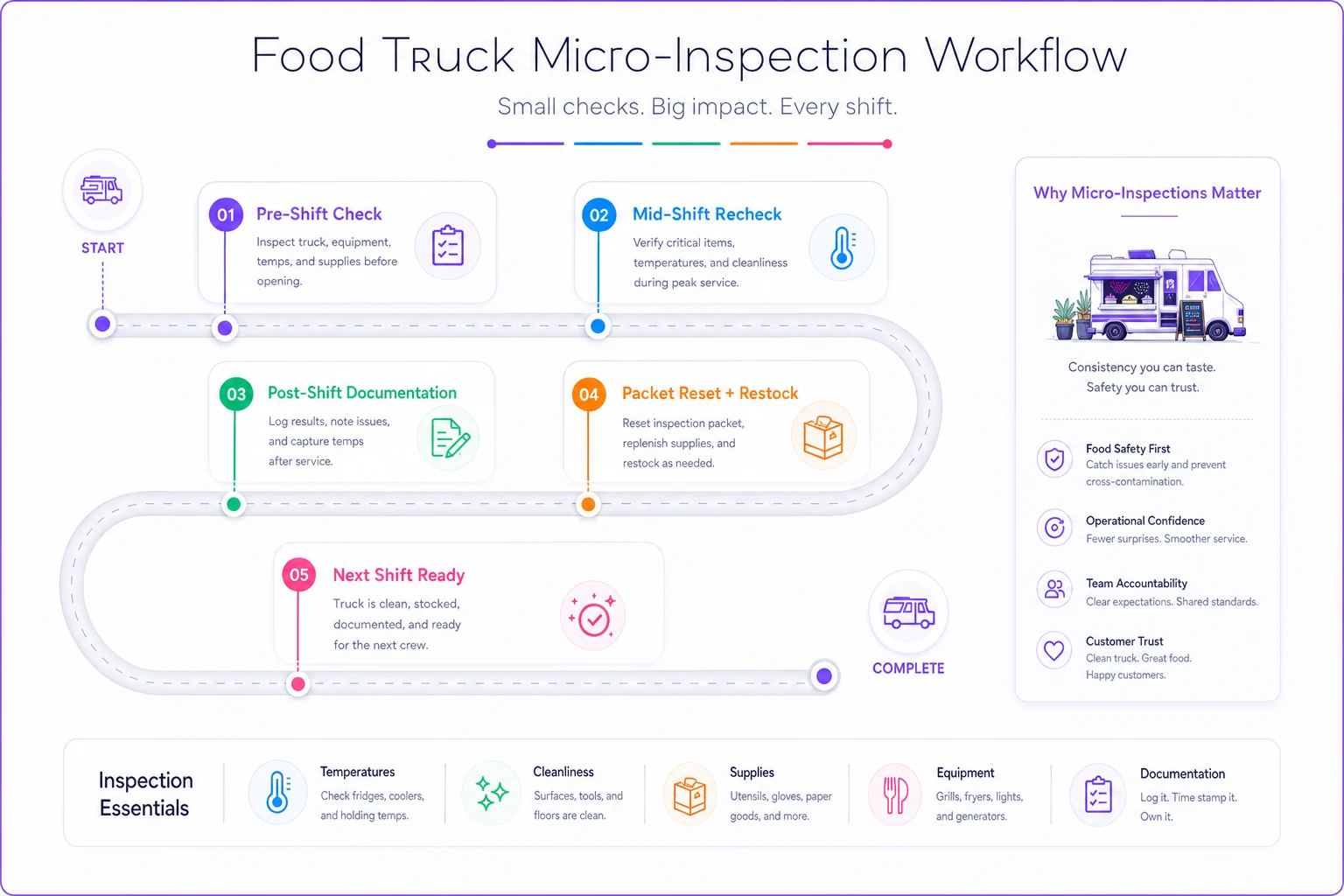
The diagram above shows the simple linear flow your team should treat as routine: quick checks that map to real moments in the shift.
Staff Scripts That Prevent Panic
When an inspector asks your newest employee about hand washing procedures, their mind goes blank. Not because they don't wash properly—they do it forty times a shift. But explaining a routine task under pressure while customers wait and tickets print creates real mental static.
Good operators prepare their teams with simple response frameworks. Not memorized speeches that sound robotic, but anchor phrases that help organize thoughts under pressure.
For hand washing, teach the "location-duration-frequency" framework. "I wash at the hand sink by the back door, for twenty seconds using the timer method, every time I switch tasks or handle raw proteins." They already know this. The framework just helps them say it clearly when someone's watching.
For temperature questions, use "tool-target-frequency." "I check with the probe thermometer from the magnetic strip, looking for under 41 for cold and over 135 for hot, at start of shift, every two hours, and whenever something seems off."
For sanitizer, teach "mix-test-change." "I mix using the packets in the chemical cabinet for 200 PPM quaternary, test with strips from the drawer every two hours, and change buckets when they look dirty or test wrong."
Your team doesn't need to memorize regulation numbers or food codes. An inspector asks about cooling procedures? "Container-depth-location." Small metal containers, less than 2 inches deep, in the back of the reach-in where it's coldest. They do this automatically. The script just helps them communicate it.
| Scenario | Framework | Example Response Anchor |
|---|---|---|
| Hand washing | Location-Duration-Frequency | "Back sink, 20 seconds, every task switch" |
| Temperature checks | Tool-Target-Frequency | "Probe thermometer, under 41 / over 135, every 2 hours" |
| Sanitizer | Mix-Test-Change | "200 PPM quat, test strips every 2 hours, swap when dirty" |
| Cooling procedures | Container-Depth-Location | "Metal pan, under 2 inches deep, back of reach-in" |
Train these frameworks during slow periods. Run quick two-minute drills during setup. New staff should hear each framework at least three times before working a solo shift.
The Packet That Stays Ready
Most trucks have their permit, license, and insurance somewhere in the cab—a manila folder in the glove box or a plastic sleeve taped inside a cabinet. But when an inspector asks for specific documents, you're digging through papers while your fries burn and your line backs up.
Build a single inspection packet that lives in one consistent spot. Behind the register, in the first drawer, magnetic-mounted inside the back door—whatever works, but always the same spot. Every crew member knows where it is without asking.
-
Current permit on top, always
-
Most recent inspection report (inspectors often reference previous violations)
-
Current food handler cards for all active staff, organized alphabetically
-
Approved menu or recipe list if required by your jurisdiction
-
Insurance certificate
-
Commissary agreement
-
The last two weeks of temperature logs
Behind those, keep blank forms ready. Fresh temperature logs for the next week, blank incident reports, spare receiving logs. Some operators laminate a single "inspection day" log they fill out with dry erase if their regular logs are missing—better to have something than nothing.
Photo backups are non-negotiable for mobile operations. Every document in that packet should also exist as a photo on your phone, backed up to cloud storage. When you're at a festival and realize your packet is sitting at the commissary, you can pull everything up on your screen. Not ideal, but far better than having nothing to show.
The Time-Stamped Photo System
Written logs create a disconnect between what happened and what gets recorded. You check the cooler temp at 9 AM but don't log it until 9:45 when you get a break. The inspector sees a temp logged at 9:45 and asks why there's nothing earlier after opening.
Photo documentation eliminates that gap. Your phone timestamps everything automatically. That picture of your cooler thermometer at 8:52 AM proves when you checked. The photo of your sanitizer test strip at 10:15 AM shows proper concentration during morning prep. The image of your hot holding temps at 12:30 PM demonstrates safety during peak lunch.
This matters especially for mobile operations where inspectors might question your time and location claims. A photo of your proper setup at 7 AM at the commissary proves you followed protocol before driving to your lunch spot. An image of your greywater tank properly connected at the brewery shows you had adequate waste handling at that specific location.
-
Opening crew three photos — cold holding, hot holding, sanitizer
-
Mid-shift lead two photos — recheck temps and sanitizer
-
Closer three photos — final temps, sanitizer, cleaned equipment
Eight photos a day that could keep you out of serious trouble. Store them in a dedicated album or folder with a simple name—"Health Inspection Photos" or "Daily Safety Checks." The current week is what matters most; archive or delete older ones monthly so it doesn't become unmanageable.
Common Inspection Scenarios and Real Responses
Festival inspection at peak service You're slammed, three people in line, two orders cooking, when the health inspector appears. Your newest employee is working alone while you run to grab more propane.
The micro-inspection approach handles this. Morning photos already documented your safe start. The temp log inside the cooler door has initials from ninety minutes ago. Your crew member knows where the packet lives and can point to the sanitizer test strips. Even if they fumble explaining procedures out loud, the documentation speaks for itself.
Commissary inspection during loadout It's 6 AM. You're loading ingredients, your perishable inventory system tracking everything coming aboard. The inspector wants to verify your cold chain and approved source documentation.
Your receiving log shows temperatures of products moving from walk-in to truck. Photos timestamp when items entered your mobile refrigeration. Your packet has the commissary agreement and approved supplier list. The inspection becomes a simple documentation review instead of a scramble.
End-of-day inspection when you're exhausted After serving 200 meals at an office park, you're breaking down when an inspector arrives. Your crew is tired, your equipment is dirty from service, and the logs might have gaps from the lunch rush.
This is where the three-check system earns its keep. Morning documentation is complete. Mid-shift check happened during the lull. Now you're running post-shift checks anyway, so you demonstrate proper cleaning and shutdown procedures in real time. The inspector sees a consistent pattern of food safety, not just tidy paperwork for show.
Building This Into Operational Software
Manual logs and photo albums work, but they create their own headaches. Photos fill up your phone storage. Paper logs get wet, lost, or left at the commissary. Staff forget routines during busy periods or when working alone.
AI-powered operational software makes a real difference here. Instead of relying on staff to remember every two-hour check, the platform sends a notification. Your team member snaps the photo, the software timestamps and stores it, and the digital log updates automatically. Skip it, and you get an alert. Record a temperature that's out of range, and the system flags it before it becomes a bigger problem.
For multi-truck operations, centralization becomes critical. You can't be at three locations simultaneously when inspections happen, but you can see that all three trucks completed their morning checks, review photos remotely, and confirm documentation is complete before anyone pulls up to a festival. When Truck 2 gets inspected at the farmer's market, you can pull their complete digital logs from your phone in seconds.
The software also helps with staff training. New employees can pull up procedure reminders when they need them—what concentration should sanitizer be, how to explain a cooling procedure, where the inspection packet lives. Some operators integrate this with their offline-capable systems, ensuring inspection readiness even when parked in cellular dead zones. Checks happen offline, sync when you reconnect, and create complete documentation regardless of connectivity.
It's worth noting that the software doesn't replace the habits—it just makes it harder for the habits to slip. The three-check system still has to exist. The scripts still have to be trained. But when a crew member skips the mid-shift recheck because it was slammed, you know about it before an inspector does.
Making Inspection Readiness Invisible
The best inspection system is one your team doesn't really think about. It gets woven into regular routine so naturally that skipping it feels wrong—like how experienced drivers check mirrors without consciously deciding to.
Start with one habit. Maybe the morning photo routine. For one week, every opener takes three photos: cooler, heat, sanitizer. Don't add anything else. Let that become automatic. Then add the mid-shift recheck. Then the evening documentation. Build the system gradually until it's just how the truck operates.
The micro-inspection approach works because it respects the reality of food truck operations. You don't have time for lengthy checklists. You don't have space for filing cabinets. You might be working alone during an inspection. This system accounts for all of that while still maintaining the documentation trail that keeps you compliant.
Your next surprise inspection won't catch you off guard—not because you'll know when inspectors are coming, but because you're always in the same state of readiness. Every shift runs the same micro-checks. Every crew member knows the scripts. The packet lives in its spot. The photos tell the story.
That's how a food truck passes inspections consistently—not through perfect operations, but through simple, repeatable documentation habits that capture the good work you're already doing.
Ready to drive your food truck business forward?
Join 2,000+ food truck operators relying on Grubzly to boost efficiency, increase sales, and delight customers.