

Most food truck owners negotiate from the back foot without realizing it. You call a distributor, get treated like a nuisance account, accept whatever terms the rep offers, and six months later you're eating minimum-order penalties and cash-on-delivery terms that strangle your week. The problem isn't that you're small. It's that you walked into the conversation without the two or three specific asks that actually move a supplier.
This playbook is built for operators doing somewhere around $8k–$30k a month in food cost — too small to command a dedicated account manager, big enough that your orders matter if you frame them right. The goal is straightforward: protect your cash by winning net terms, protect your margin by killing bad minimum-order clauses, and protect your service by writing lead-time and substitution rules into something you can actually enforce.
Why small operators get the worst terms (and it's fixable)
The default terms a distributor offers a new truck are designed around their risk, not your reality. You're an unknown. You might vanish in four months. So they anchor you to cash-on-delivery or net-7, high minimums, and no commitment on fill rates.
What most people miss: those opening terms are almost never the rep's real floor. Reps have latitude on payment terms and minimums, but they only use it when you give them a reason — predictable volume, clean payment history, or a credible promise of growth. A tiny operator who shows up with an organized order pattern and a specific ask gets treated completely differently than one who calls in a panic every Thursday.
Operators still stuck on COD a year in are rarely there because of their size. They're there because nobody ever asked for anything different, and nobody gave the rep a reason to put them up for review.
The three things you're actually negotiating
Strip away the noise and a food truck vendor negotiation comes down to three levers. Everything else is detail.
Stop losing sales to poor planning.
Grubzly helps you plan routes, track inventory, and maximize daily sales effortlessly.
- Real-time route optimization
- Inventory tracking & alerts
- Mobile sales & reporting
No credit card required
-
Payment terms (nets). COD vs net-7 vs net-14 vs net-30. This is pure cashflow. Every day of net terms is a day your money works for you instead of theirs.
-
Minimum-order and delivery clauses. Minimum dollar amounts per drop, delivery day windows, and fuel/small-order surcharges. These quietly eat margin and force you to over-order.
-
Performance guarantees. Fill rate, substitution rules, lead time on specials, and what happens when they shortfall you mid-week.
Most operators only ever argue about price per case. Price matters, but it's the least flexible lever a rep has — the one most tied to their own cost structure. You'll win more by focusing on the other three.
A tiered onboarding ladder to earn net terms
You don't ask a brand-new supplier for net-30 on day one. You build toward it on a schedule you propose up front, so the rep sees a path instead of a risk. This reframes you from "unknown account" to "account on a growth track," and that framing matters more than most operators realize.
Here's a ladder you can put directly in front of a distributor:
| Tier | Timeframe | What you commit | What you ask for |
|---|---|---|---|
| Tier 0 — Trial | Weeks 1–4 | COD or card on file, consistent weekly order | Clean pricing sheet, no surcharge games |
| Tier 1 — Established | Months 2–3 | 8+ consecutive on-time payments, steady volume | Net-7, drop minimum lowered |
| Tier 2 — Preferred | Months 4–6 | Stable monthly spend, zero payment disputes | Net-14, locked case pricing on core SKUs |
| Tier 3 — Partner | Months 7+ | Documented volume growth, referrals | Net-30, priority fill, substitution approval rights |
Here's a simple visual of the tiered ladder and the commitments at each stage.
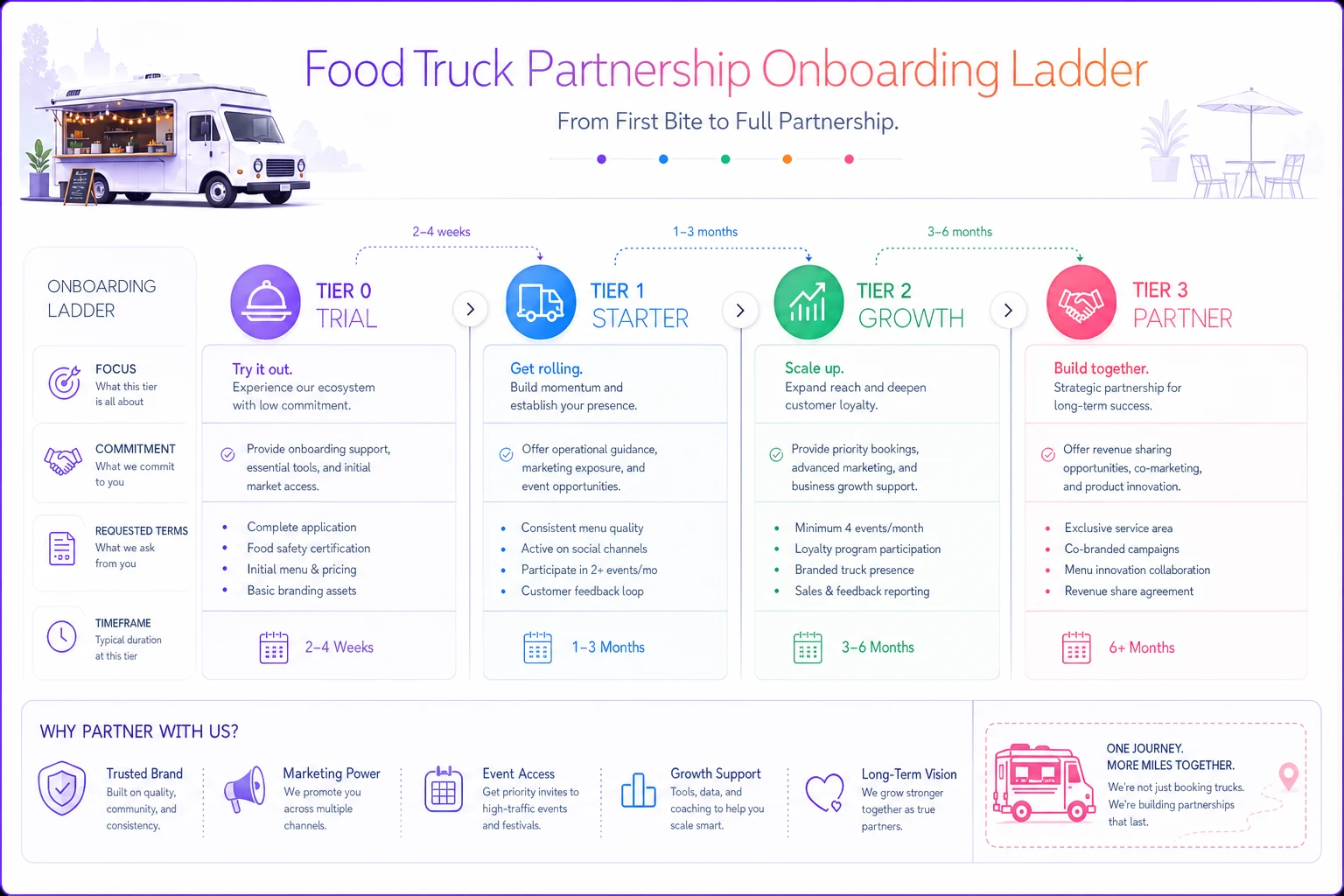
The power here is that you're proposing the ladder to them. You say: "Put me on COD now, and here's exactly what I'll have shown you by month four that earns net-14." Reps respond well to this because it's a de-risked yes — you've handed them the justification they need for their own credit desk.
Don't skip tiers trying to move fast. The whole point is a payment history clean enough that the rep's internal review becomes a formality. One bounced payment resets the clock in their eyes, so treat Tier 1 like a probation you're putting yourself through. That mindset shift is what separates operators who actually make it to net-30 from the ones who stall out at net-7 for a year.
Negotiation scripts you can use verbatim
Scripts matter because the moment of the ask is where most operators soften and accept the default. Having the words ready keeps you from folding.
Opening the terms conversation (new supplier): > "I'm starting on COD, no problem. What I want to set up now is the path to net terms. If I run eight weeks of on-time payments at a steady order, can we put me up for net-7? I'd rather agree the milestone now than renegotiate later."
Killing a bad minimum-order clause: > "The $350 drop minimum doesn't fit how a truck orders. I'll commit to a fixed weekly order day so your routing is predictable — in exchange I need the minimum at $200 or the small-order surcharge waived. Pick whichever works on your end."
Notice the trade: you give them predictability in return for flexibility on the minimum. A fixed order day helps their routing and costs you almost nothing. You're never just asking — you're always offering something that helps their operation.
Locking a fill-rate commitment: > "On my core SKUs — the eight items I order every week — I need a 95% fill commitment. If you short me on those, I need a heads-up by the evening before, not at the dock. Can we write that in?"
Escalating a repeat failure: > "This is the third short-ship on core items this month. Before I move volume elsewhere, I want to agree a fix: email notice the night before on any core shortfall, and a credit on the surcharge for weeks it happens. If that's not something you can commit to, I need to know so I can plan my sourcing."
That last script does quiet work — it signals you track failures and you have alternatives, without being a threat you can't back up.
Sample PO rows that prevent arguments before they start
A huge share of supplier disputes come from vague purchase orders. The invoice shows up, the quantities don't match what you thought you ordered, and now you're on the phone during prep. Writing your POs tightly removes the ambiguity the supplier would otherwise resolve in their own favor.
| SKU | Item | Spec | Qty | Unit | Max substitute | Lead time |
|---|---|---|---|---|---|---|
| 1042 | Chicken thigh, boneless | 40lb case, fresh not frozen | 2 | case | None — call first | 48h |
| 2210 | Brioche bun, 4" | 8-dz pack | 3 | pack | White potato bun OK | 24h |
| 3301 | Roma tomato | #2 grade, 25lb | 1 | case | Vine-ripe at same price | 24h |
| 4120 | Cheddar, sliced | 160-ct, yellow | 2 | case | No substitute | 48h |
The two columns that save you grief are Max substitute and Lead time. When you specify "None — call first" on your protein, you've removed the supplier's ability to silently swap in frozen and bill you like nothing changed. This connects to tighter procurement discipline — the same logic behind commissary procurement systems that prevent last-minute substitutions — and it's doubly important on produce where grade and ripeness can swing hard week to week, which the supplier-flex seasonal produce sourcing playbook covers in depth.
Sample contract clauses worth insisting on
You don't need a lawyer-drafted master agreement. A one-page terms sheet the rep countersigns handles 90% of the protective work for most distributor relationships. The clauses that actually matter for a small operator:
-
Core SKU fill-rate clause. Name the 6–10 items you order every single week and attach a fill-rate commitment (e.g., 95%) with next-day notice on any shortfall.
-
Substitution approval clause. No substitutions on flagged items without a phone call and your verbal OK. Unapproved subs get credited, not billed.
-
Price-hold clause. Lock case pricing on core SKUs for 30–60 days, with notice required before any increases.
-
Lead-time clause. Standard items at 24–48h; specials and large event orders at an agreed longer window so you're not caught off guard.
-
Minimum-order clause. Your negotiated drop minimum and a clear statement of any surcharge — in writing, so it can't creep.
The substitution clause is the one operators consistently underrate. A silent swap from fresh to frozen protein, or from a #1 to a #2 produce grade, doesn't just hit quality — it quietly inflates your plate cost while you think your margins are holding fine.
An escalation matrix sized for a one-truck operation
When a supplier misses, you need a pre-decided response so you're not making emotional calls mid-shift. A tiny operator can't afford to fire a distributor over one bad week, but you also can't let failures pile up silently. This matrix keeps your response proportional.
| Failure | First occurrence | Repeat (within 30 days) | Chronic (3+ in 30 days) |
|---|---|---|---|
| Short-ship on core SKU | Log it, ask for credit | Email rep, request night-before notice | Move SKU to backup supplier |
| Unapproved substitution | Request credit | Escalate to rep's manager | Written warning + dual-source |
| Late delivery | Note on PO | Flag in writing | Shift order day or supplier |
| Price creep without notice | Challenge the invoice | Invoke price-hold clause | Re-quote with competitor |
The discipline most operators lack isn't the escalation — it's the logging. If you can't show a rep "three short-ships on core items this month, here are the dates," your escalation sounds like venting. If you can, it sounds like a decision. Keep a simple running log of every miss: date, SKU, dollar impact. That log is your entire negotiating leverage at renewal time.
A real scenario
A two-person taco truck running around $11k–$13k a month in food cost was stuck on COD nine months into their main distributor relationship. Every week meant scrambling cash to cover the Tuesday drop, and twice they'd skipped an order entirely because the money wasn't there until Thursday's sales landed.
The owner stopped accepting the default. He put together a simple terms sheet, proposed the tiered ladder, and committed to a fixed Tuesday order day in exchange for a path to net terms. He also named his seven core SKUs and asked for a 95% fill commitment with night-before notice on shortfalls.
The rep agreed to net-7 immediately based on a clean card-on-file payment history, and net-14 after eight weeks. The fixed order day was what the rep actually cared about — it made routing predictable. Within three months the truck was on net-14, the Tuesday cash scramble was gone, and the substitution clause had already caught one silent swap that would've cost roughly $40 on a single case. Not dramatic on its own, but across a year of weekly orders that kind of quiet leakage adds up to real money.
When to push hard — and when to leave terms alone
Push hard when: you have a clean payment history, predictable volume, and at least one credible alternative supplier for your core items. Leverage only exists when you can walk, and a rep can usually sense whether you actually can.
Go easy when: you're genuinely new, your volume is erratic, or the supplier is the only reliable source for a specialty item you can't replace. Pushing for net-30 in week two just marks you as a risk and poisons the relationship you're trying to build.
Don't bother negotiating at all when: the account is small, infrequent, and the item is a commodity you can buy anywhere. Spend your negotiating energy on the two or three suppliers carrying your core volume. Nickel-and-diming a backup vendor you order from twice a month is wasted effort.
The quiet advantage: keeping your own records straight
Everything in this playbook runs on one thing — knowing your own order history, payment record, and failure log cold. The operators who win net terms and enforce performance clauses are the ones who can produce the numbers on demand. The ones stuck on COD usually can't tell you their own fill rate.
This is where keeping order and supplier data in one place actually pays off. When weekly orders, delivery exceptions, and payment dates live in a single operational system rather than scattered across texts, paper invoices, and memory, the tier-review conversation becomes straightforward. You pull the history, the rep sees a clean account, and the yes is easy. The negotiation isn't won in the phone call. It's won in the months of organized records that make the phone call a formality.
Start with one supplier — the one carrying your biggest volume. Print the terms sheet, propose the ladder, name your core SKUs, and begin logging every miss. By the time you've done it twice, you'll approach every new supplier relationship from the front foot, and your cashflow will stop living and dying by Thursday's sales.
Ready to drive your food truck business forward?
Join 2,000+ food truck operators relying on Grubzly to boost efficiency, increase sales, and delight customers.