


Most food truck owners don't have a month-end problem. They have a data arrives whenever it feels like it problem, and the month-end close is just where that chaos finally becomes visible.
Nobody warns you about this when you buy a mobile POS: those systems were designed for storefronts with stable Wi-Fi. You're parked under a highway overpass at a brewery lot with two bars of LTE, running $600 through the terminal in 40 minutes, and the sync queue is silently backing up. By the time you reconnect at the commissary, half your card batches settle on today's date even though the sales happened yesterday. Multiply that across 20-something service days and a couple of terminals, and your books at month-end are fiction until you fix them.
This isn't a bookkeeping article in the accountant sense. It's an operations article about designing a close process that expects the mess — late syncs, duplicate transactions, cash that doesn't tie out, payroll that straddles two months. If you build the system to survive offline days, the close stops being a two-day nightmare and becomes a Sunday-afternoon routine.
Why month-end breaks for mobile vendors specifically
A storefront closes the drawer, the terminal batches over solid internet, and the numbers are basically settled by morning. Trucks don't get that luxury. The failure points stack differently.
The sync gap creates phantom timing. When a transaction happens offline, your POS timestamps it locally but settles it whenever the processor finally receives the batch. So a Friday-night sale can hit your deposit report as a Saturday or even Monday transaction. Your sales report says one number, your bank says another, and the gap is entirely timing — not theft, not error, just physics.
Cash and card drift apart quietly. On a busy event day you might do 55% card, 45% cash. But cash doesn't sync. It sits in a bag until someone counts it, and if that count happens two days later at the commissary, the cash sale never lines up with the day it actually occurred. Cash variance in mobile operations usually isn't fraud — it's just recorded on the wrong day, or lumped into a single deposit that covers three service days.
Multiple terminals double-count. Two windows, two card readers, one shared tip pool. When both terminals reconnect and sync, it's surprisingly common for a reader that lost connection mid-shift to re-transmit part of a batch. You end up with duplicate rows that inflate revenue and, worse, inflate your sales-tax liability if you don't catch them.
The core issue: your accounting system assumes transactions arrive once, in order, on the day they happened. None of those three assumptions hold for a truck.
The mental model: treat every service day as a sealed envelope
The single biggest shift that fixes month-end is deciding that the truth of a day is locked at the day, not at the sync.
Stop losing sales to poor planning.
Grubzly helps you plan routes, track inventory, and maximize daily sales effortlessly.
- Real-time route optimization
- Inventory tracking & alerts
- Mobile sales & reporting
No credit card required
-
Opening cash float (counted before you leave the commissary)
-
Terminal Z-reports or the equivalent per-reader close-out
-
Physical cash counted at end of shift
-
Comps, voids, and staff meals logged by hand or on a tablet
-
Any manual/backup transactions written down when the terminal died
When you seal that envelope at end of shift, you have your source of truth — independent of whatever the processor eventually reports. Reconciliation later becomes "does the bank match what I already sealed?" instead of "let me try to reconstruct what happened last Tuesday from a deposit blob."
This is the same discipline that makes offline-first daily reconciliation work at the per-stop level — the month-end close is really just 22 sealed envelopes stacked and checked, not one giant guessing game at the end of the period.
The offline-first close, step by step
Here's the actual monthly routine.
It assumes you already have daily close-outs — if you don't, that's step zero, and everything else falls apart.
-
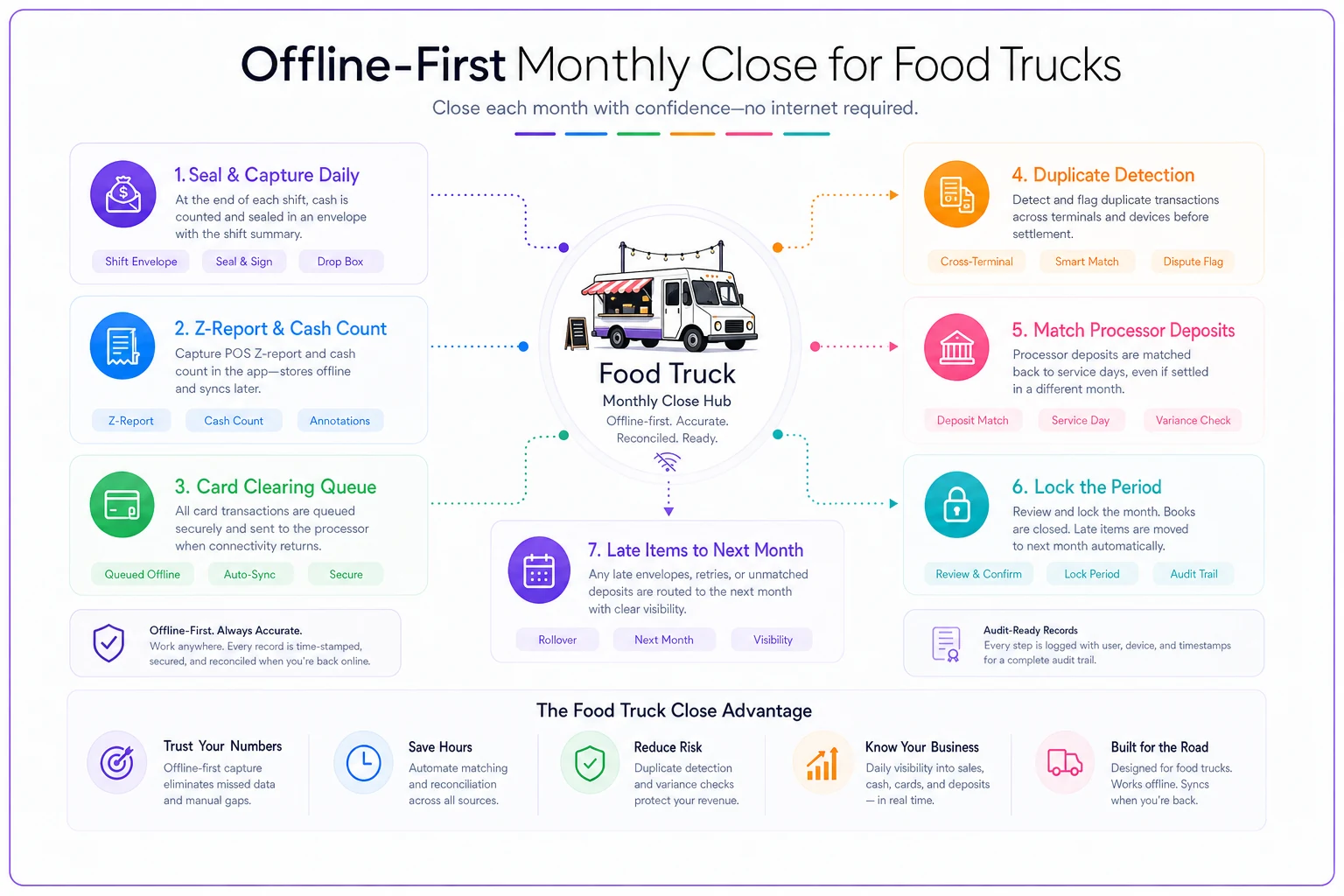
Pull every daily envelope for the month. You should have one sealed daily record per service day. If a day is missing, stop. You'll never reconcile a month with a hole in it.
-
Reconcile card settlements to daily Z-reports, not to the calendar. Match processor deposits back to the service day they belong to, using the batch ID and the pre-settlement timestamp — not the deposit date. This is where the phantom-timing gap closes. Expect a rolling 1–3 day lag between sale date and deposit date, especially over weekends.
-
Hunt duplicates before anything else. Sort card transactions by amount and time. Any two identical amounts within a few seconds on different terminals get flagged. On a two-terminal setup during a festival weekend, catching even three or four re-sent transactions can be the difference between an accurate return and overpaying tax on revenue you never earned.
-
Reconcile cash by deposit, then by day. Total physical cash counted across all envelopes should tie to total cash deposited at the bank for the month. Then allocate each deposit back to the days it covered. If your monthly cash variance is under roughly 1–1.5% of cash sales, that's normal drift. Consistently higher means a counting or logging problem somewhere.
-
Post revenue by category, not one lump. Break food, beverage, catering, and event revenue into separate lines. You can't do meaningful per-stop or per-menu profitability analysis later if everything hits one "sales" account.
-
Separate sales tax at the transaction level. You're working across multiple jurisdictions, so tax rates vary by location. Tag each day's sales with the location and applicable rate so your tax-ready ledger doesn't have to be rebuilt at filing time.
-
Reconcile tips and clear the liability. Tips collected on card are money you're holding for staff. They should flow through a tip-liability account and zero out when paid. If that balance grows month over month, something in the tip flow is getting stuck.
-
Lock the period. Once it ties, close it. Late-arriving transactions after the lock go to the next period with a note. Don't reopen a closed month to chase a $12 stray settlement — you'll break the reconciliation you just finished.
This is where the phantom-timing gap closes. Expect a rolling 1–3 day lag between sale date and deposit date, especially over weekends.
If a day is missing, stop. You'll never reconcile a month with a hole in it.
Don't reopen a closed month to chase a $12 stray settlement — you'll break the reconciliation you just finished.
Sample journal entries that survive offline days
The trick to entries that hold up is booking the sale on the day it happened and the cash movement whenever it actually clears. Two separate events, two separate dates.
On the service day (Saturday) — record the sale even though nothing has settled:
| Account | Debit | Credit |
|---|---|---|
| Undeposited Funds – Cash | $410 | |
| Card Clearing (in transit) | $590 | |
| Food Sales | $840 | |
| Beverage Sales | $115 | |
| Sales Tax Payable | $45 |
When the processor deposit lands (Monday) — clear the in-transit balance:
| Account | Debit | Credit |
|---|---|---|
| Bank – Operating | $572 | |
| Merchant Fees | $18 | |
| Card Clearing (in transit) | $590 |
When cash is deposited at the bank (Tuesday):
| Account | Debit | Credit |
|---|---|---|
| Bank – Operating | $405 | |
| Cash Over/Short | $5 | |
| Undeposited Funds – Cash | $410 |
That Card Clearing account is the whole game. It holds the gap between "we made the sale" and "the money showed up," which is exactly the offline lag you're trying to manage. At month-end, if your Card Clearing balance is anything other than genuinely in-transit recent sales, you have a sync or duplication issue to chase down.
Cashflow forecasting when your revenue is event-shaped
Trucks don't earn smooth revenue. You earn in spikes — a food festival, a wedding, three brewery nights, then a dead Tuesday. Forecasting cashflow off a monthly average will mislead you every time.
Forecast by committed vs. speculative revenue instead:
-
Committed catering deposits already collected, booked private events, standing weekly spots with a real track record.
-
Speculative open public days where revenue depends on weather, foot traffic, and luck.
A realistic pattern for a single truck might look like committed catering running $4k–$7k a month with the rest coming from public days that swing widely. The danger zone is when a large catering deposit lands early, the bank balance looks healthy, and you spend it — then the event food costs and payroll hit two weeks later. That deposit was never yours to spend; it was a liability until you delivered the event.
Book deposits as unearned revenue (a liability), not income, until the event actually happens. This one habit prevents the most common cash blowup in mobile catering — feeling flush on money you still owe work against.
Pair the forecast with your ingredient and spoilage planning too. Event demand drives purchasing spikes, and if you're not connecting forecast revenue to a real perishable plan you'll either over-buy or stock out — the same coordination problem covered in building a perishable inventory system for mobile kitchens.
Payroll cadence: where the calendar fights the month
Payroll almost never lines up cleanly with your accounting month, and for trucks that mismatch is amplified because so much pay is variable — hours swing with event schedules, and tips ride on top.
A quick comparison of what breaks with each cadence:
| Cadence | Fits mobile ops? | Main month-end headache |
|---|---|---|
| Weekly | Great for staff, matches event weeks | Pay periods split across months constantly — heavy accrual work |
| Bi-weekly | Common compromise | Some months have 3 pay runs; skews expense comparison |
| Semi-monthly | Cleaner for accounting | Awful for hourly/variable event staff, tricky overtime math |
Whatever you pick, the fix at month-end is the same: accrue the wages earned but not yet paid. If your pay period ends the 28th but the month ends the 30th, those last two days of labor still belong in this month's P&L. Book an accrued-payroll entry, then reverse it next period. Without this, months with an "extra" payday look artificially expensive and months without one look artificially profitable — and you end up making staffing decisions off numbers that were never real.
Keep tips out of your wage expense entirely. Card tips are a pass-through liability, not a cost of doing business. Mixing them into labor cost is one of the fastest ways to convince yourself your labor percentage is broken when it actually isn't.
A short checklist you can seal each day
The whole month-end only works if the daily inputs exist. Before anyone drives away from a stop, this should be locked:
-
[ ] Opening float counted and recorded before service
-
[ ] Each terminal's close-out report saved (a photo works fine offline)
-
[ ] End-of-shift cash counted, bagged, and logged against the float
-
[ ] Comps, voids, and staff meals written down with reasons
-
[ ] Any manual/backup sales during outages captured on paper
-
[ ] Location tagged for the day (drives the correct tax rate)
-
[ ] Deposit slip or drop noted when cash is actually banked
If all seven exist for every service day, month-end is arithmetic. If they don't, month-end is archaeology.
A real scenario
A two-person taco truck working a mix of brewery nights and weekend festivals was spending most of a weekend every month on the close — and still filing sales tax off numbers the owner admitted were "close enough." Two recurring problems: card batches from spotty festival Wi-Fi kept settling on the wrong day, and a second terminal added for busy events was re-sending partial batches, inflating card revenue by a few hundred dollars in the heaviest months.
Once they switched to sealing each day's totals on-site — Z-report photo, cash count, location tag — and started reconciling against a Card Clearing account instead of the deposit date, two things changed. The duplicate hunt caught roughly $200–$300 of phantom card revenue in a peak month, which had been quietly inflating their sales-tax bill. And the close itself dropped from a lost weekend to about two hours on a Sunday, because the timing gaps were already reconciled at the daily level.
The tools didn't get fancier. Revenue didn't jump. The books just stopped lying, and the owner stopped overpaying tax on money that never existed.
Where software actually helps — and where it doesn't
Plenty of accounting tools can store your numbers. Very few are built around the assumption that transactions arrive late, duplicated, and on the wrong date — which is the entire reality of mobile service. Where an operations platform built for offline-first work earns its keep is in the connective tissue: capturing the sealed daily envelope on the truck without signal, flagging duplicate card transactions across terminals automatically, and holding sales in a clearing state until the bank confirms — so reconciliation is mostly done before you even sit down to close the month.
But no software saves a truck that isn't counting cash at the end of every shift or tagging its locations. The discipline of the sealed daily record is human. Automation just removes the tedious matching and duplicate-hunting once that discipline is already there.
Month-end doesn't fail because food truck owners are bad at accounting. It fails because the standard accounting model assumes stable connectivity that trucks simply don't have. Once you flip the design — lock the truth of each day at the day, book sales separately from settlements, treat deposits and tips as liabilities until earned — the intermittent syncs stop mattering.
Late data just fills in slots you already reconciled. Build the close around offline days instead of hoping they don't happen, and the numbers you file, forecast, and pay staff from will finally start telling the truth about your business.
Ready to drive your food truck business forward?
Join 2,000+ food truck operators relying on Grubzly to boost efficiency, increase sales, and delight customers.