

The moment a food truck adds catering and delivery on top of regular street service, something subtle breaks. Not immediately. The first few weeks feel like free money — a $1,400 catering booking here, a slow Tuesday saved by DoorDash orders there. Then one Friday the truck is parked at its best lunch stop, tickets are stacking, and someone accepts a last-minute 60-person catering order for the same window. Now the on-window line is 18 people deep, the delivery tablet is chiming, and the catering prep is bleeding into the space where your walk-up throughput should be.
That's not a staffing problem. It's a governance problem.
Hybrid food truck governance is about deciding ahead of time which channel wins when they collide — because they will collide, and it almost always happens during your highest-revenue window. Most operators make these calls emotionally, in the moment, based on which order sounds bigger. That's how you end up protecting a one-time catering gig while quietly torching a recurring lunch spot that pays your rent every week.
This is about building the rules, the calendar, and the capacity math that let you say yes or no before the conflict shows up.
Why hybrid operations break at the seams, not the center
A single-channel truck is easy to reason about. You know your stop, you know your rough ticket velocity, you know when you'll run out of proteins. Add a second and third channel and the failure moves from inside one channel to the seams between them.
Here's the pattern that shows up across almost every truck that layers on catering and delivery:
-
The channels share the same physical bottleneck. One flat-top, one fryer, one window, one prep person. Catering, delivery, and walk-up all draw from the same finite capacity, but they get sold through completely separate processes — catering by phone or email weeks ahead, delivery by an always-on app, walk-up by whoever shows up.
-
Nobody owns the total capacity picture. The person booking catering doesn't see the delivery volume forecast. The delivery app doesn't know you committed the truck to a private event. Each channel gets optimized in isolation and oversells the whole.
-
The most profitable channel is usually the least defended. Walk-up throughput at a proven stop is often your highest margin per labor-minute, but it has no advocate. Catering has a contract and a deposit fighting for it. Delivery has an algorithm pinging you. Walk-up just has a line — and lines don't complain to management, they just leave.
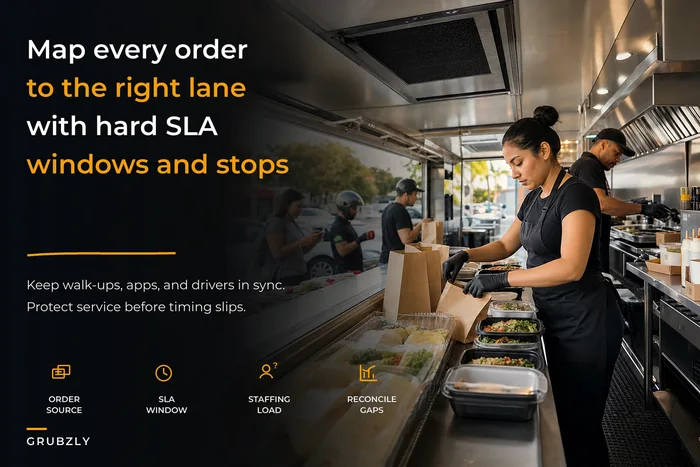
If you've already built out your channels as distinct service lanes, like in turning channels into service lanes, governance is the layer that sits above those lanes and decides which one gets the truck when they compete for it.
The core idea: capacity accounting
Before any decision rule works, you need a shared unit for what the truck can actually produce. Most operators think in dollars. Dollars are a terrible planning unit here because a $1,200 catering order and $1,200 of walk-up sales consume wildly different amounts of your real constraint — kitchen output over time.
Stop losing sales to poor planning.
Grubzly helps you plan routes, track inventory, and maximize daily sales effortlessly.
- Real-time route optimization
- Inventory tracking & alerts
- Mobile sales & reporting
No credit card required
The better unit is covers per operating hour, or if your menu varies a lot, prep-minutes of capacity.
Here's a simple way to build your capacity ledger for a given service window.
A typical lunch window looks like this:
-
Truck realistic sustained output
around 45–55 covers per hour with two people on the line
-
Prime lunch window
11:00–1:30, so roughly 2.5 hours
-
Total sellable capacity
somewhere in the 115–135 cover range for that window
Then you subtract the reserved and committed load before deciding whether a new channel order fits.
| Channel | Committed load (covers) | Notes |
|---|---|---|
| Walk-up baseline (proven stop) | 85 | Historical average for this location/day |
| Delivery (app orders) | 20 | Rolling estimate from last 4 same-days |
| Catering hold | 0 | Nothing booked yet |
| Total committed | 105 | Against ~125 capacity |
| Free capacity | ~20 | This is what you can actually sell to a new channel |
The number that matters is that last row. You have 20 covers of real slack in that window — not "a whole truck." If a delivery surge or a catering request wants more than 20, something has to give.
The mistake almost everyone makes: they look at free dollars or free time and say yes, forgetting that the walk-up baseline isn't guaranteed on paper — it just shows up. When you pull two staff into catering plating, that 85-cover baseline silently drops to 55, and you don't see the lost sales because they never became tickets.
Channel decision gates
A decision gate is a checkpoint an order has to pass before it gets accepted. The point is to move the decision out of the heat of the moment and into a repeatable rule.
For hybrid trucks, you want three gates in sequence. An order has to clear all three or it gets declined, rescheduled, or capped.
1. The window gate — Does this order fall on or near a protected on-window (a proven, high-margin stop)? If yes, it faces a much higher bar. If it's on a dead Monday or an open evening, the bar drops.
2. The capacity gate — Does the order fit inside free capacity as calculated above, after reserving your walk-up baseline? Not "can we technically cook it," but "does it fit without cannibalizing the baseline."
3. The margin-per-constraint-minute gate — Does this order produce more contribution per minute of kitchen bottleneck than the walk-up covers it displaces? A catering order at $18/head that ties up the line for prep might lose to walk-up at $11/head if the walk-up moves twice as fast per minute.
Track per-window throughput minutes weekly so your margin-per-minute gate reflects recent speed changes, not last season's theory.
That third gate is the one people skip, and it's the whole game. Big top-line numbers hide bad per-minute economics constantly.
Explicit gating rules: when to accept, when to protect throughput
Vague policies like "we'll take catering if we have room" don't survive a busy Friday. You need explicit, written thresholds. Here's a rule set that works well as a starting template — adjust the numbers to your truck.
-
Protect the on-window. During a proven stop's prime window, catering is declined unless it can be fulfilled off-truck (dropped/prepped at commissary and delivered separately) or the deposit clears a premium multiplier — usually 1.5–2x normal per-head pricing to justify pulling the truck.
-
Delivery gets capped, not turned off. Set a hard delivery order cap per 30-minute block during prime windows (something like 6–8 items) and let the app go "busy" past that. Uncapped delivery during a rush is how walk-up wait times blow past 12 minutes and your line walks.
-
Off-peak is fair game. Slow weekday evenings, Mondays, and dead-zone afternoons should be aggressively filled with catering and delivery. That's exactly the free capacity you want channels to absorb.
-
A catering booking that hits a prime window must replace, not add. If you accept catering during a normally strong stop, you cancel or relocate the walk-up stop for that day. You do not try to run both. Trying to run both is the single most common self-inflicted disaster in hybrid ops.
-
Same-day delivery surges during catering days are blocked. If the truck is committed to an event, delivery for that block is off. No exceptions on paper.
The logic: your defended asset is the recurring, predictable revenue. Catering and delivery are opportunistic revenue that should fill valleys, not compete with peaks. When they're allowed to compete with peaks, you trade guaranteed weekly margin for one-off spikes, and the truck's revenue gets more volatile even as it gets busier.
The channel-priority calendar
This is where governance becomes something the whole team can actually see. Instead of holding all this in the owner's head, you paint the week with priority tiers so anyone taking a booking knows the answer before they even have to think about it.
Each block of your week gets a priority label:
| Day / Window | Priority tier | Channel policy |
|---|---|---|
| Mon 11:00–2:00 | Open | Accept catering & delivery freely; walk-up expendable |
| Tue 11:00–1:30 | Protected | Proven stop — no catering; delivery capped |
| Wed 11:00–1:30 | Protected | Proven stop — no catering; delivery capped |
| Wed 5:00–8:00 | Flex | Delivery on; catering ok if fits free capacity |
| Thu 11:00–1:30 | Protected | Proven stop — no catering; delivery capped |
| Fri 11:00–2:00 | Premium-only | Catering accepted at 1.5x+ only; else protect walk-up |
| Sat all day | Event-first | Catering has priority; walk-up stops booked around events |
| Sun | Open | Fill with anything |
Three tiers do most of the work:
-
Protected — walk-up wins, full stop. This is your core revenue and it's not for sale.
-
Flex — genuine slack. Sell it to whichever channel books first.
-
Event-first / Premium-only — channels can win here, but only under conditions (price premium, off-truck fulfillment, or a full stop replacement).
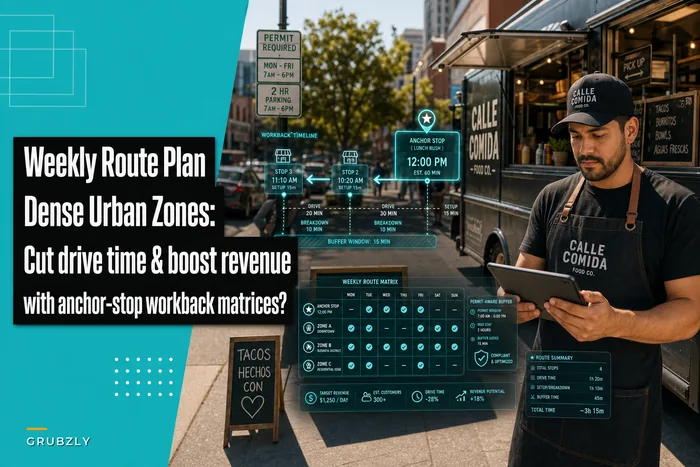
The calendar's real power is that it removes emotion and speed pressure from the booking decision. When a customer calls wanting Friday lunch catering, whoever answers doesn't guess — they look at the tier, see "Premium-only," and quote accordingly. If you route dense urban stops through a structured plan already, like this weekly route plan for dense urban zones, the priority calendar layers cleanly on top of the routing you've already committed to.
A worked example: the Friday collision
Walking through the actual decision — numbers and all — is where governance either pays off or you learn why you needed it.
The setup. A taco truck runs a strong Friday lunch stop downtown — historically around 90–100 covers, average ticket near $13, so roughly $1,200–$1,300 in walk-up sales for the window. On Wednesday, an office manager calls asking for Friday catering: 70 people, on-site, during that same 11:30–1:00 block. She's offering a flat $1,050.
The naive read. "$1,050 guaranteed versus a walk-up window that might do $1,200." Feels close, feels tempting, and the deposit removes the risk. A lot of trucks say yes here.
The governance read. Friday lunch is tagged Premium-only. The rule says catering during this window either fulfills off-truck or clears a 1.5x premium. At 70 heads, the normal per-head is roughly $13, so the premium floor is closer to $1,350–$1,400, not $1,050. The offer fails the gate.
But you don't just decline. You counter: either $1,400 to pull the truck — replacing the walk-up stop entirely, not stacking it — or a commissary-prepped drop-off at $1,050 that doesn't touch the truck's Friday window at all.
The outcome that usually happens. Half the time the client takes the drop-off, and you keep your $1,200 walk-up and add $1,050 off-truck. That's the version where hybrid actually multiplies revenue instead of just shuffling it around. The other half, they pay the premium, and you've been paid fairly to give up a defended window instead of accidentally giving it away for a net loss.
Either way, you didn't run two operations out of one flat-top during your best window and deliver a bad experience to both the office and the line. That silent failure — where nothing "goes wrong" but your Friday regulars wait 15 minutes and stop coming — is the expensive one, and it never shows up on a receipt.
When protecting throughput is the wrong call
Rules that never bend become their own problem. There are real situations where you should override the protect-the-window instinct:
-
Your "proven" stop isn't actually proven anymore. If walk-up at a Protected window has been drifting down for a month, stop defending a number from last season. Re-baseline, and that window might become Flex.
-
Catering is a customer-acquisition channel for you. If events reliably convert into recurring corporate orders or bookings, a below-premium catering gig during a decent window can be worth it as marketing — but decide that explicitly, not by accident.
-
You're building toward exiting street service. Some trucks intentionally pivot to a catering-heavy model with higher margins and fewer 5am starts. If that's the goal, catering should start winning windows on purpose. Just make sure the whole team knows the strategy shifted.
The point isn't rigidity. Every override should be a decision, made against a known baseline — not a reflex triggered by whichever order sounded biggest on the phone.
Who should not run a hybrid model at all
Not every truck should be juggling three channels, and pretending otherwise is how good single-channel operators wreck a working business.
-
You don't have reliable walk-up baseline data per stop. Without it, your capacity accounting is guesswork and every gate decision is a coin flip.
-
You're running solo or with two people and no prep buffer. A single flat-top with two hands can't absorb channel collisions no matter how good the rules are — you'll just fail politely instead of chaotically.
-
Your menu doesn't scale down cleanly for delivery or up cleanly for volume. Some concepts fall apart in a delivery bag or become impossible to plate for 70 at once, and no calendar fixes food that doesn't travel.
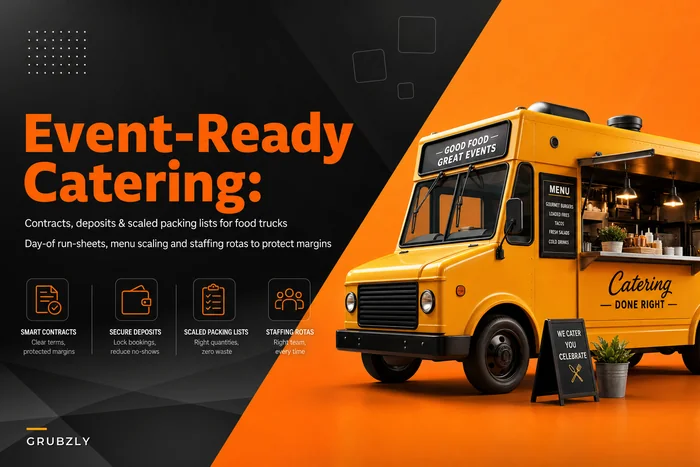
If you're still ironing out the catering side specifically — deposits, scaled packing, day-of run-sheets — get that foundation solid first. This catering playbook for private events is the piece to have working before you start letting catering compete with your street windows.
Building the whole thing into a repeatable weekly process
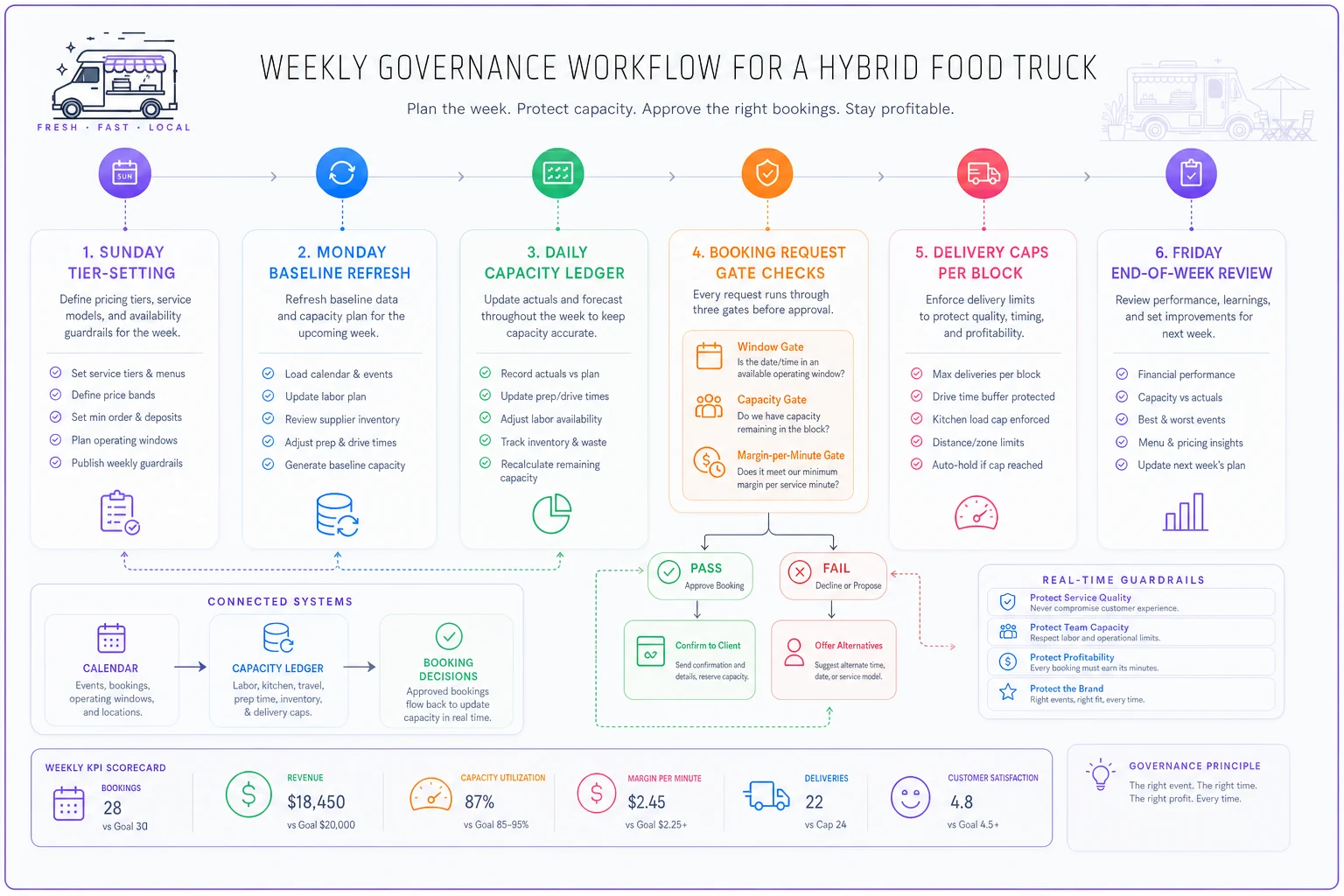
Governance only sticks if it's a routine, not a philosophy. Here's the weekly cadence that keeps the calendar, the capacity ledger, and the gates all pointing the same direction.
-
Sunday — set the tiers. Look at the week ahead. Label every window Protected, Flex, Premium-only, or Open based on stop history and known events. This is the map everyone books against.
-
Sunday — refresh baselines. Pull the last few same-day numbers for each stop and update your walk-up baseline covers. If a stop slipped, downgrade its tier.
-
Daily — run the capacity ledger. For each window, subtract committed load (baseline + delivery estimate + any catering hold) from total capacity. Post the free-capacity number where whoever answers the phone can see it.
-
On every booking request — run the three gates. Window gate, capacity gate, margin-per-minute gate. Accept, counter, or decline based on the outcome. No verbal approvals that skip the gates.
-
Set delivery caps per block at the start of each prime window, and let the app go busy when you hit them.
-
Friday/end-of-week — review the collisions. Where did channels fight? Which calls did you get right or wrong? Adjust next week's tiers accordingly.
A quick governance checklist to keep on the truck or in your booking notes:
-
[ ] Every window on the calendar has a priority tier
-
[ ] Walk-up baseline is refreshed and current for each stop
-
[ ] Free-capacity number is calculated before accepting any channel order
-
[ ] Catering during Protected windows requires replacement or premium — never stacking
-
[ ] Delivery has a per-block cap during prime windows
-
[ ] Event-committed days block same-day delivery for that block
-
[ ] Every override was a deliberate decision, not a reflex
A quick governance checklist to keep on the truck or in your booking notes:
Quick visual for the weekly process:
Most of this is judgment, and no tool replaces knowing your stops. But there's one place where an operational platform genuinely earns its keep: keeping the total capacity picture visible across channels that were designed to be booked separately.
Where software quietly helps — and where it doesn't
Most of this is judgment, and no tool replaces knowing your stops. But there's one place where an operational platform genuinely earns its keep: keeping the total capacity picture visible across channels that were designed to be booked separately.
The core failure — catering booked without seeing delivery volume, delivery running hot without seeing the event commitment — is fundamentally a shared-visibility problem. When your booking calendar, delivery caps, and per-window capacity all live in one place, the three gates become nearly automatic. Someone tries to book a Protected window and the system already shows there's no free capacity to give. That's the practical role for this kind of tooling — not making the decision for you, but making sure whoever answers the phone can see what accepting that order actually costs before they say yes.
You can absolutely run this on a whiteboard and a shared spreadsheet, and plenty of two-truck operations do exactly that. It starts to strain when you're coordinating multiple trucks, multiple channels, and more than one person taking bookings — because then the capacity picture has to be shared across people, not just held in the owner's head.
Hybrid food truck governance isn't about accepting more orders — it's about accepting the right ones and protecting the revenue that's already working. The trucks that struggle with catering and delivery aren't the ones with too few orders; they're the ones with no rule for what happens when orders collide during their best window.
Build the capacity ledger so you know your real slack. Tier your calendar so every window has a known priority. Run each order through the three gates so the decision is made by policy, not by whichever call sounded biggest. Do that, and catering and delivery stop cannibalizing your peaks and start filling your valleys — which is the only version of hybrid that actually grows the business instead of just making it busier.
Ready to drive your food truck business forward?
Join 2,000+ food truck operators relying on Grubzly to boost efficiency, increase sales, and delight customers.