

Most food truck owners think they have a staffing problem. What they actually have is a measurement problem. You can't tell who's good until the line is 20 deep and the fryer's backed up, and by then it's too late to find out your new hire can't call tickets. The whole thing runs on vibes and panic hires, and the cost shows up as blown lunch rushes, no-shows you can't cover, and good people quitting because the bad ones made the shift miserable.
A tiny crew magnifies everything. On a truck with three people working the window, one weak link isn't 33% of a problem — it's the entire shift. There's no back office to hide in, no floor to get lost on. Everyone is load-bearing. So the usual restaurant approach of "hire a bunch, see who sticks" doesn't translate. You need a system where you know within one shift whether someone can do the job, and where you can drop a trained relief person into a slot with a phone call.
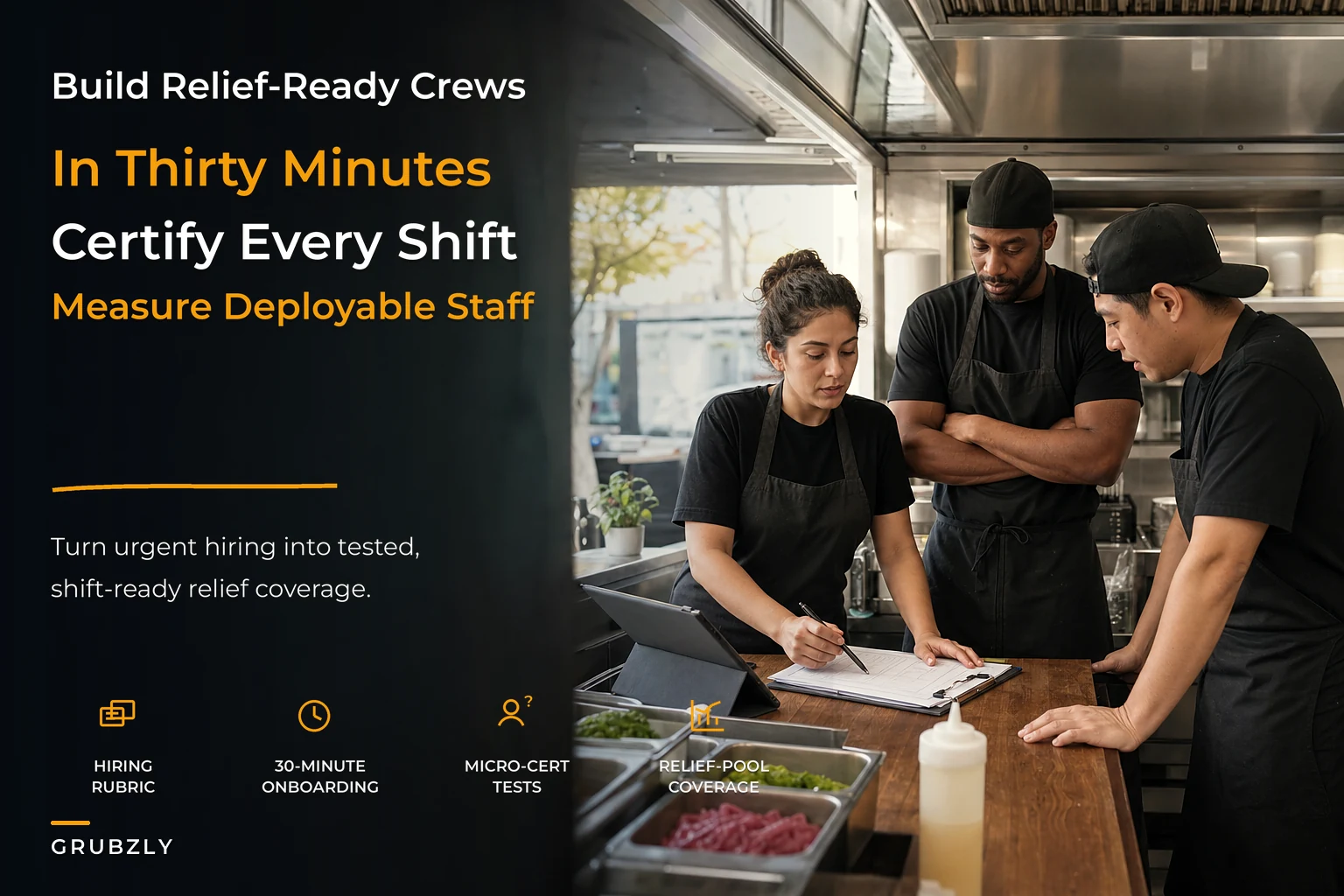
This is that system. It's built around things you can actually measure: a hiring rubric that scores for truck-specific traits, a 30-minute onboarding that gets someone functional same-day, 2-minute certification tests for each station, a forced three-shift progression that proves competence under load, and a relief pool you can roster from when someone bails. None of it requires a trainer on staff. It's designed for an owner who's already working the window.
Why food truck staffing breaks differently than restaurant staffing
The patterns across small mobile operations are almost always the same three failures, and they're all structural, not personality-driven.
First, there's no slack. A sit-down restaurant can carry a mediocre busser for months. A truck can't. When ticket velocity spikes during a 90-minute lunch window, every station has to hit its rhythm or the whole line stalls. That means hiring for speed-under-pressure matters more than resume polish, and most owners don't screen for it at all.
Second, training happens during revenue. There's no quiet Tuesday afternoon to walk someone through the POS. New people learn on a live truck during the exact windows when mistakes cost the most. So onboarding has to be chunked into something that fits between stops — not a packet nobody reads.
Third, turnover is baked in. Mobile food work skews toward students, part-timers, and people between things. You will lose staff mid-season. If your entire operation lives in one person's head, their two-weeks' notice is an existential event. Owners who survive this build for replaceability from day one.
The insight most people miss: these three problems compound. Weak hiring means slow training. Slow training means you lean harder on your veterans. Leaning on veterans burns them out, so they quit, and now you're hiring under pressure again — which produces weak hires. It's a loop, and you break it by making every stage measurable so nothing depends on gut feel or a single irreplaceable person.
The hiring rubric: score for the truck, not the resume
Interviews for truck crew are mostly useless because the job isn't conversational — it's physical, fast, and cramped. A better approach is a scored rubric where you rate four traits on a simple 1–4 scale, ideally during a 20-minute paid trial rather than a sit-down chat.
Stop losing sales to poor planning.
Grubzly helps you plan routes, track inventory, and maximize daily sales effortlessly.
- Real-time route optimization
- Inventory tracking & alerts
- Mobile sales & reporting
No credit card required
| Trait | What you're actually measuring | How to test it in 20 min |
|---|---|---|
| Pace under clutter | Can they keep moving when the space is tight and loud? | Have them restock and wipe down during a mock rush while you call random tasks |
| Ticket recall | Can they hold 3–4 orders in their head? | Read them four orders fast, have them repeat back after 60 seconds |
| Cash/POS accuracy | Do they fat-finger under pressure? | Run five quick transactions, check for errors |
| Coachability | Do they adjust immediately when corrected? | Correct one thing early, see if it sticks the second time |
Score each 1–4. Anyone averaging under 2.5 is a pass, no matter how likable. The reason to write it down isn't bureaucracy — it's that your memory of candidates degrades fast when you're interviewing between shifts, and a scored sheet lets you compare people you met two weeks apart.
The mistake here is weighting "attitude" too heavily. Attitude matters, but you can't train pace or recall into someone who fundamentally doesn't have it. You can train a fast, accurate person who's a little green. Hire for the hard-to-change traits and coach the rest.
The 30-minute emergency onboarding checklist
When someone no-shows and you need a warm body productive today, you don't have time for a full orientation. You need a floor-ready baseline. This is the 30-minute version — enough to make someone safe and useful on one station, with the rest layered in later.
-
Safety and non-negotiables (5 min) fire extinguisher location, burn/cut protocol, where the first-aid kit is, propane shutoff. The only part that's truly non-skippable.
-
The one station they'll run (8 min) walk them through a single station only — usually assembly or window. Not the whole truck. One job, done right.
-
POS basics (5 min) how to ring the five most common orders, how to void, how to take card vs. cash. Skip the edge cases.
-
The three phrases (2 min) what to say to customers when something's 86'd, when there's a wait, and when they don't know an answer ("let me grab someone").
-
Watch-one, do-one (10 min) they shadow you through two or three real orders, then do two or three with you watching.
That's it. They're not fully trained — they're deployable. The distinction matters because owners either throw people in with zero prep (chaos) or wait until someone's "fully trained" before deploying them (which means never). The 30-minute version gets you a functional third hand by the lunch rush and defers the depth for later.
Laminate the 30-minute onboarding card and tape it inside the truck so it's where you'll find it when short-staffed.
Keep this as a printed card laminated in the truck. When you're stressed and short-staffed, you will not remember the order. The card runs the onboarding for you.
2-minute micro-cert tests: proving competence per station
This is the piece almost nobody does, and it's the highest-leverage part of the whole system. Instead of vaguely deciding someone "knows the window now," you give them a 2-minute timed test per station that they either pass or fail.
A micro-cert is a tiny, specific competency check. Examples:
-
Window cert take four orders correctly in 2 minutes, with accurate change and no missed modifiers.
-
Assembly cert build three of your top sellers to spec in under 2 minutes, portions within tolerance.
-
Fry/grill cert hit correct temps and timing on two items without a prompt.
-
Close-out cert break down and sanitize one station correctly from memory.
Pass/fail, logged with a date and who certified them. It converts "I think they're ready" into a documented yes/no, and it lets the employee see their own progress. People push to clear certs. It gamifies competence in a way that's weirdly motivating on a small crew.
It also protects you. When you're deciding who gets the Saturday festival shift — your highest-revenue slot — you're not guessing. You're staffing by who's certified on which station. And if a dispute ever comes up about pay tiers or promotions, you've got a clean record. This pairs naturally with how you handle pay fairness, which gets messy fast on small teams — the logic behind tip-pooling and pay-split policies for small mobile teams works a lot better when certifications tell you objectively who's carrying more load.
The three-shift forced-run progression
Certs prove someone can do a task in isolation. They don't prove someone can hold up during a real rush. That's what the forced-run progression is for — a deliberate three-shift ramp where you force the conditions instead of hoping they come up naturally.
Shift one — protected. The new person runs one certified station only, with a veteran beside them and a lighter stop (not your busiest). Goal: clean execution, no rush pressure. You're watching for whether the cert holds up when it's live.
Shift two — exposed. Same station, but during an actual rush, veteran nearby but not hovering. This is the real test. Can they keep pace when tickets stack? Most people who looked fine on shift one show their real ceiling here. That's the point — you want to find it on shift two, not during a 200-cover festival.
Shift three — stretched. They run their primary station solo during a rush and cover a second station during the lulls. If they clear this, they're a real crew member, not a trainee. If they stall, you know exactly where and can decide whether to coach or cut.
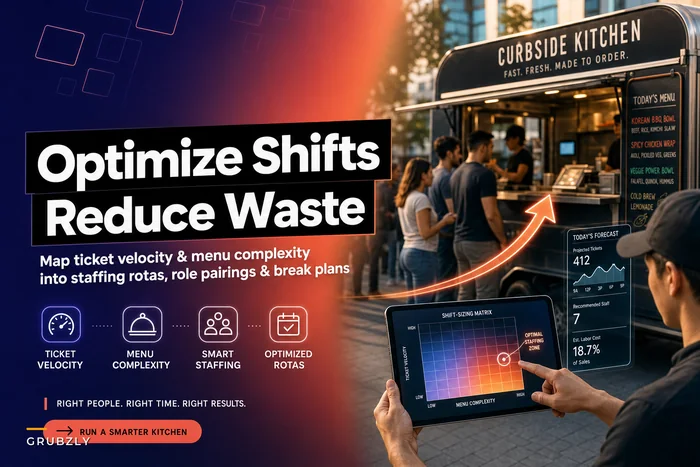
The reason to force it into three defined shifts rather than letting it happen organically: organic ramps take weeks and never pressure-test anyone on purpose. You end up finding out someone can't handle Saturday on Saturday. The forced progression front-loads the discovery into lower-stakes windows. This whole approach plugs directly into a shift-sizing model that maps ticket velocity and menu complexity into staffing rotas — once you know each person's proven ceiling, you can size shifts around who's actually on the truck instead of headcount alone.
Relief-pool rostering and pay rules
Every mobile operator eventually hits the Friday-night text: "Can't make tomorrow, sorry." If your only answer is "work short or close," you're going to lose revenue and burn your remaining crew. The fix is a relief pool — a small roster of pre-trained, pre-certified people who've agreed to be on-call, with clear pay rules so there's no friction when you call.
A relief pool is usually three to six people: past crew who left on good terms, certified part-timers from other trucks or commissary contacts, and a couple of your own staff who want extra shifts. The key is they're already certified on at least one station through the same micro-cert process. A relief person who has to be onboarded from scratch isn't relief — they're a liability.
-
A short-notice premium (a flat on-call bump for sub-24-hour calls)
-
A guaranteed minimum shift length so a two-hour callout is still worth their drive
-
A clear priority order for who you call first (usually by cert breadth and reliability)
-
A simple "accepted/declined" confirmation so you're not chasing people
Keep the relief roster, cert status, and pay tiers somewhere everyone can see — a shared sheet, a simple scheduling app, whatever works when you're off-grid. The point is that the information isn't locked in your phone. When you're the one who's sick, someone else needs to be able to run the callout.
When a relief pool makes sense — and when it doesn't
When it makes sense: You run more than three or four shifts a week, you've had at least a couple of no-shows cost you real money, and you have enough volume that the on-call premium pays for itself versus closing or running dangerously short.
When it's a bad idea: You're a one- or two-person operation doing a handful of shifts a month. The overhead of maintaining a pool and keeping people certified outweighs the risk. In that case, just build relationships with two reliable backups and keep it informal.
Who should not do this: Owners who won't commit to the pay rules. A relief pool with fuzzy pay is worse than none — you'll call, get flaked on, and resent it. If you're not ready to pay the premium, don't build the pool.
Printable artifacts and KPI targets
The whole system falls apart if it lives in your head, so it needs physical artifacts that run without you. At minimum, print and laminate:
-
The hiring rubric scoring card
-
The 30-minute onboarding checklist (taped inside a cabinet)
-
A micro-cert log (names, stations, pass dates)
-
The relief-pool roster with cert status and call order
-
A one-page pay-rules sheet for relief and tiers
For targets, keep them few and honest. The numbers worth tracking:
-
Time-to-deployable under one shift (should be, with the 30-min onboarding)
-
Time-to-certified on primary station within three shifts
-
No-show coverage rate percentage of callouts covered without closing or running short — aim for 80%+ once your pool is built
-
Rush ticket accuracy errors per 100 tickets during peak, tracked per person
Treating training and these artifacts as living documents matters more than getting them perfect on day one. The same discipline that keeps your recipes and procedures current applies here — the approach in lightweight version control, micro-training and emergency amendment rules for food trucks is exactly how you keep onboarding cards and cert standards from going stale as your menu and stations change.
A real scenario: the two-truck taco operation
A small taco operation running two trucks and about nine total crew was losing roughly one shift a month to no-shows — sometimes closing a truck entirely, sometimes running a three-person window with two people and watching lunch fall apart. Training was informal: a veteran "showed the ropes," which in practice meant new hires took two to three weeks to be trusted on the window, and a couple quit before they ever got there.
They put in the measurable system over about six weeks. Scored trials replaced casual interviews. The 30-minute card made new people useful same-day instead of shadowing for a week. Micro-certs gave them a clear roster of who could run what. They built a four-person relief pool from former crew and a commissary contact, with a flat short-notice bump.
The visible changes: time-to-useful dropped from a couple of weeks to a single shift. Over the next quarter they covered most callouts without closing a truck — not perfect, but a clear shift from the near-monthly losses they'd had before. The less obvious win was morale. The veterans stopped carrying dead weight through rushes, which is usually the real reason good crew leave. Retention on the core team held steady through a season where they'd historically churned through two or three people.
It wasn't a dramatic revenue rocket — somewhere in the range of recovering a few hundred to a thousand-plus dollars per avoided closure, a handful of times a quarter. But the compounding effect of a crew that trains itself and covers its own gaps is the part that actually changes how the business feels to run.
Bringing it together
The reason this works isn't any single piece — it's that every stage feeds the next. The hiring rubric produces people with the raw traits that make training fast. Fast onboarding gets them to certs sooner. Certs feed the forced-run progression, which proves who can handle load. Proven people populate the relief pool, which absorbs the turnover that's inevitable on a small mobile crew. And the printed artifacts mean none of it depends on you being there, healthy, and remembering everything.
Visual guide to how hiring → onboarding → certs → forced runs → relief pool connect.
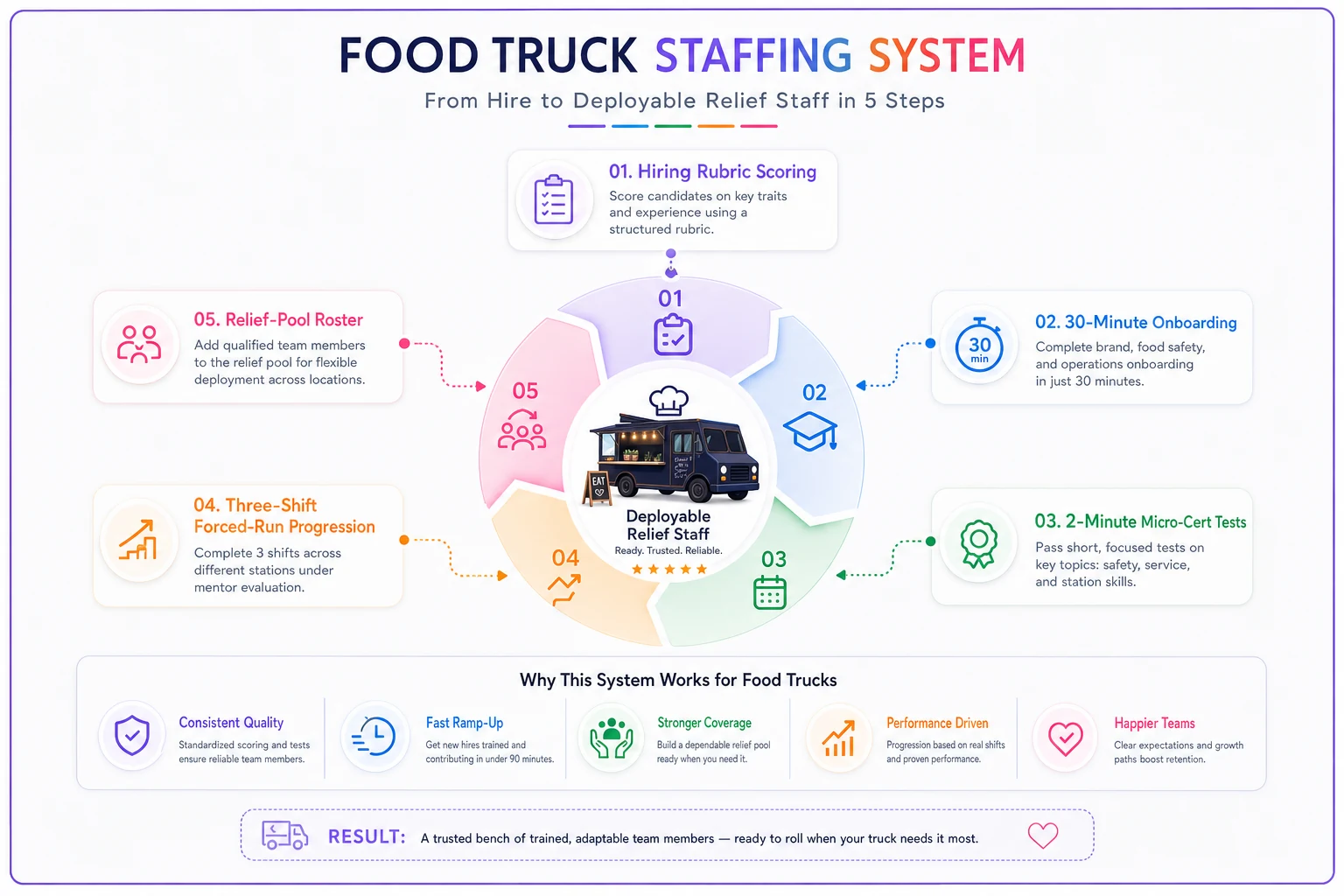
Most staffing pain on a truck comes from treating people as interchangeable bodies you hope work out, instead of building a measurable pipeline where you know what each person can do and can slot in a trained replacement when someone drops. You don't need HR software or a trainer on payroll. You need a scored rubric, a laminated checklist, a cert log, and a relief roster with clear pay rules. Build those five things and your staffing stops being the thing that keeps you up on Friday nights.
Most staffing pain on a truck comes from treating people as interchangeable bodies you hope work out, instead of building a measurable pipeline where you know what each person can do and can slot in a trained replacement when someone drops. You don't need HR software or a trainer on payroll. You need a scored rubric, a laminated checklist, a cert log, and a relief roster with clear pay rules. Build those five things and your staffing stops being the thing that keeps you up on Friday nights.
Ready to drive your food truck business forward?
Join 2,000+ food truck operators relying on Grubzly to boost efficiency, increase sales, and delight customers.