

Most food truck SOPs die a quiet death. They start as a Google Doc someone made during a slow week, get printed once, taped inside a cabinet door, and then reality happens. A new hire covers a Saturday shift. The menu changes for a festival. Someone reorders the prep steps because the old way was slow. Six months later the printed sheet says one thing and the crew does something completely different — and nobody remembers which version is correct.
That gap between "the document" and "what the crew actually does" is the real problem behind food truck SOP governance. It's not that operators don't write procedures. It's that procedures don't survive contact with a rotating crew working out of a moving kitchen. The document assumes stability. Your operation has none.
So this isn't a piece about writing SOPs. You probably have some. It's about keeping them true — governing them so the version in the truck matches the version in your head, even when your staff changes weekly and the menu shifts by the event.
Why SOPs rot faster in mobile food than almost anywhere else
Think about a fixed restaurant. Same kitchen layout, same stations, same core crew for months. An SOP posted on the wall stays roughly accurate because the environment barely changes. When someone deviates, a manager who's physically there corrects it that shift.
A food truck breaks every one of those assumptions.
The crew is tiny — usually two to four people — and it rotates. The person who knows the "real" procedure isn't on today. Nobody's standing behind the line to catch drift. The physical setup changes when you swap trucks or reconfigure for a catering gig. And your menu isn't fixed; you're running a taco special at a brewery Friday and a scaled-down breakfast menu at an office park Monday.
-
A procedure gets tweaked verbally during a busy shift ("just skip the second temp check, we're slammed").
-
The tweak works, so it sticks — but only in the heads of whoever was there.
-
Two weeks later a different crew runs the original written version, or their own invented version.
-
Now you have three procedures for one task and no idea which is live.
The scary part is you usually don't notice until something breaks — a health inspection finding, a food-cost blowout, an allergen near-miss. By then the governance failure already happened weeks earlier, invisibly.
The core idea: SOPs as living documents, not artifacts
The mental shift that fixes this is treating your procedures like software instead of paperwork. Software has versions. It has a single source of truth. It has a controlled way to push updates and a record of who changed what. You don't need enterprise tooling for this — you need the discipline pattern that version control gives you, adapted to a two-person crew that's often offline.
Stop losing sales to poor planning.
Grubzly helps you plan routes, track inventory, and maximize daily sales effortlessly.
- Real-time route optimization
- Inventory tracking & alerts
- Mobile sales & reporting
No credit card required
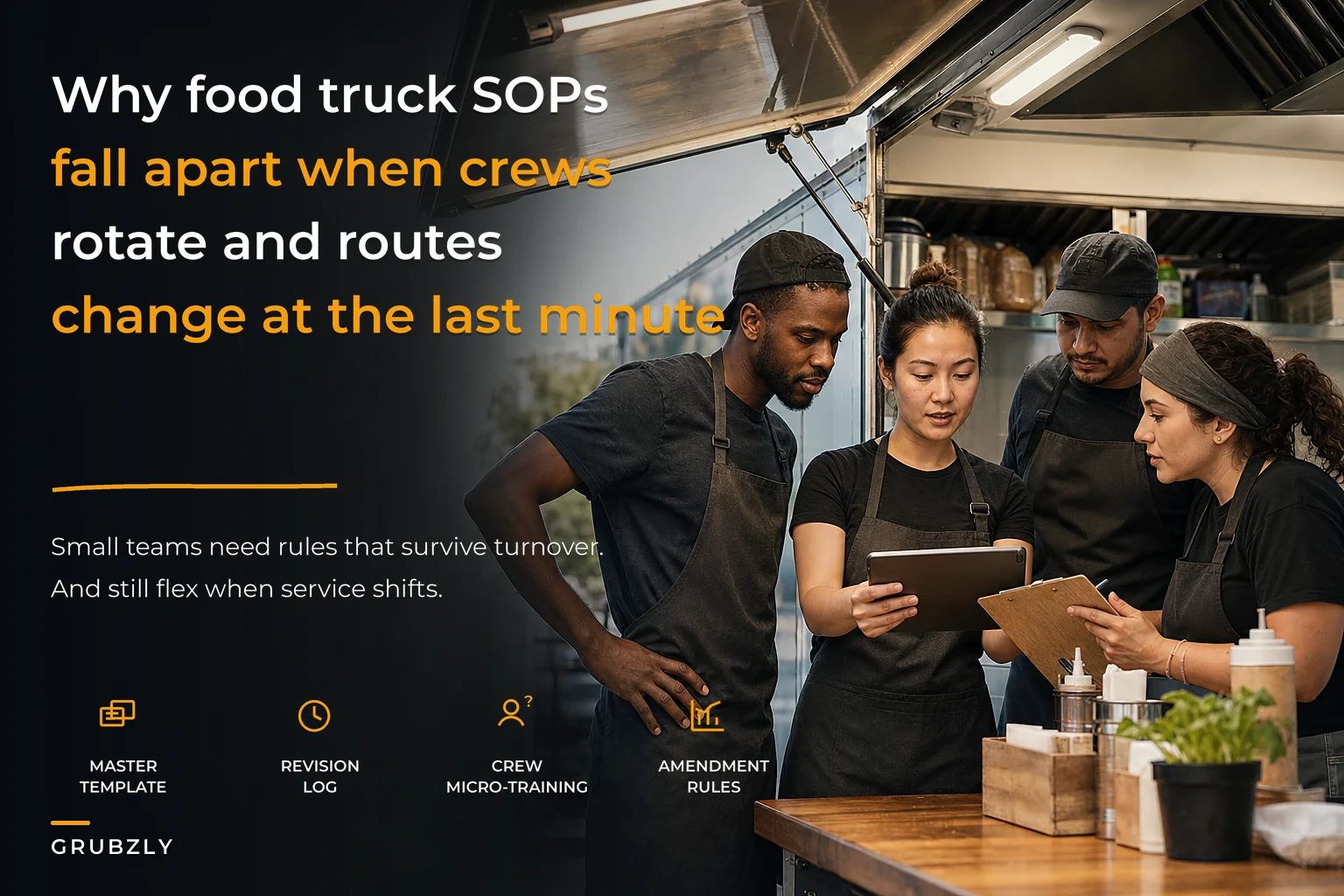
Everything below is built on four connected parts:
-
Authoring templates — so every SOP looks the same and is fast to update.
-
Lightweight version control — so there's always one live version and a history.
-
Audit cadence — a rhythm for checking the document against reality.
-
Micro-training + emergency amendments — so changes actually reach the crew, including the last-minute ones.
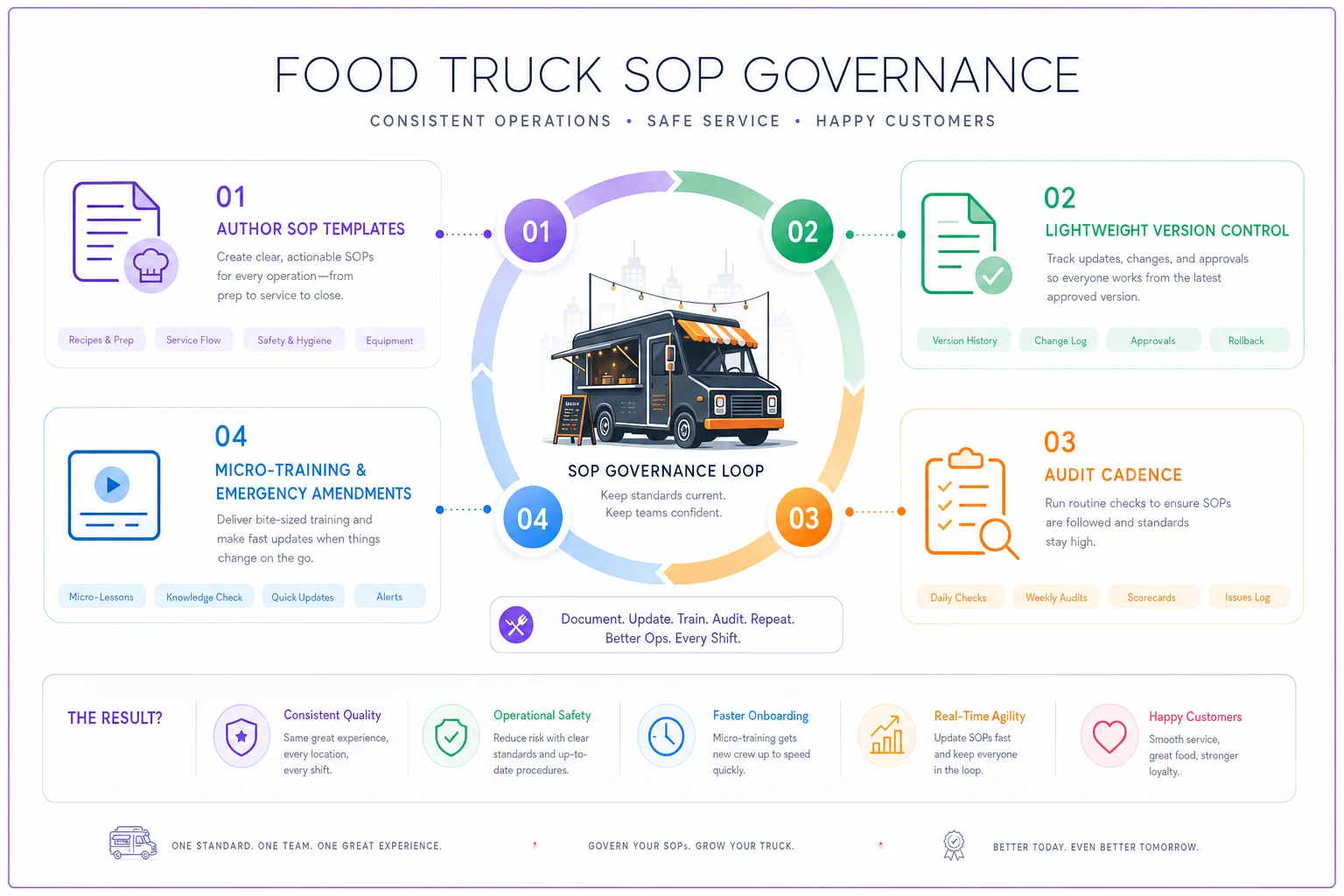
This diagram shows the four-part loop and how updates flow from authoring to the crew.
Authoring templates: make procedures boring and identical
The first failure point is inconsistency in how SOPs are written. When every procedure is formatted differently — some are paragraphs, some are checklists, some are a photo with no words — crews can't scan them fast during service, and you can't update them consistently.
A usable food truck SOP template has a fixed skeleton. Something like:
-
Task name (one line, plain language)
-
When it applies (every shift / specific menu / specific truck)
-
Version number + last updated date
-
Steps (numbered, short, action-first)
-
Critical control points (the 2–3 things that cause real problems if skipped — temps, allergen separation, cash handling)
-
What "done right" looks like (ideally a reference photo)
Notice the version number and date live inside the template, not in a filename somewhere. That single habit prevents half of all version confusion. A crew member glancing at the sheet can tell immediately if it's the current one.
Keep the language at a level a first-week hire can follow without you standing there. A common mistake is writing SOPs for yourself — dense, assuming knowledge you have and they don't. The template forces you to separate "the steps" from "the critical points," which is exactly the split a stressed new person needs during a lunch rush.
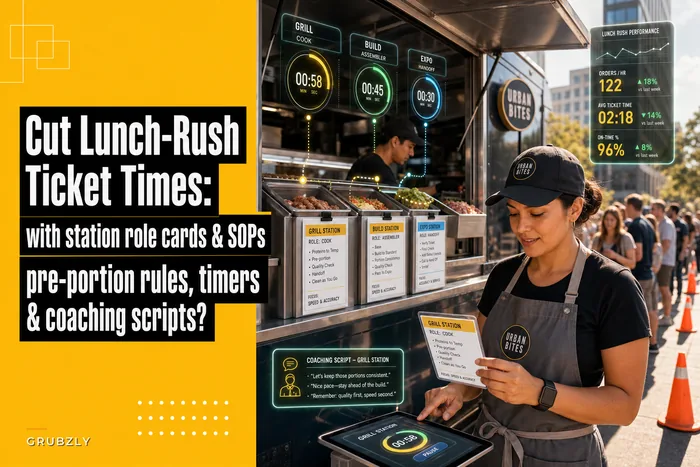
This ties directly into station-level work. If you've already built out station role cards and time-motion SOPs for the lunch rush, your authoring template should match that format so the two systems don't contradict each other. Two different formats for the same station is how drift starts.
Lightweight version control without pretending you're a tech company
You don't need Git. You need three rules that give you the benefits of version control:
One source of truth. There is exactly one master location — a shared drive folder, a simple app, whatever — where the current version of every SOP lives. The printed sheet in the truck is a copy of that master, never the master itself. If it's not in the master, it's not official.
Sequential versions, never overwritten silently. When a procedure changes, the version number bumps (v1.3 → v1.4) and the old one isn't deleted — it's archived. This matters more than people expect. When a health inspector asks why your cooling procedure changed, or when a new process causes a problem, you need to see what the old version said and when it changed.
A visible change note. One line: what changed and why. "v1.4 — added second temp check after the June cooling issue." That's your audit trail. It costs ten seconds and saves hours of "wait, who changed this?"
Keep the master in a single, clearly named location so crews always know where to get the live SOP.
Here's how this usually plays out in practice:
| Situation | No version control | Lightweight version control |
|---|---|---|
| New hire starts | Grabs whatever sheet is in the cabinet | Prints current version from the master |
| Procedure gets tweaked | Verbal only, lives in one person's head | Bumped version + change note, pushed out |
| Health inspection question | "Uh, I think we changed that?" | Pull the change history, show the date |
| Two crews disagree | Both think they're right | Check the master — one live version wins |
| Something goes wrong | Can't tell which procedure was in effect | Archived versions show exactly what was live |
The right-hand column doesn't require software. It requires discipline. But once you have more than one truck, that discipline gets hard to enforce manually — which is where a shared operational platform earns its place. It holds the single master, timestamps every change, and makes sure the version a crew member opens on their phone is the live one, not a stale printout.
Audit cadence: catching drift before it becomes an incident
A version-controlled document is still useless if it doesn't match reality. The document can be "correct" and the crew can still be doing something else. Auditing is how you close that loop — and the mistake most operators make is doing it reactively, only after something goes wrong.
Build a rhythm instead. A practical cadence for a small operation looks like:
-
Weekly (5 minutes) Spot-check one or two high-risk SOPs against what the crew actually did. Not all of them — just rotate through. Temp logs, allergen prep, and cash reconciliation are good candidates.
-
Monthly (30 minutes) Review any SOP that changed that month, plus any where you've seen repeated mistakes. Ask the crew directly: "Is the written way the way you actually do it?" You'll be surprised how often the honest answer is no.
-
Quarterly (a couple hours) Full sweep. Every SOP gets a "still accurate?" check and a fresh date stamp even if nothing changed — so a reviewed document looks different from one that's been ignored for a year.
The weekly spot-check is the one people skip and the one that matters most. Drift is small and continuous — a skipped step here, a reordered task there. Catching it weekly means correcting a small deviation, not discovering a fully diverged procedure three months in.
One thing worth flagging: when you audit and find the crew doing something different but better, that's not a violation — that's a signal to update the SOP. Governance isn't about forcing people back to a worse process. It's about making sure the best current version is the official one.
Micro-training: how changes actually reach a rotating crew
This is the part that quietly kills most SOP systems. You update the document. You bump the version. And then the crew never finds out, because there's no mechanism to push the change to people who weren't there.
Full retraining sessions don't work for mobile crews. You can't pull everyone into a room — they're part-time, they rotate, they're scattered across shifts. So training has to be broken into pieces small enough to deliver in the two minutes before a shift starts.
Micro-training modules are just that: one procedure, one change, delivered in under three minutes. A short clip, a photo, a five-line summary of what changed and why it matters. The "why" is what makes it stick — "we added a second temp check because we had a cooling issue in June" lands harder than "new step: temp again."
-
SOP changes and the version bumps.
-
A micro-module gets created for that change (just the delta, not the whole procedure).
-
Every crew member acknowledges they've seen it before their next shift running that task.
-
You track who's acknowledged what, so you know who's still on the old version.
That acknowledgment step is the enforcement mechanism. Without it, "I sent it out" isn't the same as "they know." With a rotating crew, someone is always a shift or two behind on updates — tracking tells you exactly who needs a 30-second heads-up before they start.
This is also where a shared platform does a lot of quiet work. Pushing a micro-module to phones, confirming who's read it, flagging the crew member about to run a station on an outdated procedure — that's tedious to manage over group text and it fails silently. When the "who's seen what" tracking is automated, nobody starts a shift on a version you retired last week.
Emergency amendments: the last-minute change problem
Everything above assumes you have time to update, push, and confirm. Mobile food constantly doesn't. Your fish supplier subs in a different product an hour before service. A festival organizer moves you to a spot with no water hookup. A menu item sells out and you improvise a substitute. These changes happen exactly when there's zero time for proper governance — and they're when mistakes get expensive.
You need a defined emergency amendment process so last-minute changes don't just become undocumented chaos. The rules:
-
Any crew member can invoke it. Not just the owner. The person on the truck at 11:45am is the one who needs it.
-
It's verbal + a quick note, not a full rewrite. "Sub
using chicken thigh instead of breast today, adjust cook time up ~2 min." Logged in one place — a running amendments note or a quick entry in your ops app.
-
It's flagged as temporary by default. An emergency amendment is a patch, not a permanent change. It expires at end of shift unless someone promotes it to a real SOP update.
-
It gets reviewed after the shift. During your next audit touchpoint, every emergency amendment gets a decision: promote it (bump the SOP version), or discard it (was a one-off).
That last step is what separates a controlled system from anarchy. Without a review-and-promote step, emergency changes either vanish (and the lesson is lost) or silently become permanent without ever being documented — and now you're drifting again.
The critical-control-points section of your template matters most here. When something has to change last-minute, the crew needs to know instantly which parts are flexible and which are non-negotiable. Cook time can flex. Allergen separation and temp thresholds cannot. A good template makes that distinction obvious under pressure.
A real scenario: two trucks, one drifting procedure
A two-truck taco operation — somewhere in the $30k–$40k a month range across both trucks — kept getting inconsistent food-cost numbers between the two. Same menu, same recipes on paper, but Truck B's protein cost ran noticeably higher, month after month.
The SOPs said each truck portioned protein by weight. In reality, Truck B's weekend crew had quietly switched to scooping by eye "to keep up" during rushes — a change nobody documented, made during a busy Saturday, that just became the norm. The written SOP was correct. The crew wasn't running it. Nobody caught it because there was no audit rhythm and no way to tell that Truck B's actual process had diverged.
The fix wasn't complicated. They moved SOPs into a single shared master with version numbers, started a weekly five-minute spot-check on portioning, and pushed a two-minute micro-module re-establishing the by-weight rule with a photo of the correct scoop on the scale. The portioning gap closed within a few weeks, and the protein cost variance between trucks shrank to something small enough to stop worrying about — a few hundred dollars a month recovered on that one procedure alone.
The lesson wasn't "the crew was lazy." The crew was solving a real problem — keeping up — the only way they knew how. The system failed by having no way to surface that drift or push a correction. That's a governance gap, not a people problem.
When this level of governance makes sense — and when it doesn't
When it's worth it:
-
You run more than one truck, or the same truck with rotating or part-time crew.
-
Your menu changes frequently (events, seasons, specials).
-
You've had a compliance scare, a food-cost mystery, or an allergen near-miss you couldn't fully explain.
-
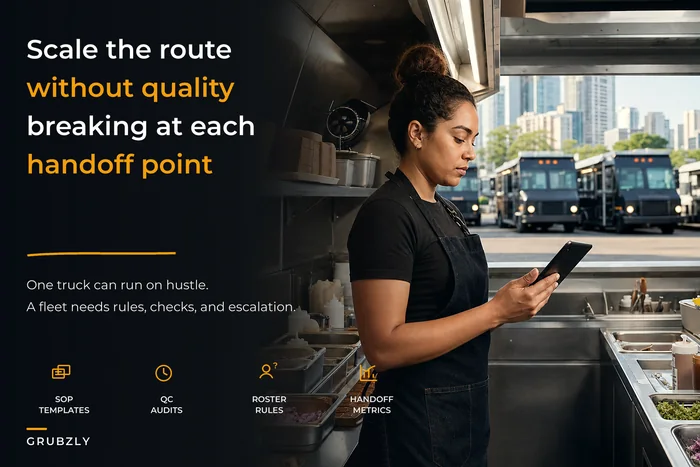
You're planning to grow — governance you build now is far cheaper than untangling chaos later. If you're mapping out expansion, this connects directly to the systems in scaling from one truck to a fleet.
When it's overkill:
-
You're a solo operator or a stable two-person crew that's worked together for years. You are the version control.
-
Your menu is fixed and simple. Fewer procedures, less drift, less to govern.
Who should wait on this: brand-new trucks still figuring out their core procedures. You can't version-control a process you haven't stabilized. Get the operation working first, document what actually works, then put governance around it. Governing a process that's still changing every week just creates paperwork churn.
Where the pieces connect
The reason all four parts have to run together is that each one covers a failure the others can't. Templates make SOPs updatable. Version control makes updates trustworthy. Audits make sure the trusted version matches reality. Micro-training and emergency amendments make sure changes reach the crew fast — including the ones that happen with no notice.
Break the chain anywhere and you're back to a taped-up sheet nobody follows. Great templates with no audit cadence means beautiful documents that don't match the truck. Perfect version control with no micro-training means the master is correct and the crew never hears about it.
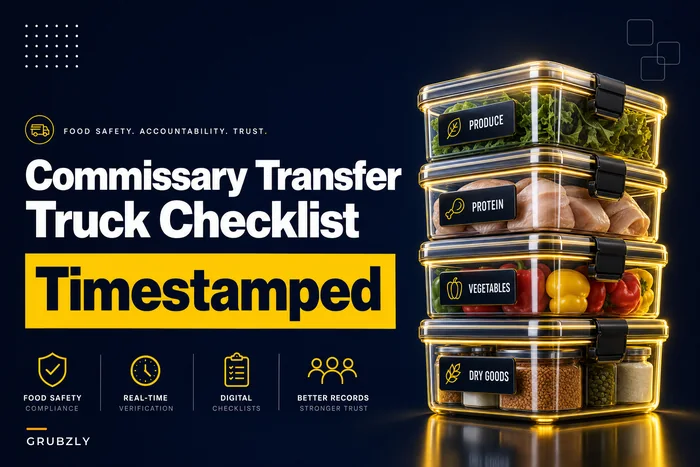
You'll also notice how tightly this connects to the rest of your operation. Your loading procedures feed your prep SOPs — if you're using a commissary-to-truck transfer checklist, that checklist is an SOP and belongs under the same governance. So do your inspection scripts, cash handling, and allergen cards. Governance isn't a separate project. It's the connective tissue that keeps every other system you've built from quietly drifting out of true.
Start small. Pick your three highest-risk procedures — the ones where a mistake means a health finding, a big food-cost hit, or a safety issue. Put those under real version control, set a weekly five-minute spot-check, and build a micro-module for the next change you make. Get that loop working on three SOPs before you try to govern thirty. Once the crew trusts that the version on their phone is always the live one, the whole thing starts running itself.
Ready to drive your food truck business forward?
Join 2,000+ food truck operators relying on Grubzly to boost efficiency, increase sales, and delight customers.