


The trucks that get burned on sales tax almost never get burned because they didn't collect it. They get burned because they collected it correctly, parked it in one operating account, and then lost track of who they owed, which rate applied at which stop, and when each city's filing window closed. Six months later a notice shows up from a jurisdiction they haven't worked since spring, and now there's penalty and interest stacked on top of tax they already had the cash for.
That's the real problem with a multi-city sales tax food truck operation. It's not a tax knowledge problem. It's a lifecycle and ownership problem. You're generating taxable events in five or six different tax authorities in a single weekend, each with its own rate, its own filing cadence, and its own rules about what's even taxable. And unless the whole thing runs as a system — from the moment the sale rings up to the moment the payment clears the jurisdiction — the gaps don't show up until they're expensive.
This is the operational backbone: a stop-type to tax-handling matrix, a remittance calendar, journal entries that actually tie out, and a clear owner for every filing with escalation triggers when something slips.
Why remittance breaks even when collection is perfect
The mistake most operators make is treating sales tax as a single number. You look at your POS at month-end, see total tax collected, and assume that's your liability. But that number is a blended figure across every place you sold, and remittance doesn't care about blended figures. Each jurisdiction wants its portion, on its schedule, calculated on its base.
-
Rates change by physical location, not by truck. Two stops eight miles apart can sit in different county or city tax districts. If your POS is set to one flat rate, you're either over-collecting and creating a refund liability, or under-collecting and eating the shortfall yourself.
-
Filing frequency isn't uniform. One city may want monthly, another quarterly, another annually based on volume thresholds. Miss the frequency and you miss the deadline even if you had the money sitting there.
-
Taxability differs by item and context. Prepared food, packaged food, bottled drinks, and catering can all be taxed differently in the same state. A festival stop and a curbside lunch stop can produce different tax outcomes on an identical menu.
-
Nobody owns the filing. On a two- or three-truck operation, "the owner handles taxes" works until the owner is running a Saturday event and the Tuesday filing deadline quietly passes.
What breaks isn't the math. It's the handoff between the sale happening in the field and the money leaving the account to the right authority on time.
Start with a stop-type → tax handling matrix
Before you touch a calendar or a journal, you need to classify how you sell. A stop-type is a repeatable selling context that carries its own tax treatment. Most trucks have four or five of them and don't realize it.
Stop losing sales to poor planning.
Grubzly helps you plan routes, track inventory, and maximize daily sales effortlessly.
- Real-time route optimization
- Inventory tracking & alerts
- Mobile sales & reporting
No credit card required
The point of the matrix is to make the tax decision automatic at the point of the stop — not something you reconstruct weeks later. When your crew arrives at a location, the stop-type tells them and your POS exactly how to ring things up.
Here's a sample matrix for a truck working a metro area that crosses several jurisdictions:
| Stop-type | Typical tax base | Rate source | Common gotcha |
|---|---|---|---|
| Public curbside (city A) | Prepared food full rate | City A combined rate | District overlay adds 0.5% on some blocks |
| Public curbside (county unincorporated) | Prepared food, lower rate | County base rate only | Crew assumes "same city" and rings A's rate |
| Private catered event | Often flat catering rate; sometimes exempt if billed as service | Client's jurisdiction | Deposit vs. final invoice split across periods |
| Recurring brewery/venue lot | Standard prepared food | Venue's address rate | Venue sometimes collects/remits — double check |
| Farmers market / festival | Prepared vs. packaged split | Market's jurisdiction | Whole packaged items may be exempt |
The insight most people miss: the gotcha column is where all the money is lost. Nobody messes up the obvious stops. They mess up the county line that looks like the city, or the catering deposit that lands in a different filing period than the event. Build the matrix around your actual routes — the ones you already covered in your multi-city permit management system map are the same locations you need to tax-classify here. Permits and tax jurisdictions overlap heavily, so if you've already mapped where you're allowed to park, you're halfway to knowing which authority you owe.
The remittance calendar: turning stops into deadlines
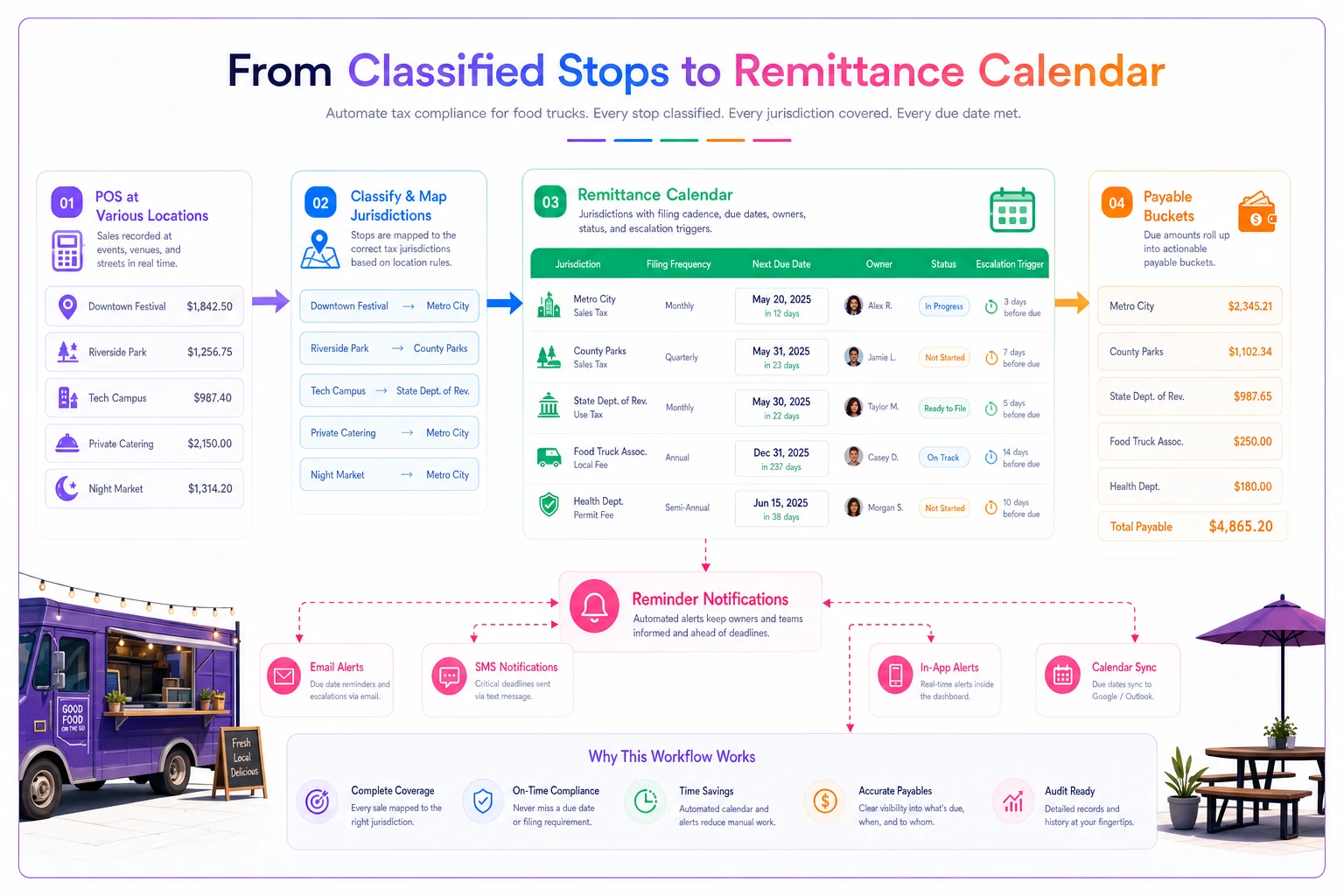
Once every stop is classified, the calendar converts your selling footprint into a filing schedule. This is the piece that keeps missed deadlines from happening, because it front-loads the work.
Build one row per jurisdiction you're registered in — not per stop, per authority. A single city might cover ten of your stops, but you file with it once per period.
-
Jurisdiction — the authority you remit to
-
Registration / account number — so whoever files isn't hunting for it
-
Filing frequency — monthly / quarterly / annual
-
Period covered — e.g., "Sept 1–30"
-
Due date — the actual deadline, not the period end
-
Owner — the named person responsible (more on this below)
-
Status — not started / prepared / filed / paid / confirmed
-
Notes — thresholds, prepayment rules, prior issues
The non-obvious part is the gap between period end and due date. A monthly filing for September might not be due until October 20th. That lag is exactly where trucks get sloppy — the month feels "closed," the cash is in the account, and then it gets spent on a generator repair or a bulk protein buy. The calendar's job is to reserve that money mentally and in your books before it disappears.
Below is a simple visual of how classified stops flow into jurisdiction rows, due dates, owners, and escalation triggers.
One pattern worth flagging: trucks that file quarterly in one city and monthly in another almost always miss the quarterly one. Monthly filings build a rhythm. Quarterly ones sit long enough to fall off the radar. If you have mixed frequencies, treat the quarterly filings as the higher-risk items and put a reminder two weeks out, not two days.
Journal entries that actually tie out
If your books dump all sales tax into one "Sales Tax Payable" account, you can't reconcile by jurisdiction, and you won't catch a shortfall until a notice arrives. The fix is sub-accounts per authority.
Here's how a typical weekend circuit posts. Say Saturday you work a city curbside stop and a county line stop, and the truck rings roughly $2,600 in sales across the two locations with different rates.
At time of sale (simplified): Dr Cash / Card Clearing 2,808 Cr Food Sales 2,600 Cr Sales Tax Payable – City A 130 (5.0%) Cr Sales Tax Payable – County 78 (3.0% on county-line portion)
The two payable lines are the whole point. City A and County are separate buckets from the first minute, so when City A's filing comes due, you pull exactly its balance — no allocation guesswork.
At remittance (paying City A for the month): Dr Sales Tax Payable – City A 540 Cr Cash 540
If you catch a rate error and owe more: Dr Sales Tax Expense (shortfall) 22 Cr Sales Tax Payable – County 22
Reconcile sales tax payables after each POS sync to catch shortfalls before they require a reconstruction.
That shortfall line is a canary. If it shows up regularly, your matrix is wrong somewhere — a stop is being rung at the wrong rate. Recurring shortfalls mean the field classification isn't matching the actual jurisdiction, and that's an operational fix, not an accounting one.
This ledger structure only works if your POS data is actually landing in your books cleanly, which is where a lot of offline trucks stumble. If your syncs are intermittent, the reconciliation habits in the daily cashflow and POS reconciliation routine are what keep these payable sub-accounts trustworthy — a payable balance is only as good as the sales data feeding it.
Owner assignment and escalation triggers
A filing without a named owner is a filing that eventually gets missed. On small teams the instinct is to leave everything with the owner, but that's exactly the setup that fails during busy season.
Assign each jurisdiction on the calendar to one named person. Even if that's you for all of them right now, writing your own name in the owner column forces the mental commitment. As you add a bookkeeper or an office manager, ownership transfers cleanly because the structure already exists.
-
T-14 days, status still "not started" owner gets a reminder.
-
T-7 days, status not at least "prepared" escalate to the operator/owner.
-
T-3 days, status not "filed" hard stop — this becomes the priority over everything except a truck breakdown.
-
Filed but not "confirmed" within 5 days of payment verify the payment actually cleared the jurisdiction. Failed ACH payments are a silent killer; the money left your account but never reached the city.
That last trigger catches something most operators never think about. A return can be filed and a payment can be initiated and it can still fail on the authority's side. Confirmation is a separate step from payment.
A real scenario: the three-city weekend truck
A taco truck running a metro region worked three recurring zones — a downtown city curbside spot, a suburban city with its own added rate, and a county-line brewery lot. Solid volume, roughly $18k–$22k a month across the circuit. Collection was fine; the POS was ringing tax on everything.
The problem was everything after collection. Tax went into one payable bucket, filings were "whenever the owner got to it," and the suburban city — a quarterly filer — got missed twice in a year. The first miss was a few hundred in penalty and interest. The second triggered a jurisdiction review that pulled in the county filings too, and suddenly they were reconstructing a year of stop-level sales to prove what was owed where. Rough cost of the cleanup, between penalties, interest, and the accountant hours to rebuild it: somewhere in the $2,400–$3,000 range, plus a genuinely stressful month.
The rebuild was unglamorous. They split the payable account into three sub-accounts, one per authority. Built the stop-type matrix so the county-line lot rang at the correct combined rate instead of the downtown rate, which had been over-collecting county customers by a small margin all year. Put all three jurisdictions on a single calendar with due dates, not just period ends. The quarterly city got the T-14 escalation flag specifically.
Nothing about their selling changed. Same three zones. But the following year they filed everything on time, the shortfall entries stopped appearing, and the month-end close — which used to involve a guessing session about tax — became a fifteen-minute pull from the payable sub-accounts. This ties directly into a disciplined month-end close process; once your tax payables are jurisdiction-clean, the whole close gets faster because you're not untangling one blended number.
When to build this out — and when not to bother yet
Not every truck needs the full matrix-calendar-ledger system on day one. Matching the system to your actual complexity keeps you from over-engineering something that doesn't need it.
When this makes sense:
-
You sell across two or more tax jurisdictions regularly.
-
You have mixed filing frequencies — some monthly, some quarterly.
-
You do catering, which splits deposits and final invoices across periods.
-
You're adding a second or third truck and can no longer track it all in your head.
When it's overkill:
-
You work a single city, single rate, single monthly filing. A clean payable account and a calendar reminder is genuinely enough.
Who should stop winging it:
-
Any operator who's already received one notice. The first notice is the signal that the informal system has broken. It won't self-correct.
The honest tell is your close. If figuring out what you owe in tax each month involves any guessing, back-calculating, or "I think it's about," the informal approach has already outgrown you — you just haven't gotten the bill yet.
Where software quietly does the heavy lifting
None of this requires software to be correct — a spreadsheet calendar and disciplined sub-accounts will get you there. But the coordination gets heavy fast when you're crossing jurisdictions every weekend. This is the kind of repetitive, deadline-driven work that an AI-assisted operational platform handles well: tagging each sale to the right jurisdiction based on the stop, keeping payable balances split by authority automatically, and firing escalation reminders before a deadline instead of after a notice arrives.
The value isn't magic. It's that the system remembers the quarterly filing you'd forget, flags the county stop ringing at the wrong rate because the shortfall pattern keeps showing up, and hands you a jurisdiction-by-jurisdiction payable total at close instead of one lump sum you have to pick apart. For a growing multi-truck operation, that's the difference between remittance being a background routine and remittance being the thing that eats a Sunday every quarter.
The takeaway
Multi-city remittance goes wrong in the space between collecting the tax and paying it to the right place on time.
The trucks that stay clean aren't the ones with the best tax knowledge — they're the ones who turned their selling footprint into a system: every stop classified, every jurisdiction on a calendar with a real deadline, every dollar of tax sitting in its own bucket, and a named person on the hook for each filing. Build that once, and you can add cities, trucks, and catering gigs without adding a tax accountant in every town you roll into.
Multi-city remittance goes wrong in the space between collecting the tax and paying it to the right place on time.
The trucks that stay clean aren't the ones with the best tax knowledge — they're the ones who turned their selling footprint into a system: every stop classified, every jurisdiction on a calendar with a real deadline, every dollar of tax sitting in its own bucket, and a named person on the hook for each filing. Build that once, and you can add cities, trucks, and catering gigs without adding a tax accountant in every town you roll into.
Ready to drive your food truck business forward?
Join 2,000+ food truck operators relying on Grubzly to boost efficiency, increase sales, and delight customers.